Read Street, Rockingham WA
Karate for kids, teens and adults.
Beginners start in their own classes, nobody spars until they’re ready, and your first class is free.
Or call Rafael on (08) 5550 0915
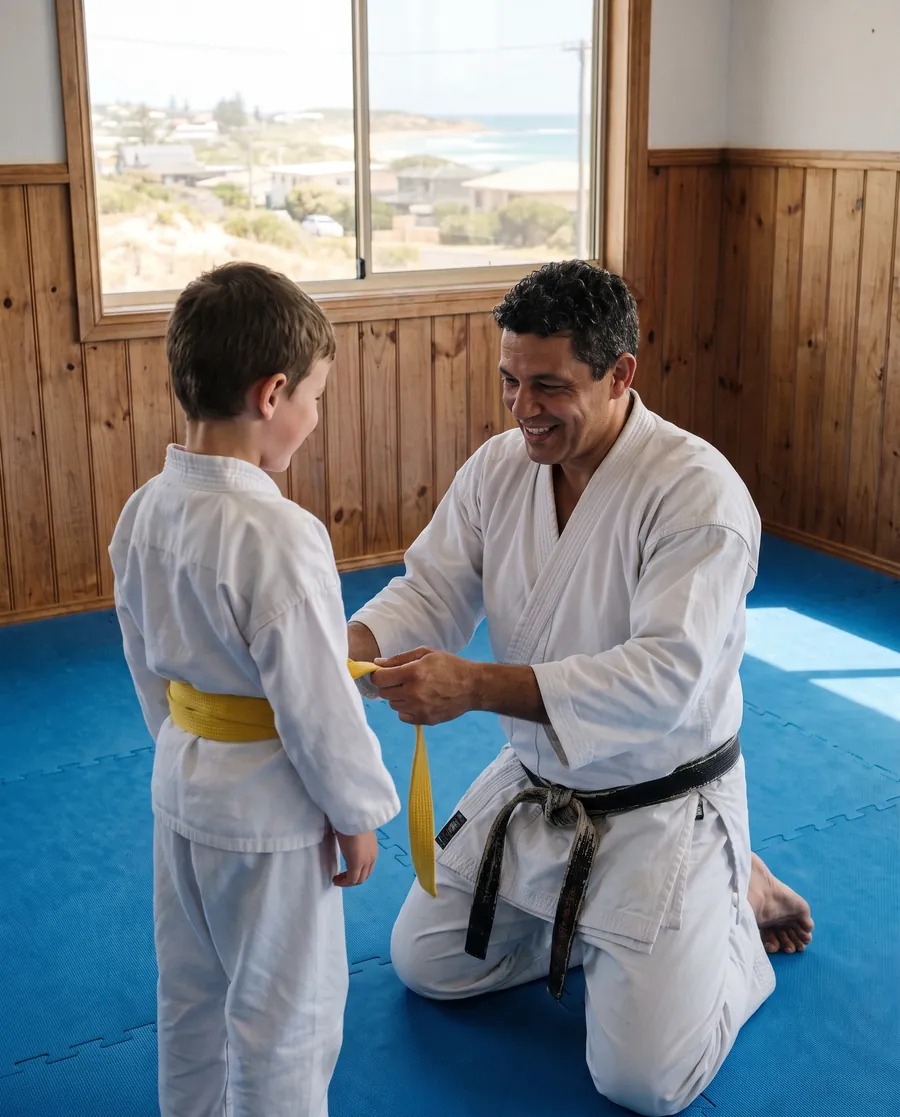
Classes by age, then by belt
Five groups. Beginners train with other beginners and move up when Rafael says they’re ready, not on a set date.
-
5 to 7years
Little ones
All belts. Mon and Wed 3.45pm, Sat 8.15am. 30 minutes.
Balance, stances and blocks, taught as games. No sparring.
-
8 to 12years
Juniors
White and yellow belts: Mon and Wed 4.30pm, Sat 9am. 45 minutes.
Orange belt and up: Tue and Thu 4.30pm, Sat 10am. 1 hour.
-
13 to 17years
Teens
All belts. Tue and Thu 5.45pm, Fri 4.30pm. 1 hour.
New starters work in their own line with Joaquin for the first few months.
-
18 and over
Adult beginners
White and yellow belts: Mon and Wed 7pm, Sat 11am. 1 hour.
You don’t need to be fit to start. The class works at your pace.
-
18 and over
Adults
Orange belt and up: Tue and Thu 7pm, Fri 6pm. 90 minutes.
Parents can watch any class from the bench seats along the front window. For Little ones, a parent stays in the building.
Your first class is free
Book the class for your age and belt. It’s a normal class with the regulars, and nobody asks you to join on the night.
- Arrive ten minutes earlyRafael or Joaquin meets you at the door, shows you where to leave shoes and bags, and asks about any injuries.
- Do the classA warm up, then three or four basics: a stance, a punch, a block. You’ll stand next to someone who knows the routine.
- Talk afterwards, if you likeAsk anything. If you want to come back, we’ll set up the membership then or later. If not, that’s fine.
What to wear and bring
- A t-shirt and tracksuit pants or shorts, with no zips
- Bare feet on the mat. Thongs or slides for walking in.
- A water bottle
- Long hair tied back, and no jewellery or watches
One short form: the class, a time, a name and a phone number.
What happens on the mat
We teach karate: punches, kicks and blocks, and kata, which are set patterns of moves you practise on your own. There are no throws to the floor and no fighting on the ground.
How contact builds
- Little onesNo sparring at all. Partner games use soft pads.
- White and yellow beltsNo sparring. Partner drills are slow, called out by the instructor, and stop short of touching.
- Orange and green beltsLight sparring starts here, one short round at a time, in full gear, with a partner your size and rank. An instructor calls start and stop.
- Blue belt and upControlled sparring with light contact to the body. Juniors and teens never make contact to the head.
Safety gear, from orange belt
- MouthguardEveryone
- Soft hand mittsEveryone
- Shin and foot guardsEveryone
- HeadgearJuniors and teens
- Groin guardMen and boys
- Chest guardOptional
You don’t need any of it before orange belt. Buy it from any sports shop; we keep loan sets in each size so you can check the fit first. Not feeling right on the day? Sit out any drill. Nobody is made to spar.
The path, belt by belt
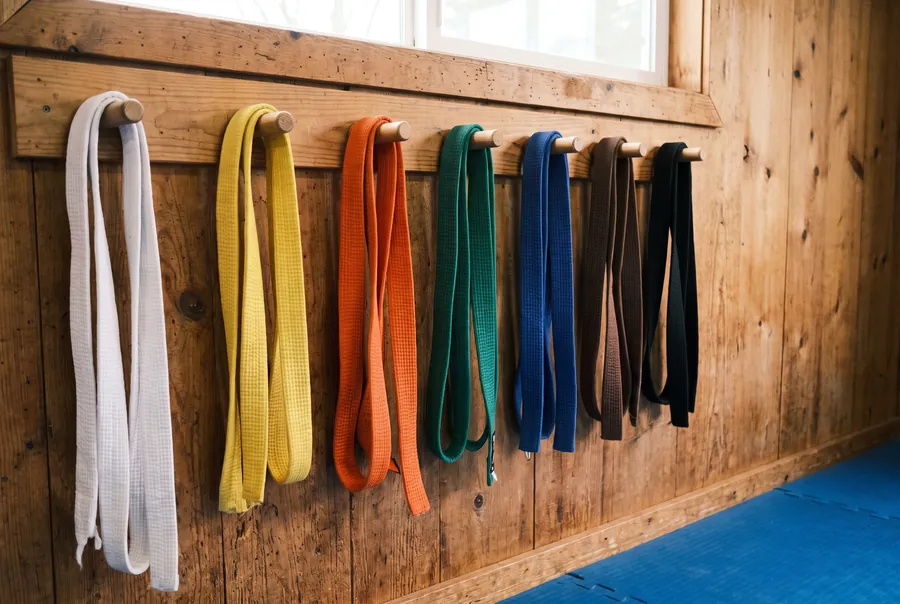
Seven belts hang on the rack by the door, white to black. Here is what each grading involves and what it costs. You grade in a normal class when you’re ready, never on a set date.
-
Belt 1 of 7
White belt
Where everyone starts, whatever their age. No grading: you tie on a white belt at your first class in uniform.
- Usually ready
- From your first week.
- Cost
- Comes with the $55 uniform
-
Belt 2 of 7
Yellow belt
Your first grading. Three stances, the first eight basic punches, blocks and kicks, and counting to ten in Japanese. About 20 minutes, during a normal class.
- Usually ready
- After three to four months of two classes a week.
- Grading fee
- $45 juniors and teens, $60 adults
-
Belt 3 of 7
Orange belt
Your first kata, and your first partner work. Your first kata on your own, and blocking a partner’s slow, called punch. After this grading you move to the orange belt and up classes.
- Usually ready
- Four to six months after yellow.
- Grading fee
- $45 juniors and teens, $60 adults
-
Belt 4 of 7
Green belt
Combinations, and a little light sparring. A second kata, combinations on pads, and two short light sparring rounds in full gear with a partner your size.
- Usually ready
- Six months or so after orange.
- Grading fee
- $45 juniors and teens, $60 adults
-
Belt 5 of 7
Blue belt
Control, and getting out of a grab. A third kata, getting free from wrist and shoulder grabs, and controlled sparring with light body contact.
- Usually ready
- Six to nine months after green.
- Grading fee
- $45 juniors and teens, $60 adults
-
Belt 6 of 7
Brown belt
Longer kata, and helping others learn. Two longer kata, all of the above under a bit of pressure, and helping Joaquin run part of a beginners’ class.
- Usually ready
- About a year after blue.
- Grading fee
- $45 juniors and teens, $60 adults
-
Belt 7 of 7
Black belt, first dan
Not the end. It means you know the basics well. A half day in front of a panel from the Swan Coastal Karate Federation, not just us: kata, sparring and teaching. Juniors grade for a junior black belt first.
- Usually ready
- Usually several years from your first class. Nobody is promised a date.
- Grading fee
- Set by the federation
- We give you the amount in writing when you’re invited, months before the day.
Grading fees are paid only when you grade, and they’re never part of the weekly fee. Nobody grades until Rafael says they’re ready, and nobody is pushed to.
What it costs, all of it
Memberships are weekly, by direct debit, and these are the full amounts. There’s no joining fee and no registration fee.
| Juniors and teens5 to 17 years | Adults18 and over | |
|---|---|---|
| First class | Free | Free |
| Each week | $32two classes a week | $38up to three classes a week |
| Uniform, once | $55white belt included | $55white belt included |
| Your first four weeks, all up | $183 | $207 |
| Each grading, apart from the weekly fee | $45 | $60 |
Train in a t-shirt for your first two weeks; the uniform is needed after that. Sparring gear is bought later, at orange belt.
To stop
Give four weeks’ notice, by email or at the desk. Your last payment is the one in four weeks’ time, and there’s no fee to leave. There’s no minimum term: it’s an ongoing weekly membership, and the notice is the only condition.
To pause
For an injury, holidays or exams, pause for one to eight weeks, up to twice a year. Tell us before the pause starts and nothing is debited while you’re away.
Who teaches
Two instructors, and the same faces every week. For each, the belt rank first, then the coaching papers, because they’re different things.
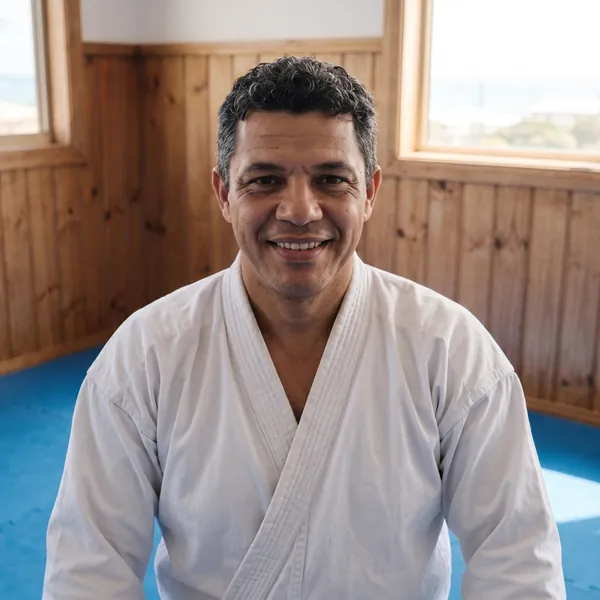
Rafael Costa
Head instructor. Teaches most classes and runs every grading.
Rafael started karate as a kid in Fremantle. He’s usually the one who meets you at the door.
- Rank
- 4th dan black belt in karate, awarded by the Swan Coastal Karate Federation
- Coaching
- Certificate IV in Fitness. First aid and CPR, kept current.
- WWC Check
- Holds a WA Working with Children Check
Joaquin Havili
Assistant instructor. Teaches beginners, juniors and teens.
- Rank
- 2nd dan black belt in karate, awarded by the Swan Coastal Karate Federation
- Coaching
- Certificate III in Sport Coaching. First aid and CPR, kept current.
- WWC Check
- Holds a WA Working with Children Check
Rank isn’t a teaching qualification
A black belt shows how far someone has come in karate, and a karate federation awards it. It doesn’t show they can teach a class of eight year olds, so we list coaching qualifications on their own line.
Working with Children Checks
In WA, people who work with children need a Working with Children Check, issued by the WA Government after a criminal record check. Rafael and Joaquin both hold one, and we confirm each card is still current every term. A police check alone doesn’t count.
If something worries you
Tell Rafael. If it’s about Rafael, email Colleen Pryor, who runs our office, at colleen@tidewaterkarate.example. Our child safety policy is at the desk, or we’ll email it.
Questions we get at the door
Can my child start at five?
Yes, in Little ones. If they’re nearly five, book a free class and we’ll see together whether they’re ready for 30 minutes of listening and copying.
I trained somewhere else. Does my belt count?
Wear it to your free class. Rafael will watch you train for a few weeks, then tell you where you fit. Most people keep their belt; some styles teach different kata, so it can take a little catching up.
What if we miss a class?
Come to another class at your level that week. Juniors can swap a weekday for Saturday whenever they need to.
Do classes run in the school holidays?
Yes, on the normal timetable. The dojo closes for two weeks over Christmas and New Year, and nothing is debited while we’re closed.
Can you work around an injury, anxiety or a disability?
Often, yes. Call Rafael before your first class and talk it through. We’ll tell you honestly what we can adapt and what we can’t, and you can bring a support person to watch or join in.
Find us on Read Street
3/22 Read Street, Rockingham WA 6168Step-free entry from the car park at the back, and street parking out the front.
| Monday | 3.30pm to 8.30pm |
|---|---|
| Tuesday | 3.30pm to 8.30pm |
| Wednesday | 3.30pm to 8.30pm |
| Thursday | 3.30pm to 8.30pm |
| Friday | 3.30pm to 8.30pm |
| Saturday | 8am to 12pm |
| Sunday | Closed |
We answer the phone between classes. If we miss you, we’ll call back the same evening.