The 2 September 2025 cosmetic advertising rules, in plain English
bdog builds websites for clinics. We are not lawyers and this is not legal advice. Check anything that matters with your indemnity insurer or professional association.
On This Page
On 2 September 2025, new advertising rules for higher-risk non-surgical cosmetic procedures took effect across Australia. No transition period. Ahpra's chief executive marked the day with one sentence: "Practitioners have been warned."
A year on, a lot of cosmetic clinic websites still read the way they did in 2024. This article is the whole picture in one place: what the guidelines changed, the TGA rule most people mix up with them, what's coming in NSW, and a table of what to write instead.
Who this applies to
Two documents commenced on 2 September 2025.
The first is the Guidelines for advertising higher risk non-surgical cosmetic procedures. All 15 National Boards adopted it. If you're a registered practitioner of any kind and you advertise a higher-risk cosmetic procedure, it applies to you.
The second is the Guidelines for registered health practitioners who perform non-surgical cosmetic procedures. That one covers how the work is done, not how it's advertised, and it applies to every registered profession except medical practitioners. Doctors follow the Medical Board's separate cosmetic surgery and cosmetic procedure guidelines, which have been in force since 1 July 2023 and still are.
So a nurse injector, a dentist doing veneers or injectables, and a doctor running a skin clinic are all covered by the advertising guidelines. They differ on the practice rules.
Which procedures count
The guidelines name these as higher-risk non-surgical cosmetic procedures:
- cosmetic injectables, meaning botulinum toxin and dermal fillers
- dental veneers
- thread lifts
- injection lipolysis
- sclerotherapy and microsclerotherapy
- platelet-rich plasma and other treatments using the patient's own blood
- hair transplants
The list isn't closed. The test is whether the procedure changes appearance for the patient's own sense of a better appearance, and usually needs a registered practitioner or a prescription. The companion practice guideline also reaches CO2 laser resurfacing, cryolipolysis, laser hair removal, dermabrasion and chemical peels.
Two things are outside. Botulinum toxin used for a medical condition isn't cosmetic. And lower-risk procedures a non-registered person can lawfully do aren't covered by these guidelines, though they're still covered by consumer law.
The four layers
This is the mistake almost every article on the topic makes. It treats the September 2025 guidelines as the rules. They're one layer of four.
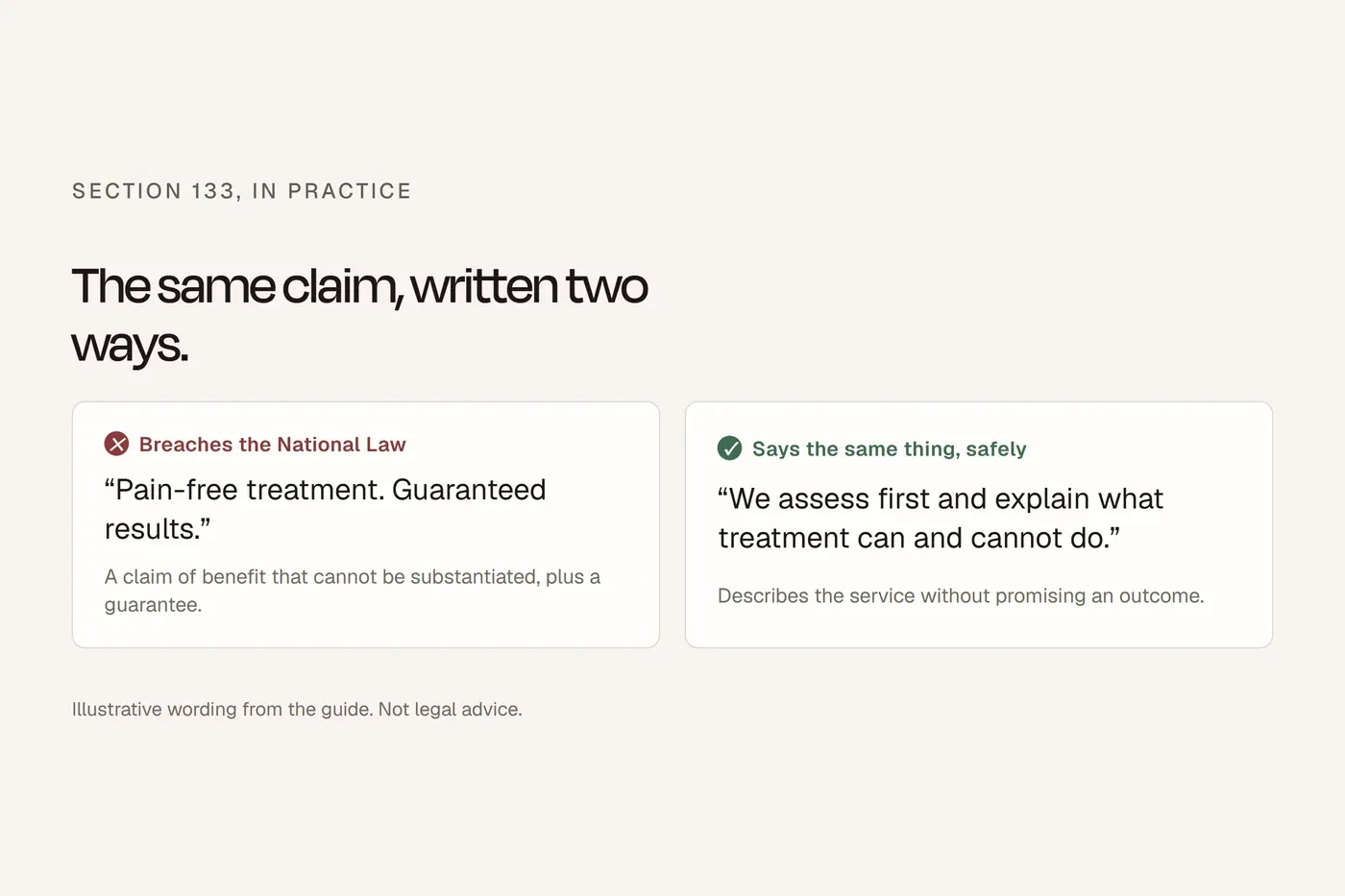
Layer one: section 133 of the National Law. The five prohibitions that apply to every registered practitioner's advertising. No misleading claims, no offers without terms, no testimonials, no unreasonable expectations, no encouraging unnecessary use. Penalty up to $60,000 per offence for an individual, $120,000 for a company, except in Western Australia where lower penalties apply.
Layer two: the higher-risk cosmetic guidelines. The 2 September 2025 rules. They don't replace layer one, they sharpen it for cosmetic work.
Layer three: the TGA. A separate regulator and a separate law. Advertising prescription-only medicines to the public is prohibited under the Therapeutic Goods Act. Since 7 March 2024, that includes the generic terms.
Layer four: consumer law and the states. The ACCC on misleading conduct and fake reviews. And from 5 November 2026, NSW's new medicines regulation on how cosmetic substances are prescribed and stored.
The rest of this article goes through layers two and three in detail, because that's where the change is.
The advertising guidelines, rule by rule
Testimonials, reviews and influencers
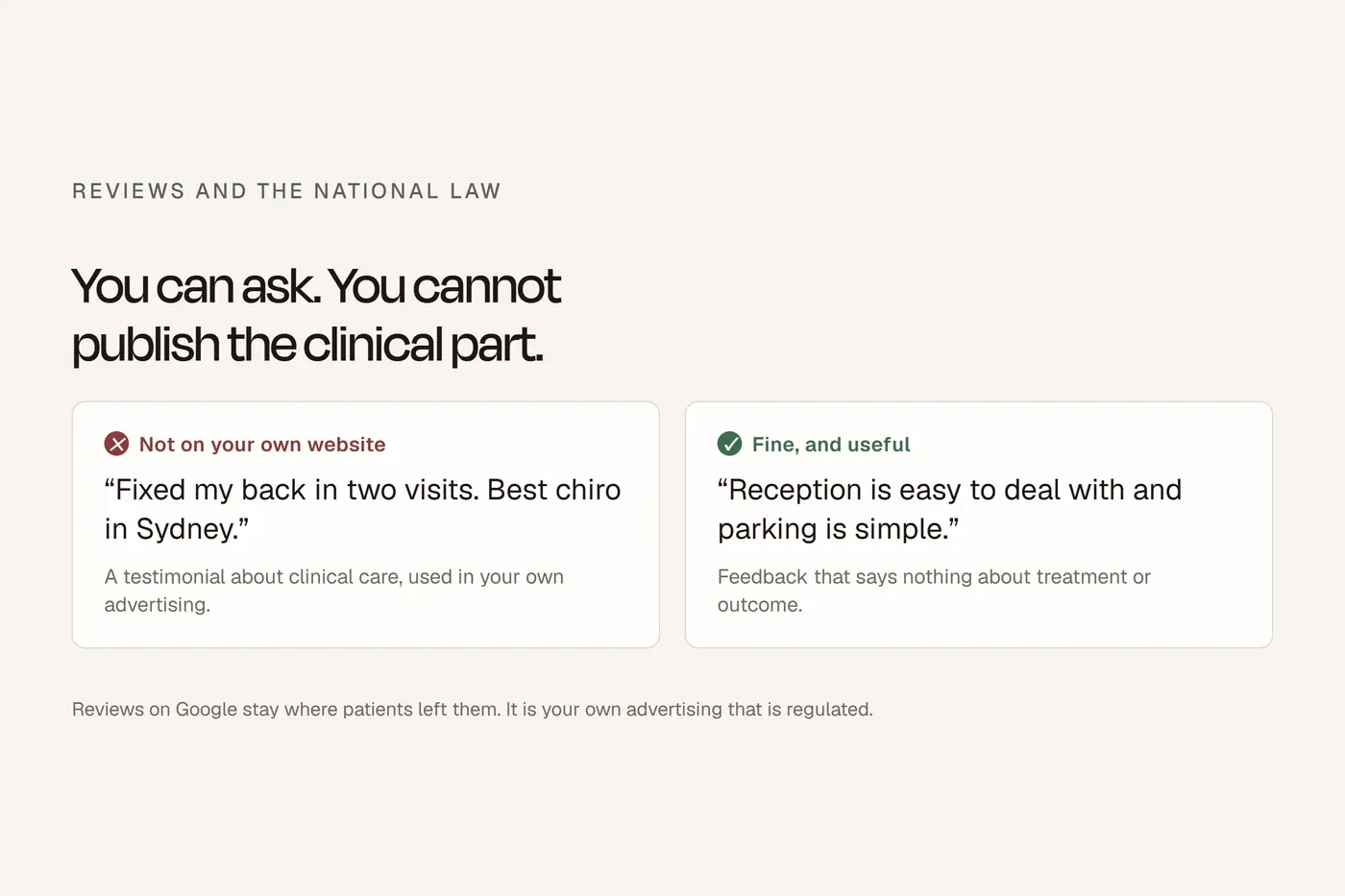
The general testimonial ban already applied. The cosmetic guidelines remove any room for interpretation.
Linking to a testimonial is using it. Re-sharing a patient's post is using it. Liking a review, or replying to one, is using it. The guidelines say practitioners can reduce their risk by switching off reviews, comments and tagging on their social accounts.
Influencers and brand ambassadors are covered by name. If you engage one, you're responsible for what they publish, and a testimonial from them is a testimonial. The TGA's rules on endorsements apply to them as well.
Images
Every before-and-after has to meet the general matching conditions. On top of those:
- the patient is a real patient, treated by the practitioner named
- the first and most prominent image is the "before" or a side-by-side composite. Leading with the "after" is a breach
- the caption states how long after the procedure the "after" was taken
- a prominent warning that the result applies to that patient only sits with the images
- no filters, retouching, colour grading or grey-scaling
- no one under 18 in any image
- images are for information. No music, dancing or comedy montages
- no lifestyle framing. Ahpra's list: no poolside or bedroom settings, no thumbs up, no crying with happiness, no emojis
- no naming the patient, no linking to their accounts
Our before-and-after article covers the matching conditions and the consent your form needs.
Words that minimise risk
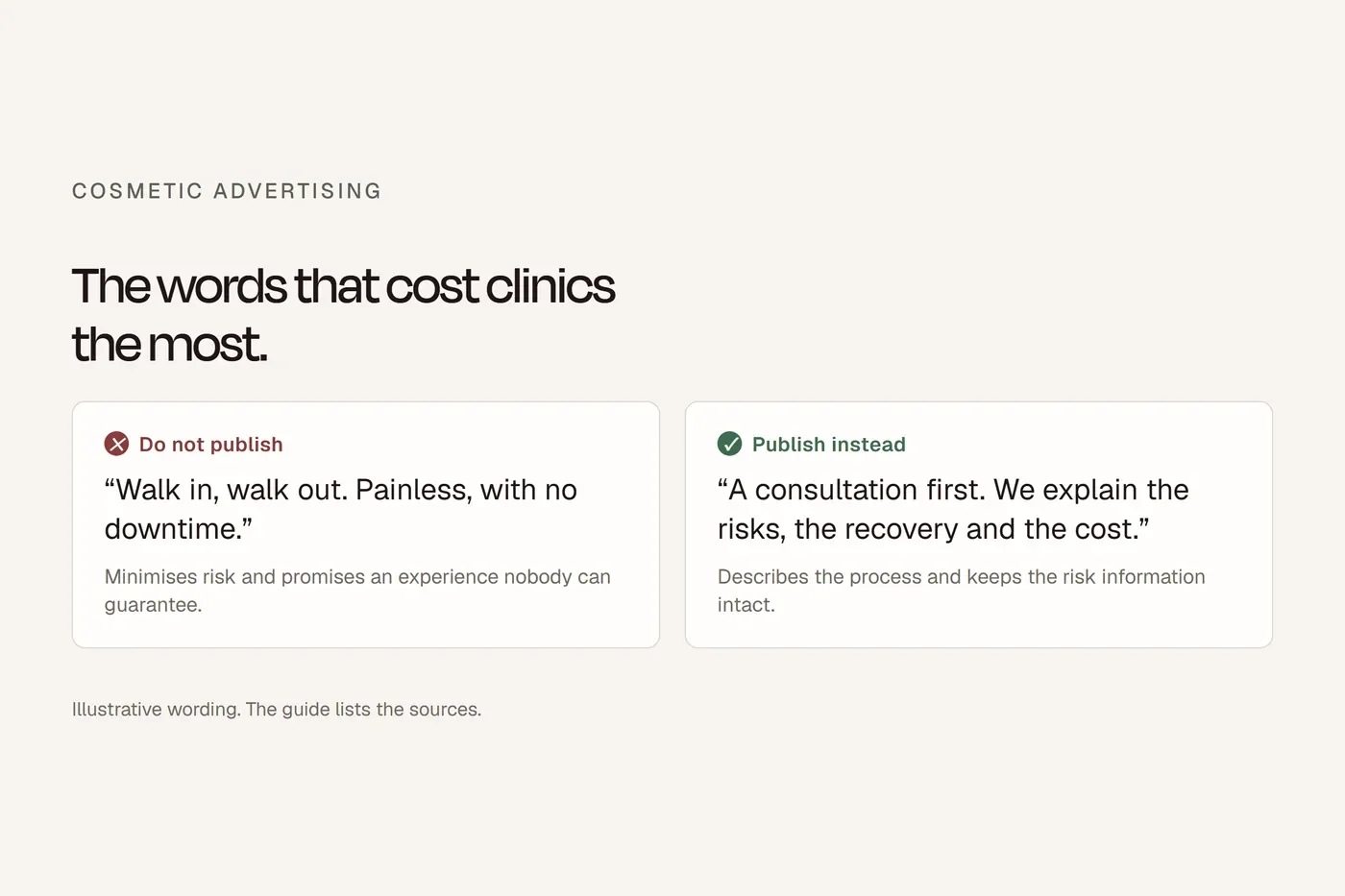
You must give accurate information about risks and recovery. And you can't describe a procedure as "gentle", "simple", "safe", "quick", "easy" or "painless" unless the risk information sits right there with it. Those six words are named in the guideline.
Words that trivialise
The guidelines list terms that treat a medical procedure like a hobby. You can't call the practitioner a "doll-maker", "sculptor", "artist", "god", "king", "queen" or "master". You can't say "magic hands", "world's best", "world renowned", "barbie" or "perfect". Gimmicks are out too. Ahpra's example is "guess how many mls of filler".
Body image
Advertising must not suggest a procedure fixes normal ageing or normal variation in how people look. It must not claim to "restore self-esteem". It can't promise a "happier you" or "the best version of yourself". Apps and tools that predict how someone would look after a procedure are banned from advertising.
Naming the practitioner
If your advertising names the person who performs the procedure, it must include their registration details, and that includes the registration number. Ahpra's worked example reads:
AB (NMW000123456) Registered nurse (Division 1), nurse practitioner
Name, registration number in brackets, profession, division or endorsement. This is the single most concrete new obligation in the guidelines and the one we see missing most often on practitioner bio pages.
Under-18s
Advertising must not be targeted at or directed to anyone under 18. Exposure in media young people use has to be limited. On social platforms, higher-risk cosmetic advertising must be marked as adult content. And you can't use hashtags, metadata or targeting settings to reach vulnerable groups.
Offers and prizes
A cosmetic procedure cannot be a competition prize. Discounts and offers follow the general rule: full terms and conditions stated and findable, and nothing that creates urgency around a clinical decision.
Titles
Only registered protected titles. No "specialist" or "specialises" unless the profession has registered specialties, which for cosmetic work generally means medicine and dentistry. And since the s115A change, "surgeon" including "cosmetic surgeon" is restricted to medical practitioners with specialist registration in surgery, obstetrics and gynaecology, or ophthalmology.
Terms like "cosmetic nurse" and "aesthetic doctor" aren't banned by name. They fall under the misleading rule if a patient could read them as a qualification that doesn't exist.
The rules that live in the other document
People confuse these with the advertising guidelines, so for clarity: the following are practice rules, not advertising rules, but they affect how your website describes the process.
Under the practice guideline for non-medical practitioners, every patient has a consultation before every treatment, in person or by video. No batch prescribing: one prescription per patient, per consultation. Enrolled nurses can't administer dermal filler to the glabella, nose or forehead.
The seven-day cooling-off period for adults, and the longer wait plus screening for under-18s, come from the Medical Board's cosmetic surgery rules. If your site describes a cooling-off period, attribute it correctly.
The TGA layer: the word most clinics still get wrong
This one is a different law and a different regulator, and it has caught more clinics than the Ahpra rules have.
Botulinum toxin and most dermal fillers are Schedule 4, prescription-only medicines. The Therapeutic Goods Act prohibits advertising them to the public. So a website that says "Botox", "Dysport", "Xeomin" or a filler brand name is in breach. That part has been true for years.
On 7 March 2024 the TGA closed the gap everyone was using. It no longer accepts the generic terms either. "Anti-wrinkle injections", "wrinkle-reducing injections" and "dermal fillers" are not permitted where a reasonable person would understand you're promoting a prescription-only product. Abbreviations, nicknames and hashtags count. A syringe image with a facial map next to a booking button counts. "Educational" content that links to a booking page counts.
The TGA has said it won't publish a list of acceptable substitute words. What it does allow is describing the concern you consult on. "Consultations about reducing the appearance of lines" is fine. "Anti-wrinkle injections from $12 a unit" is not.
Scale of enforcement: in the year to June 2025 the TGA asked for more than 13,700 unlawful advertisements to be taken down, and by its own count more than 2,500 of the removal requests related to cosmetic injectables. It has issued infringement notices to individual nurses and clinics, in one case four notices totalling $13,656 to two registered nurses. A single contravention can carry an infringement notice of around $4,300 for an individual and $21,800 for a company. Cosmetic injectables have been a stated TGA compliance focus. Check the TGA's current compliance priorities page before relying on this for a given year.
What to write instead
| Don't write | Write |
|---|---|
| Botox, Dysport, Xeomin, or any filler brand | Nothing. Don't name the product |
| Anti-wrinkle injections | Consultations on reducing the appearance of lines |
| Dermal fillers | Consultations on facial volume and contour |
| Lip fillers from $399 | Lip consultations. Discuss options and pricing in person |
| Painless, quick, safe | Describe the procedure and its risks in plain terms |
| Our sculptor of faces | Our registered nurse, [name] ([registration number]) |
| Be the best version of yourself | Drop it |
| Book now, offer ends Friday | Book a consultation |
| Five stars: "my lips have never looked better" | Remove it. Reviews stay on Google, not on your site |
What Ahpra has done since
Between September 2022 and March 2025, Ahpra investigated around 360 notifications about non-surgical cosmetic procedures and closed about 300 of them. Its cosmetic hotline (1300 361 041) took more than 1,500 calls. Ahpra's 2024/25 annual report says it trialled AI to scan websites and social media for advertising breaches, and that a Rapid Regulatory Response Unit now focuses on cosmetic procedures.
Ahpra hasn't yet published prosecution figures specific to the September 2025 guidelines. When it does, we'll add them here.
What's coming
5 November 2026, NSW. The Medicines, Poisons and Therapeutic Goods Act 2022 and its 2026 Regulation commence. Part 9 creates a framework for cosmetic-use substances: one prescription per patient, no vial sharing, record-keeping and clinical governance requirements. It's a practice rule rather than an advertising rule, but if your website describes how you prescribe or store product, check it against Part 9 before November.
Cosmetic surgery endorsement. The Medical Board is rolling out an endorsement that shows on the public register which doctors meet the cosmetic surgery training standard. Once live, a doctor's site can reference it. A doctor's site can't imply it before then.
The general advertising guidelines review. Ahpra's main advertising guidelines date from December 2020 and are reviewed every five years. A revised version is due. When it lands, every clinic's site needs a re-read.
Questions we get asked
Can I say "Botox" on my website?
No. It's a prescription-only medicine and the TGA prohibits advertising it to the public.
Can I say "anti-wrinkle injections"?
Not since 7 March 2024, where a reasonable person would understand you're promoting a prescription product. Describe the concern instead.
Can I show before-and-after photos of injectables?
Yes, with the "before" or a composite first, no editing, the timing stated, a prominent warning, and the patient treated by the named practitioner.
Do I have to put my registration number on the website?
If the advertising names you as performing a higher-risk procedure, yes. Name, number, profession.
Can I use an influencer?
You can engage one, but you're responsible for everything they publish, and a testimonial from them is banned.
Can I reply to a good review?
Not one about the procedure or the result. The cosmetic guidelines say liking or responding counts as using the testimonial.
Can I offer a discount on injectables?
With full terms and conditions, and without urgency. Pricing per unit is a TGA problem if it names or implies the product.
Do these rules apply to dentists doing veneers?
Yes. Dental veneers are on the higher-risk list.
Does this apply to a beauty therapist doing skin treatments?
Not the Ahpra guidelines, unless a registered practitioner is involved. Consumer law and the TGA still apply.
What's the fine?
Under the National Law, up to $60,000 per offence for an individual and $120,000 for a company, except in Western Australia where lower penalties apply. TGA infringement notices are separate and smaller per notice, but they stack.
About this guide
Sources are named in the text; where the rules come from a regulator we link to the regulator, not to a summary of it. This is general information about building a website, not legal advice. If you want to see what that looks like on a real page, have a look at websites for cosmetic and skin clinics.