Can I ask patients for Google reviews? The Ahpra rules in plain English
bdog builds websites for clinics. We are not lawyers and this is not legal advice. Check anything that matters with your indemnity insurer or professional association.
On This Page
Yes. You can ask.
Ahpra has confirmed it, through the medical defence organisation Avant, whose medico-legal team put the question to them directly. Practices and practitioners can ask patients to leave ratings and reviews on third-party sites like Google.
That's the short answer. The rest of this article is the conditions, because the conditions are where clinics get caught.
What Ahpra is actually worried about
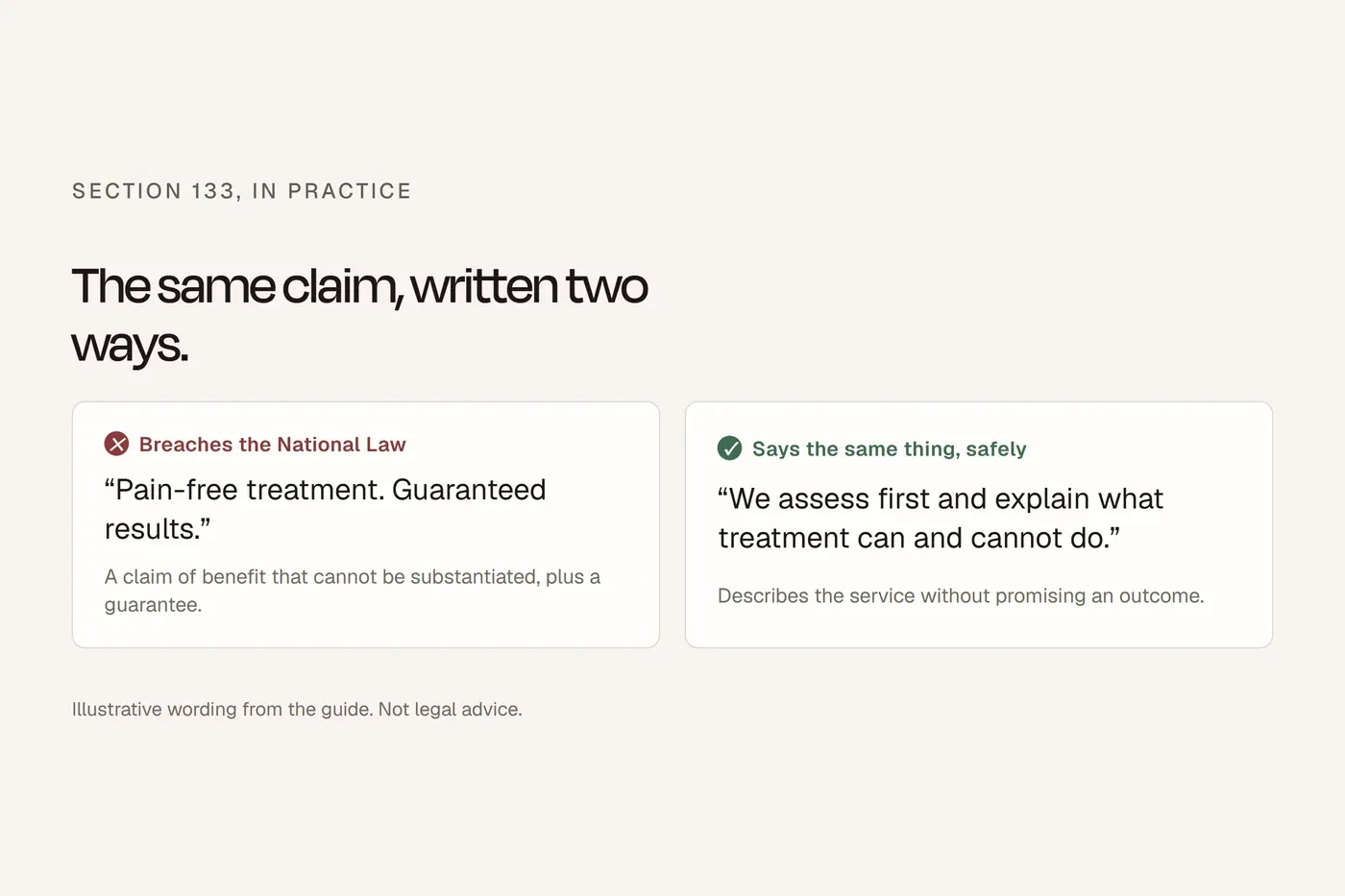
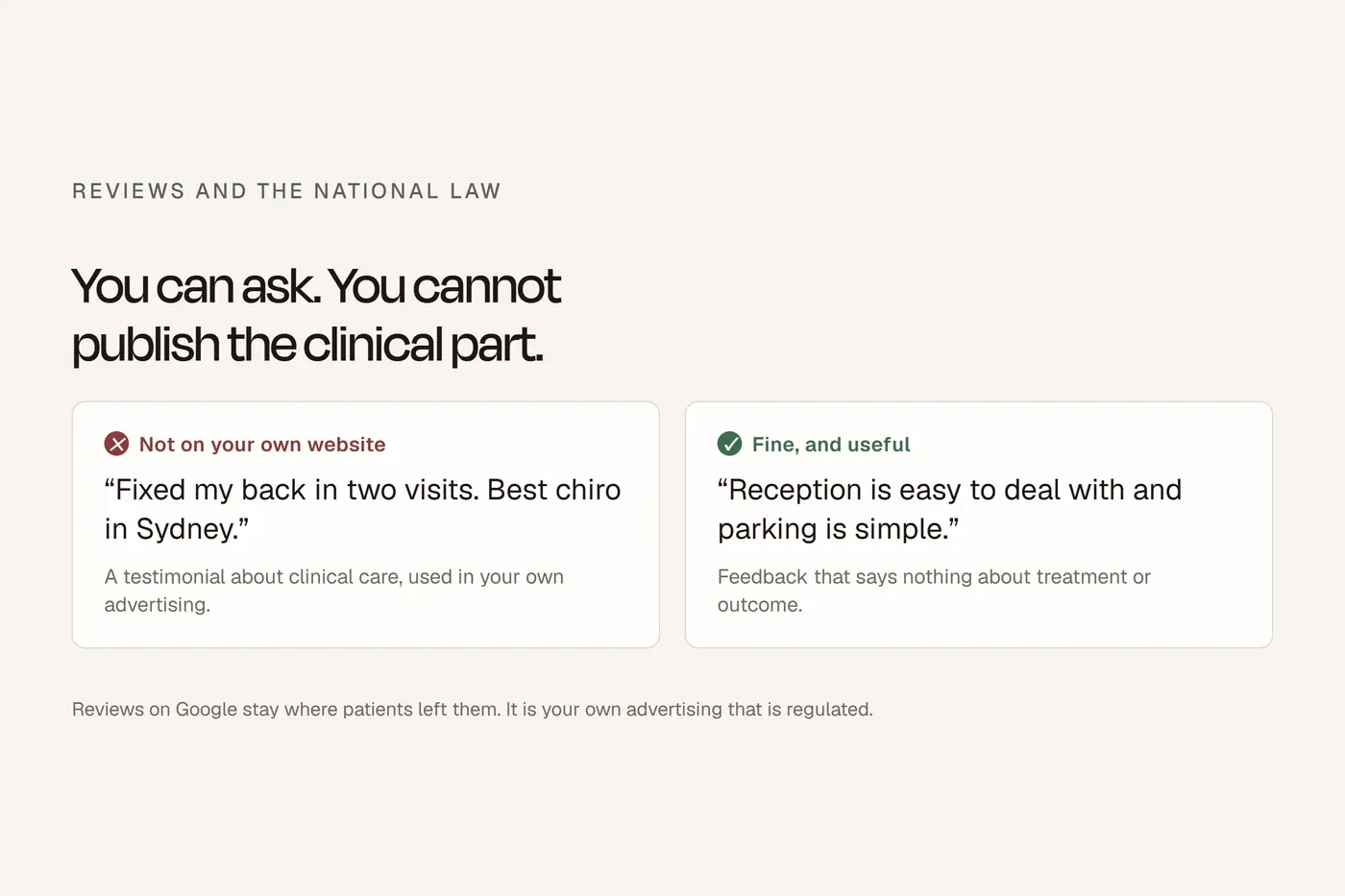
The National Law bans testimonials in health advertising. Ahpra defines a testimonial as a recommendation or positive statement about the clinical aspects of a service. There are three clinical aspects:
- the symptom, or the reason the person came in
- the diagnosis or the treatment
- the outcome, or how skilled the practitioner was
A review that says the parking was easy, the receptionist was lovely and the clinic runs on time is not a testimonial. A review that says "my shoulder hasn't hurt since" is.
The ban applies to advertising you control. That distinction does most of the work in everything below. Images are a separate question with their own rules before-and-after photos; this article is about words.
How to ask without breaching
Three rules. Ahpra's, restated by Avant.
Ask everyone the same way. Not just the patients who left smiling. If your process only reaches people who are likely to say nice things, you're shaping the result, and that's misleading. A standard message to every patient after their visit is fine. Picking and choosing is not.
Offer nothing. No voucher, no discount, no draw, no free session. An inducement for a review is a breach on its own. Google bans it too, so a review earned that way can also get your profile suspended.
Don't steer the content. Don't ask patients to mention their treatment, their results or how good the practitioner was. You're allowed to ask for a review. You're not allowed to ask for a testimonial.
Here is wording that stays inside all three:
Thanks for coming in today. If you have a minute, we'd appreciate a Google review about your experience with booking, the clinic and how we looked after you. One thing: please don't mention your diagnosis, treatment or results. We're not allowed to publish those.
Send it to every patient, by the same method, at the same point after their visit. Put it in your booking system's follow-up SMS if it has one.
The three things Google bans as well
Ahpra isn't the only rule-maker here. Google's own review policy bans incentives of any kind, review gating (asking happy patients publicly and unhappy ones privately), and pressuring people on the premises with a tablet or kiosk. An update in early 2026 added two more: setting review quotas for staff, and asking customers to name a particular staff member in the review.
Google's enforcement is removal, then ranking suppression, then profile suspension. For a clinic that lives on the map pack, suspension is worse than a letter from Ahpra.
Then there's the ACCC. Fake, manipulated or incentivised reviews breach Australian Consumer Law. The ACCC's October 2022 sweep of 137 businesses found 37 per cent engaging in review conduct it called concerning. Its largest review penalty came in 2018 when the Federal Court ordered Meriton to pay $3 million for masking guest email addresses so that unhappy guests never received a review invitation. That is review gating with a corporate budget. The principle applies to a two-room physio.
So: three regulators, one rule. Ask everyone, offer nothing, don't filter.
Where the review lives changes what you owe
This is the part most clinics haven't heard.
On Google. You can't switch Google reviews off. Because you can't, Ahpra treats them as outside your control and you're not responsible for what patients write there. A five-star review describing someone's recovery can sit on your Google profile and it isn't your breach.
On Facebook. You can switch Facebook reviews off. Because you can, Ahpra treats them as within your control. Leave the function on and that same recovery story becomes a testimonial you're using. Ahpra's guidelines say compliance "may be achieved by disabling the reviews/testimonials functions." The simplest fix is to do exactly that.
On your own website. Fully yours, fully your responsibility. Copying a Google review onto your site, or installing a widget that pulls them in automatically, makes you the advertiser for every word. If any of them mention clinical aspects, they have to go. And you can't edit a review down to the compliant bits. Ahpra treats editing as misleading in itself. The whole review goes or the whole review stays.
What about a plain star rating with no text? Ahpra hasn't ruled on it. A number isn't obviously a statement about clinical aspects, but nobody has tested that and we wouldn't be the first to try it on a client's site.
Replying to reviews
This is where the good intentions go wrong.
Ahpra's guidelines say to take care when engaging with reviews on a third-party site because doing so "may be considered using a testimonial to advertise." The cosmetic procedure guidelines from September 2025 the cosmetic advertising rules remove the doubt: liking, sharing or responding to a review counts as using it.
So the practice rule is simple. Nobody at the clinic likes, shares, thanks or replies to a review that mentions symptoms, treatment, results or the practitioner's skill. Reply to the ones about parking if you like. Leave the clinical ones alone.
If that feels cold, remember the review is still there. Patients can still read it. You just aren't allowed to wave at it.
The bad review
A negative review isn't a testimonial, so the advertising rules don't bite. Your confidentiality obligations do.
You cannot confirm the person is a patient. You cannot reference their diagnosis, their treatment or anything from their file, even to correct a factual error. A reply that says "As we explained at your appointment on the 4th, the swelling was expected" is a privacy breach in public.
A safe reply says that you take feedback seriously, that you can't discuss individual care online, and gives a phone number or email to continue the conversation privately. Two sentences. Then stop.
A note for psychologists
The Psychology Board takes a harder line than the general position. Confidentiality sits at the centre of the profession, and the Board's view is that a review referencing a client's mental health or their experience of therapy is a problem regardless of whether the client consented. If you run a psychology practice, treat any review on a platform you control as one you need to look at, and don't ask clients for reviews that touch their treatment in any way. The parking-and-reception script above is about as far as it should go.
Questions we get asked
Can I ask patients for a Google review?
Yes. Ask everyone the same way, offer nothing, and don't tell them what to write.
Can physios ask for reviews?
Yes, same rules as any registered practitioner.
Can I offer a discount or run a competition for reviews?
No. Ahpra treats it as an inducement and Google treats it as a policy breach.
Can I ask only my happy patients?
No. That's selective solicitation. Ask everyone or don't ask.
A patient's review describes their treatment. Do I have to remove it?
On Google, no, because you can't control it. On Facebook or your website, yes.
Can I put a Google reviews widget on my website?
Only if every review it shows is free of clinical content. In practice that means no.
Can I reply to a five-star review?
Not one that mentions clinical aspects. Ahpra says it may count as using the testimonial. The cosmetic guidelines say it does.
Do I have to turn off Facebook reviews?
Ahpra's position is that you're responsible for them because you can turn them off. Turning them off is the cleanest way to comply.
Does an aggregate star rating count as a testimonial?
Ahpra hasn't said. We'd treat it as untested rather than safe.
Can I ask colleagues or referrers for reviews instead of patients?
A colleague's comment about your clinical skill is still a statement about a clinical aspect. Same rules apply.
About this guide
Sources are named in the text; where the rules come from a regulator we link to the regulator, not to a summary of it. This is general information about building a website, not legal advice.