Before-and-after photos on your clinic website: what you can and can’t do
bdog builds websites for clinics. We are not lawyers and this is not legal advice. Check anything that matters with your indemnity insurer or professional association.
On This Page
Before-and-after photos are allowed. Ahpra doesn't ban them. What it does is set conditions, and most galleries on clinic websites fail at least one.
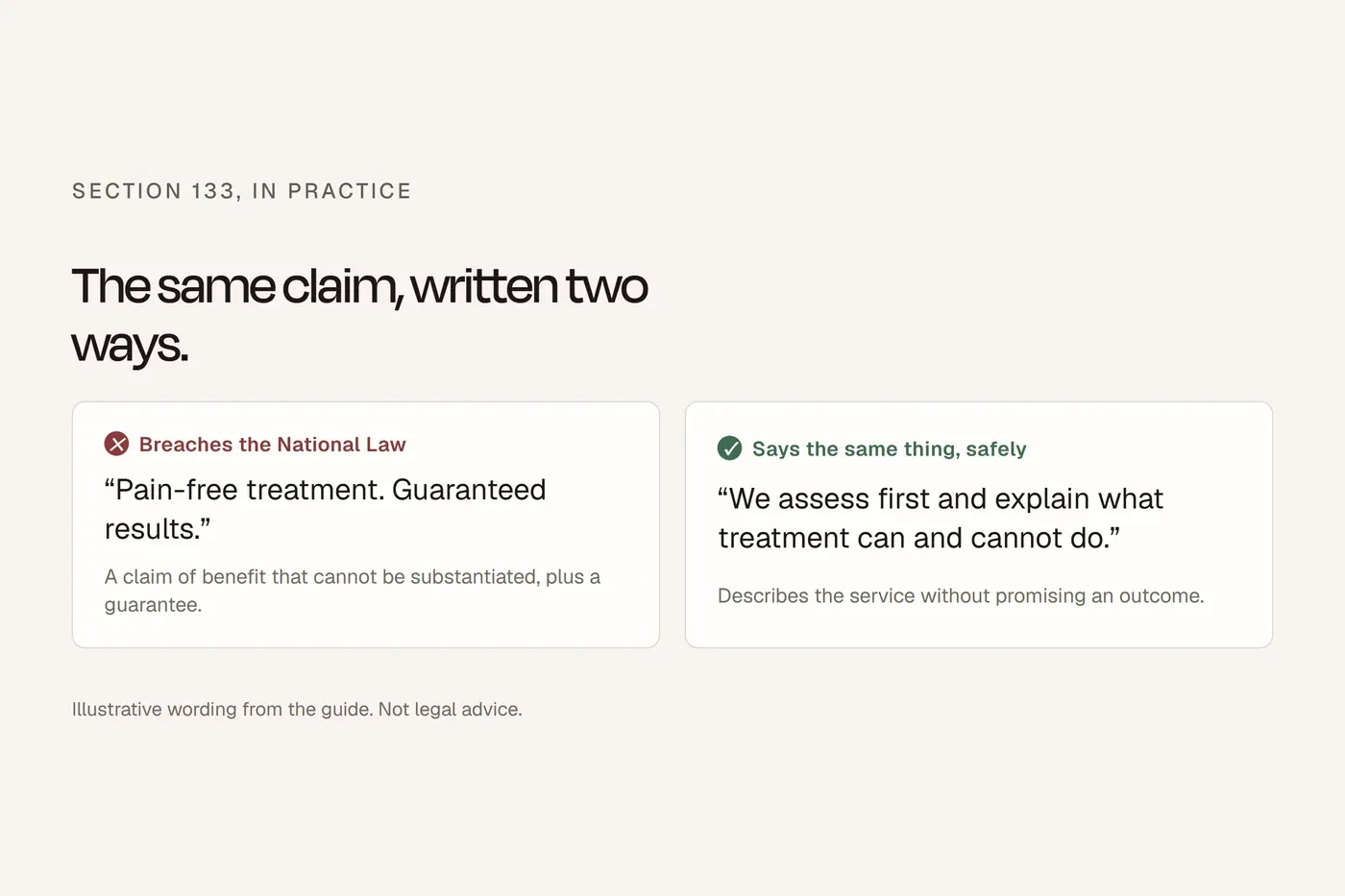
The reason is in the National Law. Advertising must not create an unreasonable expectation of beneficial treatment, and must not be misleading. A pair of photos is a claim: this treatment did this. If the lighting changed, the angle changed, the patient stood up straighter, or a filter got involved, the claim is bigger than the truth.
Here is what the guidelines require, what the consent has to cover, and where the rules get tighter.
The conditions for any before-and-after
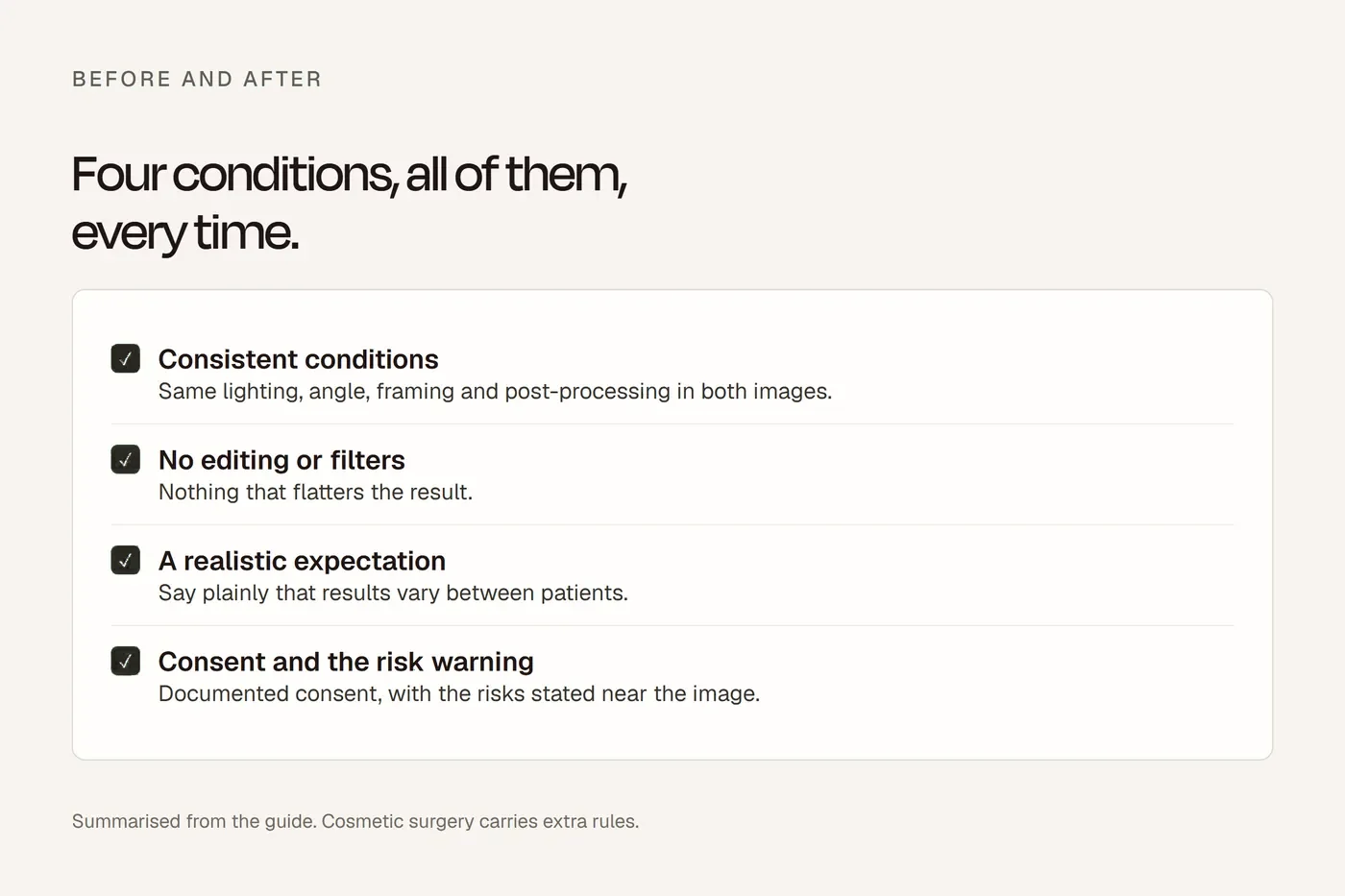
Ahpra's advertising guidelines say before-and-after images "have the potential to be misleading or deceptive" and are less likely to be if they meet these conditions. Treat them as a checklist for every pair you publish.
The two images match. Same camera angle. Same background. Same framing and distance. Same exposure. Ahpra lists content, camera angle, background, framing and exposure by name.
The patient matches. Same posture, same clothing, same make-up. A dental "after" with fresh lipstick and a smile the "before" didn't have is a different photo, not a result.
The lighting matches. Same light source, same direction, same contrast. Ring light on the after and ceiling light on the before is the most common failure we see.
Nothing has been edited. No retouching, no filters, no smoothing, no colour grading. If anything about the image has been altered, even cropping to size, the guidelines want it explained.
The treatment is the only thing that changed. If the patient also lost weight, got a tan, or had another procedure in between, the pair is misleading.
It's a real patient and a real result. Yours. Not a supplier's image, not a model, not a stock photo with a caption.
The result isn't presented as typical or guaranteed. One patient's outcome is one patient's outcome. The caption has to say so.
If a pair fails any of these, don't publish it. Ahpra's position is that the image must be genuine and it must be clear the treatment caused the change shown.
Consent that actually covers advertising
This is where the paperwork on most practices falls short.
Consent to take a clinical photo is not consent to publish it. A patient who agreed to have their smile photographed for their file has not agreed to appear on your homepage, your Instagram, or a Google ad. Clinical images are health information under the Privacy Act, which means using them for a new purpose needs its own consent.
The clearest standard for what that consent should cover is in the cosmetic procedure guidelines that commenced in September 2025. They apply directly only to higher-risk cosmetic work, but they're the best description of good practice for any profession. The consent should:
- be separate from the consent to treatment
- say where the image will appear and for how long
- warn that once published, third parties may copy, reuse or comment on it
- let the patient see the images before they agree
- make clear they can say no without it affecting their care
- say where the originals are stored and who can see them
- be documented
- be withdrawable at any time, with the image taken down promptly when it is
That last one matters for your website. If a patient withdraws consent, you need to be able to find and remove the image the same week. A gallery buried in a page builder you can't edit is a liability.
Where the rules get tighter
Cosmetic and skin clinics
Since 2 September 2025 the higher-risk cosmetic advertising guidelines add a layer on top of everything above. If the photo shows an injectable, a thread lift, PRP, a hair transplant or any other higher-risk non-surgical procedure:
- the patient must be yours, treated by the practitioner named
- the "before" image, or a side-by-side composite, must be the first and most prominent image. Leading with the "after" is a breach
- the caption must say how long after the procedure the "after" was taken
- a prominent warning that the outcome is specific to that patient sits with the images
- no filters, retouching or grey-scaling
- no images of anyone under 18
- no music, dancing or comedic montages. Images are for information, not entertainment
- no lifestyle framing. No poolside, no bedroom, no champagne, no thumbs up, no emojis
- the patient isn't named and their social accounts aren't linked
And separately, from the TGA: no prescription medicine named in the caption. Not the brand, and since March 2024 not "anti-wrinkle injections" or "dermal fillers" either. Describe the concern, not the product.
We've written the cosmetic rules up in full in a separate article.
Dentists
Two things. First, dental veneers are on Ahpra's list of higher-risk cosmetic procedures, so a veneer gallery has to follow the cosmetic rules above, including "before" first and the prominent warning. Second, the Dental Board has publicly urged compliance with the advertising rules and before-and-after images are one of the things it watches. Consistent lighting and angle, no editing, consent that covers advertising, and no patient identifiers anywhere in the image. That includes names on radiographs.
Physios, podiatrists, chiros and osteos
There's no profession-specific instrument for you. The general conditions above are the rules. Posture photos and gait images are before-and-afters like any other, so the matching requirements apply. For chiropractic and osteopathy, add one more: don't let an image imply a benefit for a condition you don't have acceptable evidence for. A posture pair captioned as fixing headaches is two claims, not one.
Psychologists
Before-and-afters don't apply. Your exposure is testimonials and confidentiality, which we cover in the reviews article.
The by-profession table
| Allowed | Conditions | Not allowed | |
|---|---|---|---|
| Dental | Yes | Matched lighting and angle, unedited, advertising consent, results-vary caption, no identifiers | Editing, cherry-picked best cases, names on scans. Veneers follow the cosmetic rules |
| Cosmetic and skin | Yes, tightly | Your patient, "before" first, matched, unedited, timing stated, prominent warning, separate consent | Under-18s, filters, "after" first, models as results, lifestyle framing, product names |
| Physio | Yes | General conditions: matched, unedited, consented, not implying a typical result | Edited or mismatched pairs, implied guarantees |
| Podiatry | Yes | As physio | As physio |
| Chiro and osteo | Yes | As physio, plus no implied benefit without evidence | Images tied to evidence-poor claims |
| Psychology | Not applicable |
Scroll the table sideways to see every column.
The mistakes we see most
The supplier gallery. A laser or injectable supplier gives you a folder of results to use. They're not your patients, so on your site they're models presented as results. Ahpra's cosmetic guidelines say images must be of actual patients treated by the practitioner named. Delete the folder.
The mismatched pair. Clinical camera for the before, phone for the after. Different room, different light. It happens because the after is taken months later in a hurry. Build the photo setup once and use it both times.
The good-side crop. Cropping tighter on the after so the flaw sits outside the frame. That's an alteration and it's a misleading one.
The best-case-only gallery. Six perfect results and none of the ordinary ones. Ahpra's evidence guidance says results must not be cherry-picked. A gallery that shows the range is both safer and more believable.
The white coat. Not a before-and-after, but related. A practitioner photographed in scrubs with a stethoscope who isn't a medical practitioner is implying a qualification they don't hold. The misleading rule catches it.
Questions we get asked
Can dentists post before-and-after photos?
Yes, with matched lighting and angle, no editing, consent that covers advertising, and no patient identifiers. Veneers follow the stricter cosmetic rules.
Does the patient have to consent to advertising specifically?
Yes. Consent to a clinical photo doesn't cover publication. It needs to be separate, documented, and withdrawable.
Can I use my supplier's before-and-after images?
Not as results. They're not your patients.
Can I use a filter or fix the lighting in editing?
No. Any editing has to be explained, and for cosmetic work it's banned outright. Fix the lighting when you take the photo.
Do I need a "results may vary" line?
The image shouldn't imply a typical or guaranteed result. For cosmetic work a prominent warning is required. For everyone else it's the simplest way to meet the condition.
Which image goes first?
For higher-risk cosmetic procedures, the "before" or a composite must be first and most prominent. For other professions there's no rule, but leading with the "before" is the honest order anyway.
What if a patient asks me to take their photo down?
Take it down promptly. The consent standard in the cosmetic guidelines says patients can withdraw at any time.
Can I show a before-and-after of a child?
Not for cosmetic work. For other professions, the consent has to come from the parent or guardian and everything above still applies.
About this guide
Sources are named in the text; where the rules come from a regulator we link to the regulator, not to a summary of it. This is general information about building a website, not legal advice. If you want to see what that looks like on a real page, have a look at websites for cosmetic and skin clinics.