Medicare, NDIS and DVA: what to put on your clinic website, and what not to
Dollar figures are as at 1 July 2026 and change every July. bdog builds websites for clinics. We’re not accountants, lawyers or registered practitioners, and this is general information. Confirm your own situation with your professional association or the relevant agency.
On This Page
The most common reason a patient doesn't book is that they couldn't work out what it would cost them. Not the fee. What it would cost them, after Medicare, after their fund, after their plan.
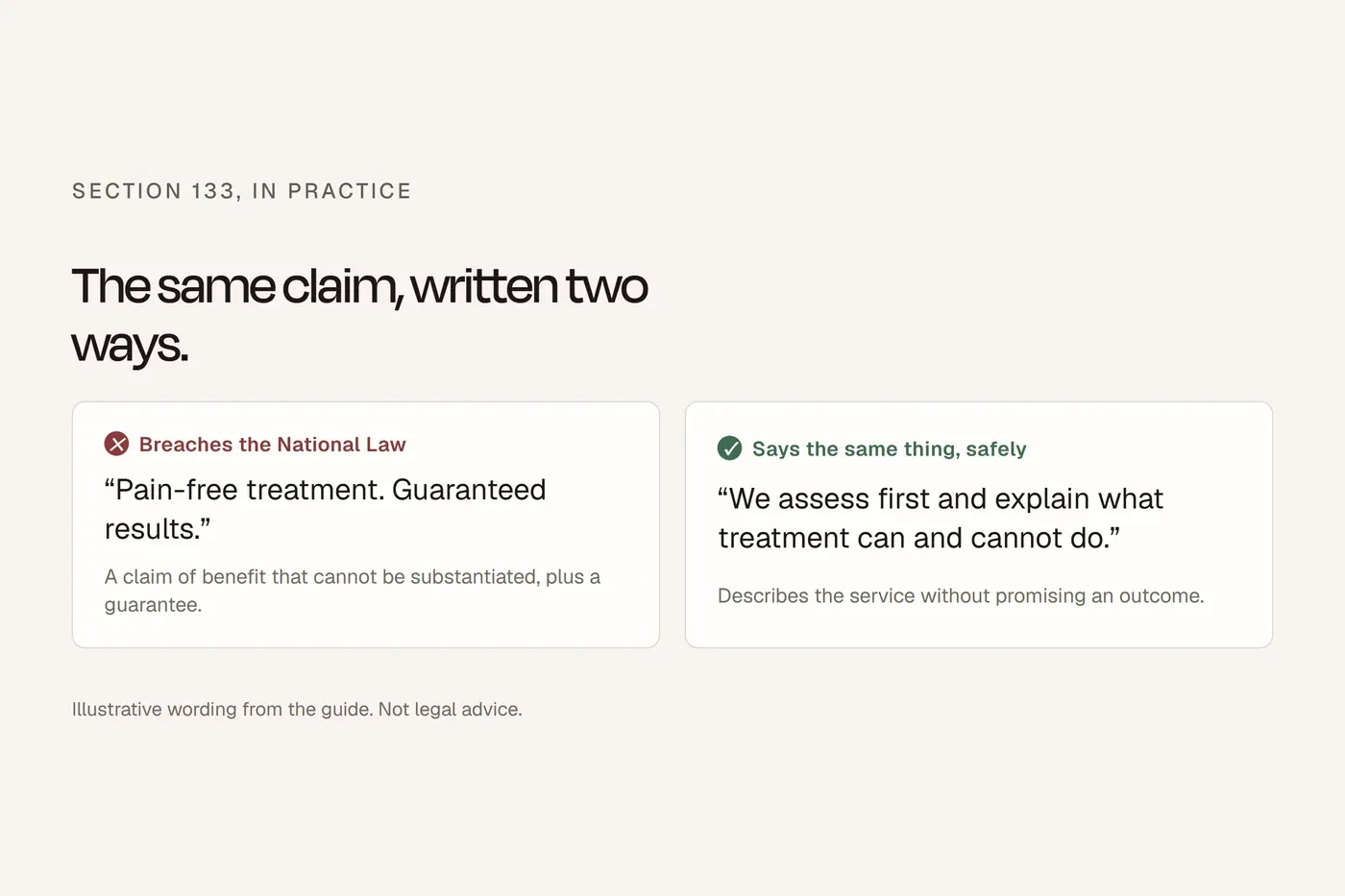
The second most common problem we see is clinics fixing that with wording that isn't true. "Medicare covered." "No gap." "NDIS registered," when they aren't. Each of those is a complaint waiting to happen.
Here's what the rules say for each funding type, the mistakes that turn up on clinic sites, and factual wording you can adapt.
Medicare for allied health: the plan changed last year
If your patients used to arrive with a GP Management Plan and a Team Care Arrangement, that ended on 1 July 2025. Both were replaced by a single GP Chronic Condition Management Plan, or GPCCMP.
What a clinic website needs to get right:
The patient needs a plan and a referral. Medicare doesn't cover allied health for anyone who walks in. The GP prepares the GPCCMP and refers. Any wording that implies Medicare "covers" your service without that step is misleading.
Five services a year, shared. Up to five individual allied health services per calendar year, pooled across every allied health profession on the plan. Not five physio plus five podiatry. Five total. Aboriginal and Torres Strait Islander patients have ten under separate items. The count resets on 1 January and doesn't roll over.
The plan has to be current. To keep claiming, the patient's GPCCMP must have been prepared or reviewed within the last 18 months. The plan itself doesn't expire.
Old plans still work for now. Patients with a GPMP or TCA from before 1 July 2025 can keep using them until 30 June 2027. After that, everyone needs a GPCCMP.
The rebate is fixed. Your fee isn't. From 1 July 2026, the Medicare schedule fee for a physiotherapy service under item 10960 is $74.55 and the rebate is 85 per cent of that, $63.40. Podiatry (10962), exercise physiology (10953) and chiropractic (10964) carry the same amounts. If you charge more than the schedule fee, the patient pays the difference. If you accept the rebate as full payment, that's bulk billing, and only then.
That last point is where "no gap" claims go wrong. Bulk billing has a definition: the practitioner accepts the Medicare rebate as full payment and the patient has no out-of-pocket cost. If you charge $95 and the rebate is $63.40, you are not bulk billing, and your website can't say you are.
One more thing. The Medicare logo belongs to the Commonwealth. It's not there for your website. Describe the rebate in words.
Better Access: mental health
For psychologists, occupational therapists and mental health social workers.
Ten plus ten. Up to ten individual and ten group sessions per calendar year. That didn't change in the November 2025 reforms, despite what some clinic sites now say. The initial referral covers six sessions; the GP reviews before the remaining four.
A Mental Health Treatment Plan is required. Since 1 November 2025, it has to come from the GP at the patient's MyMedicare-registered practice, or their usual GP, or by direct referral from a psychiatrist or paediatrician.
Rebates, from 1 July 2026. A 50-minute session with a registered psychologist under item 80110 has a schedule fee of $119.45 and a rebate of $101.55. The clinical psychologist item 80010 carries a higher rebate, $149.05. Both are indexed every July, so date any figure you publish.
A lot of psychology websites still show the 2025 figures. Check yours.
Health funds: don't name a number
Extras cover works differently from Medicare, and websites regularly get it wrong the same way.
The rebate depends on the patient's fund and their level of cover. There is no fixed health fund rebate for a physio consult. A website that says "receive up to $60 back" is quoting one fund's top tier as if it were everyone's.
On-the-spot claiming is worth saying. If you have a HICAPS or Tyro terminal, the patient swipes their card and pays only the gap. That's a fact patients want to know. Some practice systems claim health funds, Medicare and NDIS natively and some don't; our system comparison covers which the booking system comparison.
Preferred provider networks. Bupa Members First, nib First Choice, Medibank Members' Choice, HCF's programs. If you're in one, you can say so, but each fund has rules about how. Bupa, for example, requires any material using its marks to be approved by its network manager, and Members First providers agree to a maximum chargeable amount. Check your fund's provider agreement before you put its logo on the page.
NDIS: registered, unregistered, and the word you can't use
This is where the biggest mistakes live, because the stakes are highest.
Unregistered providers can serve most participants. If a participant's plan is self-managed or plan-managed, they can use you. If it's NDIA-managed, they can only use registered providers.
Unregistered providers can't imply they're registered. The NDIA's words: you must not "advertise or pass yourself off as a 'registered provider' or use other language (for example, 'official NDIS provider'), which falsely implies you are registered." What you can say is factual: you support participants whose plans are self-managed or plan-managed.
The logo needs written consent. The NDIS logo and acronym are registered trademarks. Nobody uses the logo without the NDIA's written permission. The "I heart NDIS" and "we support NDIS" marks are for registered providers only, with the registered provider tagline. The NDIA has signalled it's phasing "I heart NDIS" out, so check before you build a page around it.
Registration group. For allied health the relevant group is 0128, Therapeutic Supports, which covers physiotherapy, occupational therapy, podiatry, psychology, speech pathology, dietetics and others. You're allowed to say you're registered under it. You're not required to display a provider number or registration group on your website; registration status is public on the NDIS Provider Register.
Price limits are ceilings. For NDIA-managed and plan-managed participants, you may charge less than the price limit but not more. The 2026-27 national hourly limits are $183.99 for physiotherapy, $193.99 for occupational therapy and speech pathology, $188.99 for podiatry, $178.99 for dietetics, $161.99 for exercise physiology and $252.99 for psychology. Travel is billable at half the hourly rate. If your website publishes NDIS fees, they can't exceed these.
What NDIS funds changed in 2024. Since 3 October 2024, plans can only be spent on things on the NDIS supports list, or approved replacements. If your service pages describe what participants can use their funding for, check them against that list.
Coming up. From 1 October 2026, children aged eight and under with developmental delay or autism and lower support needs start moving to the new Thriving Kids program. If you work in paediatrics, your funding page will need a line about it.
DVA: the treatment cycle
Gold and White cards. Gold covers clinically necessary treatment for all conditions. White covers accepted service-related conditions plus mental health.
Twelve sessions or a year. A GP referral covers up to twelve sessions or one year, whichever comes first. Then a new referral. There's no limit on cycles if the GP considers them clinically necessary. TPI Gold Card holders receiving physiotherapy or exercise physiology sit outside the cycle.
No gap. Full stop. Providers accept the DVA fee as full payment. A DVA patient never pays out of pocket, and your website can say so plainly, because it's one of the few funding types where "no gap" is simply true.
WorkCover, CTP and TAC
State schemes: SIRA and icare in NSW, WorkSafe and TAC in Victoria, WorkCover in Queensland, and their equivalents elsewhere. If you treat compensable patients, say so factually: you treat workers compensation, CTP and TAC patients with an accepted claim and referral. Don't promise outcomes for claims you don't control.
The seven mistakes we see most
- "Medicare covered" with no mention of the plan and referral.
- Implying every patient gets a rebate.
- "No gap" or "bulk billed" while charging above the schedule fee.
- A fixed health fund rebate figure.
- "NDIS registered" when the practice isn't.
- The Medicare or NDIS logo, without permission.
- Last year's rebate figures.
Every one of them is an honest mistake by a busy clinic. Every one of them is also misleading advertising under the National Law and consumer law.
Wording you can adapt
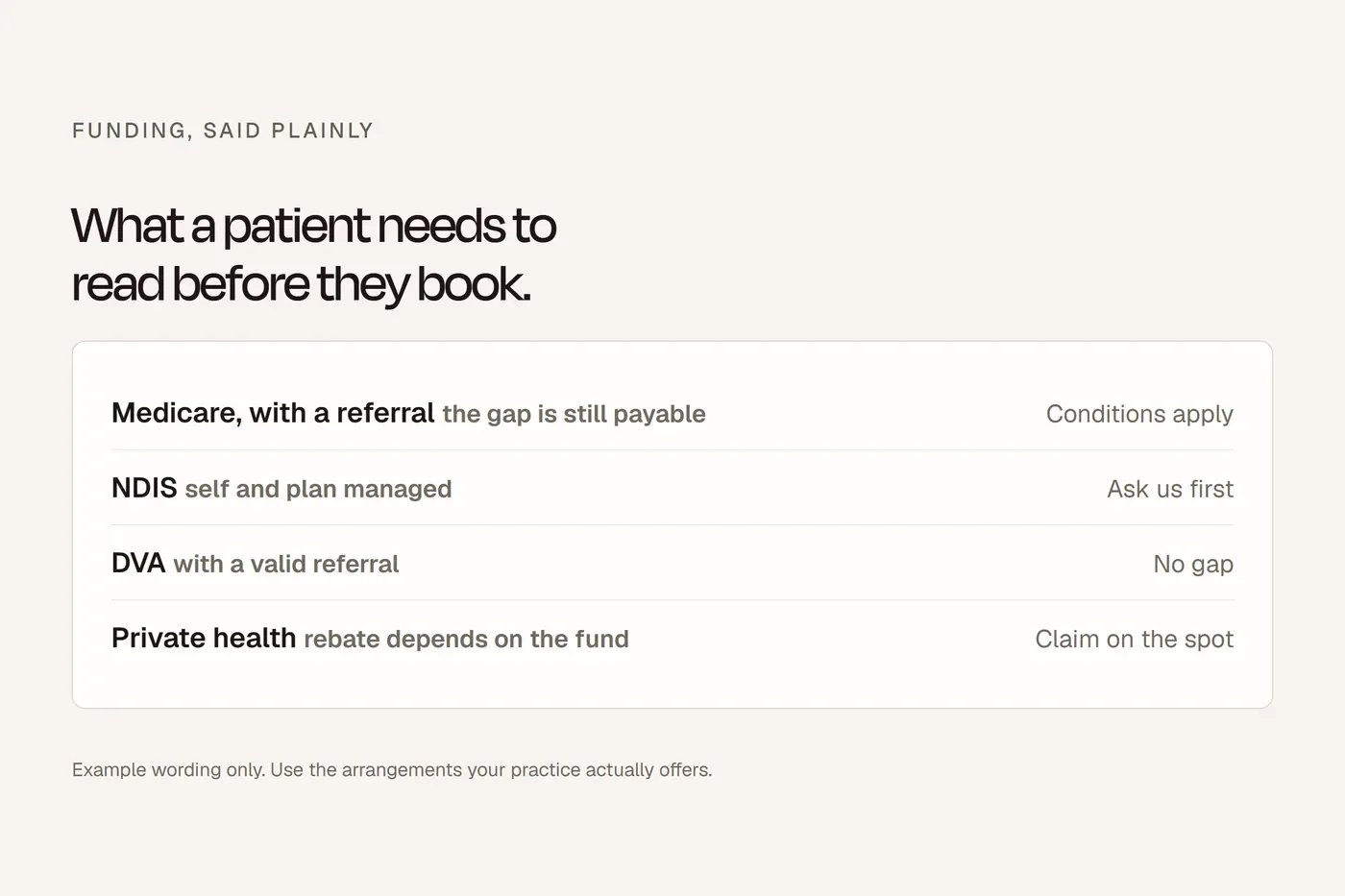
Factual, not marketing. Replace the bracketed parts and check the figures each July.
| Funding | Wording |
|---|---|
| Medicare, allied health | If you have a chronic condition, your GP may prepare a GP Chronic Condition Management Plan and refer you for up to five Medicare-rebated allied health sessions per calendar year, shared across the allied health providers on your plan. From 1 July 2026 the Medicare rebate for [physiotherapy] is $63.40 per session (item 10960). Our fee is $[X], so the gap is $[Y]. |
| Better Access | With a Mental Health Treatment Plan and referral from your GP, you can claim a Medicare rebate for up to ten individual sessions per calendar year. From 1 July 2026 the rebate is $101.55 per session with a registered psychologist (item 80110). Our fee is $[X]. |
| NDIS, registered | We are a registered NDIS provider (registration group 0128, Therapeutic Supports). We see NDIA-managed, plan-managed and self-managed participants. |
| NDIS, unregistered | We support NDIS participants whose plans are self-managed or plan-managed. We are not a registered NDIS provider. |
| DVA | We see DVA Gold and White Card holders with a GP referral under the DVA treatment cycle (up to twelve sessions or one year per referral). We accept the DVA fee as full payment, so there is no cost to you. |
| Health fund | If you have extras cover for [service], you can claim on the spot with our HICAPS terminal and pay only the gap. Your rebate depends on your fund and your level of cover. |
| Preferred provider | We are a [Bupa Members First] provider, which may mean a lower out-of-pocket cost if you're an eligible member. |
| WorkCover, CTP, TAC | We treat workers compensation, CTP and TAC patients with an accepted claim and a referral. Contact us with your claim details. |
Put this on a page called Fees and funding, link it from the first screen of your homepage, and date it.
Questions we get asked
Does Medicare cover physio?
With a GP Chronic Condition Management Plan and referral, up to five allied health sessions a year, rebated at $63.40 each from 1 July 2026. You pay the gap if the fee is higher.
What's the difference between a GPMP and a GPCCMP?
The GPCCMP replaced the GP Management Plan and Team Care Arrangement on 1 July 2025. Old plans keep working until 30 June 2027.
Can I say "bulk billed" if I charge a gap?
No. Bulk billing means you accept the rebate as full payment.
Can an unregistered provider advertise NDIS services?
Yes, factually. You can say you support self-managed and plan-managed participants. You can't say or imply you're registered.
Can I use the NDIS logo?
Not without the NDIA's written consent. The "I heart NDIS" mark is for registered providers only.
Can I charge NDIS participants more than the price limit?
Not for NDIA-managed or plan-managed participants. Less is fine.
How many sessions does a DVA referral cover?
Twelve, or one year, whichever comes first. Then a new referral. No gap.
What health fund rebate should I show?
None. It varies by fund and cover. Say patients can claim on the spot and pay the gap.
What changed with Better Access in 2025?
From 1 November 2025 the Mental Health Treatment Plan has to come from the patient's MyMedicare practice or usual GP. Session numbers didn't change.
Do I have to put my NDIS provider number on my website?
No. Registration is public on the NDIS register. You may say you're registered if you are.
About this guide
Sources are named in the text; where the rules come from a regulator we link to the regulator, not to a summary of it. This is general information about building a website, not legal advice. If you want to see what that looks like on a real page, have a look at websites for psychology practices.