Cliniko vs Halaxy vs Nookal vs Zanda (plus Splose and Coreplus): the comparison for Australian allied health
bdog builds websites for clinics and connects them to all six of these. We don’t resell any of them and we don’t take referral commissions. Prices are from vendor pages at the time of writing and change; check before you decide.
On This Page
Most comparisons of these systems are written by one of the vendors, or by an agency that gets paid when you pick one. This one is written by the people who have to wire your website into whichever you choose. We have opinions about how well each connects. We don't have a stake in which you buy.
Six systems. Five questions. Then who each one is for.
The short version
| Cliniko | Halaxy | Nookal | Zanda | Splose | Coreplus | |
|---|---|---|---|---|---|---|
| Pricing model | Flat tiers by headcount, USD | Free core, pay per credit | Per practitioner (check vendor) | Tiers, AUD | Per practitioner, AUD | Free tier plus paid plans |
| Medicare and DVA claiming | Via integration | Built in (credits) | Via integration | Built in | Built in, region-specific | Built in, free on paid plan |
| NDIS | Via workflow | Built in (credits) | Via workflow | Via workflow | Built for it | Supported |
| Telehealth | Built in | Built in (credits) | Via integration | Paid add-on | Built in | Built in |
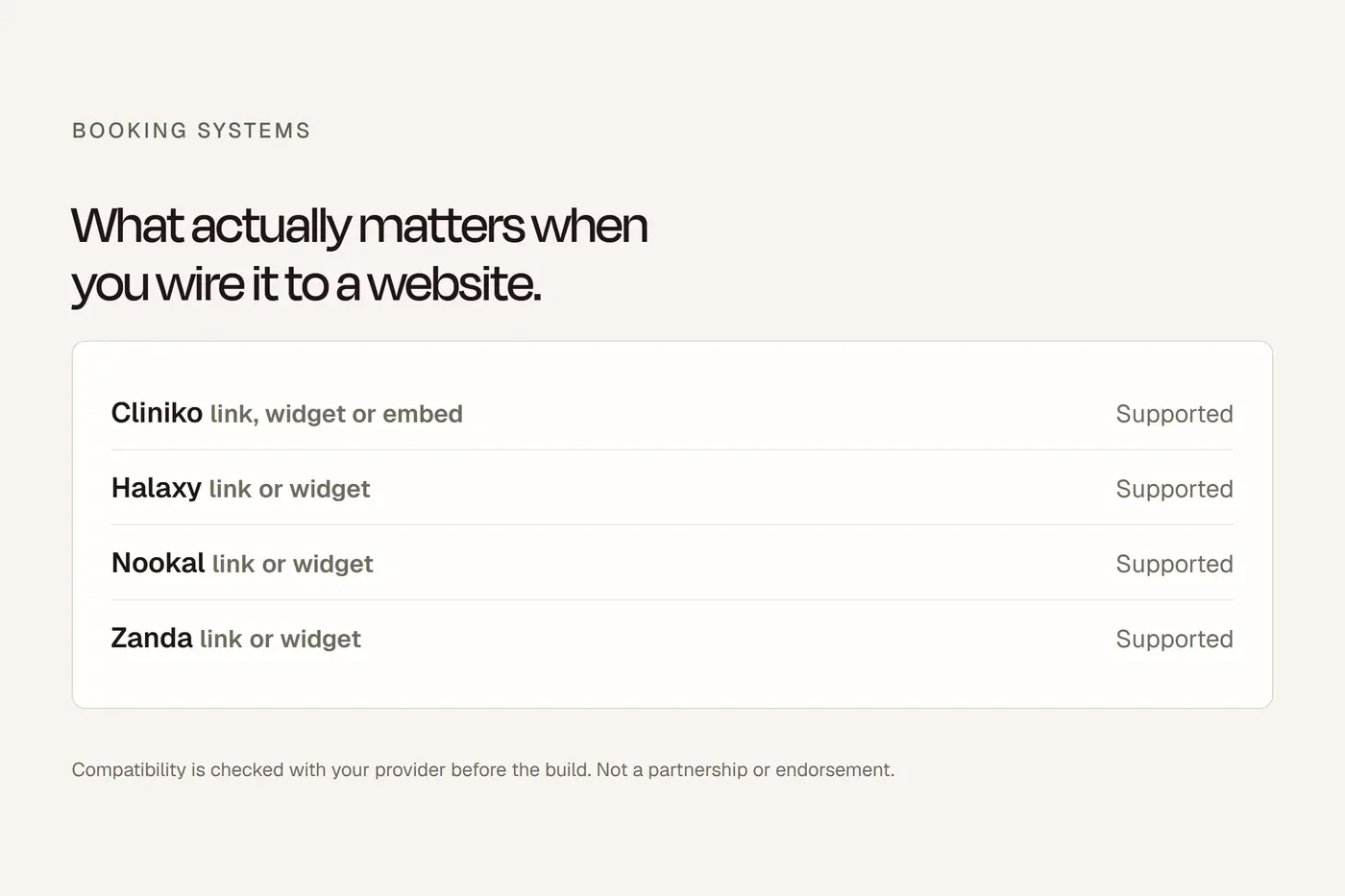
| Website connection | Embed, button, per-practitioner URLs | Embed, button, per-practitioner links | Embed, link | Portal embed, link | Embed, link | Button |
| Own marketplace | No | Free directory | No | No | No | No |
| Generally suits | Broad allied health | Solo and low volume | Physio and multi-site | Psychology and mental health | NDIS and mobile | Claiming-heavy allied health |
Scroll the table sideways to see every column.
1. How each connects to your website
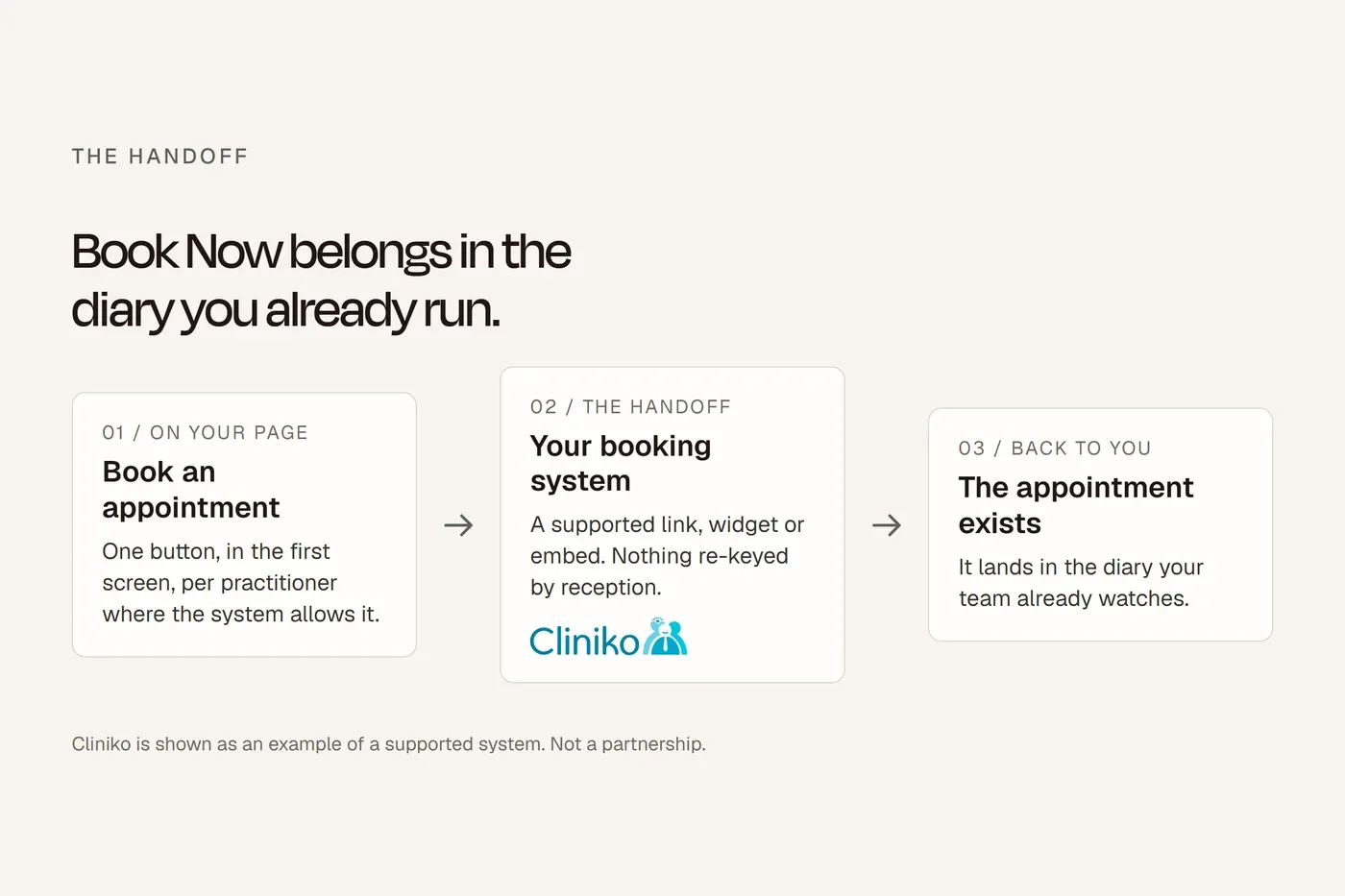
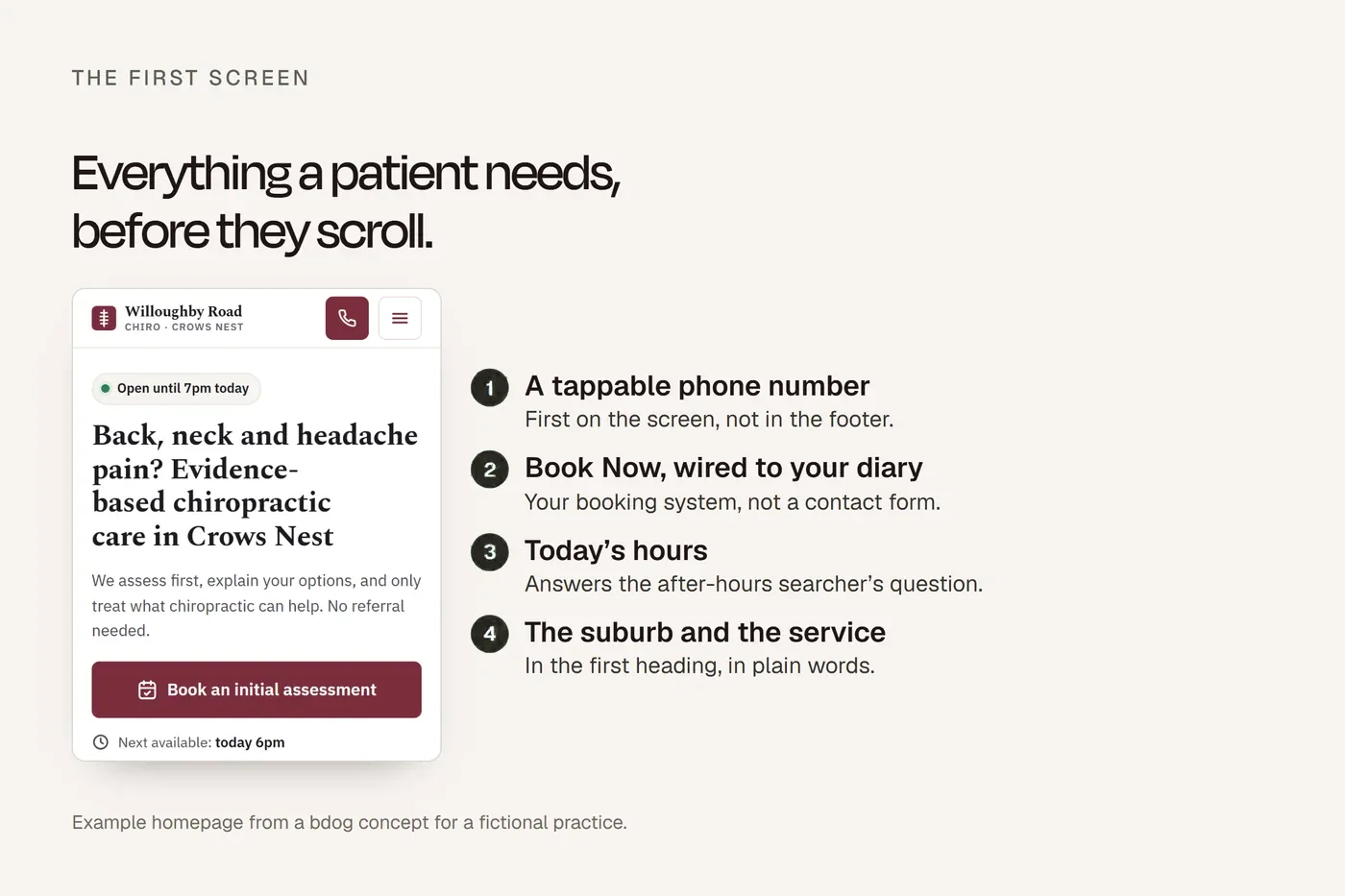
This is the question the other comparisons skip, and the one that decides whether your Book Now button works.
Cliniko is the cleanest. A URL builder produces separate booking pages per practitioner, per location and per appointment type, so every bio on your site can link to that person's diary. Embed code is one click. It's the one we have the fewest support tickets about.
Halaxy is close behind. Direct links per practitioner, per location, per fee and per appointment type, plus embed code and HTML buttons. The difference is that your Halaxy profile has to be visible for the embed to work, though "enabled but not searchable" counts as visible. If you don't want to be in their directory, that setting is your friend.
Nookal generates a link or embed code per starting point. It's capable but has two systems running side by side, New and Legacy. Anything you build now should use New. One thing Nookal does that others don't: its booking report records where each booking came from.
Zanda (Power Diary until November 2024) connects through a client portal that embeds or links. It works. The documentation moved with the rebrand, so expect to look for it.
Splose offers online booking with embed and link options. Its booking flow is built around NDIS intake, which matters if that's your patient base.
Coreplus gives you a book-now button for your website or Facebook page. Simple and reliable. Coreplus also feeds HotDoc and HealthEngine if you list there.
If website integration were the only criterion, Cliniko and Halaxy would be the top two. It isn't the only criterion.
2. What they cost
Two warnings before the numbers. Cliniko bills in US dollars, so the figure on your card moves with the exchange rate. And three of the six use models where the headline price isn't the real price.
Cliniko. Flat tiers by practitioner count: US$45 a month for one practitioner, US$95 for two to five, up to US$395 for 26 to 200. Every tier gets every feature. SMS is 10 US cents a message, email is free, and migration in and out is free. Cliniko says its prices haven't changed since it launched in June 2011, which we can't think of another software company saying.
Halaxy. The core platform is free. That's real, not a trial. You pay in credits for the things that cost Halaxy money: SMS, claiming transactions and similar, at 15 to 22 Australian cents each. Some features are a subscription from around A$25 a month. Payment processing runs from 1.5 per cent. From 1 October 2026 Halaxy's payment processing rates drop slightly, and passing card surcharges to patients through Halaxy stops, following the Reserve Bank's change. For a solo practitioner sending a few SMS a week, Halaxy can be close to free. For a busy multi-practitioner clinic, do the sums on credits.
Zanda. Australian pricing is published in tiers starting around A$29 a month for a single practitioner, with SMS and the Telehealth Plus add-on billed separately. Check the AU pricing page directly, because the rebrand shuffled things.
Splose. Around A$30 per practitioner per month is the figure most sources give. They don't all agree. Confirm on splose.com.
Coreplus. A free tier with limited features, then paid plans per practitioner. Medicare and DVA claiming is included free on the paid plan, which for a claiming-heavy practice can offset the difference.
Nookal. We haven't published a figure because we couldn't verify one from the vendor page at the time of writing. Ask them.
The pattern: Cliniko is the predictable one. Halaxy is the cheapest to start and the most variable. The others sit per practitioner in the A$30 to A$60 range with add-ons.
3. Claiming
For a lot of allied health practices this decides it.
Zanda has Medicare and DVA claiming built in, both bulk bill and patient claims.
Halaxy covers Medicare, DVA, ECLIPSE, TAC, WorkCover, Comcare, HICAPS and NDIS, paid per successful transaction in credits.
Coreplus does Medicare and DVA free on the paid plan, and connects to Tyro Health and Pin Payments. It does not integrate with HICAPS; private fund claiming runs through Tyro Health.
Splose has region-specific billing built in and NDIS at its core: bulk payment requests, plan manager invoicing, the workflows a disability practice runs every day.
Cliniko and Nookal do claiming through integrations rather than natively. Tyro is the common one. It works, but it's another system in the chain.
If you bulk bill heavily or run NDIS, start your shortlist with Halaxy, Zanda, Coreplus and Splose and work backwards.
4. Telehealth and messages
Cliniko, Coreplus and Splose have telehealth built in at no extra cost. Halaxy has it, paid in credits. Zanda sells it as Telehealth Plus. Nookal uses an integration.
SMS reminders are where costs hide. Cliniko is 10 US cents. Halaxy is one credit, 15 to 22 cents. The others bill separately. A practice sending 400 reminders a month is spending $40 to $90 on SMS before anything else, on any of these systems. Budget for it.
5. Leaving
Nobody asks this before they sign up. Everybody asks it after.
Cliniko offers free migration in and out. Users note there's no self-serve export button; you ask, and they do it. Zanda carried every record through the rebrand without a migration. Jane, which isn't in this comparison but is in Australia, publishes an import guide from Zenoti, which tells you data does move between these platforms when vendors want it to.
Ask every vendor two questions before you sign: can I export my complete patient records and appointment history, and in what format. If the answer is vague, that's your answer.
Who each one is for
These are generalisations from reviews on Capterra, G2 and Australian practice forums, not from vendor marketing. Yours may be the exception.
Cliniko for allied health generally, especially practices that want one price, every feature, and the widest set of integrations. Reviewers praise ease of use. The complaints are SMS cost in USD and the export process.
Halaxy for solo practitioners and low-volume practices who want to start free and grow into paying. Reviewers praise the free plan. The complaints are a dated interface and basic reporting.
Nookal for physio and multi-site clinics, particularly those running classes and group bookings.
Zanda for psychology and mental health practices. Its scheduling is regularly called the best of the group, and it's ISO 27001 certified with Australian data on AWS Sydney, which matters when your client notes are the sensitive kind.
Splose for NDIS and mobile allied health teams. Reviewers praise the AI note-taking. The complaints are repetitive setup and limits on editing notes.
Coreplus for allied health practices where claiming volume is the main event. Coreplus says it supports more than 16,000 Australian allied health providers.
On scale, treat every number as the vendor's own. Cliniko says more than 65,000 health professionals. Coreplus says 16,000 in Australia. Nobody independent has counted.
Two things no comparison table shows you
Your front desk already has an opinion. The person who uses the system eight hours a day should sit in on every demo. A system your admin hates is a system with a workaround built around it within a month.
Switching is a project. Migration, retraining, patients re-registering for online bookings, updating every link on your website adding online bookings, and often a fresh look at what the site itself should cost you what a clinic website costs. If you're on one of these six and it mostly works, the case for switching needs to be strong. If you're choosing for the first time, that's the moment to choose well.
Questions we get asked
Cliniko vs Halaxy, which is cheaper?
Halaxy to start. Cliniko once you're sending a lot of SMS and doing a lot of claiming, because Cliniko's price doesn't move with volume and Halaxy's does. Do your own sums on your own volumes.
Is Halaxy really free?
The core platform is. SMS, claiming and payment processing cost credits. Plenty of solo practitioners run it for a few dollars a month.
What's the best system for NDIS?
Splose was built for it. Halaxy and Coreplus support it well. Ask each to show you a plan-managed invoice end to end.
Zanda vs Cliniko for psychology?
Zanda's scheduling and its Australian data hosting are the usual reasons psychologists pick it. Cliniko's flat price and website integration are the usual reasons they don't.
Can I export my patient data if I leave?
All of them will give you your data. How easily varies. Ask before you sign.
Which has built-in telehealth?
Cliniko, Coreplus and Splose at no extra charge. Halaxy per credit. Zanda as a paid add-on.
Which has the best website booking integration?
Cliniko, then Halaxy. Both make separate booking links per practitioner and per location without a developer.
What happened to Power Diary?
It became Zanda in November 2024. Same company and product.
Is Nookal's Legacy booking system going away?
Nookal runs New and Legacy side by side and is moving people to New. Build on New.
Which should I pick?
The one your front desk likes, that does your claiming natively, and that produces a booking link per practitioner. For most allied health practices that's a short list of two, and this article should have told you which two.
About this guide
Sources are named in the text; where the rules come from a regulator we link to the regulator, not to a summary of it. This is general information about building a website, not legal advice. If you want to see what that looks like on a real page, have a look at websites for physio practices.