Ahpra’s advertising guidelines, in plain English
Every advertising rule for a registered health practice traces back to one section of the National Law. This is the plain-English map of it: the five rules and what each is for, who’s covered and who isn’t, the TGA and consumer law layers on top, the penalties, and what really happens when someone complains.
On This Page
- The law: five things your advertising can’t do
- The guidelines, and how old they are
- Who the rules cover
- What each rule is for
- Titles: “Dr”, “specialist” and “surgeon”
- Evidence for claims
- Reviews, social media and influencers
- The 2025 cosmetic layer
- The TGA layer: medicines and devices
- The consumer law layer
- The penalties in one table
- What happens when someone complains
- Ahpra’s own tools
- Questions we get asked
Every rule about how an Australian health practice can advertise comes back to one section of one law. Section 133 of the Health Practitioner Regulation National Law runs to five short lines. Ahpra's advertising guidelines are the long explanation of those lines, and everything you've heard about testimonials, "Dr", "specialist" and before-and-after photos hangs off them.
This page is the map. What the law says, who it covers (and who it doesn't), what each rule is for, the other rulebooks that sit on top of it, and what actually happens when someone complains about your website. Where we've written a deeper guide on one part, we link to it rather than repeat it.
The law: five things your advertising can't do
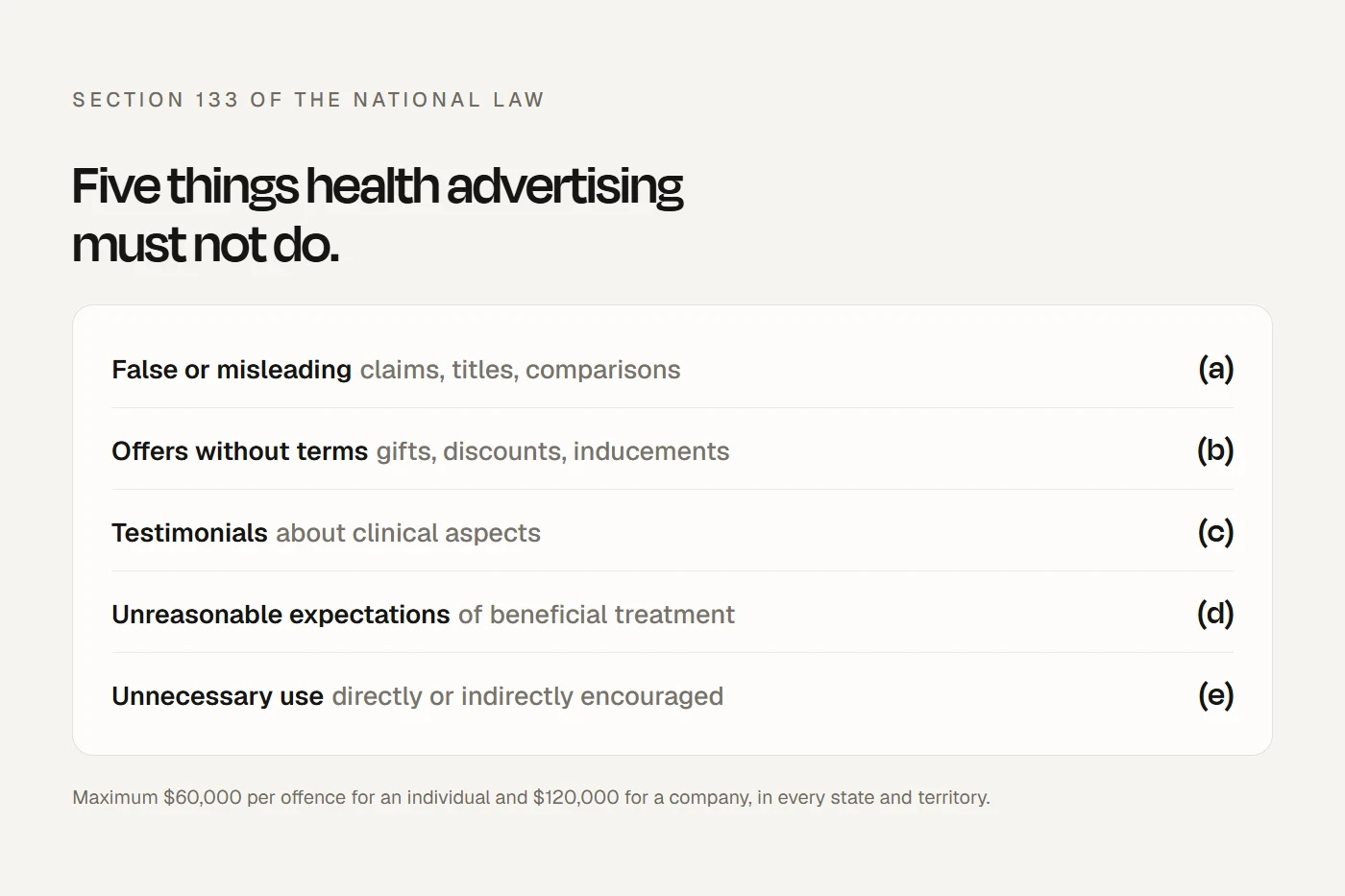
Section 133(1) says a person must not advertise a regulated health service, or a business that provides one, in a way that:
- is false, misleading or deceptive, or is likely to be
- offers a gift, discount or other inducement to attract a person to use the service or the business, unless the advertisement also states the terms and conditions of the offer
- uses testimonials or purported testimonials about the service or business
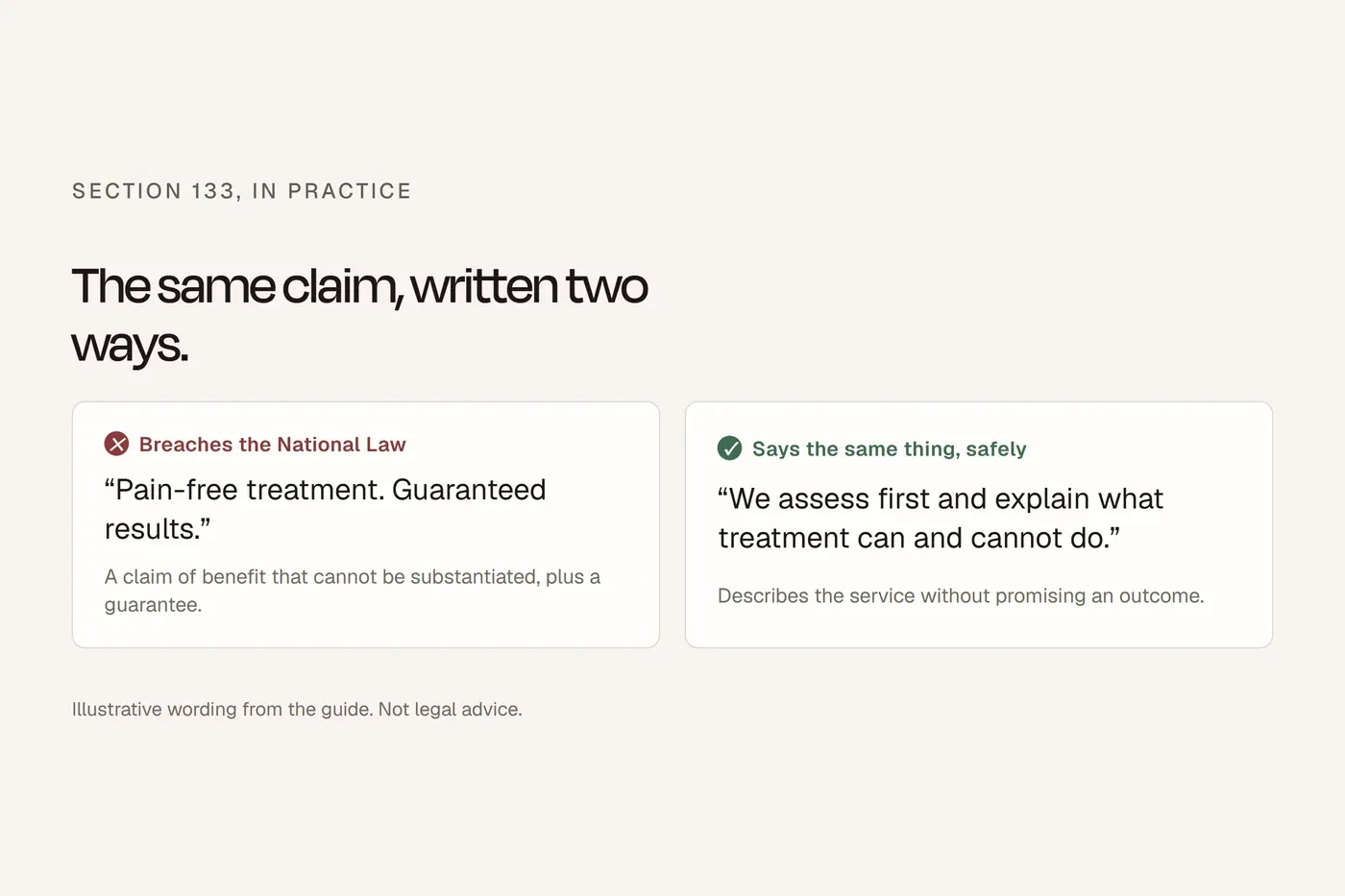
- creates an unreasonable expectation of beneficial treatment
- directly or indirectly encourages the indiscriminate or unnecessary use of regulated health services.
A regulated health service is a service provided, or usually provided, by a health practitioner registered in one of the professions the law covers. The maximum penalty is $60,000 for an individual and $120,000 for a body corporate, for each offence.
The section also says a court hearing a prosecution "may have regard to" the advertising guidelines. That's why the guidelines, which aren't legislation, carry real weight.
The guidelines, and how old they are
The Guidelines for advertising a regulated health service were written jointly by the National Boards and took effect on 14 December 2020. In October 2026 they're still the current version. They say they'll generally be reviewed at least every five years, so a new version is due.
Two things have already overtaken the text:
The penalties. The guidelines still quote maximums of $5,000 and $10,000. The National Law was amended in 2022 to $60,000 and $120,000, and Ahpra says that as of July 2024 the higher amounts apply in every state and territory, including Western Australia. If you see $5,000 quoted anywhere, it's out of date.
The word "surgeon". Section 115A now limits "surgeon" for medical practitioners to those with specialist registration in surgery, obstetrics and gynaecology, or ophthalmology. Ahpra notes the guidelines will add this when they're next reviewed.
One more thing the guidelines say plainly: Ahpra and the National Boards can't tell you whether a specific ad complies. They point you to your own lawyer or your indemnity insurer instead.
Who the rules cover
Section 133 starts with "a person", not "a practitioner". Anyone who advertises a regulated health service is covered: the practitioner, a practice company, a non-clinical owner, a marketing agency. Ahpra calls whoever controls the content the advertiser. That includes anyone who publishes or authorises it, or directs someone else, like a staff member or an agency, to write or post it. Your web designer writing a bad bio doesn't move the problem to them.
| Your practice | Ahpra's advertising rules | Also in play |
|---|---|---|
| Physio, dental, chiro, osteo, psychology, podiatry, OT, optometry and the rest of the 16 professions regulated through Ahpra | Yes | Australian Consumer Law; the TGA if you mention medicines or devices |
| Owned by a company or a non-practitioner | Yes, if it advertises a regulated health service | Australian Consumer Law |
| Cosmetic injectables, veneers and other higher-risk cosmetic work | Yes, plus the September 2025 cosmetic guidelines | The TGA, on prescription medicines; Australian Consumer Law |
| Counselling or psychotherapy (not a registered profession) | No Board to act against you; see below | Australian Consumer Law; state codes for unregistered practitioners; your association's code |
| Veterinary | No | Your state or territory veterinary board's code; Australian Consumer Law |
Scroll the table sideways to see every column.
Counsellors. Counselling isn't a registered profession, so there's no Board to act against you. But "psychologist" is a protected title, and section 133 applies to "a person" advertising a regulated health service; whether that reaches a counselling-only practice is a question we haven't seen a court answer. Some states add their own rules: in New South Wales, counsellors are bound by the Code of Conduct for non-registered health practitioners, which the Health Care Complaints Commission enforces. Our advice is to follow Ahpra's rules anyway.
Vets. Vets are outside the National Law. They're registered by a veterinary board in each state and territory under that jurisdiction's own Act, with its own code of conduct. The Australian Consumer Law still applies, so misleading claims are still unlawful. The testimonial ban in section 133 doesn't apply, but check your own board's code before you publish client stories; we haven't reviewed every state's.
What counts as advertising. Ahpra's definition is wide: your website and social media, directory listings, signs, business cards, flyers, and even patient recall notices. Information you give a patient in a consultation, where they can ask questions, isn't advertising. Neither are comments patients make on sites you don't own or control.
What each rule is for
Each rule solves a problem. A patient reading your website can't check your claims, and doesn't get the conversation that informed consent requires.
False or misleading
This is where most breaches sit, because it covers the most ground: titles, qualifications, comparisons with other clinics, claims that you're the best, and long lists of conditions you "treat" or "help with". Ahpra names that list as an example of an unqualified effectiveness claim: every condition on it needs evidence behind it.
Offers without terms
Discounts and gifts are allowed. Hiding the catch isn't. The guidelines point out that the public reads "free" as absolutely free, so a free session paid for by a higher price elsewhere, or by Medicare, isn't free. Put the terms in plain language next to the offer, or link to them.
Testimonials
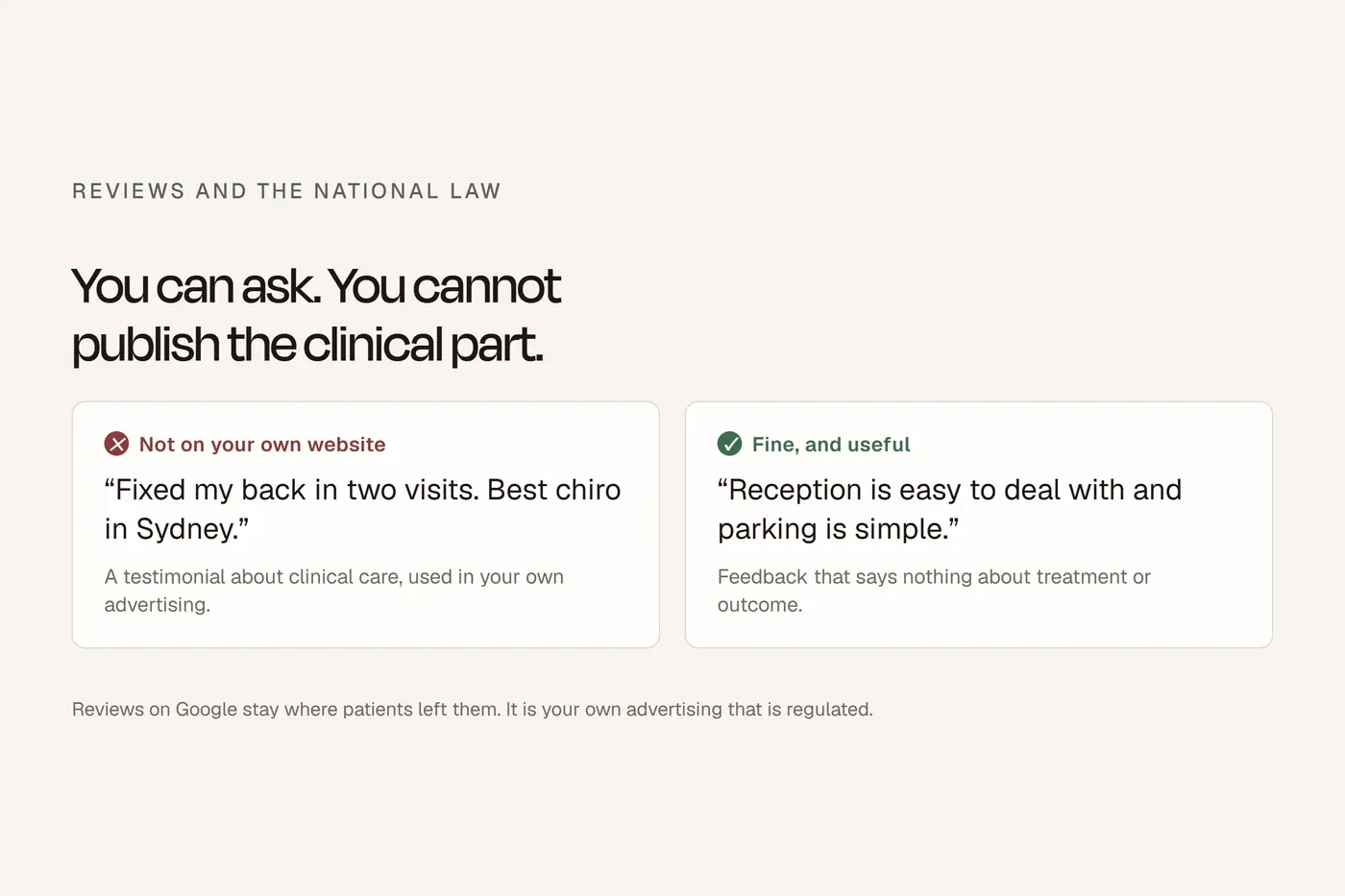
Patient stories persuade because they feel like evidence, and they aren't. Ahpra defines a testimonial as a positive statement about a clinical aspect of a service: the symptom or reason for coming in, the diagnosis or treatment, or the outcome and the practitioner's skill or experience. "The receptionist was lovely and I was seen on time" isn't one. "My back pain is gone" is. Our reviews guide covers asking for Google reviews, and the before-and-after guide covers images.
Unreasonable expectations
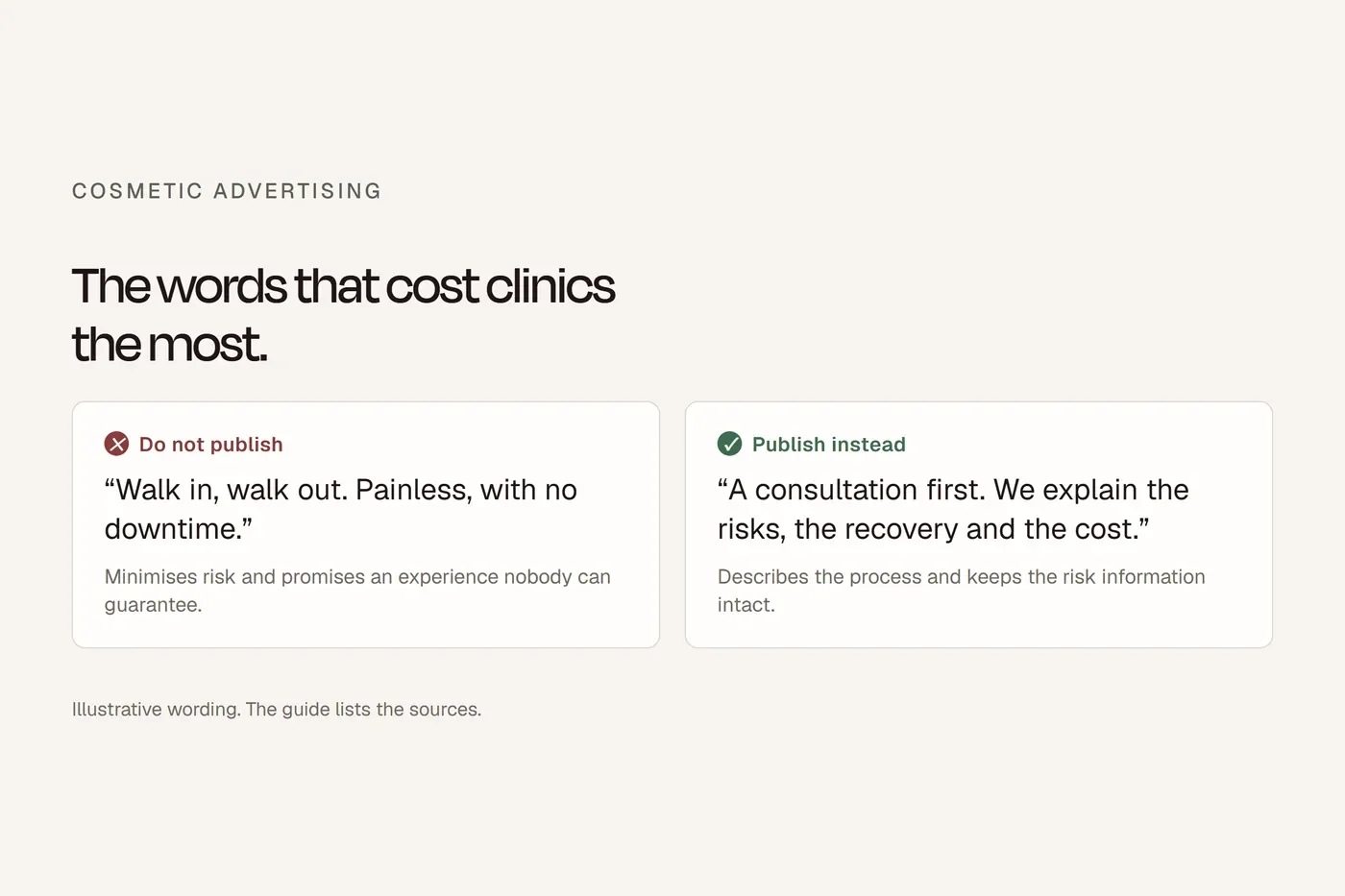
Words like "safe", "effective", "risk-free" and "pain-free" without the risks alongside them, recovery times stated as promises, results without the caveats. The patient arrives expecting something you can't guarantee.
Unnecessary use
Urgency tied to health where there's no clinical reason for it, and prizes or rewards that encourage people to have treatment regardless of need. Ahpra's example is a draw for a luxury car with an entry for every cosmetic injection appointment. Every intervention carries some risk, and advertising shouldn't create demand that isn't there.
Titles: "Dr", "specialist" and "surgeon"
Titles are the one part of this that can carry a prison term.
Protected titles. Section 113 protects each profession's name: physiotherapist, psychologist, dentist, chiropractor, podiatrist and the rest. Using one without registration, or using it about someone else who isn't registered, carries up to $60,000 or three years' imprisonment for an individual, and $120,000 for a company.
"Specialist". Only medicine, dentistry and podiatry have registered specialties. Sections 115 and 118 make it an offence to use a specialist title, or hold yourself out as a specialist, without that registration, with the same maximums. For everyone else, "specialises in" is the risk. Ahpra's own example: "Dr Lopez (Chiropractor) is a specialist in paediatric chiropractic care" is a potential breach; "has substantial experience working with musculoskeletal issues in children" is fine.
"Dr". Not a protected title. But the public assumes it means a medical doctor, so if you're not one, the profession has to sit beside it, PhD or not. "Dr Lee" is a potential breach. "Dr Lee (Osteopath)" is fine.
"Surgeon". For medical practitioners, section 115A limits it to the three surgical specialties above, which rules out "cosmetic surgeon" for a GP. Dentists using "dental surgeon" and surgical podiatrists aren't affected.
Evidence for claims
If your advertising says a treatment works, you need what Ahpra calls acceptable evidence. That mostly means peer-reviewed research, and the guidelines name a well-conducted systematic review of randomised controlled trials as the highest level. They also list what generally won't do: studies with no human subjects, before-and-after studies with few or no controls, patient self-assessment, anecdotes from your own practice, and audits that don't control for bias.
The bar is higher than in clinic, deliberately. With a patient in front of you, you can weigh the evidence together; a web page can't. It's why we cut most "conditions we treat" lists down when we rebuild a clinic site.
Reviews, social media and influencers
The testimonial ban applies to advertising you control. Reviews on Google, which you can't switch off, aren't your responsibility. Reviews on your own website, or republished from Google onto it, are. Ahpra also warns that engaging with reviews on a third-party site "may be considered using a testimonial". The cosmetic guidelines give liking or responding to a patient's post as examples of engaging, and it's why replying to a review needs care. We've written up how to reply to a bad review without breaching privacy or the testimonial rules.
Social media gets no special treatment. Ahpra's social media guidance says the National Law and the advertising guidelines apply to advertising there as they do anywhere else. Influencers are where clinics get caught. If you pay someone, or give them free treatment, to post about their results, you've directed the content, and in our reading their post is a testimonial you're using. The 2025 cosmetic guidelines say this outright for cosmetic work: practitioners are responsible for advertising delivered by influencers and brand ambassadors.
The 2025 cosmetic layer
Since 2 September 2025, the Guidelines for advertising higher risk non-surgical cosmetic procedures apply on top of everything above. Ahpra's examples of higher-risk procedures include cosmetic injectables like botulinum toxin and dermal fillers, thread lifts, injection lipolysis, sclerotherapy, platelet rich plasma, hair transplants and dental veneers, so dentists are in scope too. The headline changes: no testimonials of any kind, including through influencers; practitioners must take steps not to interact with positive reviews; strict rules for before-and-after images; and no images of people under 18. Our cosmetic advertising guide goes through it rule by rule.
The TGA layer: medicines and devices
The Therapeutic Goods Administration doesn't regulate the promotion of health services. It regulates advertising for therapeutic goods, meaning medicines and medical devices, and an ad for your service can turn into an ad for goods without you noticing.
The big one is prescription medicine. You can't advertise prescription-only medicines to the public, and the TGA says that includes terms that stand in for them, naming "wrinkle reducing injections" and "weight loss injections" as examples. Its guidance gives a safe pattern: promote the consultation and the condition, not the product. "Call our clinic for a consultation to discuss treatment options for migraine" is fine. A page promoting a particular medicine for migraine is advertising that medicine.
This isn't theoretical. In September 2024 the TGA issued 21 infringement notices totalling $319,260 to four businesses and three individuals, including medical practices offering telehealth, over the alleged unlawful advertising of prescription-only medicines, mostly for weight loss, on their websites. Medical devices you sell or name in your advertising are therapeutic goods too, and the TGA's advertising code applies to them.
The consumer law layer
The Australian Consumer Law applies to every business, registered or not, vet or counsellor. The ACCC says claims must be true, accurate and based on reasonable grounds, whether or not you meant to mislead, and that includes websites, social media and testimonials. Its infringement notices are $4,368 for an individual and $21,840 for a company, and court penalties go far higher (see the table below). Ahpra says it works with the ACCC and the TGA when an advertiser breaches their laws too.
The penalties in one table
| Breach | Law | Individual, maximum | Company, maximum |
|---|---|---|---|
| Any of the five advertising rules | National Law, s133 | $60,000 per offence | $120,000 per offence |
| Misusing a protected title, "specialist" or "surgeon" | National Law, ss113, 115, 115A, 118 | $60,000, three years' imprisonment, or both | $120,000 |
| Misleading representations | Australian Consumer Law | $2.5 million (conduct from 28 March 2026) | The greater of $100 million, three times the benefit, or 30% of turnover (conduct from 28 March 2026) |
| Advertising prescription medicines and other therapeutic goods unlawfully | Therapeutic Goods Act | Infringement notices, court penalties and prosecution | |
Scroll the table sideways to see every column.
For registered practitioners there's a second track that matters more day to day: conditions on your registration, a caution, or a tribunal hearing.
What happens when someone complains
Anyone can complain about advertising, and Ahpra says it reviews every complaint: is it advertising a regulated health service, what breaches are there, who controls it, and how risky is it. In Queensland, complaints are managed jointly with the Office of the Health Ombudsman.
Most cases start with a letter telling you the advertising breaches the National Law and asking you to fix it within 30 days, with education material attached. Fix it and the matter usually closes. If a registered practitioner doesn't, the Board can propose conditions on their registration that stop them advertising. If the advertiser isn't registered, Ahpra may prosecute. Very serious breaches that put the public at significant risk can be prosecuted even after they're corrected.
The 2024/25 annual report shows how that plays out. Ahpra assessed 775 advertising complaints. 356 involved companies, unregistered people or serious risk and went to its Criminal Offences Unit; most of those were about specialist titles or people holding themselves out as registered. 419 were lower-risk complaints about registered practitioners. 74 per cent of practitioners contacted fixed their advertising early. Of 86 audited because they hadn't, 75 then fixed it, eight had conditions imposed and three were cautioned.
For a practitioner, the realistic outcome is a letter and a deadline. The real risk is ignoring it.
Ahpra's own tools
Ahpra's advertising hub has more practical help than most people realise: a self-assessment tool that walks through each rule as questions, a testimonials page with examples of what counts as a clinical aspect, worked examples for chiropractic, osteopathy and Chinese medicine, a titles guide, and a framework for acceptable evidence.
When you're ready to check your own site line by line, our 22-point website checklist turns all of this into things to look for. If you mention Medicare, NDIS or DVA, our funding wording guide covers what to say about rebates without misleading anyone.
Questions we get asked
What are the Ahpra advertising guidelines?
The Guidelines for advertising a regulated health service, published by the National Boards and in effect since 14 December 2020. They explain section 133 of the National Law, and courts can take them into account.
Are the 2020 guidelines still current?
Yes, as of October 2026. Their penalty figures are out of date, and a review is due.
What is the penalty for breaching Ahpra's advertising rules?
Up to $60,000 per offence for an individual and $120,000 for a company. Misusing a protected title can also bring up to three years' imprisonment.
Can I use patient testimonials on my website?
Not ones that mention symptoms, diagnosis, treatment, outcomes or the practitioner's skill. Comments only about service, like parking or friendly staff, aren't testimonials.
Can I reply to Google reviews?
Carefully. Ahpra says engaging with reviews may count as using a testimonial, and for higher-risk cosmetic procedures you must not interact with positive reviews.
Do the rules apply to social media?
Yes. Ahpra says the National Law and the guidelines apply to advertising on social media as anywhere else. If you pay or direct an influencer, treat their posts as your advertising.
Can a chiropractor or physio call themselves Dr?
Yes, if the profession is stated beside it, like "Dr Lee (Osteopath)". "Dr" on its own suggests a medical doctor.
Can I say I specialise in something?
Only medicine, dentistry and podiatry have registered specialties. Everyone else should use wording like "has substantial experience in".
Do Ahpra's advertising rules apply to vets or counsellors?
Not to vets, who answer to state and territory boards. Counsellors aren't registered, but can't use protected titles, and the consumer law applies to both.
What does the TGA have to do with my clinic's advertising?
If your ad names or hints at a prescription medicine, or promotes a device, it's also advertising therapeutic goods. Prescription medicines can't be advertised to the public.
About this guide
We are not lawyers and this is not legal advice. Check anything that matters with your indemnity insurer or professional association. The law and the figures here were checked against the sources below on 7 October 2026.
Main sources:
- Health Practitioner Regulation National Law, as in force in Queensland
- Ahpra, Guidelines for advertising a regulated health service
- Ahpra, Advertising and the law
- Ahpra, How we manage advertising complaints
- Ahpra annual report 2024/25
- Ahpra, Guidelines for advertising higher risk non-surgical cosmetic procedures
- Ahpra, Specialties and specialty fields
- TGA, Advertising health services that involve therapeutic goods
- TGA, telehealth businesses fined over $300,000
- ACCC, Fines and penalties
- NSW Health Care Complaints Commission, Code of conduct for non-registered health practitioners