Ignition for accountants: Australian pricing and an honest review
What Ignition costs an Australian practice once payment fees are in, which plan you need, what reviewers complain about, and the switching cost hidden in the terms. With a calculator for your practice.
On This Page
Ignition is the proposal and billing software a lot of Australian accountants and bookkeepers use to send engagement letters, get them signed and then collect the fees automatically. If you search for its price, Google's AI summary will tell you Pro is $229 a month and card fees are 2.5%. Neither is what Ignition's Australian pricing page says. Here's what it does say, what the plan you need actually costs once payment fees are in, and what the reviews and the terms tell you.
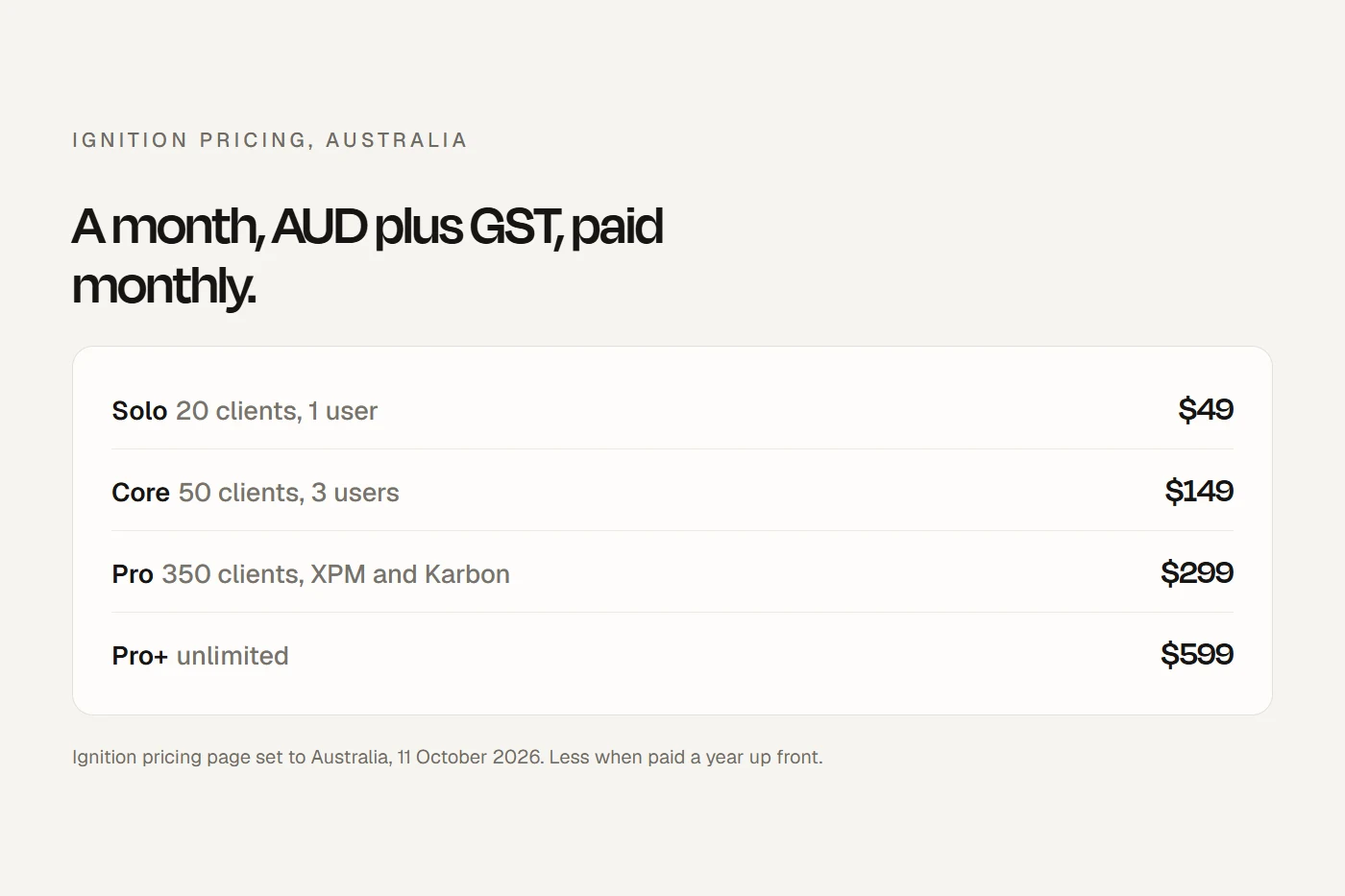
- Plans, AUD, plus GSTSolo $49, Core $149, Pro $299, Pro+ $599 a month, or $39, $99, $249 and $499 a month paid a year up front.
- Payment fees on topStandard cards 1.95% + 30c, Amex and premium cards 2.5% + 30c, direct debit 1% + 30c capped at $5 (plus 0.3% above $3,000).
- The catchThe XPM, Karbon, FYI and Zapier links start at Pro, and you can't export clients' saved card and bank details if you leave.
I build websites for accounting and bookkeeping practices and have no commercial relationship with Ignition or any of its competitors. I haven't run a practice on it. What I have done is read its Australian pricing page, its terms, its security page and help centre, and the reviews, and set out what they say. Everything was checked on 11 October 2026.
Ignition pricing in Australia
Ignition's pricing page, set to Australia, says "All prices are in AUD and exclude tax." The big number on each card is the price when you pay a year in advance. Switch the toggle to monthly and the prices go up.
| Plan | Paid monthly | Paid a year up front, per month | Active clients included | Each extra client, a month | Users |
|---|---|---|---|---|---|
| Solo | $49 | $39 | 20 | $7 | 1 |
| Core | $149 | $99 | 50 | $5 | 3 |
| Pro | $299 | $249 | 350 | $3 | 15 |
| Pro+ | $599 | $499 | Unlimited | n/a | Unlimited |
Scroll the table sideways to see every column.
Add 10% GST to all of those. A few rules from the pricing page and its FAQ that change the sums:
- Solo has conditions. Your business "must earn less than $200,000 in annual revenue", you get one user, and you have to connect Xero, MYOB or QuickBooks Online and turn on payments.
- An active client is someone who has accepted a proposal and still has an active service in that month, "most commonly" one business, entity or person. A client with several proposals counts once. Leads and unsigned proposals don't count.
- Extra clients are billed in arrears at the end of each month, and if you upgrade, your plan "will stay at the upgraded plan even if it falls below the bracket".
- Paying yearly means no refund. The fee is "collected for 12 months in advance" and "no refunds are provided for any remaining months" if you cancel.
- The trial is 14 days, with no card needed, and you can collect up to $10,000 in payments with no fees during it.
Add-ons
Online forms and the deals pipeline are $49 a month each unless your plan includes them (forms come with Pro and Pro+, the pipeline with Pro+). AI price insights are $399 a year and aren't in any plan. Identity checks for AML and KYC, from Core up, are $6 for a standard check and $10 for an enhanced one.
Which plan is cheapest at your size
On subscription alone, the extra-client fees decide when it's worth moving up.
| Move | Paying monthly, cheaper from | Paying yearly, cheaper from |
|---|---|---|
| Solo to Core | 35 active clients | 29 active clients |
| Core to Pro | 81 active clients | 81 active clients |
| Pro to Pro+ | 451 active clients | 434 active clients |
Scroll the table sideways to see every column.
Price isn't the only reason to move up, though. Solo is one user. Two signers on a proposal, the XPM, Karbon, FYI and Zapier integrations, and online forms all need Pro. Proposal reviews and approvals need Pro+.
Payment fees
Ignition Payments runs on Stripe, and the rates are the same on every plan.
| How the client pays | Fee | On a $600 invoice |
|---|---|---|
| Standard Visa or Mastercard, credit or debit | 1.95% + $0.30 | $12.00 |
| Amex, corporate and rewards cards | 2.5% + $0.30 | $15.30 |
| Direct debit | 1% + $0.30, capped at $5, plus 0.3% on the part above $3,000 | $5.00 |
Scroll the table sideways to see every column.
Ignition's own example: a $5,000 direct debit costs $5 on the first $3,000 plus 0.3% of the other $2,000, so $11. Payment fees aren't locked in by a yearly plan; you pay "the current payment rates offered at the time". Ignition's pages don't say whether GST is added to them.
Surcharging
Ignition still lists a setting to "Pass on card processing fees to clients". But the Reserve Bank has removed surcharging on Visa, Mastercard and eftpos cards, so if you'd been passing card fees on, check that setting with Ignition. The fee now comes out of your margin, which makes direct debit, capped at $5, the cheaper way for clients to pay.
What Ignition would cost your practice
From Ignition's Australian pricing page. Subscription excludes GST. Add-ons and identity checks not included.
A worked example: a practice with 45 clients each paying $600 a month by direct debit, on Core paid yearly. That's $99 a month for the subscription and 45 × $5 in direct debit fees, $225, so $324 a month before GST on the subscription. If 13 of those clients paid by standard card instead, the fees would rise to $316 and the total to $415. In both cases the payment fees cost more than the plan.
What Ignition does
You build a proposal from your services, with up to three options for the client to choose from, and Ignition sends it with your engagement terms. When the client signs, it creates the client and invoices in Xero, QuickBooks Online or MYOB, collects payment on the schedule you set (on acceptance, recurring or on completion) and reconciles it. Every plan includes engagement letter templates. The Institute of Public Accountants has a template made with Ignition for its members, and an Ignition page says CPA Australia has partnered with it to give members CPA's engagement letter template.
That fits how the Tax Practitioners Board sees engagement letters. Its guidance says they aren't a specific requirement of the Code of Professional Conduct, but are "an important and effective mechanism" for complying with it. It recommends a separate letter for each client entity unless agreed otherwise, and that recurring arrangements be reconfirmed "regularly (preferably annually)". Ignition's proposal renewals do that reconfirmation: one at a time from Core, in bulk from Pro. The separate-letter point also explains why your active-client count can run higher than your number of families.
From Core up there's also an AML and KYC dashboard with identity checks. Whether your services fall under the AML/CTF rules is a question for AUSTRAC's own guidance for accountants, not your software.
Ignition reviews
| Where | Rating | Reviews | Worth knowing |
|---|---|---|---|
| Xero App Store, Australia | 4.9 | 552 | 96% five stars |
| Capterra Australia | 4.7 | 153 | Value for money is its lowest score, at 4.4. Customer service 4.8 |
| G2 | 4.7 | 123 | "Expensive" is the most-tagged complaint |
Scroll the table sideways to see every column.
The ratings are high everywhere, and the praise is consistent: onboarding, support, proposals that look professional to clients, and money coming in on time. Two things to bear in mind. Most Capterra and G2 reviewers are US firms. And many recent Xero reviews thank Ignition staff by name for training, so they lean towards the onboarding experience.
The complaints are consistent too, and they're about cost: the subscription once add-ons are needed, and payment fees compared with collecting payments yourself. One Capterra reviewer put it simply: "Cost gets non-competitive after the add-ons". Others mention payout times and integrations with their practice software.
The terms, your data and leaving
Ignition is the trading name of Practice Ignition Pty Ltd, an Australian company, and its terms are governed by NSW law. The parts I'd read before signing:
- It renews automatically at the end of every billing period. To stop, cancel "no later than 24 hours prior to the end of the Billing Period". No refund for the rest of a period you've paid for.
- Fees can change with at least 14 days' notice.
- Your data is your job to keep. The terms say "You are expected to maintain copies of all User Inputs" and Ignition "is under no obligation to retain copies" after you leave. Its security page is kinder, saying it keeps data "indefinitely" unless the account's principal asks for deletion. Export your proposals and clients to CSV before you cancel either way.
- Clients' card and bank details don't come with you. Ignition says exporting payment records would risk PCI compliance, so it doesn't offer it. If you leave, every client re-enters their payment details somewhere else. That's the real switching cost.
- Your data is in the US. Ignition's security page says its servers "are located within the United States of America", on AWS, and that it's SOC 2 Type 2 certified. Check how that sits with your privacy policy's overseas disclosure section.
Ignition alternatives with published Australian prices
| Product | How it's priced | Published price, ex GST | Worth knowing |
|---|---|---|---|
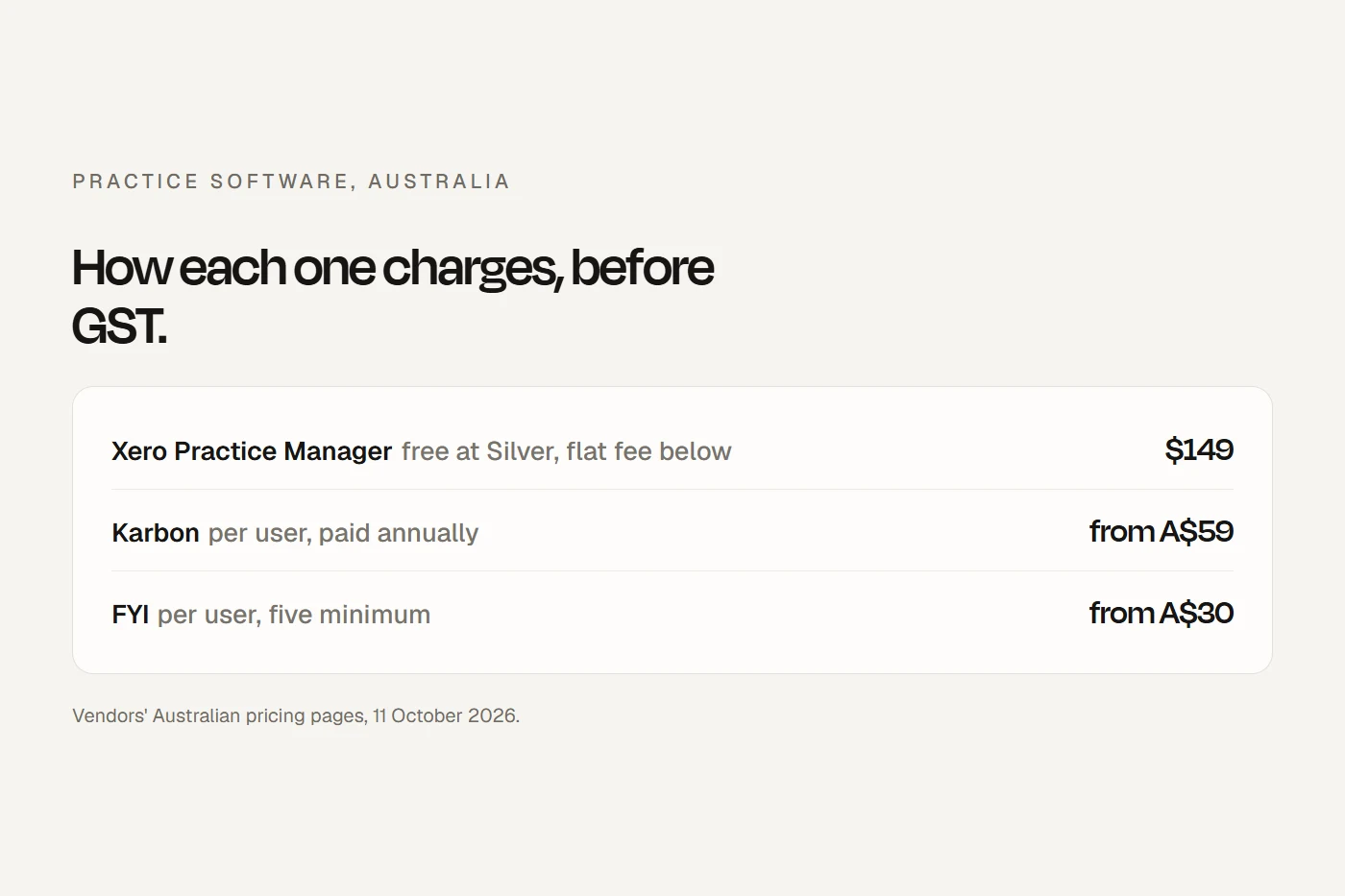
| Karbon | Per user | Team A$59 a user a month paid yearly, A$79 monthly (monthly only for teams of four or more). Business A$89 or A$109 | Full practice management with proposals and engagement letters built in. Ignition connects to it from Pro |
| OnboardMe | By requests a month (engagements, onboardings, forms, AML screens) | A$59 for 30 requests to A$599 for 700. Identity checks A$8 | Unlimited users and clients and "onshore hosting" on every plan |
| GoProposal (by Sage) | By proposals and users | Shown to Australians from $106 to $376.50 a month, converted from pounds | A UK product; some of its compliance add-ons are UK-focused |
Scroll the table sideways to see every column.
They don't compare like for like. Karbon is practice management priced per person; OnboardMe charges for activity, not clients; Ignition charges by active clients and adds its payment fees on whatever you collect through it.
Ignition and your website
This is the part I deal with. Ignition does the paperwork once a client says yes. Your website still has to win the enquiry. The documented way to connect them today is an Ignition online form: you put a link to it behind a button on your site, and a submission creates a deal in Ignition. Forms come with Pro and Pro+, or cost $49 a month on Solo and Core. Ignition's help centre describes a link, not a form you can embed in the page.
I'd put a "Become a client" or "Get a quote" button on your services pages, and keep the enquiry form on your own site short for people who just want to ask a question first. From Pro, proposal links can sit on your own domain too. My guide to accountant websites shows how I lay out services and fees for a practice.
- Count your active clients the way Ignition does: each entity with an accepted proposal and an active service.
- Price the plan you'll need in a year, not today. Plans don't move back down on their own.
- Check whether you need Pro for your integrations: XPM, Karbon, FYI and Zapier start there.
- Work out payment fees on what you collect a month, and steer clients to direct debit.
- Check your surcharging setting if you'd been passing card fees on.
- Update your privacy policy for data held in the US.
- Export proposals and clients regularly, not just when you leave.
Questions I get asked
How much does Ignition cost in Australia?
Solo $49, Core $149, Pro $299 and Pro+ $599 a month, or $39, $99, $249 and $499 a month paid a year up front, all in AUD plus GST. Payment fees and add-ons are extra.
Is Ignition a one-off purchase?
No. It's a subscription, billed monthly or a year in advance, and it renews automatically.
Can I use Ignition for free?
Only during the 14-day trial, which needs no card and lets you collect up to $10,000 in payments with no fees.
What are Ignition's payment fees?
Standard Visa and Mastercard 1.95% + 30c, Amex and premium cards 2.5% + 30c, and direct debit 1% + 30c capped at $5, plus 0.3% on any amount over $3,000.
Does Ignition work with Xero Practice Manager?
Yes, from the Pro plan. Solo and Core connect to Xero, QuickBooks Online and MYOB, but not to XPM, Karbon, FYI or Zapier.
Is Ignition the same as Practice Ignition?
Yes. Practice Ignition renamed itself Ignition, and the company behind it is still Practice Ignition Pty Ltd.
Where does Ignition store its data?
Its security page says on AWS servers in the United States.
About this guide
Written by Joseph Alzein, founder of bdog. I build websites for accounting and bookkeeping practices and have no commercial relationship with Ignition or the alternatives named. Prices come from Ignition's pricing page set to Australia, read on 11 October 2026; review figures from the sites below the same day. Prices and fees change, so confirm in your account. This is general information, not tax or legal advice.
Main sources:
- Ignition pricing (Australia)
- Ignition Terms of Use
- Ignition security
- Ignition: online forms
- Ignition Payments FAQ
- Ignition: client payment details
- Ignition: exporting proposals
- Xero App Store: Ignition
- Ignition: IPA engagement letter template
- Ignition and CPA Australia
- Tax Practitioners Board: letters of engagement
- AUSTRAC: accountants
- Reserve Bank: card surcharging decision
- Capterra Australia: Ignition
- G2: Ignition
- Karbon pricing
- Xero App Store: OnboardMe
- GoProposal pricing