Website subscription vs one-off build: what you pay, what you own, what to check
I sell websites on subscription, so I’ll be upfront about when a one-off build is the better deal. Here’s a calculator for your own quotes, who owns each part of a website, the contract questions that matter, and how the ATO treats each.
On This Page
- How a website subscription and a one-off build work
- Website subscription vs one-off build: the calculator
- What the monthly fee actually buys: changes
- What a one-off build still costs each year
- Who owns your website
- What to check in the contract before you sign
- How the ATO treats each
- When each one is the better choice
- Questions I get asked
I sell websites on subscription, so you'd expect me to say a subscription is better. Sometimes it isn't. A one-off build costs more up front and less later, and with the right contract you own the whole site the day it's handed over. A subscription spreads the cost and usually includes hosting, security and changes, but the terms vary a lot: some end with the site being yours, some offer a paid buyout, and some never say. This guide is how I'd compare the two if I were buying, with a calculator for your own quotes.
- A one-off build usually winsif you have the cash, the site won't change much for three years or more, and someone you already pay can handle updates.
- A subscription usually winsif you'd rather not pay thousands up front, and you want changes made whenever you need them by the people who built the site.
- Either way, check four things in writingThe minimum term, what it costs to leave, whose name the domain is in, and who owns the design at the end.
Prices below are from Australian providers' own pages on 11 October 2026. I've left the other studios unnamed. This is about how the two models work, not about them.
How a website subscription and a one-off build work
A one-off build. You pay a designer or studio for the build, often in stages. After handover you pay separately for what every website needs: a domain, hosting, a security certificate, updates, and any changes. Published prices for small business sites spread widely. The studios I checked listed from under $600 for a one-page site in Perth, to $1,699 to $3,490 +GST for one to fifteen pages in Melbourne, to from $3,500 +GST for a custom WordPress site in Sydney. Those are starting prices from five studios, not a market average. I couldn't find an independent survey of Australian prices.
A subscription. You pay monthly, sometimes with a setup fee, and the provider builds the site, hosts it and looks after it. Among four Australian subscription offers I checked, the minimum term ran from none to 12 months, monthly prices from $99 to $299, and what happens at the end ranged from "the site is yours" after 12 months, to a $2,000 buyout, to nothing stated at all.
Website subscription vs one-off build: the calculator
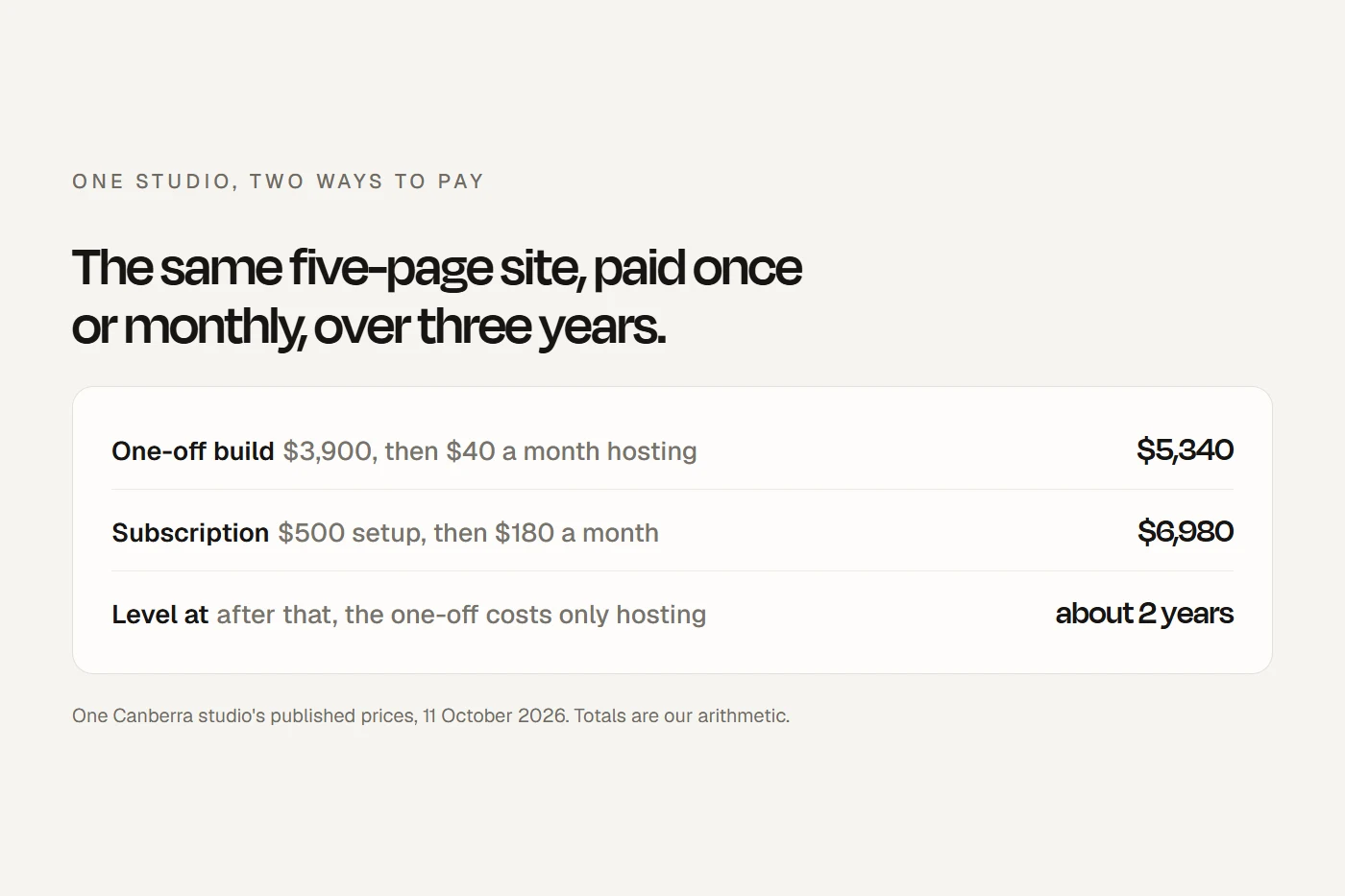
Put in the quotes you've been given. The examples are real published prices: one Canberra studio that offers the same five-page site both ways, and a Melbourne studio's build and care plan against my own Full Site plan.
The first example is the useful one, because the same studio publishes both prices for the same site: $3,900 plus $40 a month hosting, or $500 setup plus $180 a month with a 12-month minimum. The subscription is cheaper for the first two years, they're level at about two years, and after that the one-off path costs only hosting. That's the pattern to look for in any pair of quotes. The longer you keep a site without changing it, the better a one-off build looks.
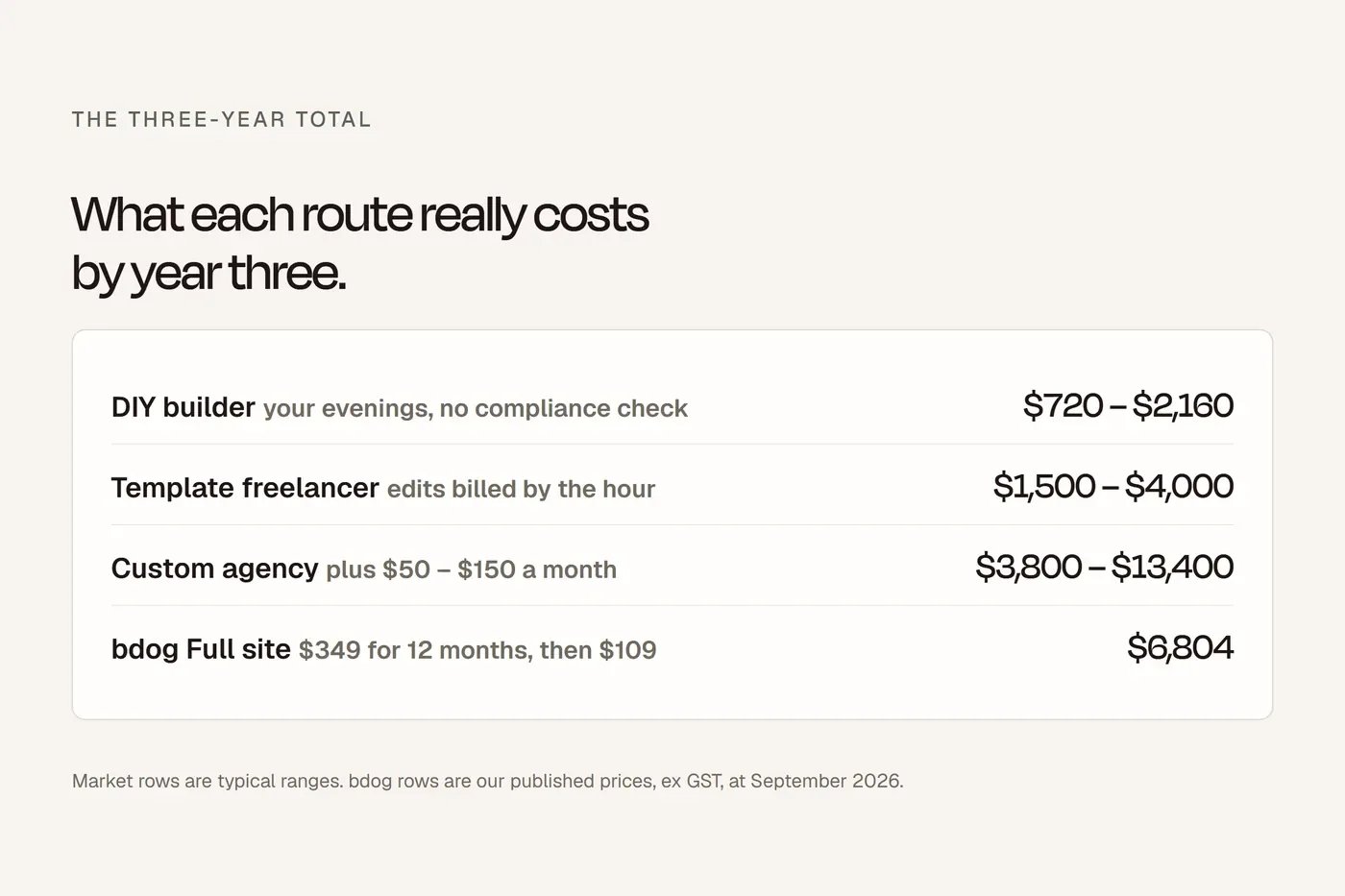
The second example compares more like with like. A Melbourne studio lists a small business site at $2,490 +GST, and a managed hosting and maintenance plan with up to 30 minutes of changes a month at $107.50 +GST. My Full Site plan is $349 a month for 12 months, then $109 a month, +GST. Over three years they come out within about $450 of each other. The difference is in what you get for the monthly fee, which is the next section.
What the monthly fee actually buys: changes
Keeping a site online is cheap. Hosting can cost less than $20 a month. What costs money, and what most owners actually need, is someone to change things: new hours, a new practitioner, a price update, a new service page, a photo that's out of date. So when you compare care plans, look at what they say about edits.
| Published plan (+GST) | A month | Changes included |
|---|---|---|
| Brisbane studio, essentials | $49 | None. Updates, backups and monitoring |
| Melbourne studio, entry plan | $59 | None. Updates, backups and security |
| Brisbane studio, business | $99 | 1 hour of content edits |
| Melbourne studio, growth plan | $107.50 | Up to 30 minutes of changes |
| A web designer's price list | $200 | None. Updates, security checks and a monthly backup |
| The same price list, higher tier | $500 | Content updates, up to 3 hours |
| My plans, after the first 12 months | $89 to $129 | Edits whenever you need them, within reason |
Scroll the table sideways to see every column.
That last row is why my plans are built the way they are. Keeping a site online is the cheap part. The monthly fee pays for changes: when you send me one, it gets done, without a quote or a timesheet. "Within reason" means changes to the site you have, not a new site every month. Whoever you go with, ask for their fair-use rule in writing so you know where the line is.
What a one-off build still costs each year
A one-off build isn't the end of the spending. Typical running costs at Australian providers:
- A .com.au domain: about $20 to $25 a year at Australian registrars once any first-year discount ends.
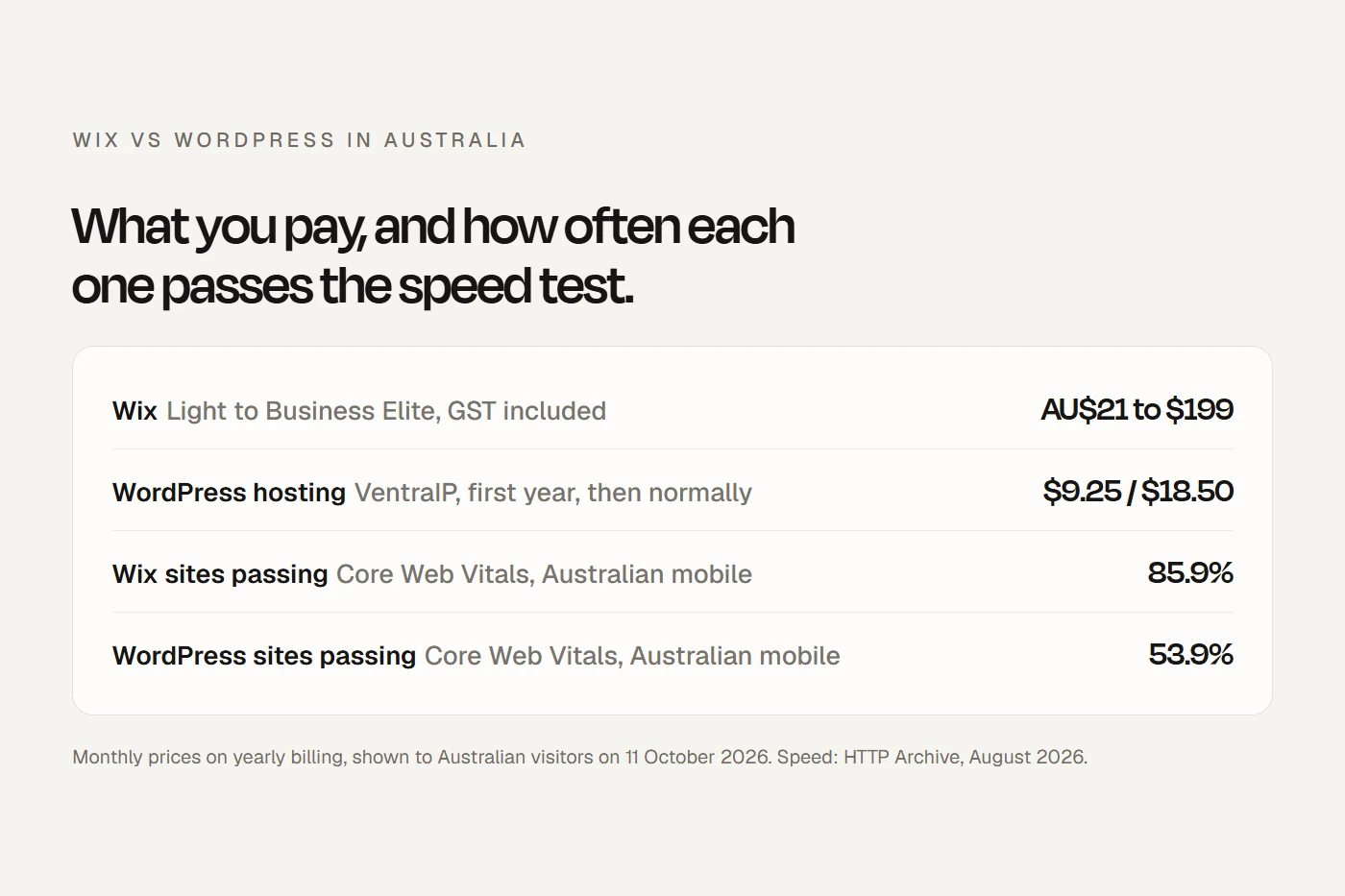
- Hosting: VentraIP's WordPress plan was $9.25 a month for the first year and $18.50 normally. Introductory and renewal prices often differ.
- A security certificate: free from Let's Encrypt, and included by most hosts.
- Updates, backups and changes: the care plans in the table above, or someone's hourly rate.
business.gov.au puts it plainly: if your website is self-hosted, "you'll need to keep your CMS and other tools up-to-date by applying the latest security patches." Someone has to do that.
Who owns your website
A website isn't one thing you own or don't. The Australian Copyright Council's position, as the ATO quotes it, is that "whole websites are not protected by copyright", but the parts are: the text, images, logos and the underlying code and files. So ask about each part on its own.
The design and code is where the default surprises people. Paying for a build doesn't, by itself, make the design yours. business.gov.au says it too: if you want your business to own it, "the contract must clearly say this."
My own position, so you can compare: your domain and content are yours from day one, and the design files and a static export of the site are yours at month 12, or as soon as the build is paid out. It's in my terms.
How to check who holds your domain
- Go to auDA's WHOIS lookup and enter your domain.
- Look at the Registrant field. It should be your business's legal name, often with your ABN or ACN as the registrant ID.
- If it's your web designer, auDA says you can ask for a correction. If you have the passwords but aren't the registrant, auDA says you're not the licence holder.
- Make sure the registrant contact email is one your business controls. That's where the code to move the domain is sent. Moving a .au domain between registrars is free.
What to check in the contract before you sign
Since 9 November 2023, the ACCC says, "proposing, using or relying on unfair contract terms in standard form contracts" is banned. Small businesses with fewer than 100 employees, or under $10 million in annual turnover, are covered for new or varied contracts. A website subscription on the provider's published terms is almost always a standard form contract. The ACCC lists the kinds of terms that may be unfair, including terms that let one party but not the other end the contract, penalise only one party for ending it, or change its terms. Its current enforcement priorities single out "automatic renewals, early termination fee clauses and non-cancellation clauses". Only a court can decide a term is unfair, but you can ask for a change before you sign.
These are the questions I'd want answered in writing. Tick them off as you go through a quote.
- How long is the minimum term, and what happens when it ends? Good answer: a stated term, then month to month or a lower rate. Watch for: silence, or a new term starting automatically.
- What does it cost to leave early? Good answer: a figure you can work out, like the unpaid part of the build. Watch for: the rest of the contract's fees regardless.
- Does it renew automatically, and how much notice do you need to give? Good answer: no, or a reminder before it does. Watch for: renewal unless you cancel in a narrow window.
- Can the price change, and can you leave if it does? Good answer: a capped rise with notice and the option to cancel first. Watch for: changes at any time with no way out.
- Whose name is the domain in? Good answer: yours. Watch for: the provider's.
- Who owns the design and code, and from when? Good answer: you, at a stated point. Watch for: nothing in writing.
- What do you get if you leave? Good answer: your content and the design files or an export. Watch for: nothing.
- What's included each month, and how many changes? Good answer: hosting, updates, backups and changes, with the fair-use limit in writing. Watch for: "maintenance" with no mention of edits.
My answers, so you can see the list in use. The minimum is the 12-month build. Leaving early means paying out the rest of the build, after which I hand over the design files and an export. Edits are included whenever you need them, within reason. The monthly care fee is fixed for 12 months, after which it can rise by up to 5% once a year, with 30 days' notice and the option to cancel first.
How the ATO treats each
The ATO has a ruling on exactly this, TR 2016/3. In summary:
- Building a website is capital expenditure, usually treated as "in-house software", which is depreciated rather than claimed as a running cost.
- Paying for a build in instalments doesn't change that. In the ruling's own example, progress payments for a build "retain their capital nature".
- Hosting, licence, domain and maintenance fees are revenue expenses, deductible over the period they cover.
- Periodic payments to lease a website from a developer are deductible as incurred, "provided the business does not also have a right to become the owner of the website."
For in-house software, the ATO says small businesses may be able to use the simplified depreciation rules, including the instant asset write-off, whose threshold changes from year to year. So how a subscription is treated depends on its terms, particularly whether you end up owning the site, as you do with mine. Your accountant can tell you how your agreement is treated. Don't assume either kind is simply deductible.
When each one is the better choice
| Your situation | Usually better |
|---|---|
| Cash on hand, and the site won't change much for three years or more | One-off build |
| You or a staff member can handle updates and small changes | One-off build |
| You already have a developer you trust | One-off build |
| You'd rather not pay thousands up front | Subscription |
| Your hours, team, prices or services change often | Subscription with edits included |
| You want one person to call when something needs changing | Subscription with edits included |
| Any situation | Get the domain in your business's name first |
Scroll the table sideways to see every column.
Questions I get asked
Is a website subscription worth it?
It can be, if you'd rather spread the cost and want changes made whenever you need them. Over three or more years a one-off build is often cheaper, if the site doesn't need much changing.
Do I own my website if I pay monthly?
It depends entirely on the contract. Some subscriptions hand over the site after a set term, some offer a paid buyout and some don't say. Get the answer in writing before you sign.
Does my web designer own my website?
IP Australia says IP created by a contractor belongs to the contractor unless the contract says otherwise. If you want to own the design, the contract needs to say so.
Whose name should my domain be in?
Your business's. auDA says the business must be the registrant, not the developer. You can check with auDA's WHOIS lookup.
What does a website care plan include?
It varies a lot. Some cover only updates, backups and security. Some include a set amount of changes each month, from 30 minutes to a few hours. Mine includes edits whenever you need them, within reason. Ask for the fair-use rule in writing.
Is a website subscription tax deductible?
Hosting and maintenance fees generally are. A build is capital, even if paid in instalments, and the ATO only treats lease payments as deductible as incurred where you have no right to become the owner. Ask your accountant how your agreement is treated.
Can a website subscription lock me in?
A minimum term is common. The ACCC's unfair contract terms rules cover small business contracts, and it's currently focused on automatic renewals, early exit fees and non-cancellation clauses.
About this guide
Written by Joseph Alzein, founder of bdog. I sell websites on subscription, so I'm one of the options described. Prices were taken from providers' own pages on 11 October 2026; I checked five studios' one-off prices, four subscription offers and three studios' care plans, and kept the pages on file, but left the businesses unnamed. Prices change. This is general information, not tax or legal advice: ask your accountant or lawyer about your own contract.
Main sources:
- ATO, TR 2016/3: deductibility of expenditure on a commercial website
- ATO: in-house software
- ATO: instant asset write-off
- ACCC: contracts and unfair contract terms
- ACCC: compliance and enforcement priorities
- auDA: third-party use of .au domain names
- auDA: how to use the .au WHOIS tool
- auDA: transfer your .au domain name
- auDA: com.au domain names
- IP Australia: who owns intellectual property
- business.gov.au: hiring contractors
- business.gov.au: set up a business website
- Copyright Agency: ownership
- VentraIP WordPress hosting and domain pricing
- Let's Encrypt
- bdog plans and prices