What a law firm website needs, and what the rules allow
A law firm’s website is advertising under the Solicitors’ Conduct Rules, and some states go further. Here are the rules for your state, a wording checker for your own copy, a homepage marked up section by section, and a page-by-page checklist.
On This Page
- The advertising rule behind every law firm website
- The rules in your state
- Check your own wording
- “Specialist”, “expert” and “we specialise in”
- A law firm homepage, marked up
- Personal injury advertising on a law firm website
- Can lawyers use testimonials and reviews?
- Prices on a law firm website
- The fine print
- Contact forms and confidential information
- What a law firm website needs: page by page
- Questions I get asked
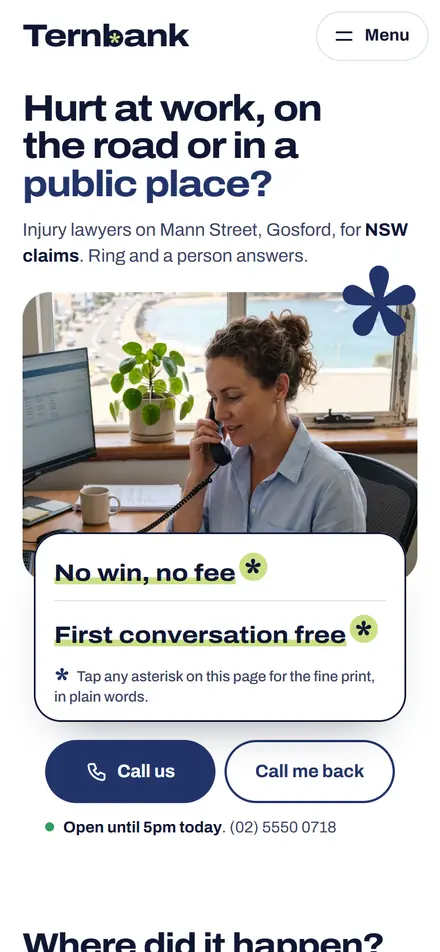
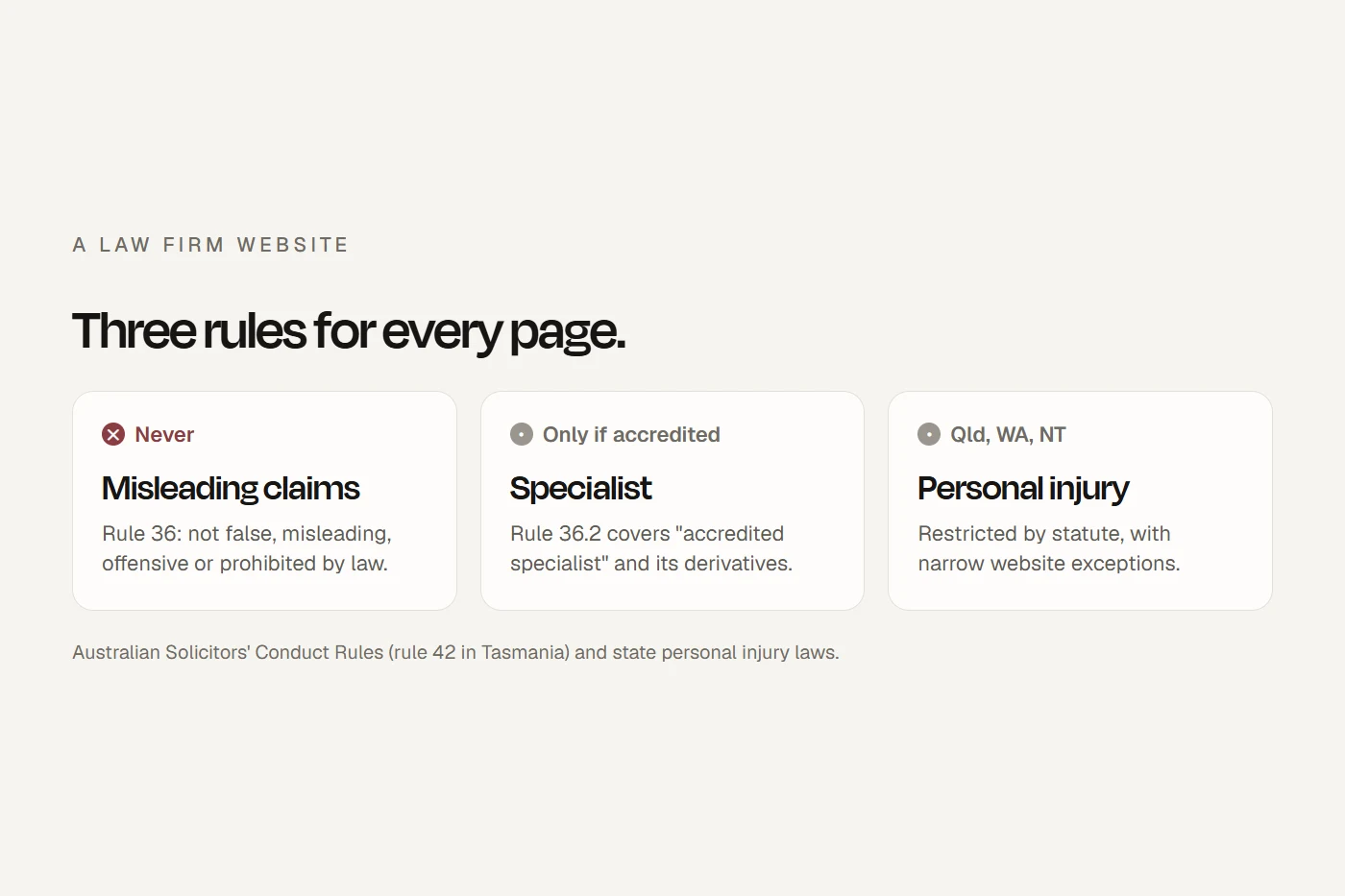
A law firm's website is advertising, so the advertising rule in the Australian Solicitors' Conduct Rules applies to every page: rule 36 in most of Australia, rule 42 in Tasmania. Nothing on it can be false, misleading or deceptive, offensive or prohibited by law, and it can't give the impression of specialist expertise unless the solicitor is accredited. Queensland, Western Australia and the Northern Territory also restrict personal injury advertising. Within those limits, a good law firm website explains each practice area in plain words, introduces your lawyers honestly, says how fees work, and makes first contact easy without collecting confidential details too early.
- Every pageNot false, misleading, offensive or prohibited by law (rule 36.1). No "specialist" unless accredited, and say who holds it (rule 36.2).
- Personal injury workRestricted by statute in Queensland, WA and the NT. In Queensland and WA your own website may only explain the law of negligence and the terms on which you act.
- The fine printYour firm name, the exact limited liability statement if you're in a scheme, a privacy policy, and a contact form that doesn't ask for the story.
I build websites for law firms, so these rules shape what I write for them. This is an explainer drawn from the rules themselves and law society guidance, not legal advice. For your own firm, check with your law society.
The advertising rule behind every law firm website
Rule 36.1 says a solicitor or principal "must ensure that any advertising, marketing, or promotion in connection with the solicitor or law practice" is not false, misleading or deceptive or likely to mislead or deceive, offensive, or prohibited by law. The obligation sits with the principal, so a page your web designer or marketing agency wrote is still yours to check. The Law Society of NSW says a breach of rule 36 is capable of being unsatisfactory professional conduct or professional misconduct.
The Australian Consumer Law applies on top, including its bans on misleading or deceptive conduct and on false or misleading representations about services. The Queensland Law Society's guidance on websites adds that information "should be accurate and up-to-date" and that claims about expertise "must avoid hyperbole".
The rules in your state
Every state and territory now has the Solicitors' Conduct Rules in some form, but the instrument, the rule number and the personal injury rules differ. Choose your state:
New South Wales
- Conduct rules
- Legal Profession Uniform Law Australian Solicitors' Conduct Rules 2015, rule 36
- Personal injury advertising
- The old ban wasn't carried into the Uniform Law, the Law Society of NSW says. Rule 36 and consumer law apply.
- Specialist accreditation
- The Law Society of NSW runs a specialist accreditation scheme.
- Costs
- A price on your website doesn't replace costs disclosure under section 174 of the Uniform Law once a client instructs you.
Victoria
- Conduct rules
- Legal Profession Uniform Law Australian Solicitors' Conduct Rules 2015, rule 36
- Personal injury advertising
- I found no specific statute. Rule 36 and consumer law apply. Check with the Law Institute.
- Specialist accreditation
- The Law Institute of Victoria's scheme requires five years in full-time practice, three in the area, an examination, and re-accreditation every three years.
- Costs
- Section 174 of the Uniform Law applies once a client instructs you.
Queensland
- Conduct rules
- Australian Solicitors' Conduct Rules 2023, rule 36 (accreditation "by the relevant professional body")
- Personal injury advertising
- Personal Injuries Proceedings Act 2002, Chapter 3 Part 1. Ads are generally limited to your name, contact details and area of practice, in allowed publications. The Queensland Law Society says personal injury advertising isn't allowed on radio, television or in cinemas.
- Your own website
- May only cover how the law of negligence works and people's rights under it, and the conditions on which you'll act. The QLS says that can include no win, no fee. The Legal Services Commission doesn't treat Facebook, Instagram or LinkedIn pages as your website.
- "Specialist"
- The Legal Services Commission treats the word "specialist" on its own as covered by rule 36.2.
Western Australia
- Conduct rules
- Legal Profession Uniform Law Australian Solicitors' Conduct Rules 2015, rule 36
- Personal injury advertising
- Civil Liability Act 2002, Part 3, restricts statements likely to encourage people to make injury claims or to use a named lawyer for them.
- Your own website
- Limited to the law of negligence and people's rights under it, and the conditions on which you'll provide personal injury services.
- Costs
- Section 174 of the Uniform Law applies once a client instructs you.
South Australia
- Conduct rules
- South Australian Legal Practitioners Conduct Rules, Part A, rule 36, worded for "legal practitioners"
- Personal injury advertising
- I found no specific statute. Rule 36 and consumer law apply. Check with the Law Society of SA.
- Limited liability statement
- South Australia is the only state whose legislation names websites, according to the Professional Standards Councils.
Tasmania
- Conduct rules
- Legal Profession (Solicitors' Conduct) Rules 2020, rule 42, "Advertising (ASCR 36)"
- Personal injury advertising
- I found no specific statute. Rule 42 and consumer law apply. Check with the Law Society of Tasmania.
Australian Capital Territory
- Conduct rules
- The ACT's version of the Australian Solicitors' Conduct Rules
- Personal injury advertising
- I found no specific statute. The conduct rules and consumer law apply. Check with the ACT Law Society.
Northern Territory
- Conduct rules
- The Australian Solicitors' Conduct Rules as adopted in the Territory
- Personal injury advertising
- Legal Profession Act 2006, Part 3.2. Statements are limited to your name, contact details and area of speciality, in listed publications.
- Your own website
- Unlike Queensland and WA, the Act has no express exception for a firm's own website. Check with the Law Society NT before publishing injury content.
Check your own wording
Paste a paragraph from your website below. It flags the words and claims that most often cause trouble, and says why. It's a first pass, not legal advice, and it can't tell whether a claim is true. That part is still yours.
"Specialist", "expert" and "we specialise in"
Rule 36.2 says a solicitor must not "convey a false, misleading or deceptive impression of specialist expertise", and must not use the words "accredited specialist" or a derivative of them, including post-nominals, unless accredited by the relevant professional association.
The everyday words are where firms slip. The Queensland Law Society says a claim "to be a specialist or to specialise is likely to be seen to be a claim to expertise", and that Queensland's Legal Services Commission treats "specialist" on its own as a derivative covered by the rule. Accreditation also belongs to the person, not the firm, so a page should say which lawyer holds it.
| Instead of | Try |
|---|---|
| Family law specialists | Family law is all we do |
| We specialise in wills and estates | Our practice areas: wills, estates and probate |
| Expert criminal defence | Criminal defence, with 15 years in the local court (if it's true) |
| Accredited specialists in family law | Jane Citizen is an Accredited Specialist (Family Law) |
Scroll the table sideways to see every column.
A law firm homepage, marked up
Below is a homepage with the kinds of lines I'd flag. It's a mockup with a made-up firm and lawyer. Some of it is fine and some of it isn't. Tap a number to see which.
The area's leading family law specialists
Separation, children and property. Guaranteed results.
Book a consultationPractice areas
No win, no fee
Our people
Accredited Specialist (Family Law)
Clients say
Fees
Wills from $350 including GST. First 30-minute consultation free.
Get in touch
Privacy policy
- The headline: change it"Leading" needs proof, "specialists" needs accreditation, and "guaranteed results" is a promise nobody can keep. All three risk rule 36. "Family law is all we do. Separation, children and property" says the same thing safely.
- Personal injury: depends on your stateIn Queensland, WA and the NT, personal injury advertising is restricted by statute. In Queensland your own site may describe the conditions on which you act, including no win, no fee. In the NT there's no website exception. Check the tabs above.
- Accreditation: keep it like thisAccreditation belongs to the person, so naming the lawyer and the area is exactly right. Just don't let it drift up into the headline as "our specialists".
- The testimonial: fine, with careLawyers can use genuine testimonials. This one is about service, de-identified, and not a claim about results. The QLS recommends the client's written consent first, and taking it down if the client later falls out with the firm.
- Fees: fine, if they're realThe ACCC says an advertised price must be the minimum total cost, and a "from" price should be one some clients actually pay. A fee on the website doesn't replace costs disclosure once a client instructs you.
- The contact form: shorten it"Tell us what happened" invites confidential details before you've run a conflict check. Ask for the type of matter only, and add a line asking people not to send details until you confirm you can act.
- The footer: something's missingIf the practice is in a Professional Standards Scheme, the exact limited liability statement belongs here, at least 8 point. The privacy policy link is right.
Personal injury advertising on a law firm website
If your firm does personal injury work, your state decides what the website can say about it. In Queensland, the Personal Injuries Proceedings Act limits a firm's own website to statements about "the operation of the law of negligence and a person's legal rights under that law" and "the conditions under which the practitioner or law practice is prepared to provide personal injury services". Western Australia's Civil Liability Act has an almost identical carve-out. The Northern Territory's Legal Profession Act limits statements to name, contact details and area of speciality, in listed publications, and has no website exception. NSW's old ban wasn't carried into the Uniform Law. For Victoria, South Australia, the ACT and Tasmania I found no specific statute, but rule 36 and consumer law still apply.
Two details catch Queensland firms. The Legal Services Commission doesn't treat Facebook, Instagram or LinkedIn pages as the firm's website, so the website exception doesn't cover them. And the Queensland, WA and NT statutes all restrict touting, so nothing on the site should read as an approach to people at hospitals or accident scenes.
Can lawyers use testimonials and reviews?
Yes. Unlike registered health practitioners, lawyers aren't banned from using testimonials. They must not mislead, under rule 36 and the Australian Consumer Law, and they mustn't breach confidentiality.
The Queensland Law Society's guidance on websites and social media says to get "the written consent of the client" first and de-identify the comments, to remove a testimonial if the client later falls out with the firm, and not to allow unmoderated client comments. Confidentiality applies to replies too: answering a Google review can disclose that the person was a client, so keep replies general.
The ACCC's rules on reviews apply to law firms like any business. Reviews written by staff or family without saying so can mislead. A business mustn't suppress or edit negative reviews. Any incentive must apply whether the review is positive or negative and be clearly disclosed. And if you show a star rating, show how many reviews it's based on.
Prices on a law firm website
Some firms publish fixed fees for wills, conveyancing or a first consultation. The ACCC says an advertised price must be the minimum total cost as a single figure, including taxes and unavoidable fees, and accepts a "from" price only where the extra can't be worked out in advance. So "Wills from $350" should be a price some clients actually pay, GST included where you're advertising to consumers. A price on your website doesn't replace your costs disclosure once a client instructs you, under section 174 of the Uniform Law in NSW, Victoria and WA. Other states have their own costs rules, so check yours.
The fine print
Your firm name. The Uniform Legal Practice (Solicitors) Rules require the firm or business name on all written communications in the course of legal practice. Whether a website counts isn't spelled out, so show the full name clearly, in the footer at least.
The limited liability statement. If your practice is in your law society's Professional Standards Scheme, the Professional Standards Councils say the exact words are below, in a font no smaller than Times New Roman 8 point. Websites are named in the legislation only in South Australia, but the Councils say it's prudent to include it on websites everywhere. It isn't needed on social media. The Councils say you must use the prescribed statement, and that failing to disclose can mean you're not covered by the scheme.
Liability limited by a scheme approved under Professional Standards Legislation.A privacy policy. Australian Privacy Principle 1 requires organisations covered by the Privacy Act to have a clearly expressed, up-to-date privacy policy. Even if your firm is under the small business threshold, publishing one is simple.
Contact forms and confidential information
A contact form can create a problem a phone call usually doesn't. The Law Society of NSW's professional standards team wrote in the Law Society Journal that a prospective client can become a former client "if the person has disclosed confidential information during that conversation", which can stop the firm acting against them in a related matter. The Queensland Law Society warns that an unintended solicitor-client relationship can also be created on social media.
No law society prescribes form wording that I could find, but the good practice follows from that. Ask only for a name, contact details and the type of matter. Add a line like "Please don't send details of your matter until we've confirmed we can act for you." Run a conflict check before the first real conversation.
What a law firm website needs: page by page
People with a legal problem go online early. The Victoria Law Foundation's 2023 survey of more than 6,000 Victorians found almost half of those with legal problems turned to the internet for support. The rules above limit what you can claim, not what you can explain, and explaining is what a nervous client wants. Tick off what your site already has; the list remembers your progress on this device.
- A page for each practice area In plain words: what the matter involves, what you do, and what happens first.
- Your lawyers Real experience, and any accreditation stated precisely, against the person who holds it.
- How you charge Fixed fees where you offer them, and what the first appointment costs.
- Where and when Your address, hours, and whether you see clients by phone or video.
- A short contact form Name, contact details, type of matter, and the confidentiality line.
- Personal injury pages checked against your state's statute Queensland, WA and the NT especially.
- Every "specialist", "expert" and "leading" checked Run your pages through the wording checker above.
- Testimonials with consent Written consent, de-identified, and nothing about results you can't stand behind.
- The firm name in the footer Your full firm or business name.
- The limited liability statement, if you're in a scheme Exact wording, at least 8 point.
- A privacy policy Linked from every page.
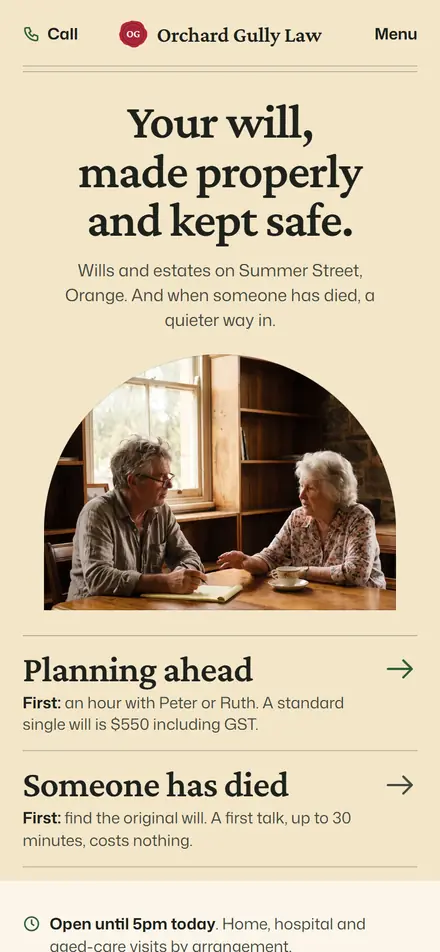
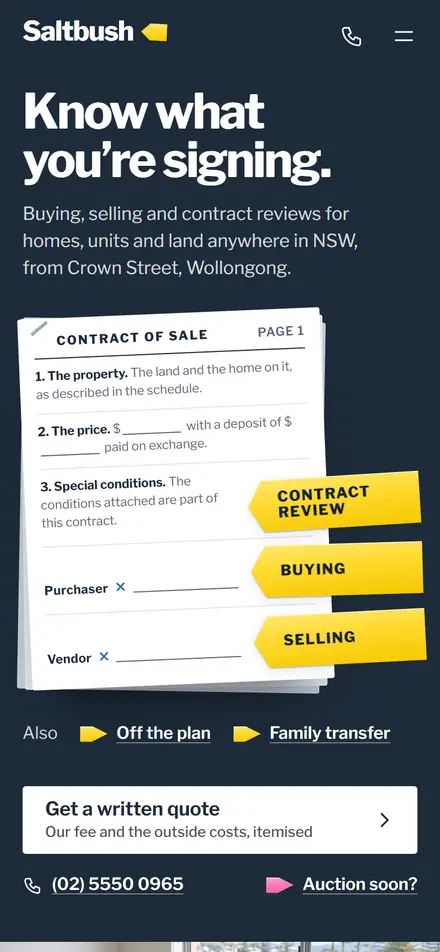
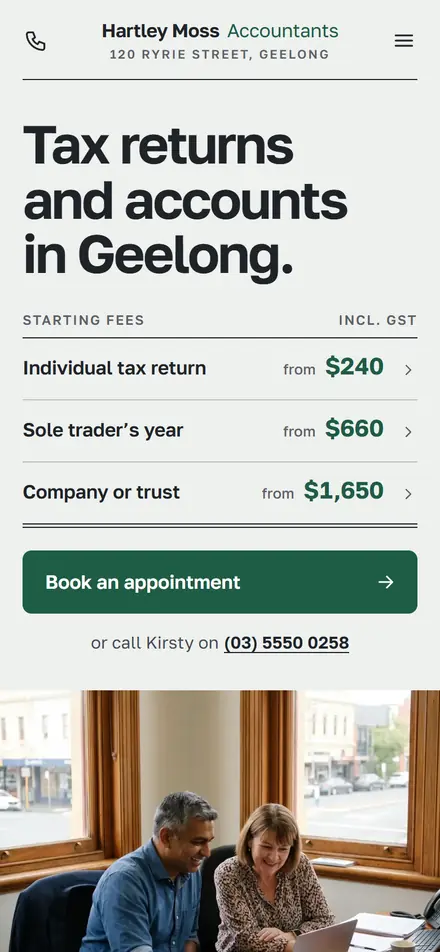
My page on law firm website design shows how that looks on a real layout, and there are pages for family law, personal injury, criminal law, wills and estates and conveyancers.
Questions I get asked
What should a law firm website include?
A page for each practice area in plain words, your lawyers and their real experience, how you charge, where and when you see clients, a short contact form, your firm name, the limited liability statement if you're in a scheme, and a privacy policy.
Can lawyers advertise in Australia?
Yes. Advertising must not be false, misleading or deceptive, offensive or prohibited by law, under rule 36 of the Australian Solicitors' Conduct Rules (rule 42 in Tasmania). Personal injury advertising is restricted in Queensland, WA and the NT.
Can a law firm use client testimonials?
Yes, if they're genuine and not misleading. The Queensland Law Society recommends the client's written consent and de-identified comments, and removing a testimonial if the client later falls out with the firm.
Can I call myself a specialist?
Only if you're accredited by the relevant professional association. Rule 36.2 covers derivatives of "accredited specialist", and Queensland's Legal Services Commission treats "specialist" on its own as one.
Can personal injury lawyers advertise no win, no fee?
It depends on the state. In Queensland your own website may describe the conditions on which you act, which the Queensland Law Society says can include no win, no fee. Check your state's rules first.
Does a law firm website need the "liability limited" statement?
If your practice is in a Professional Standards Scheme, the Professional Standards Councils say it's prudent to show the exact statement on your website, at least 8 point.
Should a law firm put prices on its website?
It can. The ACCC says an advertised price must be the minimum total cost, and a "from" price is only acceptable where the extra can't be known in advance. It doesn't replace costs disclosure once a client instructs you.
About this guide
Written by Joseph Alzein, founder of bdog. I build websites for law firms. Sources were checked on 11 October 2026; the rules are amended from time to time, so check the current version. This is general information, not legal advice. For your firm, check with your law society or legal services regulator.
Main sources:
- Legal Profession Uniform Law Australian Solicitors' Conduct Rules 2015 (NSW Legislation)
- Law Council of Australia: Australian Solicitors' Conduct Rules
- Queensland Law Society: Australian Solicitors' Conduct Rules
- Legal Profession (Solicitors' Conduct) Rules 2020 (Tas)
- South Australian Legal Practitioners Conduct Rules
- Law Society of NSW: advertising legal services
- Law Society of NSW: specialist accreditation
- QLS: advertising as a specialist or expert
- QLS: advertising for personal injury work
- QLS Guidance Statement No. 24: social media and law practice websites
- Personal Injuries Proceedings Act 2002 (Qld)
- Civil Liability Act 2002 (WA)
- Legal Profession Act 2006 (NT)
- Law Institute of Victoria: accredited specialists
- Professional Standards Councils: disclosing your liability
- Professional Standards Councils: limited liability disclosure factsheet
- LSJ: who is considered a former client
- ACCC: online reviews
- ACCC: price displays
- OAIC: Australian Privacy Principles
- Victoria Law Foundation: Public Understanding of Law Survey