What a mortgage broker website must show
The licence line, the credit guide, comparison rates, the words ASIC and the Act rule out, complaints and privacy, set out for brokers, with a footer builder and a phrase checker.
On This Page
A mortgage broker's website is advertising credit, and that brings rules most website templates ignore. The licence line has to be written a particular way. Any interest rate needs a comparison rate and a set warning. Some words are banned outright for commission-paid brokers. And ASIC's advertising guide now has broker examples throughout. This guide sets out what a broker's site should show and what it shouldn't say, with a footer builder and a phrase checker.
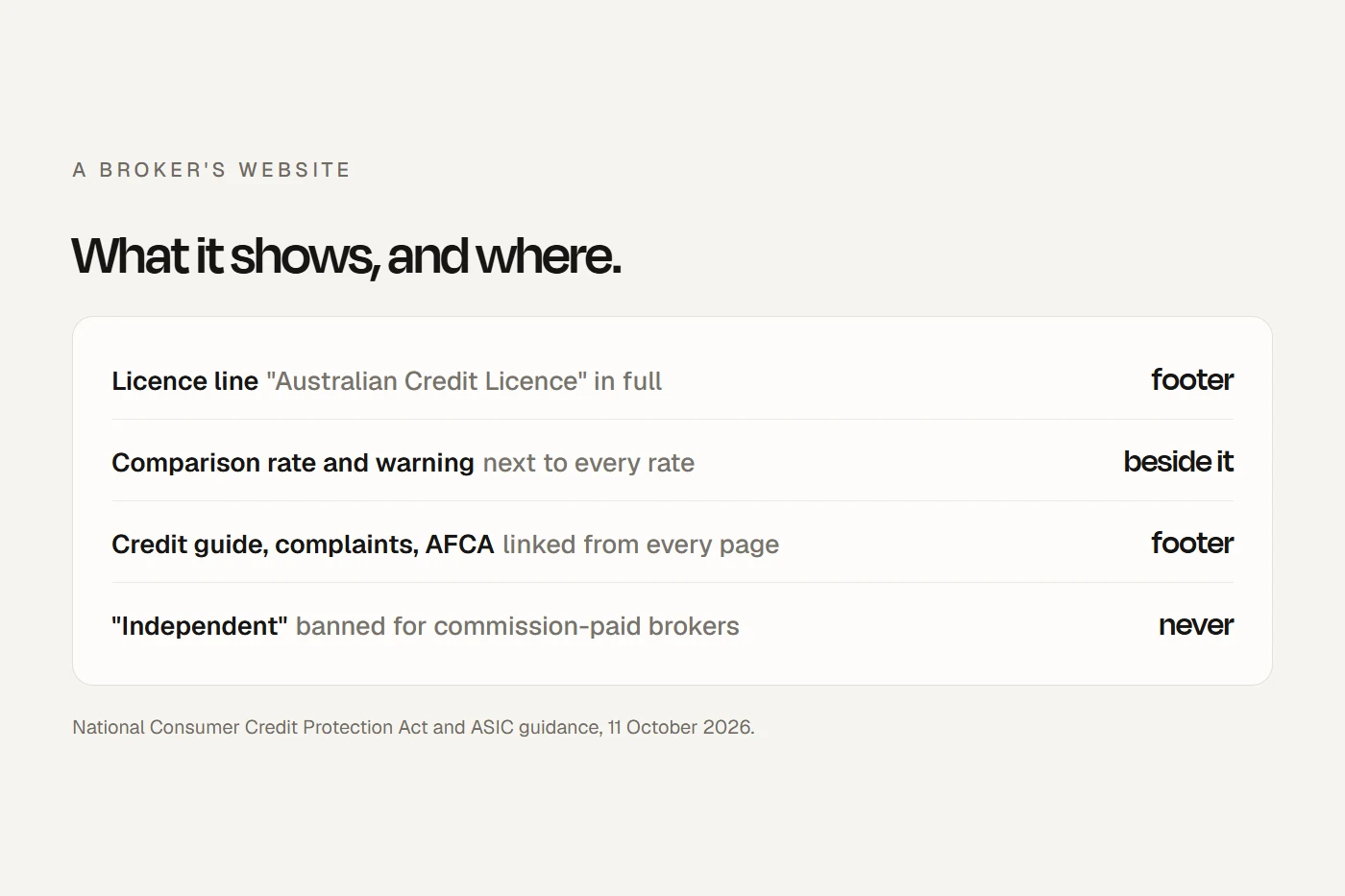
- In the footerWho you are and whose licence you work under, with "Australian Credit Licence" written in full, plus links to your credit guide, complaints policy and privacy policy.
- Next to any rateThe comparison rate, as prominent as the rate, with the product name, the $150,000 over 25 years basis and the prescribed warning.
- Never on the page"Independent", "unbiased", "guaranteed approval", "100% success rate", or "licensed" if you're a credit representative.
I build websites for mortgage brokers. I'm not a lawyer and this is general information, not legal advice; your licensee's compliance team has the final say on your advertising. Everything below comes from the National Consumer Credit Protection Act, its regulations, ASIC's regulatory guides, AFCA and the MFAA, read on 11 October 2026.
Your licence line
The Act requires a credit licensee to include its Australian Credit Licence number in certain documents, including "a printed advertisement that relates to the provision of credit". ASIC is specific about the wording: "'Australian credit licence 12345'. It is not sufficient to only use an abbreviated form, such as 'ACL 12345'." After the first full mention, the short form is fine.
Whether a webpage counts as a "printed advertisement" isn't settled; I couldn't find ASIC saying either way. It doesn't matter much in practice. Your credit guide must carry the number, licensees expect the licence line on your site, and Moneysmart tells consumers to check a broker on ASIC's register before meeting them. So put it in the footer, on every page.
Most brokers are authorised credit representatives under an aggregator's licence. Two things follow:
- Don't call yourself "licensed". The Act says a person must not hold out "that the person holds a licence" if they don't. "Authorised credit representative of [your licensee]" is the accurate phrase.
- Show your credit representative number. It's required in your own credit guide, and I'd put it next to the licence line so clients can match you to the register.
Build your footer
Check the exact wording with your licensee. Many aggregators have their own required wording and approve advertising before it goes live.
Your credit guide
The credit guide is a document you must give each client before you provide credit assistance: the licensee's guide under section 113, and as a credit representative, your own under section 158 (or one combined document). It covers your name, contact details and numbers; fees; the lenders you deal with (up to six named); the commissions you're likely to receive, with estimates; and how to complain, including AFCA's details.
Putting it on your website as a PDF is common and sensible, but posting it doesn't count as giving it. The regulations let you give it electronically only with the client's consent, by making it available and "promptly notifying the consumer" that it's there. So: a saveable, printable PDF linked from your footer, and a link sent to each client with their OK to receive documents electronically. Keep it current; an out-of-date guide on your site is worse than none.
Key Facts Sheets are the lender's job, not yours. The Act's website requirement applies to licensees whose own home loans are offered.
Showing interest rates
The National Credit Code applies to anyone who publishes "an advertisement in any form or medium that states or implies that credit is available", so it applies to a broker's site as much as a lender's. If you show an interest rate:
- Show the comparison rate, identified as a comparison rate, and "not less prominent" than the interest rate or any repayment figure.
- Say what it's based on. The product name, and for home loans, $150,000 over 25 years.
- Add the warning immediately after it, in the prescribed words. Online, if the rate is in text, the comparison rate and warning must be in text too.
- Don't hide it. ASIC says a comparison rate isn't prominent enough if it's smaller or faded, or if someone has to click or hover to see it.
- Introductory rates: state the discount period with equal prominence, and what the rate reverts to.
The short form of the warning, word for word from the regulations:
WARNING: This comparison rate is true only for the examples given and may not include all fees and charges. Different terms, fees or other loan amounts might result in a different comparison rate.A lender's rate on your site also has to match the lender's current details. ASIC's guide says brokers promoting a lender's product should make sure the features "match the current product information". Rates you don't keep updated are a liability; I'd show rates only if someone owns updating them.
Words and claims to avoid
The Act bans "independent", "impartial" and "unbiased" (and terms of similar meaning) for anyone who receives commissions from lenders, and bans "financial counsellor". ASIC's current advertising guide adds a long list of broker examples: it says ads "should not use terms such as 'guaranteed acceptance' or 'pre-approved'", that a broking firm's "100% success rate" claim "may be misleading because it suggested that credit will be provided to all applicants", and that a broker who "only ever considers one or two main lenders" shouldn't advertise a "wide range of lenders". Paste your website copy below to check it.
Complaints and AFCA
Licensees must have an internal dispute resolution process and be AFCA members; credit representatives must be AFCA members too, and their complaints are covered by their licensee's process. ASIC's guide says a firm's complaints policy "should appear on the firm's website in an accessible location", explaining how to complain, the help available, the steps, timeframes and how to reach AFCA. If you're an MFAA member, its Code of Practice requires your complaints policy and AFCA information to be "posted on the Member's website".
AFCA publishes the wording it recommends, including its free call number, 1800 931 678. Its logo rules are strict: use the logo only "in conjunction with our contact details", never as a trust badge or in a way that "implies endorsement".
Privacy
You'll collect payslips, tax returns and ID, so you need a privacy policy whether or not the Privacy Act strictly applies to you. A broker turning over less than $3 million isn't automatically covered just for being a broker, but paid referrals of client details can bring a small business under the Act, and your licensee will almost certainly require a policy anyway. The Act's list of what a privacy policy covers: what you collect and how, why, how people can access and correct it, how to complain, and whether information goes overseas and where. The last one matters if you use offshore processing.
Reviews and testimonials
Testimonials aren't banned for brokers, but the ASIC Act reverses the usual onus: a testimonial "is taken to be misleading unless evidence is adduced to the contrary". So use only real ones you can prove. ASIC also says that if someone posts a comment on your website or Facebook page and you leave it up once you know about it, you're responsible for it from then on. A review saying "they guaranteed my approval" becomes your claim.
The checklist
- Licence line in the footer, with "Australian Credit Licence" in full and your credit representative number.
- "Authorised credit representative of", not "licensed", if you work under someone else's licence.
- Credit guide as a current, printable PDF, linked from the footer.
- Complaints page with how to complain, timeframes and AFCA's details.
- AFCA logo only beside AFCA's contact details.
- Every rate with its comparison rate, product name, $150,000 over 25 years and the warning, as prominent as the rate.
- Introductory rates show the period and the revert rate.
- No banned words and no approval, success-rate or best-rate promises.
- Lender panel claims match what you actually use.
- Calculators state their assumptions.
- Testimonials real and provable, and misleading comments removed.
- Privacy policy covering what you collect, why, access, complaints and overseas disclosure.
- MFAA or FBAA logos only while you're a member, and never ASIC's.
- Your licensee has approved the site.
What clients actually want to know
Moneysmart gives consumers a list of questions to ask a broker, including "Do you offer loans from a range of different lenders? What kind of lenders can't you access?", "How do you get paid for the advice you're giving me?" and "Can you show me a couple more options, including one with the lowest cost?" A broker site that answers those plainly, before anyone asks, does more for trust than any badge. The commission one especially: the honest answer, "the lender pays us, and we have to act in your best interests", is also the compliant one.
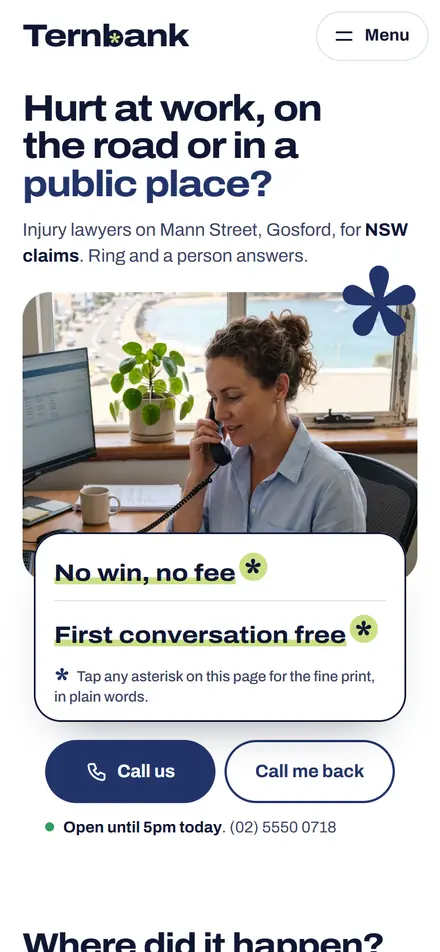
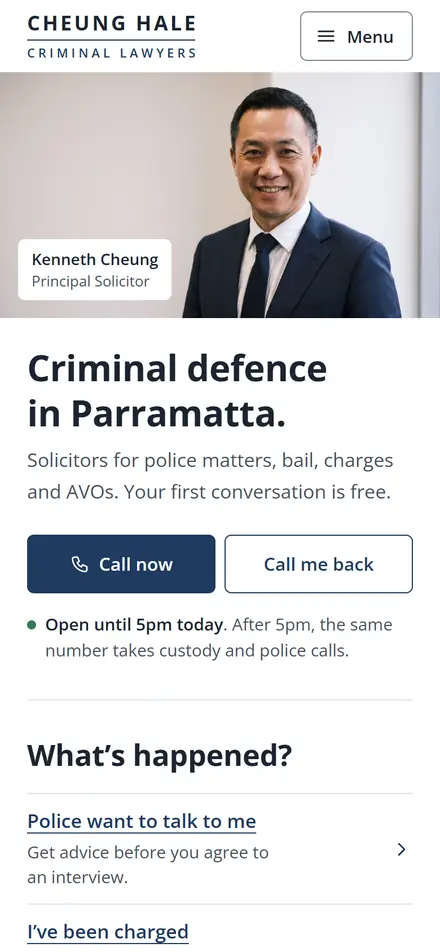
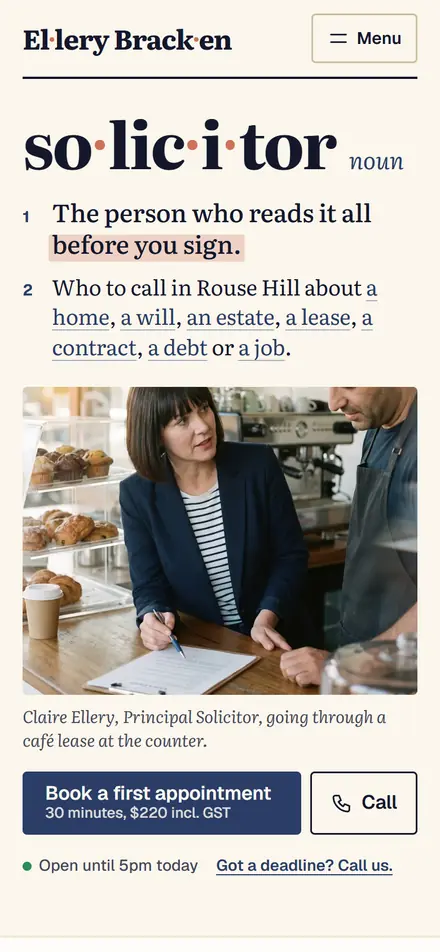
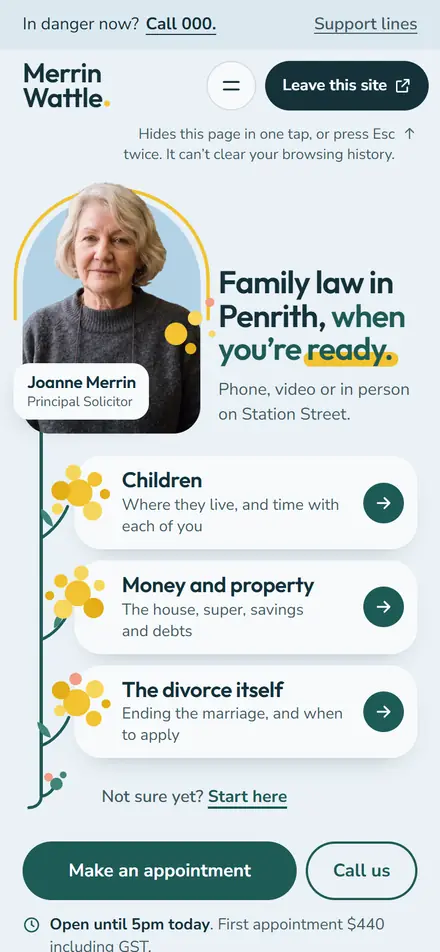
My mortgage broker websites page shows how I lay that out.
Questions I get asked
Does a mortgage broker need their licence number on their website?
The Act requires the licence number in printed credit advertising and in the credit guide; whether a webpage is a printed advertisement isn't settled. Licensees expect the licence line on the site, written as "Australian Credit Licence" in full.
Can I put my credit guide on my website?
Yes, as a saveable PDF, but you still have to give it to each client. Electronic delivery needs the client's consent and a notice that it's available.
Do mortgage brokers have to disclose commissions?
Yes. The credit guide must estimate the commissions you're likely to receive, and when you recommend a loan you must give a disclosure of the commission on that loan.
Can a mortgage broker call themselves independent?
Not if they receive commissions from lenders. The Act bans "independent", "impartial" and "unbiased" in that case.
What comparison rate warning do I need?
The prescribed short or long warning, immediately after the comparison rate. The short one begins "WARNING: This comparison rate is true only for the examples given".
Do I need a complaints policy on my website?
ASIC says a firm's complaints policy should appear on its website, and the MFAA Code requires members to post it with AFCA's details.
About this guide
Written by Joseph Alzein, founder of bdog. I build websites for mortgage brokers. Everything here comes from the National Consumer Credit Protection Act and Regulations, the National Credit Code, ASIC's regulatory guides and information sheets, AFCA and the MFAA, read on 11 October 2026. Your licensee's compliance requirements come first. This is general information, not legal advice.
Main sources:
- National Consumer Credit Protection Act 2009
- National Consumer Credit Protection Regulations 2010
- ASIC: FAQs, getting a credit licence
- ASIC: responsible lending disclosure obligations
- ASIC RG 234: advertising financial products and services
- ASIC RG 273: mortgage brokers, best interests duty
- ASIC RG 271: internal dispute resolution
- AFCA: telling your customers about AFCA
- MFAA Code of Practice
- Privacy Act 1988
- ASIC Act 2001
- Moneysmart: using a mortgage broker