What a recruitment agency website needs
Candidates and clients want opposite things from your site, and the rules most agency sites ignore: labour hire licensing, job ad discrimination, candidate privacy and SEEK’s terms. With a state picker and a job ad checker.
On This Page
A recruitment agency's website has two audiences who want opposite things. Candidates want to find a job and apply in a minute. Clients want to know you understand their industry and can fill the role. On top of that sit rules most agency sites ignore: labour hire licensing in four states and territories, discrimination law that reaches the agency that writes the ad, privacy obligations for every resume you collect, and SEEK's terms about linking back to your own site. This guide covers what the site needs and what the rules say.
- Two front doorsA clear path for candidates (jobs, apply, job alerts) and one for clients (what you recruit for, your consultants, how to brief you).
- Your jobs on your own domainEach job as its own page on your site, fed from your recruitment software, and taken down when it's filled.
- The rulesA labour hire licence in Queensland, Victoria, South Australia and the ACT if you supply workers you pay. South Australia requires your licence number on your ads. And a privacy policy, because most agencies are covered by the Privacy Act whatever their size.
I build websites for recruitment agencies. I'm not a lawyer, and this is general information, not legal advice. Everything here comes from the labour hire Acts and regulators, the Australian Human Rights Commission, the Fair Work Ombudsman, the OAIC, SEEK's terms and Google's documentation, read on 11 October 2026.
Two audiences, two paths
Most agency homepages try to speak to both at once and end up clear to neither. I'd split them from the first screen:
- For candidates: search jobs, a short apply form, job alerts by email, and what happens after they apply.
- For clients: the industries and roles you recruit for, a page for each consultant with their specialty, how your fees work in plain terms, and a short brief form.
The client side is where your own site earns its keep. Candidates mostly find jobs on SEEK and LinkedIn; clients deciding whether to trust you with a role will look you up.
Getting your jobs onto your site
Your recruitment software can usually publish jobs to your website. The way it does it matters: a hosted careers page or an embedded frame lives on the software company's domain or inside a box, while a feed or API lets each job be a real page on your own domain.
| Software | How jobs reach your website |
|---|---|
| JobAdder | Four ways: a hosted careers page, a JavaScript widget, an XML job feed or the API. JobAdder says all four "update every 15 minutes". The hosted page has "Minimal customisation"; the feed and API need a developer but give you full control |
| Bullhorn | An open-source career portal you host, with extra features like a job feed in its advanced hosting setup |
| Vincere | Jobs marked public go to your Vincere job board and jobs page through Vincere Engage |
| Loxo | Point your "Open Positions" page at your Loxo careers page, embed it, or use its API |
Scroll the table sideways to see every column.
Take filled jobs down. Queensland's code for private employment agents bans publishing false information about "the nature or availability of any work", and a site full of closed roles reads badly to candidates and clients alike.
A note on Google's job search
You'll read that adding job posting markup gets you into "Google for Jobs". Google's own documentation lists the regions where its job search experience is available, and Australia isn't on the list. The markup is cheap to add and harmless, and Google's rules for it are good discipline (no fake or expired jobs, one job per page), but don't expect it to put your jobs in a special Google panel here.
SEEK and your website
SEEK's Australian advertising terms say "You are not permitted to insert links to an external website or an externally hosted application form" within a job ad. Candidates apply through SEEK's own form unless SEEK sets your account up to link out, and SEEK says hirers "are not configured to link out by default". So your website won't get traffic from your SEEK ads directly. It gets candidates who look you up after seeing an ad, and the job alert subscribers you own.
Labour hire licensing
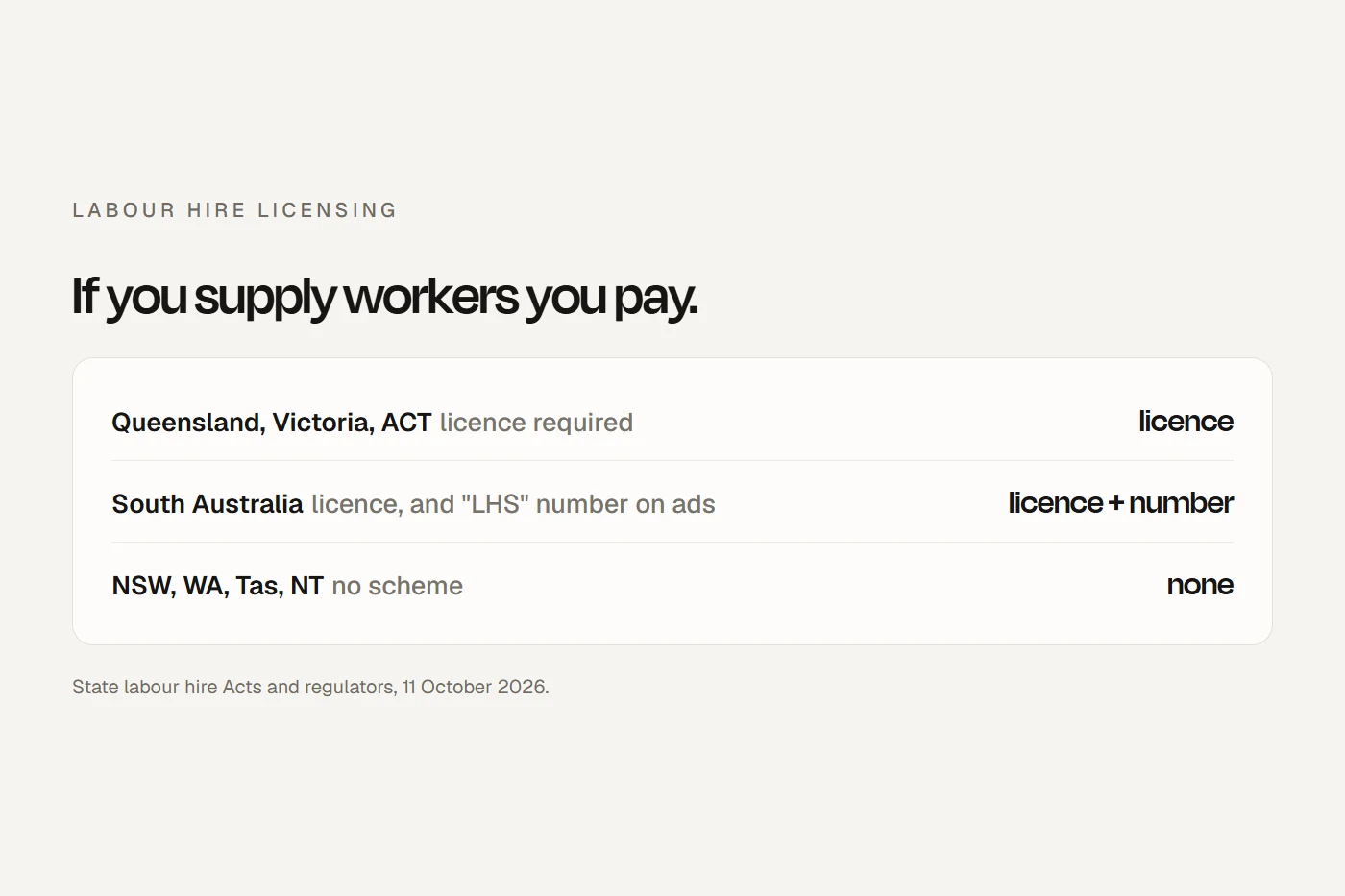
If you supply workers to clients and you pay them (temp, contract and on-hire work), four states and territories require a labour hire licence, and three of them prohibit advertising labour hire services without one. A permanent placement where the client employs and pays the candidate directly is generally not labour hire, but Victoria has widened its definition. Pick your state.
Queensland
- Licence
- Required to provide labour hire services, under the Labour Hire Licensing Act 2017
- Advertising
- "A person must not advertise, or in any way hold out, that the person provides or is willing to provide labour hire services, unless the person is the holder of a licence"
- Recruiters
- The Act says a person isn't providing labour hire "merely because" they're a private employment agent, which Queensland regulates separately, including a ban on false information about work
Victoria
- Licence
- Required, under the Labour Hire Licensing Act 2018
- Advertising
- Advertising or holding out without a licence is prohibited. The regulator counts "an active website promoting services" and social media posts as advertising, and says advertising must stop if a licence lapses at renewal
- Recruiters
- The definition now includes recruitment or placement businesses that also arrange accommodation for the workers, and contractor management services
South Australia
- Licence
- Required, under the Labour Hire Licensing Act 2017, now in all industries
- Advertising
- Advertising or holding out without a licence is an offence
- Your licence number
- The only state that requires it. An advertisement for labour hire services must show "the licence number preceded by the letters "LHS"" next to your name or contact details. Your website counts
Australian Capital Territory
- Licence
- Required, under the Labour Hire Licensing Act 2020
- Advertising
- It's an offence to falsely represent that you hold a labour hire licence. The Act's own example is a hirer who saw an ad on social media with nothing in it to prompt a licence check
NSW, WA, Tasmania and the NT
- Licence
- No labour hire licensing scheme. Governments have endorsed principles for making state schemes consistent, but there's no national licence
Even where it isn't required, I'd put your licence number in the footer if you hold one. Hosts can check it against the public register, and the ACT's example shows why they might.
Job ads: discrimination and pay
The Australian Human Rights Commission says the federal Sex Discrimination Act "specifically covers employment agencies and recruitment companies", and liability can extend to "the employment agency or recruitment company that drafts and places the advertisement". It also says recruiters "must not follow through with discriminatory requests from an employer", and gives the example of an agency that might be liable for following a client's instruction not to send "anyone with an accent".
On pay, the Fair Work Ombudsman prohibits ads with pay rates below the minimum the role is entitled to, and piecework ads must state the periodic rate or say one applies. Nothing I found requires stating pay in an ad. Paste a job ad below to check it.
Candidates' personal information
Small businesses under $3 million turnover are usually exempt from the Privacy Act, but the OAIC says a business is covered regardless of turnover if it discloses personal information "for a benefit, service or advantage". An agency paid a fee for putting a candidate forward looks a lot like that, so I'd assume the Act applies to you. The OAIC also says the employee records exemption "will not apply" to unsuccessful job applicants and is "unlikely to apply" to recruitment providers.
What that means on your website:
- A privacy policy linked from every apply form, and a short note at the resume upload saying who'll see the resume and whether it's stored overseas.
- Ask only what the role needs. The OAIC's guidance gives the example of requiring applicants to disclose an unrelated work injury as collection that wasn't reasonably necessary.
- Consent before sending a resume to a client, and for police or background checks, since criminal record is sensitive information.
- A retention period for unsuccessful applicants. The Privacy Act requires destroying or de-identifying information you no longer need.
- Job alerts with real consent. The Spam Act needs consent before marketing emails, a working unsubscribe honoured within 5 working days, and you can't email people to ask for consent.
Promises about your service
If you're an RCSA member, its code says members "exercise care to fulfil any value promise they have made or promoted", and defines a value promise as any representation that your services are "of a particular standard, quality, value or grade". So "we fill roles in seven days" is a promise you should be able to keep. Consumer law says the same in general terms.
The checklist
- Two clear paths on the homepage: candidates and clients.
- Each job as its own page on your domain, fed from your recruitment software.
- Filled and expired jobs removed promptly.
- Consultant pages with each person's specialty.
- A short client brief form.
- Labour hire licence number in the footer, as "LHS" plus the number if you're licensed in South Australia.
- A privacy policy and collection notice at every apply form and resume upload.
- Consent to send resumes to clients and for background checks.
- A retention period for unsuccessful applicants.
- Job alerts with an unticked consent box and a working unsubscribe.
- Job ads checked for discriminatory wording and below-minimum pay.
- Service promises you can actually keep.
My recruitment agency websites page shows how I lay out the two paths.
Questions I get asked
Do I need a labour hire licence for my recruitment agency?
If you supply workers you pay to clients in Queensland, Victoria, South Australia or the ACT, generally yes. Permanent placements where the client employs the candidate are generally not labour hire, though Victoria now includes some recruitment businesses that also arrange accommodation.
Do I have to show my labour hire licence number on my website?
In South Australia, yes: ads for labour hire services must show the licence number, preceded by "LHS", next to your name or contact details. The Queensland, Victorian and ACT Acts don't require it, but it helps hosts check you.
Is it worth having our own website if we advertise on SEEK?
Yes, mainly for clients and for candidates who look you up. SEEK's terms don't let you link to your website from a SEEK ad, so your site does the work SEEK can't: showing clients your specialty and building your own job alert list.
Can I add Google for Jobs markup to my job pages?
You can, but Google doesn't list Australia among the regions where its job search experience is available.
Can a recruitment agency be liable for a discriminatory job ad?
Yes. The Australian Human Rights Commission says liability can extend to the agency that drafts and places the ad, and that agencies must not follow discriminatory requests from clients.
Does the Privacy Act apply to small recruitment agencies?
Very likely. The OAIC says businesses that disclose personal information for a benefit are covered regardless of turnover, and the employee records exemption is unlikely to apply to recruiters.
About this guide
Written by Joseph Alzein, founder of bdog. I build websites for recruitment agencies. Everything here comes from the labour hire Acts and regulators, the Australian Human Rights Commission, the Fair Work Ombudsman, the OAIC, ACMA, SEEK's terms and Google's documentation, read on 11 October 2026. Labour hire law is changing, so check with your state's regulator. This is general information, not legal advice.
Main sources:
- Labour Hire Licensing Act 2017 (Qld)
- Labour Hire Licensing Act 2018 (Vic)
- Labour Hire Authority: advertising rules
- Labour Hire Licensing Act 2017 (SA)
- Labour Hire Licensing Act 2020 (ACT)
- Private Employment Agents Code of Conduct (Qld)
- AHRC: writing recruitment advertisements
- AHRC: preventing discrimination in recruitment
- Fair Work Ombudsman: job ads
- OAIC: small business
- OAIC: employee records exemption
- ACMA: avoid sending spam
- SEEK advertising terms
- SEEK: application methods
- Google: job posting structured data
- JobAdder: job posting
- Bullhorn: open source career portal
- RCSA Code of Professional Conduct