What an insurance broker website needs (FSG, warnings, quotes)
Which rules reach your book, the two words to get right everywhere, the Financial Services Guide as a web page, the general advice warning, quote tools that turn into personal advice, and following up without hawking. With a retail quiz, a wording checker and a weighted checklist.
On This Page
- Who buys through brokers
- First, which rules apply to you
- The words you can and can’t use
- The Financial Services Guide on your website
- The general advice warning
- Quote forms and tools
- Following up: the hawking ban
- Complaints, the Code and how you’re paid
- Check your wording
- How does your website score?
- Broking software and your website
- My view
- Questions I get asked
An insurance broker's website sits under more financial services law than most broker websites show: the restricted words, the Financial Services Guide, the general advice warning, quote tools that turn into personal advice, and the hawking ban on following up. Much of it applies only to "retail" clients, and for general insurance that definition is narrower than most people think, so the first job is working out which rules reach your book. This guide is for a general insurance broking business, whether you hold your own licence or are an authorised representative of a network. It goes element by element through what the site must and mustn't say. It's from the Corporations Act and Regulations, ASIC's regulatory guides and information sheets, the Insurance Brokers Code of Practice, and NIBA and Vero's research, read on 12 October 2026. It's general information, not legal advice; your licensee's compliance team has the final say.
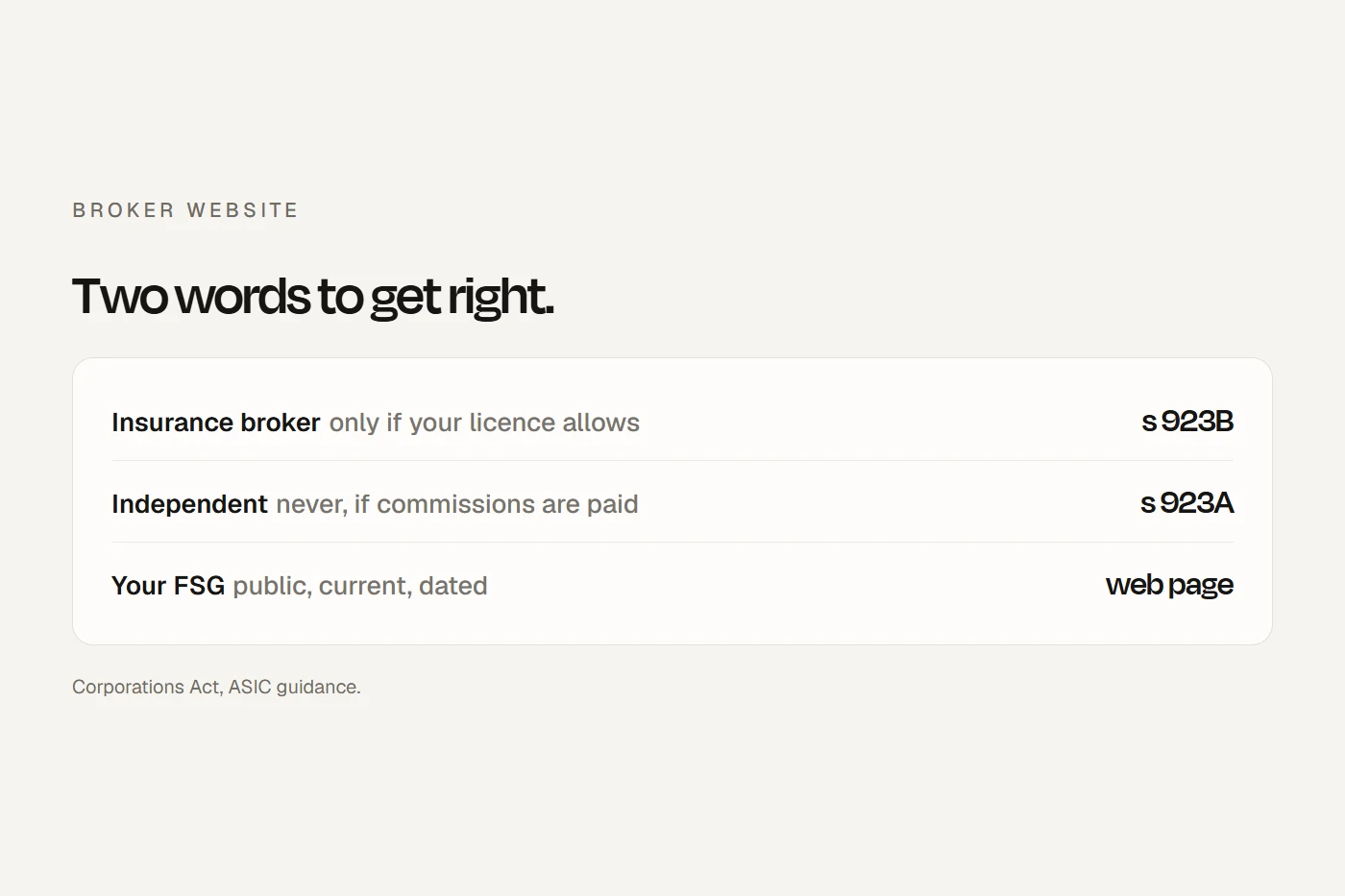
- Two words to get right everywhere"Insurance broker" only if your licence (or your licensee's) authorises it. "Independent" never, if commissions are paid.
- Your FSG can be a web pageIf it is, it must be public, current, show when it was last updated, and be the version your licensee authorised.
- Keep quote tools generalA tool that asks detailed questions and lands on "the right policy for you" is personal advice, whatever the warning says.
Who buys through brokers
NIBA's research says nearly half of all general insurance premium in Australia goes through a broker, SMEs are the biggest group of broker clients, and most brokerages hold their own licence. Vero's survey of businesses adds the other side: about one in five businesses use no broker, and most of the rest buy some cover through a broker and some direct. The businesses that skip brokers mostly say they can do it themselves, don't want a middleman, think a broker costs more, or worry brokers recommend the policy with the biggest commission. Those are the objections your website has to answer: what you do that they can't, and how you're paid.
First, which rules apply to you
For general insurance, a client is a retail client only if they're an individual or a small business (fewer than 20 employees, or 100 for a manufacturer) and the policy is one of eight types: motor vehicle, home building, home contents, sickness and accident, consumer credit, travel, personal and domestic property, or medical indemnity. Public liability, business packs and professional indemnity aren't on the list. For those, the Financial Services Guide, the general advice warning, the PDS, design and distribution obligations, the hawking ban and the commission consent rules don't apply. The restricted words, misleading conduct rules, the Spam Act and the Code still do.
The words you can and can't use
"Insurance broker"
Section 923B of the Corporations Act restricts "insurance broker", "insurance broking", "general insurance broker" and words of like import. You can use them only if the conditions on your licence, or your licensee's, authorise it, and ASIC authorises them only for licensees that act on behalf of intending insureds. An agent of one insurer can't call itself a broker.
"Independent"
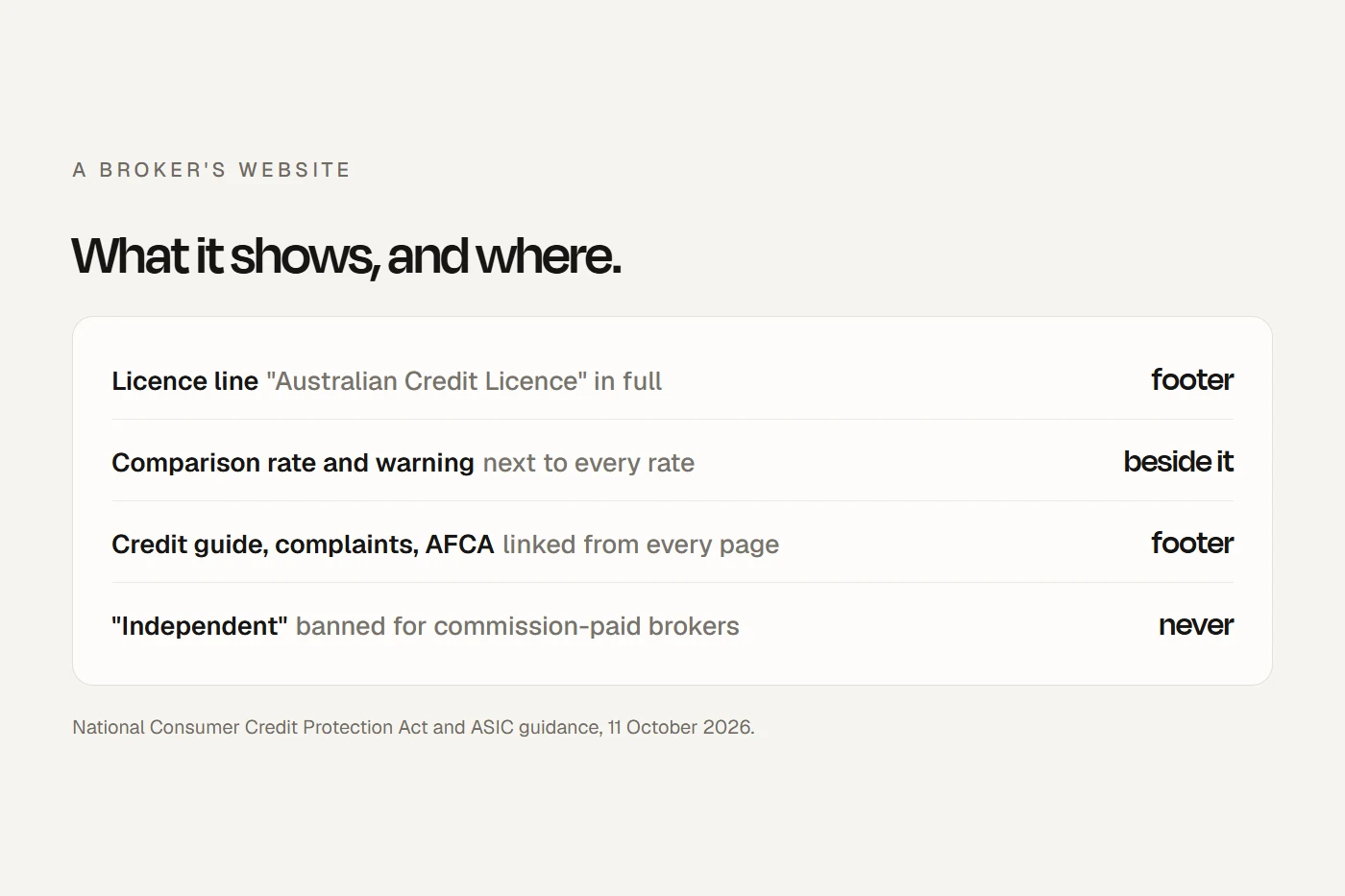
Section 923A bans "independent", "impartial" and "unbiased" for anyone who receives commissions, or whose licensee or fellow representatives do. ASIC's guidance says "independently owned" and "non-aligned" are caught too, while "locally owned" and "privately owned" are more likely to be fine. ASIC is explicit that this includes your website. If you give personal advice to retail clients, your FSG must also carry a boxed "Not independent" statement in a prominent position, explaining why.
Your licence line
The law puts your licence number in your FSG, not necessarily on every web page. Put it in your footer anyway: clients check, networks expect it, and Google and Meta ask for it to verify financial services advertisers. If you hold a licence: "[Business name] holds Australian Financial Services Licence [number]." If you're an authorised representative: "[Business name] is an authorised representative (AR [number]) of [Licensee], AFSL [number]." An authorised representative shouldn't describe itself as licensed; holding out a licence you don't have is an offence.
The Financial Services Guide on your website
Your FSG has to tell retail clients who you are and who you act for, what you're authorised to do, how you and your people are paid (in one place, not "ask us for details"), your relationships with insurers, how complaints work, your compensation arrangements, and whether you act under a binder. It must be dated.
It can now be a web page. If you give financial product advice, you can publish the same content as "website disclosure information" instead of handing over an FSG. ASIC's information sheet says it must be readily accessible to the public, not behind a login, kept up to date, and show when it was prepared or last updated. An authorised representative can only publish the version its licensee has authorised, and can't change it without authorisation. ASIC says the website route covers advice, and dealing to put that advice into effect, so if you sometimes just arrange what a client asks for without advising, keep giving out the FSG as well. Either way, link it from your footer and your quote page, and include the link in your first email to every enquiry.
The general advice warning
When you give general advice to a retail client, you must warn them at the same time, and by the same means, that it doesn't take account of their objectives, financial situation or needs, that they should consider whether it suits them, and that they should read the PDS. ASIC doesn't require exact words and encourages building the warning into the advice in plain English rather than fine print. So put it next to the article, product page or calculator it relates to, not only in the footer. Something like: "This is general information. It doesn't take into account your business or what you need, so think about whether it suits you and read the insurer's PDS before you decide."
Quote forms and tools
ASIC's advice guide has an example that describes many insurance websites: an interactive tool asks detailed questions about the user's circumstances, then lands them on a page recommending a product, with a general advice warning. ASIC says that's personal advice, and "The presence of a general advice warning does not alter this." Personal advice brings the best interests duty, a Statement of Advice and, for retail general insurance, the client's prior consent to your commission.
What's fine: telling someone the price of a policy they asked about isn't of itself a recommendation, and asking questions only to check whether someone is in a product's target market isn't personal advice. So a quote form should ask for contact details, business or personal, the type of cover, postcode and the facts the insurer needs, plus a tick for a call or email about that cover. For retail products, put the insurer's PDS and target market determination links beside any quote. Leave criminal history and health questions for the proposal stage, with consent, rather than the first web form.
Following up: the hawking ban
For retail products, you can't offer a policy, or invite someone to apply, in an unsolicited call, meeting or live chat. Consent must be a positive act, clear, about that product, and given within the six weeks before the contact. ASIC says filling in an online form counts. It also says a quote is an offer, so an emailed quote straight after a cold call can breach, and chat-bots are covered, with the licensee responsible for what they say. Renewal offers to existing clients have a carve-out for now. The practical rule: let the web form be the front door, make the consent tick specific and unticked, and have the chat-bot answer questions and book calls rather than quote.
Complaints, the Code and how you're paid
- Complaints: a licensee serving retail clients needs an internal dispute resolution process and AFCA membership. Publish the steps, the 30-day response timeframe, help for people who need it, and AFCA's details: 1800 931 678, www.afca.org.au. Use the AFCA logo only beside its contact details, never as a badge.
- The Code: if you subscribe to the Insurance Brokers Code of Practice, it asks you to refer to it on your website and publish your complaints information. It's being rewritten, so check the current version.
- How you're paid: a plain section that matches your FSG. The Code also asks you to tell retail clients the dollar amount of commission at the same time as your advice. "No fee for a quote; if you buy, the insurer pays us a commission" answers the commission worry, if it's true.
Check your wording
Paste a page, an ad or your Google profile, and I'll flag the patterns above.
It catches common patterns, not everything.
How does your website score?
Tick what your site already does, and tick anything that doesn't apply (for example, the retail-only items if you only arrange business policies outside the retail list). Your ticks save in this browser.
- No "independent", "impartial", "unbiased" or "non-aligned" anywhere.
- "Insurance broker" only if your licence authorises it.
- An FSG given, or website disclosure information that's public, current and dated (retail).
- Licence or authorised representative numbers in the FSG (retail).
- Remuneration explained in one place, not "ask us" (retail).
- A general advice warning beside advice and tools (retail).
- A specific, unticked call-back consent on forms (retail).
- A complaints page with steps, timeframes and AFCA's details.
- PDS and target market links beside retail quotes.
- A quote form that doesn't become a "find your policy" quiz.
- A "Not independent" box, if you give personal advice.
- The Code mentioned and linked, if you subscribe.
- A privacy policy.
- No guarantees, and conditions beside any "up to" claim.
- A chat-bot that informs and books, rather than quoting retail cover.
- Genuine, attributable testimonials only.
- A licence line in the footer.
- Pay-monthly claims that show the real cost.
Broking software and your website
Your broking system holds the trust account and the policy records; the website just needs to get enquiries into it cleanly, with consent recorded. Almost no broking system publishes prices. WinBEAT, and its cloud version WinBEAT NEXT, connect to the Sunrise Exchange for quoting with insurers; iBAIS is browser-based; Steadfast's INSIGHT and quoting platform are for its network members. Ask your vendor how web enquiries get in, and whether consent and the source of each enquiry come with them.
My view
Most of this is an afternoon's work: take out "independent", check you're allowed to say "broker", put the FSG on a dated public page your licensee has signed off, put the general advice warning next to the advice, and make the quote form short with a proper consent tick. Then answer the reasons businesses give for not using a broker, in plain words on the home page, including how you're paid. That's both the compliance work and the marketing.
Questions I get asked
Does an insurance broker need an FSG on its website?
Retail clients must get an FSG, and if you give financial product advice you can publish it on your website as website disclosure information instead: public, current and dated.
Can an insurance broker call itself independent?
Not if it, its licensee or the licensee's other representatives receive commissions. "Independently owned" and "non-aligned" are caught too.
Who can use the title "insurance broker"?
Only a business whose licence conditions, or whose licensee's, authorise it, which ASIC grants to licensees acting for intending insureds.
Is an online insurance quote tool personal advice?
It can be. ASIC says a tool that asks detailed questions about someone's circumstances and recommends a product is personal advice, even with a general advice warning.
Can a broker call someone who filled in a web form?
Yes, about the cover they asked about, within six weeks. A web form is a positive act of consent; a pre-ticked box or bought list isn't.
About this guide
Written by Joseph Alzein, founder of bdog. bdog builds websites for insurance brokers and has no arrangement with any vendor named here. The rules come from the Corporations Act and Regulations, ASIC's regulatory guides and information sheets, and the Insurance Brokers Code of Practice; the data from NIBA and Vero's SME insurance research, read on 12 October 2026. This is general information, not legal advice; your licensee's compliance team has the final say.
Main sources: