RTO marketing: what the ASQA standards say about advertising
Which rules apply now, Compliance Standard 7 in plain English, guarantees and job claims, what students must see before enrolling, brokers and lead sites, the NRT logo, VET Student Loans, state funding contracts, CRICOS and agents. With a cost per enrolment calculator, a wording sorter and a pre-publication checklist.
On This Page
- Which rules apply now
- Compliance Standard 7, in plain English
- Guarantees, shortcuts and job claims
- What students must see before they enrol
- Brokers, lead sites and agencies
- The NRT logo
- VET Student Loans
- State funding contracts
- Overseas students and education agents
- Consumer law, emails and calls
- What does an enrolment cost you?
- Can I say this?
- Before anything goes out
- Questions I get asked
If an RTO marketing checklist quotes "Clause 4.1" or "Schedule 4", it's out of date. The 2015 Standards for RTOs have been repealed, and much of what ranks on Google still cites them. This guide covers the rules that apply now: what the 2025 Standards say about advertising and guarantees, what students must be able to see before they enrol, who answers for brokers and lead sites, the Nationally Recognised Training logo, VET Student Loans, the NSW and Victorian funding contracts, CRICOS and education agents, and the consumer law on top. It's built from the Standards instruments, ASQA's practice guides, the NVR Act, the VET Student Loans Act and Rules, the National Code, the funding contracts and NCVER's research. It's general information, not legal advice.
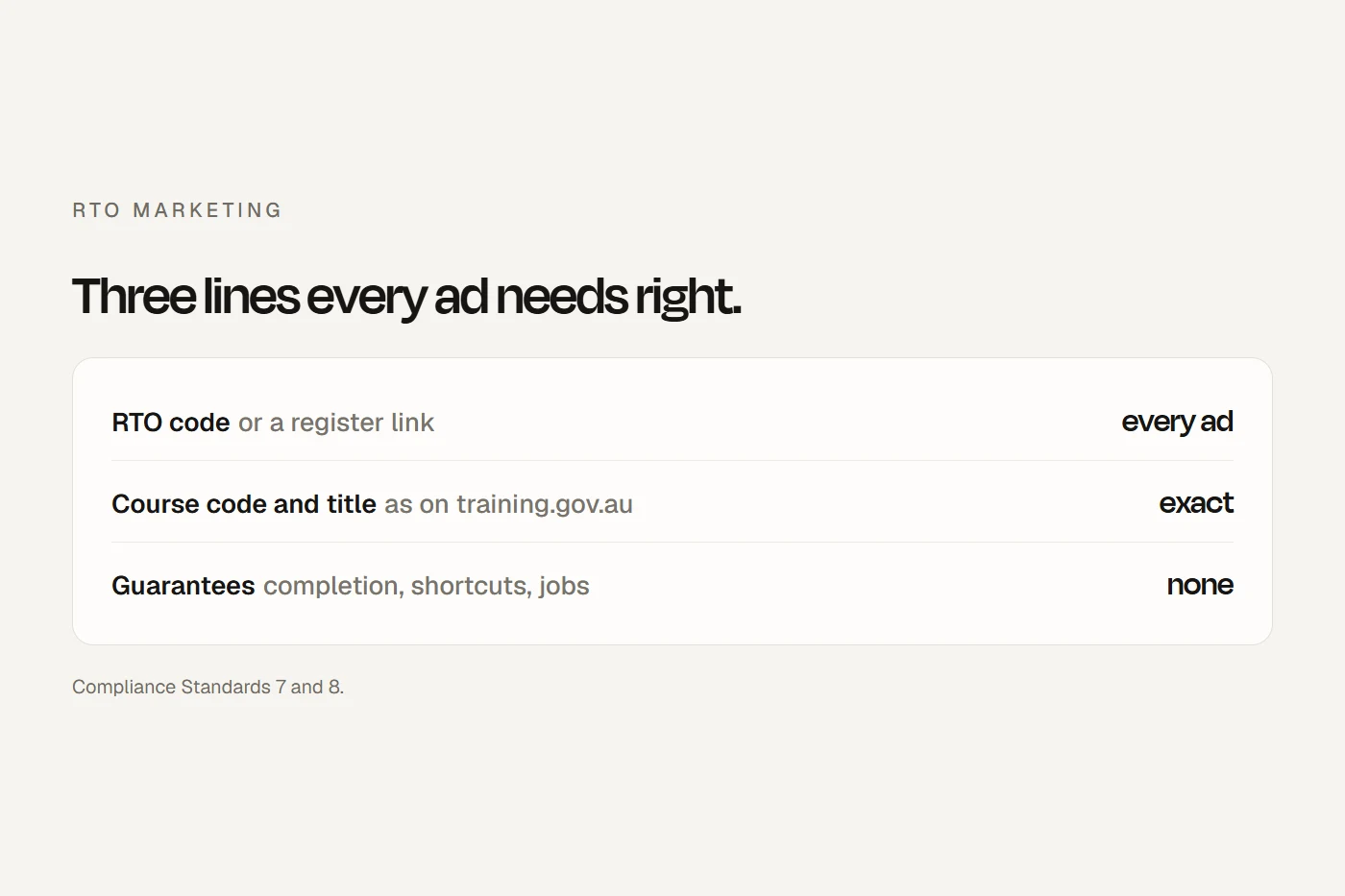
- Every ad needs your RTO codeOr a link to your National Register entry. Any ad naming a course needs its code and title exactly as on training.gov.au.
- No guaranteesNot of completion, not of a shortcut, and not of a job you don't control. Licence claims only where the industry regulator has confirmed them.
- You answer for everyone who markets for youBrokers, lead sites and agents are third parties. Their ads must name you and your code, and they can't use your branding or the NRT logo.
Which rules apply now
The 2015 Standards for RTOs have been repealed. RTOs registered with ASQA now work under the 2025 Standards, which come in three parts: the Outcome Standards instrument, the Compliance Standards instrument (with the Fit and Proper Person Requirements), and the Credential Policy. Western Australian RTOs regulated by TAC have moved to them too. Victorian RTOs registered only with the VRQA are being brought onto the same national standards; check the VRQA's guidelines for your start date.
The marketing rule itself is Compliance Standard 7, "Marketing and advertising". The guarantee rule is Standard 8. What students must be told before enrolling is Outcome Standard 2.1, and the suitability check is 2.2. The NRT logo rules are now Schedule 2 of the Compliance Standards instrument.
Compliance Standard 7, in plain English
Standard 7 applies to every ad or piece of marketing published by the RTO, "a third party or an expert engaged by the organisation". Every one must:
- Include your RTO code, or "a link to the part of the National Register where the organisation's registration code is located".
- Represent your services accurately, including "distinguishing the types of training and assessment" that lead to AQF certification "from any other training and assessment". Recognised and non-accredited courses must be clearly apart.
- Describe any funding accurately. That covers VET Student Loans, government subsidies and any other government-funded support. ASQA's guide says to make clear who provides the funding, whether there are extra costs, and whether it affects other entitlements.
- Not imply a connection with anyone who hasn't consented. That includes employer and industry logos: get their consent and keep it.
When an ad names a course, it must also:
- Use the code and title "as published on the National Register". "Cert 3 in Childcare" isn't the title.
- Only name courses on your scope, and a superseded course only while it stays on your scope and new enrolments are allowed.
- Only promise a licence "where this has been confirmed by the relevant industry regulator". Keep that confirmation on file.
And when a third party delivers or recruits, the ad must say which services they deliver, "including where an expert or third party is recruiting prospective VET students on behalf of the organisation".
ASQA's practice guide lists the mistakes it sees: losing track of the marketing in circulation, leaving out a course's full title or code, not separating recognised from non-accredited training, marketing superseded or deleted courses, not updating ads when delivery changes, and "using images ... of facilities or resources which do not accurately depict those used by your RTO". Use photos of your own training rooms and equipment.
Short ads. ASQA hasn't said how this works in a search ad or a social caption. My reading: put the RTO code in the ad text itself, because a link to the National Register doesn't work as a search ad's destination, and use the course code and full title whenever you name a course.
Guarantees, shortcuts and job claims
Standard 8 bans "verbal or written guarantees" that a student will complete a course, that they can complete it in a way that breaks the training product rules, or that they "will obtain a particular employment outcome, where obtaining such an employment outcome is not within the organisation's control". It applies to what your staff say on the phone as much as to your ads.
ASQA's known risks include "implying students can complete their training faster without specifying how", "marketing unrealistically short courses", and marketing that promotes "an easier path to qualifications", such as "inadequate or 'easy' RPL". If you offer a faster pathway through recognition of prior learning, say what the criteria are.
The consumer law sits on top: a claim about the future, like "job ready" or "pass first time", needs reasonable grounds. NCVER's national survey found most graduates train for work reasons, and about six in ten report a better job situation afterwards. That means about four in ten don't, which is exactly why a job guarantee is risky.
Despite its heading, Standard 8 says nothing about inducements. The inducement bans come from VET Student Loans law and the state funding contracts, below.
What students must see before they enrol
Outcome Standard 2.1 says this information must be "easily accessible": the course code and title, duration, delivery modes, location, start dates, scheduling, entry and assessment requirements, any licensing requirements, and any third-party arrangements. Then the support services and how to reach them, "all fees, costs and charges" with payment terms, refund policy and any subsidies, and obligations like buying equipment, the Student Identifier, withdrawal costs and work placements. Standard 2.2 adds a check, before enrolment, of each person's language, literacy, numeracy and digital literacy, and advice on whether the course suits them. Complaints and appeals information must be publicly available.
That's also what works. NCVER's experiment on how students choose found "course cost was found to be the most influential factor", followed by delivery mode and travel time. Support services had some influence, and "any type of support was considered much more valuable than none at all". When NCVER looked at 100 RTO websites, it found "great variability": some showed support clearly, some buried it in a downloadable handbook, some had nothing. Put fees, mode, location, start dates and support on the course page itself, not in a PDF. Among students who left a qualification early, about one in nine said the training "was not as expected", so accurate information helps retention as well as compliance.
If you teach online, ASQA's online learning page lists the questions to answer up front: is everything online, is there face-to-face assessment or placement, what must students supply themselves (computer, software, internet), and how quickly you answer questions and return assessments.
Brokers, lead sites and agencies
The Standards define a third party as anyone with an arrangement to deliver "services", and services include "any activities related to the recruitment of VET students including marketing". A comparison site, lead platform, call centre or Facebook lead agency that finds students for you is likely a third party. That means:
- A written agreement before they start, which bars them from "using the NRT logo" and "using the organisation's branding".
- ASQA notified within 30 days of the agreement starting, and again when it ends.
- Your ads say a third party is recruiting for you.
- Their ads name you. The NVR Act makes it an offence for any person to advertise a VET course without "the name and registration code of the registered training organisation that will issue" the qualification.
ASQA lists "assuming that outsourcing services to third parties will release your RTO of its compliance obligations" as a known risk. Whether a marketing agency running ads in your own name, under your control, counts as a third party isn't settled; ASQA hasn't said. Take advice, and treat anyone paid per lead or per enrolment as a third party.
The NRT logo
The Nationally Recognised Training logo is a registered trademark, and its rules are strict:
- Only for nationally recognised training on your scope, and never in a way that suggests all your training is recognised. The classic mistake is the logo in the site header on every page when you also run non-accredited courses. Put it next to the specific recognised course.
- Never on "corporate stationery, business cards, building signage, merchandise" or learning resources. That includes email signatures.
- Only from the files the regulator supplies, never mirrored, rotated or recoloured. The colours are green PMS 343 and red PMS 192, or one colour in green or black, reversed to white if needed. The triangle is never used without the words.
- Third parties must not use it at all.
VET Student Loans
If you're an approved course provider, the VET Student Loans rules are the toughest marketing rules in the sector, written after the VET FEE-HELP collapse. In one case the ACCC took action over door-to-door sales that told people they'd get a free laptop and that courses were free; the laptops were on loan and students ended up with a Commonwealth debt. The rules now say:
- No inducements beyond small branded merchandise. DEWR names items usable outside the course, travel, entertainment, vouchers and money, and warns that bursaries, scholarships and fee discounts can cross the line.
- Never say a loan isn't a loan or doesn't have to be repaid.
- No mention of loans in cold contact, in person, by phone, email or message.
- No mention of loans to people on someone else's list unless they gave express consent through a separate, optional, unticked box that named you and disclosed any referral fee.
- No mention of loans on social media at all. DEWR names Facebook, Instagram, X and YouTube.
- Every ad for an approved course must prominently show your name, RTO code and the maximum tuition fee, and the fees must be published on your website before you market the course.
- Any marketing that mentions loans must also say, at about the same font size and on the same web page, that loans won't be approved for people who don't meet the eligibility requirements, and that a loan creates a debt to the Commonwealth until it's repaid.
- No brokers to enrol students or give advice about loans. The VSL logo goes only on your own VSL information page, not the homepage.
State funding contracts
NSW, Smart and Skilled. Every communication about Smart and Skilled must use the statement "This training is subsidised by the NSW Government." Where the course is fee-free, the statement is "This training is fee-free and fully subsidised by the NSW Government." You must not otherwise suggest training is "free of charge" or that you or a third party subsidise it. The guidelines name three banned inducements: a tablet or iPad not needed for the training, "an inducement to enrol by a particular date", and "an inducement to refer any students". Your homepage must link to the Smart and Skilled website, and you can't use the Department's logos without permission.
Victoria, Skills First. The contract bans incentives "whether to any prospective student or to any other person (such as an employer or social organisation)". Promotional material must acknowledge the funding prominently, for example "This training is delivered with Victorian and Commonwealth Government funding", and show your legal or business name and TOID. Your website must show standard tuition fees with the set caveat, other fees, every broker you use, and your subcontractors. The Department's fact sheet gives the examples: no laptop or voucher for a student, and no equipment for a sports club whose members enrol.
Queensland. The Skills Assure marketing directive I could find bans gifts or benefits likely to drive enrolment, and calling training free or fee-free where a co-contribution fee applies. Check the current directive for your contract period.
Funding contracts change each year, so check the current version before you write an ad.
Overseas students and education agents
If you're on CRICOS, the National Code adds its own marketing rules. Include your CRICOS registered name and number in any written or online material offering a course to overseas students. Never claim to secure a migration outcome or guarantee an assessment outcome, so no "pathway to PR". Give full pre-enrolment information, including the CRICOS course code, compulsory online or work-based training, indicative fees and living costs.
You answer for your education agents: a written agreement with each, agents who know the agent code of ethics, and immediate termination for "false or misleading recruitment practices". ASQA says to publish your list of agents on your website, and agent agreements for VET count as third-party arrangements. The National Code also bans paying commission to an agent for recruiting a student who's already studying with another provider, with limited exceptions.
Consumer law, emails and calls
The Australian Consumer Law applies on top of everything. A student testimonial is taken to be misleading unless you can show it's real, so keep the source and the student's written consent. Claims of sponsorship, approval or affiliation must be true, and so must claims about price and need. VET isn't a health service, so testimonials are allowed, as long as they're real and framed as one person's experience, not a promise.
For email and SMS, the usual Spam Act rules apply: consent, sender identified, unsubscribe in every marketing message. The Spam Act has an exemption for messages from an educational institution to its current and former students, and "college" is in the list, but no regulator has said whether it covers RTOs, and it never covers people who only enquired. Put an optional, unticked consent box on your enquiry form. Enrolling people at a stall or door to door can trigger the consumer law's cooling-off rules for unsolicited agreements.
What does an enrolment cost you?
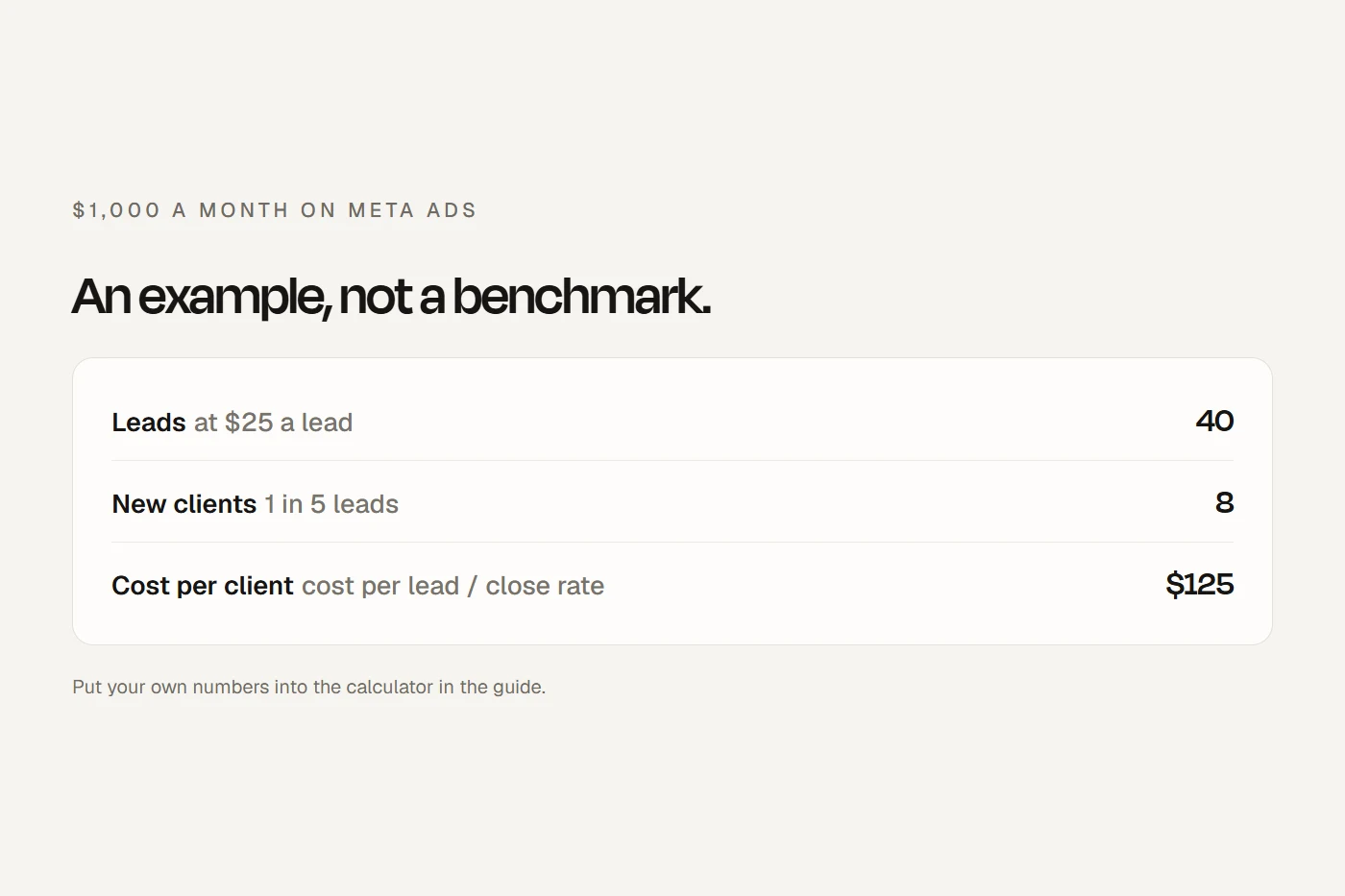
I found no credible Australian benchmark for RTO cost per lead or per enrolment, so use your own numbers. The figures below are made up. Watch what happens when an ad brings more enquiries but more of them withdraw.
On those made-up numbers: $50 an enquiry, 12 enrolments, about $324 per enrolment that stays, and marketing at about 13% of the revenue those students bring. An ad that overpromises might lift enquiries, but if more students find the course "not as expected" and leave, the cost per retained enrolment goes up, not down.
Can I say this?
Tap a card to see the verdict.
Before anything goes out
Run every ad, page, post and flyer through this. Tick items off as you go; the list remembers your progress on this device.
- RTO code shown Or a link to your National Register entry.
- Course code and title exact As on training.gov.au, for every course named.
- On scope and open Not superseded past its window, and not deleted.
- Recognised and non-accredited training kept apart NRT logo only beside recognised training.
- NRT logo correct Supplied file, right colours, words with the triangle, not on stationery or merchandise.
- No guarantees Of completion, a shortcut, or a job you don't control. Shorter pathways state their criteria.
- Licence claims confirmed In writing by the industry regulator.
- Funding described accurately Plus your funding contract's set words.
- No gifts, devices, vouchers, deadline deals or referral rewards For funded or VET Student Loans courses.
- VET Student Loans statements Name, code and maximum fee; eligibility and debt statements if loans are mentioned; nothing about loans on social media.
- Third parties named For what they deliver or recruit, with agreements signed and ASQA notified.
- Consent on file For every person, employer or body named or shown.
- Your own photos Of your own facilities and equipment.
- The landing page carries the 2.1 information Duration, mode, location, dates, entry and assessment, placements, equipment, all fees, refunds, subsidies and support.
- CRICOS name and number For overseas-facing material, with no migration claims.
- A dated copy archived ASQA can ask for every ad you've had in circulation.
Questions I get asked
What are ASQA's marketing guidelines?
The rules are in Compliance Standard 7 of the 2025 Standards for RTOs, with ASQA's Information and Transparency Practice Guide explaining them. Every ad needs your RTO code or a register link, course codes and titles exactly as listed, recognised training kept apart, accurate funding claims, consent from anyone named, and third parties identified.
Do RTOs have to show their RTO code in ads?
Yes, or a link to the RTO's entry on the National Register. Separately, the NVR Act makes it an offence for anyone to advertise a VET course without naming the RTO that will issue the qualification and its code.
Can an RTO guarantee a job?
Only where the job is within the RTO's control. Standard 8 bans guaranteeing a job outcome otherwise, as well as guaranteeing completion or a faster path that breaks the training product rules.
Can we offer a free laptop or a referral reward?
Not for Smart and Skilled, Skills First or VET Student Loans courses: each bans inducements, and devices and referral rewards are named. For other courses, the Standards don't ban inducements, but the consumer law still applies.
Can we mention VET Student Loans on social media?
No. The VET Student Loans Rules ban mentioning loans in any social media marketing. On your website, loan information needs the eligibility and debt statements at about the same size, on the same page.
Where can we use the NRT logo?
Next to nationally recognised training on your scope, in the supplied file and colours. Not on stationery, business cards, email signatures, signage, merchandise or learning resources, and not in a way that suggests all your training is recognised.
About this guide
Written by Joseph Alzein, founder of bdog. I build websites for training providers and education businesses. Sources were checked on 12 October 2026. This is general information, not legal advice. Funding contracts change each year, so check the current version. I've left out penalties, dollar thresholds and transition dates.
Main sources:
- Compliance Standards for NVR Registered Training Organisations 2025
- Outcome Standards for Registered Training Organisations 2025
- ASQA: Information and Transparency Practice Guide
- ASQA: Information Practice Guide
- ASQA: Standards for RTOs
- VRQA: new standards for RTOs
- NSW: Smart and Skilled Operating Guidelines
- Victoria: VET funding contracts
- NCVER: drivers of student training choices
- NCVER: VET student outcomes
- DEWR: Standards for RTOs
- ACCC: false or misleading claims
- ACMA: avoid sending spam