Marketing a residential aged care home in Australia
How families actually find and choose a home, why your My Aged Care listing does the comparing, the rules on room prices, optional extras, deposits and Star Ratings, what not to say, and what your website is for. With an empty-bed calculator, a can-I-do-this sorter and a 90-day plan.
On This Page
- How families actually arrive
- Room prices: published on My Aged Care, never higher anywhere
- Optional extras: list them, never sell them before move-in
- Star Ratings: allowed, on the department’s terms
- Testimonials, “specialist” and pressure
- What your website is for
- What an empty bed costs you
- Can I do this?
- A 90-day plan
- My view
- Questions I get asked
Before a family ever reaches your website, they've usually seen your room prices, room sizes, Star Rating, residents' survey results and finances on My Aged Care, side by side with every other home nearby. This guide is for the owner, CEO or marketing lead of a small independent or not-for-profit residential aged care provider with one to five homes. It covers how families actually arrive, the rules that shape what you can say about rooms, prices, extras and ratings, what your website is for once the government listing has done the comparing, and a 90-day plan. I build aged care websites. Everything here comes from the Aged Care Act and Rules, the Department of Health, Disability and Ageing, My Aged Care, the Aged Care Quality and Safety Commission, the AIHW and the ACCC. In-home care is a different set of rules, covered in my home care marketing guide.
- Your listing does the comparingFamilies shortlist on My Aged Care's Find a provider, which shows your prices, rooms, Star Rating and residents' survey. Keep it accurate and link it to your site.
- Your website shows daily lifeFood, activities, rooms, people and how moving in works: the things the listing can't show and the government tells families to ask about.
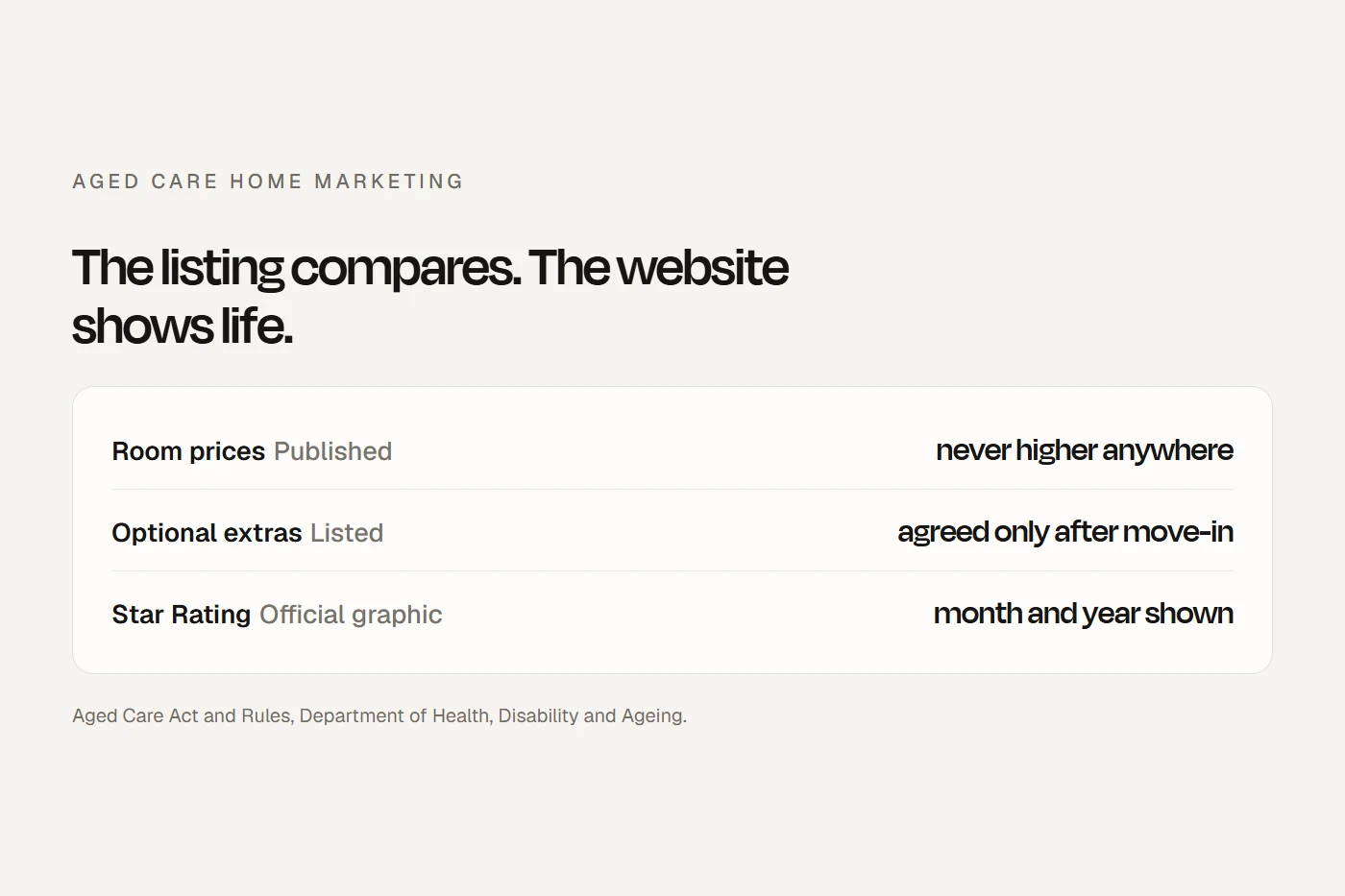
- Three rules shape the copyNever advertise a room above its published price, never offer optional extras before move-in, and use your Star Rating only with the official graphic.
How families actually arrive
The government's own path is: an assessment, then the assessor refers or the family searches Find a provider, compares homes side by side, visits, and applies to several at once. My Aged Care tells families "If you have found more than one aged care home you like, it's best to apply to them all", and that they "don't need to accept an offer". So you're competing to get onto a shortlist and then to be the offer that's accepted.
- Respite is the front door. In the most recent AIHW pathway data, almost half of people entering permanent care had used residential respite first, more than came from any other path. A clear, easy respite page is the cheapest marketing a home can do.
- Hospital is a trigger. AIHW found about one in four people with dementia who were living at home before a hospital stay moved into residential care within a week of leaving hospital. Discharge teams need to know what you have available, quickly.
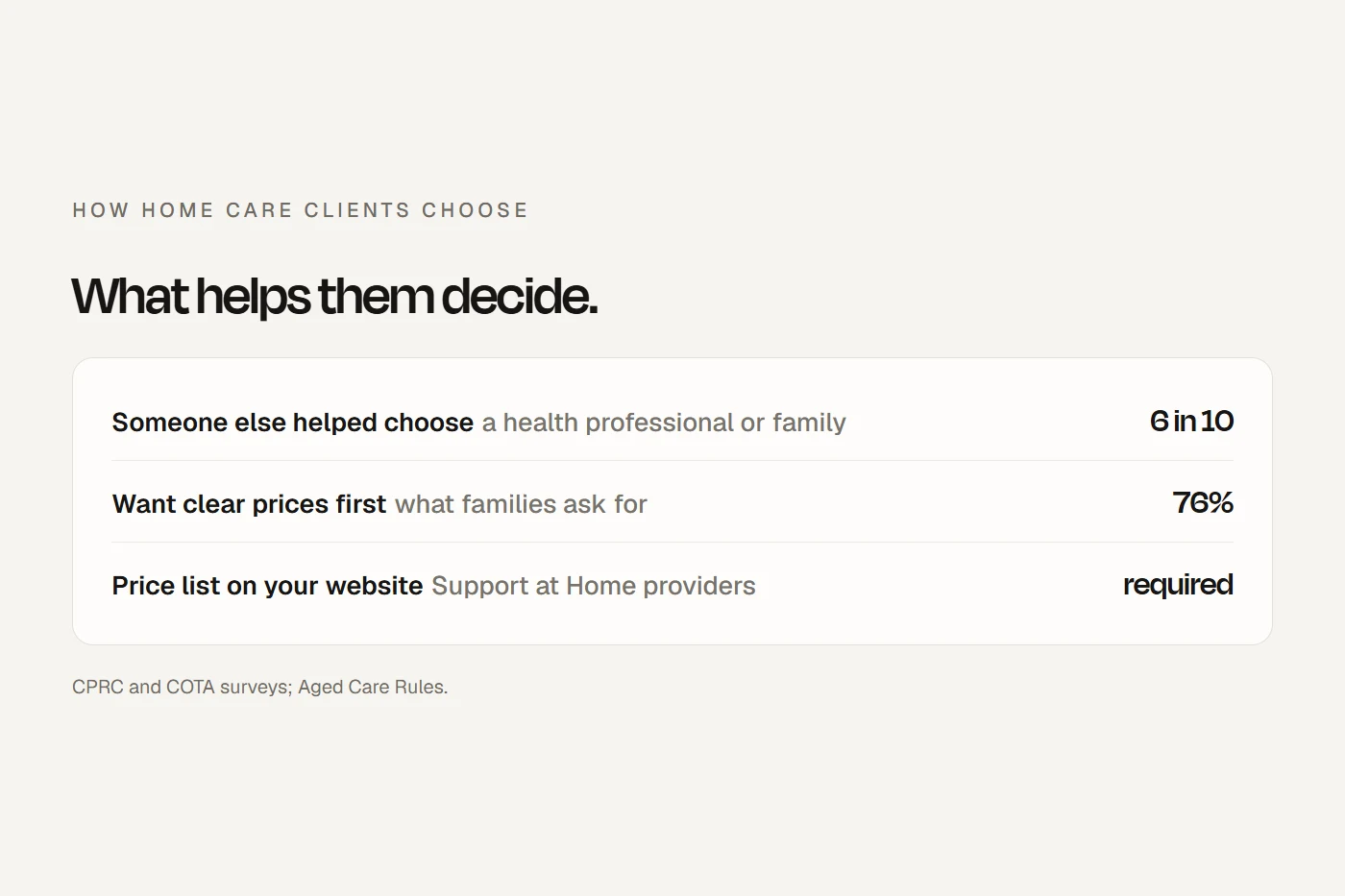
- Families want costs first. In COTA's survey, clear information about what you'll pay ranked first, followed by quality of life (food, social activities), staff skills and what life is like for residents.
- Most homes are close to full on average, but averages hide homes with empty beds, and every empty bed is revenue not earned.
Room prices: published on My Aged Care, never higher anywhere
To charge for accommodation, a home must publish the maximum price for each room, or part of a room, on My Aged Care. The department is blunt: "You can't charge more than your published room price. This includes prices published on My Aged Care, printed materials and your own website." And "If you don't publish an accommodation price on My Aged Care, you can't charge a resident an accommodation payment."
- The published room description is a legal notice. The Rules require it to describe the room's quality, condition, size and amenity, whether it has an ensuite or shared bathroom, its features, how many residents it's for, and the common areas. Your website's room pages should say the same, with better photos.
- The published price is a ceiling. My Aged Care tells families they agree a room price in writing before entry, and the department calls the published price "the maximum you and an individual can agree to".
- No payment choice before move-in. A home "must not require an individual to choose how to pay" before their start day, and can't take a refundable deposit before then. "Pay your deposit to secure the room" and "lock in this price today" are out.
- No rule requires prices on your own website, but if you show them, they can't be higher than My Aged Care.
- One thing must be on your website: the general purpose financial report, published so the public can read it easily.
Optional extras: list them, never sell them before move-in
The higher everyday living fee replaced extra and additional service fees. It's for services above the standard every resident gets. Two rules pull in different directions, and both matter for your website:
- You can't offer it before move-in. A home must not, before the start day, "ask the individual to pay a higher everyday living fee" or "offer to enter a higher everyday living agreement". It can't be tied to a room or be a condition of entry. My Aged Care tells families the same thing.
- But the department recommends listing it before move-in. Its guidance says providers should share their extras and prices before a person enters care, "listing HELF services on their website" is a named method, and bundles must show each item's single price too.
So put a plain "Optional extras" page on your site: what everyone gets, each extra and its price, any bundle beside the single prices, and a line that extras are chosen after moving in and never affect which room you get. Agreements have a 28-day cooling-off period. And every feature you advertise has to exist: the ACCC took a large national provider to court for taking payments for extra services, like dementia gardens and physiotherapy rooms, that weren't fully provided.
Star Ratings: allowed, on the department's terms
You can promote your overall Star Rating on your website, brochures, signage, ads and social media, under the department's brand terms:
- Only the official graphic, downloaded from the department, unchanged. Don't draw your own stars or write "5-star care".
- Say which home and when: the month and year it applies to, and a pointer to Find a provider for current ratings.
- Take it down or update it when it changes. The terms call a superseded rating misleading, and the compliance part of the rating can change any day.
- No implied endorsement: no "government approved", no My Aged Care logo.
New homes and homes with new owners can take up to 12 months to get an overall rating. Don't invent a substitute.
Testimonials, "specialist" and pressure
- No testimonials about care. A home must have a registered nurse on site at all times and advertises nursing care, so I treat its advertising as advertising a regulated health service: no resident or family quotes about care. Let Google reviews and the government's Residents' Experience results speak instead.
- "Specialist dementia care unit" is a government program. Unless you run one, describe what you have: "a secure, small household for residents living with dementia".
- No fear lines about falls or hospital stays.
- No false urgency. The Quality Standards require giving people time to consider an agreement and seek advice. "We have one single room with ensuite available now" is fine if it's true; "decide today" isn't.
- Residents' photos and stories need consent from the resident if they have capacity, or from the person legally able to decide for them. About half of permanent residents live with dementia, so this comes up constantly. Never make it a condition of care.
What your website is for
The listing shows the numbers. Your website shows the life. The government's own visiting checklist tells families what to ask, and it reads like a website brief:
- Rooms: each room type with the same name, price and details as My Aged Care, real photos and current availability.
- How paying works, in plain words, with a link to the government fee estimator and no thresholds.
- Food: the menu and the dining room. Food and dining is its own Quality Standard for homes.
- Daily life: activities, outings, gardens, visiting doctors and allied health.
- Respite: availability, how to book, what to bring.
- Visiting: what to bring, that family are welcome, and that nobody decides on the day.
- The required and the reassuring: the financial report, complaints process, Star Rating graphic and a link to your Find a provider listing.
What an empty bed costs you
Use your own figures. This shows what vacancies cost and what each admission costs you to win.
The example numbers are made up; put in your own. The point holds at almost any size: a filled bed pays for a lot of marketing.
Can I do this?
Tap each card.
A 90-day plan
Your ticks save in this browser.
- Days 1 to 30: check every room on My Aged Care: price, description, photos, availability.
- Days 1 to 30: make every website and brochure price match or sit below the published price.
- Days 1 to 30: publish your financial report on the website.
- Days 1 to 30: remove any feature you don't fully deliver, any care testimonials, government logos and unsupported "specialist" claims.
- Days 1 to 30: Star Rating: the official graphic with month and year, and a named person to update it.
- Days 31 to 60: room pages and a plain "how paying works" page.
- Days 31 to 60: an optional extras page with single and bundle prices.
- Days 31 to 60: a respite page.
- Days 31 to 60: life here: menu, dining, activities, visiting health professionals.
- Days 31 to 60: a "visiting us" page that says nobody decides on the day.
- Days 61 to 90: a one-page sheet for discharge teams and assessors: vacancies by room type, respite, care you can take, one direct number.
- Days 61 to 90: tidy your Google Business Profile and ask for reviews without incentives.
- Days 61 to 90: a small Google Ads test on "aged care home" plus your suburb.
- Days 61 to 90: an open day, with consent forms ready for any photos.
- Every month: run the empty bed numbers and drop the channel that brings the least.
My view
For a small home, marketing is mostly accuracy and warmth. Get the My Aged Care listing exactly right, because that's where you're compared. Then build a website that shows what a family can't see in the listing: the dining room at lunch, the garden, the activities board, the room their mother would actually have. Make respite easy, give discharge teams one number that gets answered, and keep the Star Rating graphic current. That's what fills beds.
Questions I get asked
Can an aged care home advertise its room prices?
Yes, but never above the maximum price published on My Aged Care for that room. Prices must be published there to charge for accommodation.
Can we promote our Star Rating?
Yes, using the department's official graphic for the right home, with the month and year, and updated or removed when the rating changes.
When can we offer optional extra services?
Only after the person has moved in. You can, and the department recommends you do, list the extras and their prices on your website beforehand.
What is the 28 day rule for aged care?
One common meaning is the 28-day cooling-off period for agreements to pay a higher everyday living fee for optional extras.
Can we use family testimonials on our website?
I'd leave them off. A home advertises nursing care, which is a regulated health service, and testimonials about it aren't allowed.
About this guide
Written by Joseph Alzein, founder of bdog. bdog builds aged care and health websites. The rules come from the Aged Care Act 2024 and Aged Care Rules 2025, the Department of Health, Disability and Ageing, My Aged Care, the Aged Care Quality and Safety Commission and the ACCC; the data from the AIHW, the department and COTA. Sources were checked on 13 October 2026. This is general information, not legal advice.
Main sources:
- My Aged Care: connecting with aged care homes
- Department: published prices and maximum accommodation payments
- Department: higher everyday living fee guidance
- Department: Star Ratings brand guidelines
- Aged Care Quality and Safety Commission: higher everyday living fee bulletin
- AIHW GEN: pathways in aged care
- Department: Specialist Dementia Care Program
- COTA: quality and choice in aged care