Marketing a home care provider: what families look for
Six in ten home care clients relied on someone else to choose, usually a health professional or family. Here’s how to market to them, the price list rule for Support at Home providers, and the pressure tactics to avoid, with a website checklist and a 90-day plan.
On This Page
Most of what ranks for home care marketing is written by American and British agencies for private-duty home care, and none of it mentions Support at Home, My Aged Care or the one marketing rule written into Australian aged care law. This guide is for a small Australian in-home aged care provider, registered or delivering for one. It covers how older people and their families actually choose a provider, what the rules allow, and the channels that work, from the Aged Care Act and Rules, the Support at Home program manual, the Aged Care Quality and Safety Commission, the ACCC and My Aged Care, read on 12 October 2026. It's general information, not legal advice, and the program is still changing, so check the department's pages before you rely on anything here.
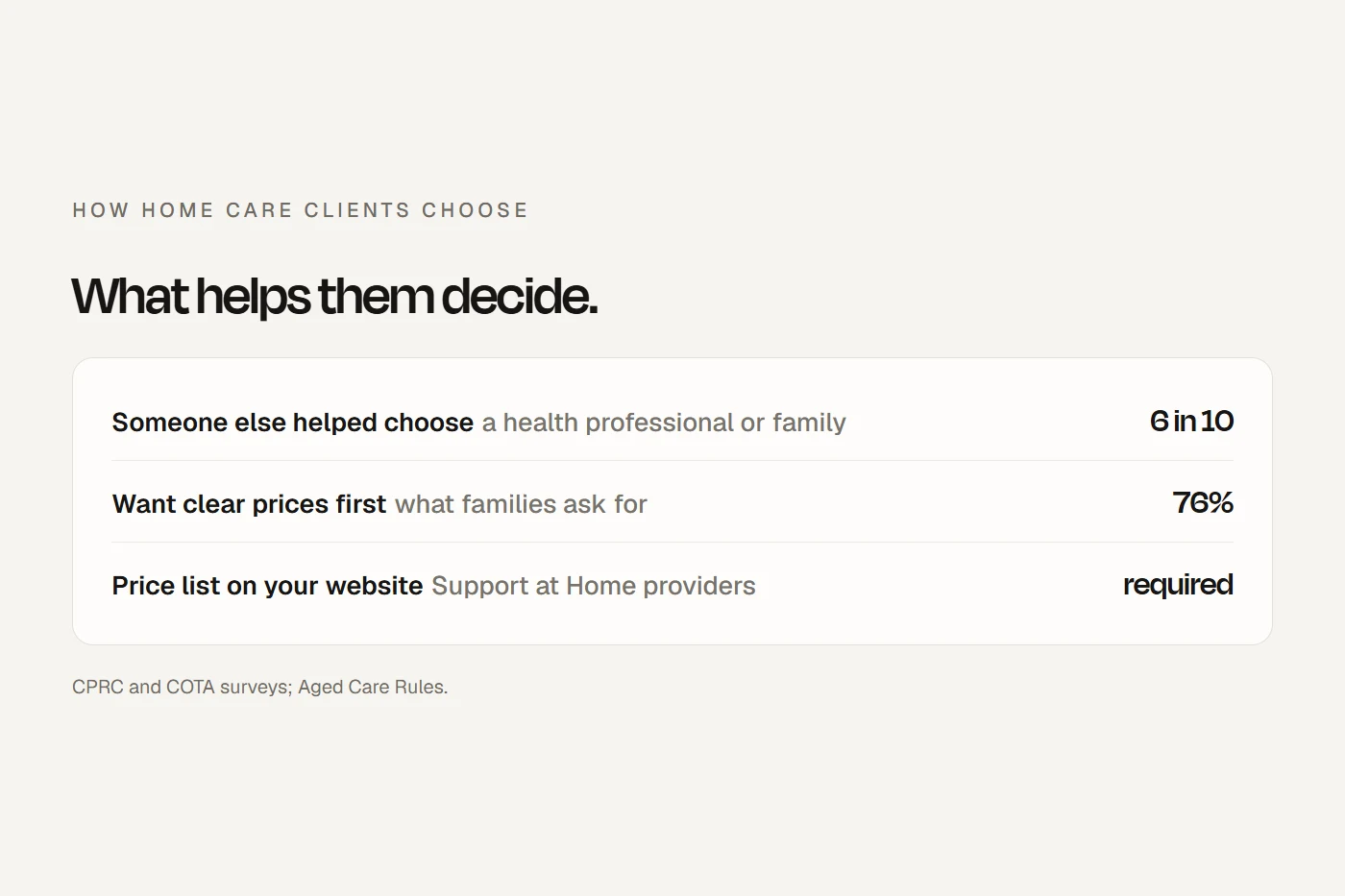
- Someone else usually helps chooseIn the largest Australian survey of home care clients, six in ten relied on someone else to pick a provider, most often a health professional. Market to them as well as to families.
- Your price list is the law, not a nice-to-haveRegistered Support at Home providers must publish their most common price for each service type on their own website, by time band, kept current.
- No door-knocking, no pressureThe ACCC says home care won't normally be sold at the door or over the phone, and the Quality Standards require time to consider before signing.
How older people and families choose
By the time a family looks at your website, they've usually been through an assessment, have a letter approving Support at Home services and a referral code, and have a set window to choose a provider. My Aged Care tells them there are three ways to find one: ask the assessor to refer them to a local provider, search the Find a provider tool, or ring My Aged Care. They're comparing, not browsing, and they need all their services from one provider.
The best Australian research on how people choose is a Consumer Policy Research Centre survey of about 500 people receiving home care (from the Home Care Packages era). Six in ten relied on someone else to choose, most often a health professional, then family. A recommendation from a health professional was the single most important factor, followed by the provider's quality and reputation, cost, and location. Only a small share said they used provider websites, and almost half weren't confident online. So the person reading your website is often the adult child, the GP or the nurse helping, not the older person.
When COTA asked older people and carers what they'd want to know when choosing in-home care, "clear information about how much I need to pay" came first, at 76%. Next came the views of people they know who've used the service, how it improves quality of life, hours of care, and staff qualifications. Those are the sections your website needs.
The rules that shape your marketing
The price list
This is the one marketing-type rule written into aged care law. The Aged Care Rules require a registered provider delivering home support to publish on its own website the most common price it charges for each service in twelve service types: allied health and therapy, care management, domestic assistance, home maintenance and repairs, respite, meals, nursing, personal care, restorative care management, social support, therapeutic services for independent living, and transport. Each needs a price for standard business hours, weekday after hours, Saturdays, Sundays and public holidays, refreshed every two months.
The department and the Commission are specific about what doesn't count: a "call for a quote" page doesn't, and "uploading or linking to a pricing schedule on the provider's website does not meet this reporting requirement". You can't charge separate administration or travel fees; every cost goes in one unit price. And you can't charge to enter or leave the service. The Commission has run a targeted review of how providers publish prices and has said it will have providers refund amounts where they don't comply. The upside: price is what families say they want most, and the department has said it will publish typical prices so families can see how yours compares. A clear, current price page is both compliance and your best sales page.
No pressure, no door-knocking
The ACCC's home care page says providers should "give customers time to seek advice and make decisions" and "avoid adopting commission-based business models which might lead to pressure selling", and that home care "won't normally be sold at a person's door or over the phone". Queensland Fair Trading says the same. If you do approach someone uninvited, the ACL's unsolicited selling rules apply: limited calling hours, a ten business day cooling-off period, leaving when asked, and respecting do-not-knock signs. The ACCC also treats knowingly targeting people experiencing vulnerability as a sign of unconscionable conduct. For registered providers in the personal care, nursing and transition care categories, the Quality Standards add that people must have time to consider an agreement and a chance to seek advice before signing. So "sign today" offers are out.
Logos, endorsements and star ratings
My Aged Care's terms don't allow its trade marks, its images or the Coat of Arms to be used without permission, though you can link to it. So write "Find us on My Aged Care" with a plain link to your listing, and leave the logos off. Registration with the Commission is a legal status, not an endorsement: "Registered with the Aged Care Quality and Safety Commission" plus your provider number is accurate; "government approved" isn't. And Star Ratings are for aged care homes, so there's no star rating for a home care provider to promote.
If you're a subcontractor
Under the Aged Care Act, the registered provider answers for anything a subcontractor does in delivering its services, and the subcontractor's workers are bound by the Aged Care Code of Conduct. Subcontractors aren't required to register with the Commission themselves. So don't call yourself a "registered Support at Home provider". Say what you are: "We deliver cleaning, gardening and transport for Support at Home clients through registered providers." Because each client must get all their services through one registered provider, your marketing audience is mostly those providers, plus private-pay clients.
Nursing and allied health
If you advertise home nursing, physio, OT or podiatry, Ahpra's advertising rules apply to that part of your business: no testimonials, offers only with terms, and no claims that create unreasonable expectations. Cleaning, meals, transport and social support aren't regulated health services. The simplest path is no client testimonials on your care pages at all.
Photos and stories
Most home care providers hold health information, so the Privacy Act applies whatever your size. Client photos and stories need consent from someone with capacity to give it. The Information Commissioner's guidance is that if you're unsure whether someone has capacity, you shouldn't rely on their consent, and dementia is named as a reason capacity may be affected. A relative's yes isn't enough unless they hold legal authority. Never make photos a condition of care. Commissioned photos with models are the safer default.
Can I do this?
Tap a card to see the verdict. General information, not legal advice.
The channels
Your Find a provider listing
The government's directory is where families shortlist and compare, side by side, and it links straight to your website. It shows your services and costs, compliance history, finances, and specialisations verified by the department. You maintain most of it yourself in the provider portal, and My Aged Care says the provider is responsible for keeping it accurate. Mark services you don't offer as offline, check your service area, write a clear outlet description, and make sure the website link works. If you serve a particular community, such as culturally and linguistically diverse clients, Aboriginal and Torres Strait Islander people or LGBTI older people, the department's specialisation verification gives you a tick on the listing.
People who refer
Because health professionals are the biggest influence on the choice, GPs, practice nurses, allied health, hospital discharge teams and care finders are a marketing audience in their own right. Care finders, commissioned by Primary Health Networks, help people with no one else to support them shortlist providers. Give each a short sheet or a page on your website: your service area, which services you deliver yourself and which through others, current availability, how fast you call back, and a link to your prices. Don't pay or give gifts for referrals.
Your website
The family member or nurse reading your site wants what COTA's respondents asked for. Put these on it:
- Your price list, by service type and time band, kept current.
- A plain note on contributions: that what a client pays depends on their means assessment, with a link to My Aged Care's estimator.
- Your service area, by suburb.
- Which services you deliver yourselves and which through others.
- Current availability and how quickly you can start.
- How you match workers, and how a client changes worker.
- Staff qualifications, training and screening.
- Quality of life: choice in activities, meals and outings.
- How you handle complaints, with the Older Persons Advocacy Network on 1800 700 600 and the Commission on 1800 951 822.
- Languages, interpreters and cultural fit, and any verified specialisation.
- Your registration line and provider number, with a link to your Find a provider listing.
- A "Helping a parent?" section: what to bring and that they're welcome at the meeting.
- A "no pressure" line: take your time, bring someone, sign only when ready.
- A privacy note at the enquiry form, with no health details needed to ask a question.
- A page for referrers.
Write it for the person helping as much as the person receiving care, in plain language, and make it readable for people with low vision. The Statement of Rights gives older people the right to be informed in a way they understand and to communicate in their preferred language.
The family phrase is "home care package provider", and Google's related searches still use the old program name alongside "My Aged Care providers near me". Set up your Google Business Profile as a service-area business, write a page for each area you really serve, and bid on both old and new program names if you run ads. More in local SEO for small business and what Google Ads cost.
Facebook and Instagram
Meta's ad policy doesn't allow ads that imply someone's age, disability or health, so "Are you over 65?" is out; describe the service instead: "Help at home with showering, meals and transport in [suburb]". Remember the buyer is often the adult child, so an older age floor on targeting can miss them. Don't put a retargeting pixel on care pages without consent. More in Meta ads for small business.
Directories and placement services
My Aged Care itself warns families that commercial directories carry "sponsored content" and that providers "can pay to appear higher or first". Claim any free base listings. Placement services that match families to providers and charge per signed client aren't regulated by the Commission, though they must follow consumer law. Weigh their fee against what a client costs you through your own channels.
Private-pay clients
My Aged Care notes people sometimes use private services while they wait for funded services to become available. Help while you wait is a genuine offer for a provider with capacity, and those clients may stay with you once their funding starts.
What a new client costs you, by channel
Put in one channel's numbers for a month. The starting figures are made up; use your own revenue per client from your own price list, not program budgets.
A 90-day plan
Your ticks save in this browser.
- Check every service you advertise sits inside your registration categories.
- Publish or fix your website price list, and check it matches the portal.
- Clean up your Find a provider listing: services, area, description and website link.
- Remove government logos, "approved", "official" and star claims. Subcontractors fix their registration wording.
- Remove client testimonials from nursing and allied health pages.
- Set up your Google Business Profile as a service-area business.
- Write a referrer sheet and page, then visit GP practices, allied health, discharge teams, care finder organisations and carers' groups, with no gifts.
- Ask every client or family for a Google review, the same way, with no reward.
- Claim free directory listings, and decide on paid ones with the calculator.
- Apply for specialisation verification if you serve a particular community.
- Write a "Helping a parent?" page and answers to what families ask.
- Run a small Google Ads test on old and new program names in your suburbs.
- Run Meta ads that describe the service, with location targeting.
- Compare cost per new client by channel, and drop the worst.
- Before any photo or story, check capacity and get written consent.
My view
Home care is chosen on trust, price and someone's recommendation, usually with a family member or health professional doing the reading. So the marketing that works is plain: a clear, current price list, a Find a provider listing you keep accurate, a website written for the person helping, and good relationships with the people who refer. The pressure tactics that work in other markets are out here, and they'd lose you families anyway.
Questions I get asked
How do home care providers get clients?
Mostly through health professionals, assessors and families. Keep your Find a provider listing accurate, publish clear prices, write your website for the person helping, and build relationships with GPs, discharge teams and care finders.
Do Support at Home providers have to publish prices?
Yes. Registered providers must publish their most common price for each service type on their own website, for each time band, and keep it current. A quote request or a linked PDF doesn't meet the rule.
What is the new name for Home Care Packages?
Support at Home. It replaced the Home Care Packages and Short-term Restorative Care programs.
How do I become a home care package provider?
Register with the Aged Care Quality and Safety Commission in the right categories, then follow the department's steps for providing Support at Home services.
Can home care providers door-knock or cold call?
The ACCC says home care isn't normally sold that way, and the consumer law's unsolicited selling rules apply if you do. Avoid it.
About this guide
Written by Joseph Alzein, founder of bdog. bdog builds websites for aged care and home care providers. The rules come from the Aged Care Act and Rules, the Support at Home program manual, the Aged Care Quality and Safety Commission, the ACCC and My Aged Care, read on 12 October 2026. The client research is from the Consumer Policy Research Centre and COTA. The program is still changing, so check the department's pages. This is general information, not legal advice.
Main sources:
- My Aged Care: connecting with Support at Home providers
- My Aged Care: how to choose a provider
- Department of Health: prices for Support at Home participants
- Commission: Support at Home pricing requirements
- Commission: guidance for associated providers
- ACCC: home care services
- ACCC: telemarketing and door-to-door sales
- My Aged Care: terms of use
- My Aged Care: non government-funded providers
- Consumer Policy Research Centre: Choosing care
- COTA: Measuring quality and consumer choice in aged care