How NDIS providers find participants, within the rules
Three in four participants who research providers look at provider websites, and only 1% go by advertising. Here’s each channel that works, and where the Code of Conduct, the NDIA’s logo rules and the consumer law draw the line.
On This Page
Most advice on NDIS provider marketing comes from agencies selling it, and very little of it mentions the rules. That's a problem in this sector more than most. The NDIS Code of Conduct binds every provider, registered or not. The NDIA polices its logo and name. And the NDIS Commission can now order a business to stop promotion that undermines the scheme.
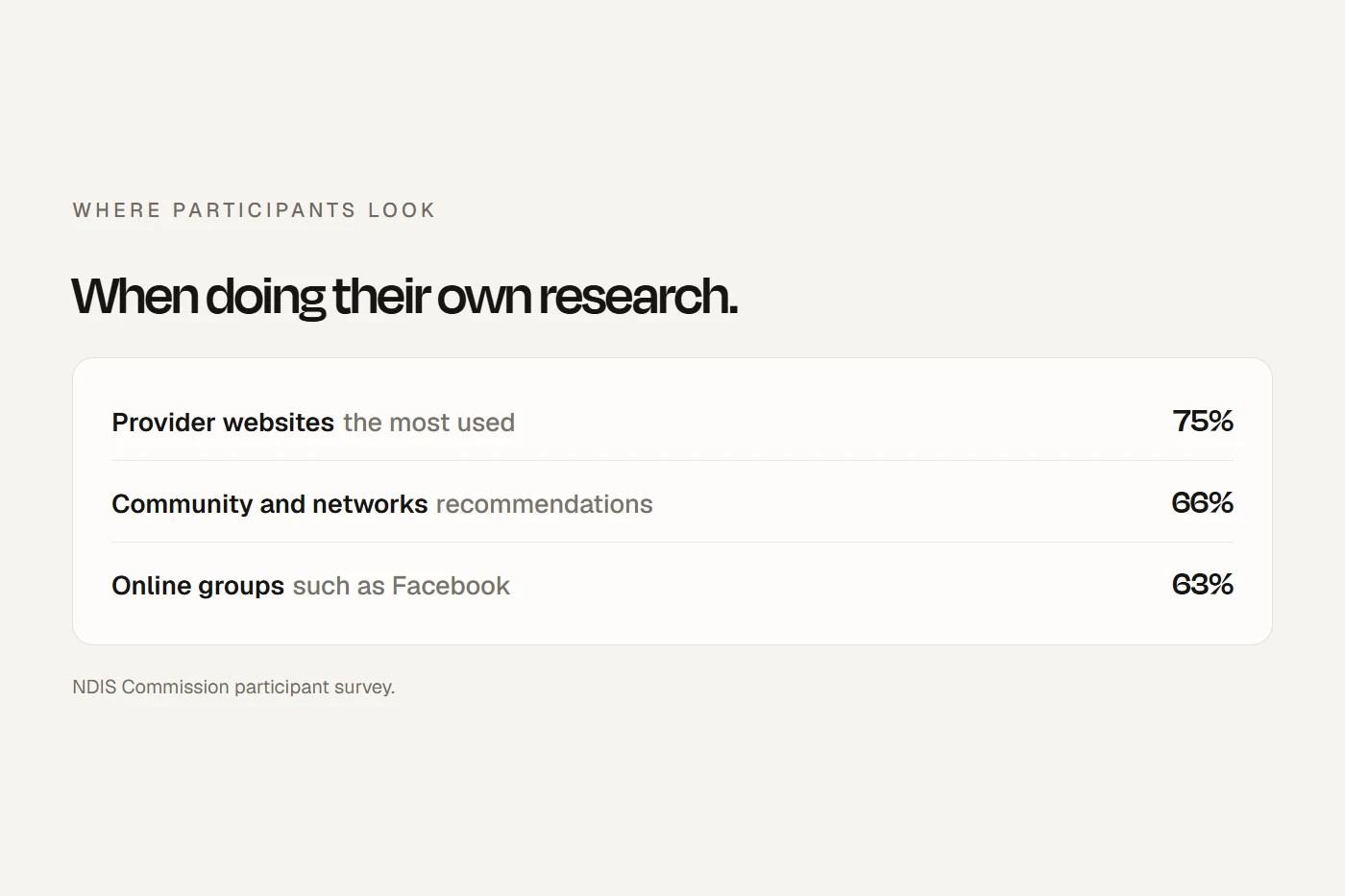
The good news is that the honest channels are also the ones that work. In the NDIS Commission's own survey, three in four participants who researched providers looked at provider websites. Two in three asked their community, and almost two in three used online groups. Only 1% said they went by provider advertising. This guide goes through each channel and where the lines are. It's general information, not legal advice.
- Get found where participants lookYour website, the NDIS Provider Finder if you're registered, Google, and the support coordinators and plan managers who help participants choose.
- Say exactly what you areRegistered or not, who you can serve, and what you charge. "NDIS approved", NDIS logos you're not entitled to, and "NDIS" in your business or domain name are out.
- Never pay or reward for sign-upsGifts, "free" devices, referral payments and pressure sales are the practices the Commission and the NDIA are cracking down on.
Where participants look
The NDIS Commission surveyed participants about how they find information on providers. This is what they said.
Participants also said they compare provider websites and read Google reviews to judge safety and quality, and that they wanted to see services, location, staff qualifications and reviews in one place. The NDIA itself tells participants to "check provider reviews". So the two things that matter most are a website that answers their questions and a steady flow of honest reviews.
The rules every provider shares
There's no NDIS page called "marketing rules". The rules sit in the NDIS Code of Conduct, which covers registered and unregistered providers alike, and in the NDIS Commission's guidance on it. The parts that touch marketing:
- Tell the truth about your people and services. Supply "truthful information about the capacity, qualifications, training and professional affiliations" of your workforce, and make no claims about supports that "cannot be substantiated independently". In one of the Commission's own examples, a provider advertising psychology it wasn't registered for was told to stop until it was.
- No inducements. Don't "give, ask for, or accept any inducement or gift" that may affect how you provide supports, "including any referral arrangements with other providers".
- No sharp practices. The guidance names "over-servicing, high pressure sales and inducements", and offering rewards with "no particular link to a person's NDIS plan".
- No higher prices for participants. The Code bans "promoting, advertising and publishing higher prices" for participants than for other people without a reasonable justification.
- Declare conflicts of interest, and keep a policy on gifts and conflicts that your staff follow.
The Australian Consumer Law applies on top. The ACCC says complaints about false or misleading advertising are the biggest share of contacts it gets about NDIS providers. The NDIS Commissioner has said: "Using inducements to pressure participants into signing agreements is unlawful." And the NDIA has said its investigations show "a strong link between providers making 'incentive' or 'referral' payments and fraud".
The NDIS logo and "registered provider"
The NDIA's logo guidelines are short and strict:
- "No provider, person or business is permitted to use the NDIS logo without written consent from the NDIA." That includes your website, van and business cards.
- Only registered providers may use the "I heart NDIS" or "We heart NDIS" logos with the "Registered Provider" tagline. The NDIA has packs to download.
- You may only call yourself a "registered provider" if you're registered with the NDIS Commission. Unregistered providers must not use other wording that implies it, like "official NDIS provider".
- "NDIS approved", "100% NDIS funded" and "NDIS packages" are out. The NDIA "does not endorse or approve any products or services".
- The one that catches people: the NDIA lists "use of the NDIS acronym in business names, trading names or domain names" as a misleading statement of affiliation.
So if your business is called something like "Acme NDIS Supports" at acmendis.com.au, the NDIA's guidelines say that implies a relationship you don't have. You can use "NDIS" to describe what you do ("we work with NDIS participants"), but not as part of your name. If that's you, a new name and domain is worth planning for. Participants can check the Commission's provider register in seconds, so whatever your site says about registration has to match it.
What an unregistered provider can say
Plenty, as long as it's accurate. "Unregistered NDIS provider" and "We work with NDIS participants who self-manage or use a plan manager" both describe you correctly. The NDIA's own guide says participants "can choose unregistered providers" for self-managed supports and when they use a plan manager. Participants with NDIA-managed funding must use registered providers, so saying who you can serve up front saves everyone time.
Check your wording
Paste your website copy, flyer or ad here and I'll flag phrases that cross the NDIA's or the Commission's lines.
It catches the common phrases, not every way of saying them, so read your copy with the rules above in mind too.
The channels, and where the lines are
Your website
It's where participants look most, so it's where your effort pays back most. A page for each service you're set up to deliver. Who you can serve: NDIA-managed, plan-managed or self-managed. Your areas, how quickly you can start, and your prices, matching your private prices. A privacy policy that covers health information, because information about someone's disability is health information under the Privacy Act, and health service providers are covered whatever their size. Write it for the participant and their family, in plain words.
The NDIS Provider Finder
If you're registered, participants and support coordinators can find you through the NDIA's Provider Finder, which shows your website, phone, email and suburb. You're not listed automatically: your account manager chooses whether your business displays, in the myplace provider portal. Switch it on and check your details. Unregistered providers don't appear.
Support coordinators, plan managers and NDIS partners
These are the people participants ask. Support coordinators keep their own lists of providers, and they're expected to offer participants at least three options. Introduce yourself with a short, accurate sheet: what you do, where, your registration status, your waitlist and how fast you respond. Keep it to information. Any gift or payment for referrals runs straight into the Code. If you're a support coordinator, requests for service from the NDIA go to another provider if you don't accept or decline them within four business days in the portal, so check it every working day.
If you're a support coordinator whose organisation also delivers therapy or support work, you can refer participants to your own team, but only after declaring the conflict, offering outside options and recording it. In a Commission example, a coordinator who recommended her employer's program without saying so led the employer to apologise and change its process.
Google and reviews
If you visit people at home and have no shopfront, your Google Business Profile is a service-area business: hide your home address and set the areas you cover. Your name on Google is your real name, so no "NDIS" added unless it's genuinely your trading name, and then see the logo section above. Ask every participant for a review the same way, with nothing in return; Google bans incentives and the Code treats a gift for a review as an inducement. When you reply, never confirm someone is a participant or mention their disability or supports. My guide to local SEO covers the profile and reviews in detail.
Directories and platforms
Paying a flat fee for a listing is advertising. Paying another provider or a coordinator for each participant they send you is a referral payment, which is what the Code and the NDIA warn against. Pay-per-enquiry lead sellers sit in between; get advice before you sign up. Two examples of how platforms charge, in their own words:
- Clickability, a disability services directory, has a free listing and paid plans billed yearly that include a set number of service requests a month. It says it won't publish reviews written by a provider about itself or by anyone paid or induced.
- Mable is a platform where participants book independent support workers. It adds a fee to the rate for the client and deducts a fee from the worker. It suits a sole-trader support worker more than an organisation.
NDIS digital platforms, the kind that match participants with workers, now have to register with the NDIS Commission too, so check a platform's status before you rely on it.
Social media and online groups
Online groups are where many participants ask for recommendations. Be useful there as yourself: answer questions, say what you offer when it's relevant, and don't send cold messages. Facebook and Instagram ads can't assert or imply that someone has a disability, so "Living with a disability?" is out. And if your site has pages about specific disabilities or therapies, the privacy regulator's view is that retargeting visitors with a pixel needs their consent. My guide to Facebook and Instagram ads explains why.
Door-knocking and cold calls
I'd avoid them. Nothing in the NDIS rules names them, but the Code's ban on high-pressure sales covers how they usually go, and the consumer law limits when you can knock or call and gives a cooling-off period. In one Commission example, a seller who rang a participant three times in a week about an offer that was about to end was referred to the ACCC.
Photos and stories
A photo that shows someone's disability, a mobility aid or that they receive supports is likely to reveal health information. Get express, specific consent for each use, in a format the person understands, with their supporter or guardian involved where needed. No names or suburbs without consent, nothing that implies an endorsement they didn't give, and no story written to make people pity anyone. Stock or commissioned photos with models are the safe default.
If you're a registered health practitioner (an OT, physio or psychologist, for example), Ahpra's advertising rules apply as well, including the ban on testimonials about clinical care. They don't apply to speech pathologists, exercise physiologists or support workers, but the consumer law and the Code still do. My guide to Ahpra's advertising guidelines has the detail.
Can I do this?
Tap a tactic to see the answer and where it comes from.
What a new participant costs you, by channel
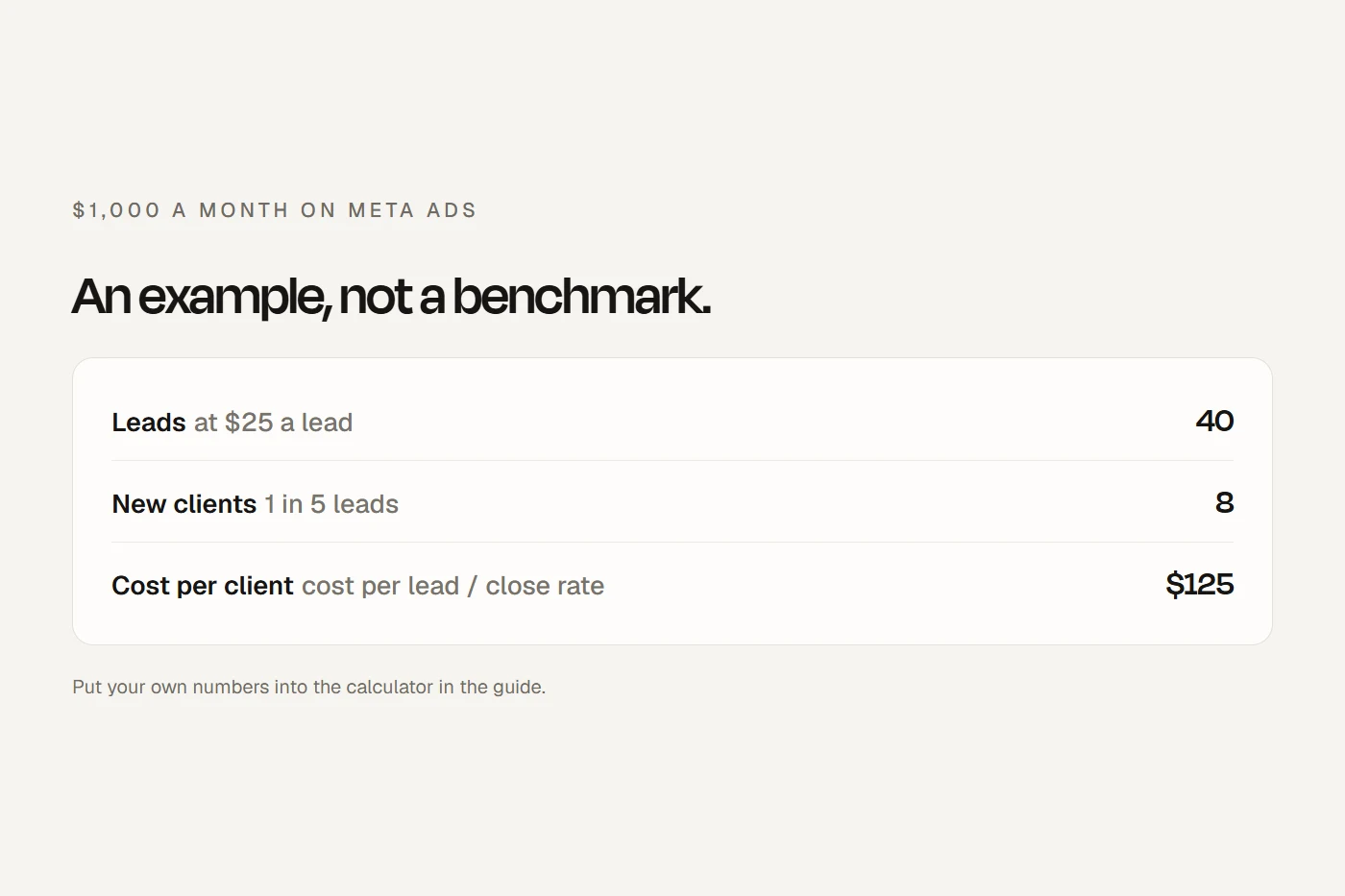
Put in one channel's numbers for a month, then the next. You'll need to count enquiries by channel, calls as well as forms. Use your own revenue figures; the starting numbers are only an example.
A 90-day plan
Your ticks save in this browser.
- Check your status and wording everywhere: website, Google profile, Facebook, flyers, van. Fix every "registered" claim, logo and "NDIS approved" line.
- If "NDIS" is in your business or domain name, plan a change.
- Registered: switch on your Provider Finder display in myplace and check your website, phone and email.
- Website: a page per service, who you can serve, your areas and prices, and a privacy policy that covers health information.
- Write a one-page conflicts and gifts policy, and a list of outside options for each support you also offer.
- Google Business Profile set up as a service-area business if you visit people at home.
- Introduce your service to local support coordinators, plan managers and NDIS partners with an accurate one-page sheet. No gifts.
- Support coordinators: check the portal every business day for requests for service.
- Ask every participant for a Google review, with nothing in return.
- Choose one directory on a flat fee if the numbers work, and take the free listings.
- Answer the questions participants ask on your site: what you do, who you serve, how to start, what it costs.
- Photos and stories only with consent that's express, specific and accessible.
- Be useful in local online groups as yourself, without pressure or cold messages.
- Work out cost per new participant by channel and drop the worst.
My view
NDIS marketing rewards providers who are plainly honest. Participants research carefully, ask each other, and check registration. A clear website that says exactly what you are, who you can help and what it costs, a steady flow of genuine reviews, and good relationships with the coordinators and plan managers in your area will do more than any campaign. And the shortcuts this sector is known for, the gifts, the referral payments and the pressure, are exactly what the regulators are now going after.
If your business or domain name has "NDIS" in it, I'd treat that as the first job.
Questions I get asked
How do NDIS providers get clients?
Mostly through their website, recommendations, online groups, and the support coordinators, plan managers and NDIS partners who help participants choose. Registered providers can also appear on the NDIS Provider Finder.
Can I use the NDIS logo on my website?
Not the plain NDIS logo without the NDIA's written consent. Registered providers may use the "I heart NDIS" or "We heart NDIS" logos with the "Registered Provider" tagline. Unregistered providers may not.
Can I have "NDIS" in my business name or domain?
The NDIA lists "NDIS" in a business, trading or domain name as a misleading statement of affiliation. You can use it to describe what you do, not as your name.
Can an unregistered provider advertise to NDIS participants?
Yes, accurately. Say you're unregistered and that you work with self-managed and plan-managed participants. Don't use the registered provider logos or imply registration.
Are registered providers automatically on the Provider Finder?
Not necessarily. The NDIA's portal guide says your account manager chooses whether your business displays. Check the setting in myplace.
Can I pay for NDIS referrals?
Paying another provider or a support coordinator per referral is the kind of arrangement the Code of Conduct and the NDIA warn against. A flat fee for a directory listing is advertising.
How do I check if someone is a registered NDIS provider?
Search the NDIS Commission's Provider Register and choose the status "Approved".
About this guide
Written by Joseph Alzein, founder of bdog. bdog builds websites for Australian businesses, including NDIS providers. I'm not a lawyer, and this is general information, not legal advice. The rules here were read from Sydney on 11 October 2026 on the NDIS Commission, NDIA, ACCC and OAIC sites. Registration rules are changing, so check the NDIS Commission's site for whether your supports now need registration. Platform details are the platforms' own.
Main sources:
- NDIS Commission: The NDIS Code of Conduct, guidance for providers
- NDIS Commission: NDIS Code of Conduct
- NDIA: NDIS logo guidelines
- NDIA: what a conflict of interest is
- NDIA: guide to working with providers
- NDIA: Provider Finder
- NDIS Commission: find a registered provider
- NDIS Commission: fair pricing
- NDIS Commission and NDIA: crackdown on inducements
- NDIS Commission: Quality and Consumer Consultation Insights Report
- OAIC: small business and the Privacy Act
- OAIC: posting photos and videos
- Clickability: provider plans
- Mable: guide to fees