What an architect’s website needs
The design and the rules together: what a referred client looks for, the title and registration rules in your state, how to credit projects and photographers, and how to show a client’s house without exposing them.
On This Page
Look up "architect website" and you'll find galleries of beautiful sites: full-bleed photos, thin type, a portfolio that scrolls forever. Some are lovely. Almost none mention what actually trips up an Australian practice online. "Architect" is a protected title in every state and territory, your registration number belongs on your site in several of them, the photos in your portfolio usually belong to your photographer, and the house you're proudest of belongs to a client who may not want their street on the internet. This guide covers what an architect's website needs, the design and the rules together.
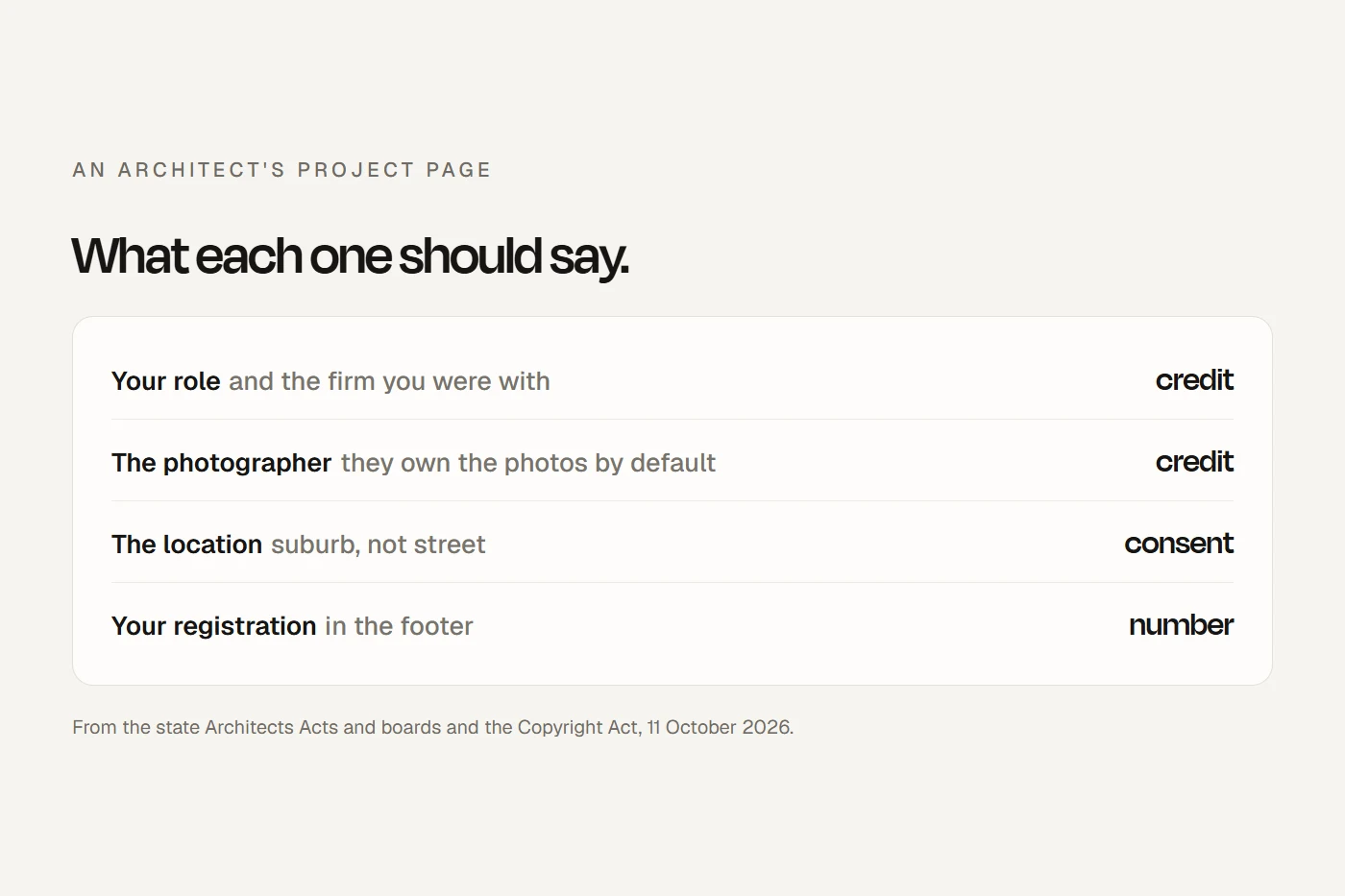
- Show who's registeredThe registered architect's name and registration number, and for a firm the nominated architect, in your footer or contact page. Victoria's board names websites; the ACT makes leaving it off an ad an offence.
- Credit honestlyYour role on each project, collaborators, the firm you were with at the time, the photographer, and awards exactly as given.
- Protect your clientsWritten consent before publishing a private house, and the suburb rather than the street.
I build websites for architecture practices. I'm not a lawyer, and this is general information, not legal advice. Everything below comes from each state's Architects Act and board, the Copyright Act and the Australian Institute of Architects, read on 11 October 2026. Where a board hasn't said something, I've said that too.
What the site needs to do
The Institute's own client survey, from 2021 and mostly commercial clients, found that 71% chose their architect by "referral from a trusted source", and 10% from "marketing material (social/web/collateral)". My reading of that: for most practices the website isn't where clients find you. It's where a referred client checks you out. So it needs to answer the questions that person has, quickly:
- What kind of work you do, in plain words on the first screen. Houses, alterations, multi-residential, commercial, heritage. Your location too.
- Projects that show your role. A small number of well-photographed projects with a few lines each on the brief, the site and what you did, beats an endless grid.
- How you work. The stages, what the client agreement covers, and roughly how fees are worked out. Several states require a written agreement before you start; explaining it up front sets expectations.
- Who you are. The people, their registration status described accurately, and how to reach you.
- Proof a client can check. Your registration number, which they can look up on the state register in seconds.
The title "architect" and the words around it
Every state and territory restricts "architect" to people registered with its board, and requires companies and partnerships to have their own approval before they call themselves architects. The details differ, and several states restrict more words than you might expect.
New South Wales
- Law
- Architects Act 2003, sections 9 to 14
- Firms
- Need a nominated architect (a director, member, partner or employee) and a listing on the NSW List of Architect Corporations and Firms
- Other restricted words
- "architectural designer" and "architectural design" as a description of services
- Registration number
- The Code requires it "in publications" connected with your practice, and the nominated architect identified
- Register
- architects.nsw.gov.au/architects-register
Victoria
- Law
- Architects Act 1991, sections 4 to 8D
- Firms
- Must be an approved company or approved partnership, with a registered architect responsible for the services
- Other restricted words
- "architectural services", "architectural design services" and "architectural design"
- Registration number
- The 2026 Code requires your name, registration number and contact details in publications, and the board's guide lists "websites"
- Client agreements
- A signed agreement before any fee or service, "including concept designs, sketches or reports", given to the client at least 7 business days before signing
- Register
- arbv.vic.gov.au/find-architect
Queensland
- Law
- Architects Act 2002, sections 113 to 117 and 141A
- Firms
- Give the board a notice under section 141A naming the responsible architect
- Other restricted words
- "architectural services", "architectural design services" and "architectural design", plus a prescribed list including "architectural", "architecture", "architecturally designed", "architectural plans", "interior architect" and "graduate architect"
- On your website
- The Code asks for your name, business address and phone on "websites"
- Register
- boaq.qld.gov.au
Western Australia
- Law
- Architects Act 2004, sections 64 to 68
- Firms
- Must be a licensed corporation, and need the board's written consent to trade under any name other than the registered one
- Other restricted words
- A "restricted word" is "architect", "architects", "architectural" or "architecture", plus abbreviations, derivatives and look-alikes
- Registration number
- The board encourages it on stationery and brochures, and can make it a condition of consenting to a trading name
- Register
- architectsboard.org.au/search-register
South Australia
- Law
- Architectural Practice Act 2009, sections 38 to 41
- Firms
- Must be a registered architectural business, with registered architects making up at least half (or a majority) of the governing body
- Other restricted words
- The board's guidance rules out "interior architect", "graduate architect" and "architectural" in a business name unless registered
- Registration number
- The Code says architects "should include their registration number in any advertising material"
- Project images
- A guidance note on attribution in advertising, including websites (below)
- Register
- archboardsa.org.au
Tasmania
- Law
- Architects Act 1929, section 19
- Restricted words
- "architect" or anything that "sounds or looks like" it
- Registration number
- I found no rule
- Register
- architectsboardtas.org.au
Australian Capital Territory
- Law
- Architects Act 2004, sections 57 to 62
- Firms
- A corporation or partnership needs a nominee to offer architectural services
- Registration number
- The strictest rule I found. Advertising an architectural service without the registered name and registration number (for a firm, its primary nominee's) is a strict liability offence. The Act says it's "to allow the public to check the individual's register entry"
- Register
- Access Canberra's public registers
Northern Territory
- Law
- Architects Act 1963, sections 23G to 23K
- Firms
- Must be a registered architectural company or partnership
- Other restricted words
- "architectural practitioner", "architectural consultant" and "architectural designer"
- Register
- architects.nt.gov.au
If you work across borders, registration in one state doesn't cover using the title in another. South Australia's board says you can only use it there after registering through mutual recognition or notifying it under automatic mutual recognition.
Websites have already been evidence. The NSW board's own factsheet describes a tribunal case where a consumer won because "the firm's website contained an implied representation" that a registered architect would do the work. And the Victorian board tells practices to "critically assess the information on your website (particularly in staff biographies)".
Can I say this?
Tap each one to see whether someone who isn't a registered architect can use it. The answer for a registered architect working through an approved firm is generally yes.
One gap: I found no board guidance on domain names. A domain is part of how a business presents itself, so I'd apply the same rules to it as to your business name.
Your project pages
Say what you did
The codes in NSW, Victoria and Queensland all prohibit letting your name imply authorship you don't have. South Australia's board has a guidance note written for exactly this, project images on websites. It says architects must "clearly define their role in projects" and "attribute other participants", that "acknowledging the firm of architects engaged for the project is important", particularly if you did the project in a previous role, and suggests wording like "when working at XYZ Architects Pty Ltd" on the images. It also says the attribution "should be no less obvious than the text used to describe the project", and that less than full attribution "could fall into the category of misleading the public".
So on each project page I'd include a short credits line: your role, the year, collaborators, the builder if the client is happy to name them, and the photographer.
Credit the photographer, and get a licence
Unless your agreement says otherwise, the photographer owns the photos of your buildings. Under the Copyright Act, the person who takes a photograph owns it; only photos for "a private or domestic purpose" belong to whoever commissioned them. The Institute's guidance says the same: "Unless otherwise agreed, architectural photographers own the copyright of their images and control their use and reproduction."
Photographers also have a moral right to be credited, and the Act says the credit "must be clear and reasonably prominent". So credit the photographer on each project, and make sure your agreement with them licenses the photos for your website, social media, award entries and print. The Institute's own awards make photographer licences and credits a condition of entry.
One more copyright point that cuts both ways: under the Copyright Act, photographing a building doesn't infringe the building's copyright. Builders, agents and suppliers can publish photos of your work too.
Ask the client first
A photo of someone's home, with its suburb, is personal information in the OAIC's sense. Most small practices sit outside the Privacy Act, but the codes in NSW, Victoria, Queensland and the Northern Territory all require client confidentiality, and the Institute's awards require written owner consent before a project can be entered. My practice for houses: written consent from the owner to publish, the suburb or region rather than the street, and no house numbers, number plates, family photos or floor plans that give away security details unless the owner is happy with them.
Awards, exactly as given
NSW's code says that if you claim an award, "all persons or bodies that shared in the award or honour are identified accurately in the claim". Victoria requires awards to be "stated accurately", and Queensland's code covers accurate attribution of awards. The Institute's awards have three tiers, a Named Award, an Architecture Award and a Commendation, and the jury's shortlist isn't one of them. So write it the way it was given: the tier, the category, the program and the year. "Shortlisted" isn't "award-winning", and an award from a previous firm shouldn't read as your current firm's.
Reviews, endorsements and prices
- Testimonials aren't banned for architects, unlike regulated health services. Consumer law still applies: reviews must be genuine, and the ACCC says reviews from staff, family or paid people mislead unless the connection is stated. Get the client's consent before quoting them.
- Paid endorsements need disclosing. The NSW and Victorian codes require you to disclose fees or inducements for endorsing or specifying products.
- If you publish prices, the ACCC's rules on total prices apply. Victoria's new code also means a "free concept design" offer needs care: it requires a signed agreement before any service, including sketches. That's my reading; check it with the board.
The checklist
- Practice name as registered, and for a firm, the nominated architect's name.
- Registration numbers in the footer or on the contact page.
- Your state of registration, if you work across borders.
- Staff described accurately: "Architect" only for registered staff; "Graduate of Architecture" or similar for others.
- A credits line on every project: your role, collaborators, and "when working at" for work done at a previous firm.
- Photographer credited on each project, with a written licence covering web, social, awards and print.
- Owners' written consent for private houses, and the suburb, not the street.
- Awards written exactly: tier, category, program and year, with co-recipients named.
- Paid endorsements disclosed.
- Testimonials genuine and consented to.
- Prices, if shown, as genuine totals.
- A page on how you work, including the written client agreement.
The design
An architect's site is judged by people who notice spacing, type and how a page is put together. That's a high bar, and it's the reason so many practice sites end up as a full-screen slideshow with a hamburger menu: it looks considered, and tells a referred client almost nothing. What I'd aim for is the photography doing the work, the type quiet, and the facts easy to find: what you design, where, how you work and how to start. The registration number and credits can sit quietly in the footer and captions without spoiling anything. My architect websites page shows how I approach it.
Questions I get asked
Can I use the word architect in my business name?
Only if your business is approved, licensed, registered or nominated under your state's Act, which generally means a registered architect is responsible for the services. Rules differ by state; check with your board.
Do I need my registration number on my website?
NSW's code requires it in publications, Victoria's board guide lists websites, South Australia's code says it should be in advertising, and in the ACT leaving it off an advertisement is an offence. Putting it in your footer covers all of them.
Who owns the photos of my buildings?
The photographer, unless your agreement says otherwise. Get a written licence for how you'll use them and credit the photographer on your site.
Can I show projects from a previous firm on my website?
Yes, with clear attribution. South Australia's board suggests wording like "when working at" the previous firm, as visible as the project description.
Can a building designer say "architectural design"?
Not in Victoria or Queensland, and not in NSW, where "architectural design" is a prescribed description. Those words are restricted to registered architects and approved firms.
Can I show photos of a client's house?
Get the owner's written consent. The codes in several states require client confidentiality, and I'd use the suburb rather than the street address.
About this guide
Written by Joseph Alzein, founder of bdog. I build websites for architecture practices. Everything here comes from the Architects Acts and boards of each state and territory, the Copyright Act, the OAIC and the Australian Institute of Architects, read on 11 October 2026. Codes are being updated, so check with your board. This is general information, not legal advice.
Main sources:
- Architects Act 2003 (NSW)
- NSW ARB: illegal use of the title architect
- NSW Architects Code of Professional Conduct
- Architects Act 1991 (Vic)
- Architects Regulations 2026 (Vic), including the Code
- ARBV: guide to the Code
- ARBV: guidance for prohibited conduct
- Architects Act 2002 (Qld)
- BOAQ: holding out offences
- BOAQ Code of Practice
- Architects Act 2004 (WA)
- Architects Board of WA
- APBSA: use of the title architect
- APBSA: attribution in advertising
- APBSA: Architects' Code of Conduct
- Architects Act 1929 (Tas)
- Architects Act 2004 (ACT)
- Architects Act 1963 (NT)
- Copyright Act 1968
- Institute: copyright and architectural photography
- Institute: Client Feedback Report 2021
- OAIC: what is personal information
- ACCC: online reviews