Marketing a hearing clinic: the rules and what works
Who regulates a hearing clinic’s marketing, the Code of Conduct’s advertising rules, the Hearing Services Program’s wording and logo rules, advertising hearing aids under the TGA Code, the ACCC’s cases, free test offers, and GP referrals. With a client value calculator, a wording sorter and a 90-day checklist.
On This Page
- Who regulates a hearing clinic’s marketing
- The Code of Conduct: advertising rules
- The Hearing Services Program’s advertising rules
- Advertising hearing aids: the TGA Code
- What the ACCC found
- Competing as an independent
- “Free hearing test” offers
- GPs, ENTs, Medicare and DVA
- What is a new client worth?
- Your website, Google profile and recalls
- Can I say this?
- Your first 90 days
- Questions I get asked
Ask Google how to market an audiology clinic and its own top answer tells you to put testimonials and success stories on your website. For an Australian clinic whose practitioners belong to Audiology Australia or ACAud, that's against the code of conduct. Most of what ranks is American, or written by software vendors and hearing aid manufacturers. This guide covers the Australian rules for a hearing clinic's marketing: the shared Code of Conduct, the Hearing Services Program's advertising rules, the TGA's rules for advertising hearing aids, the ACCC's hearing aid cases, and what works for an independent clinic within them. It draws on the Code, the Hearing Services Program instrument, handbook and provider notices, the TGA Advertising Code, ACCC reports and cases, Services Australia and DVA. It's general information, not legal advice.
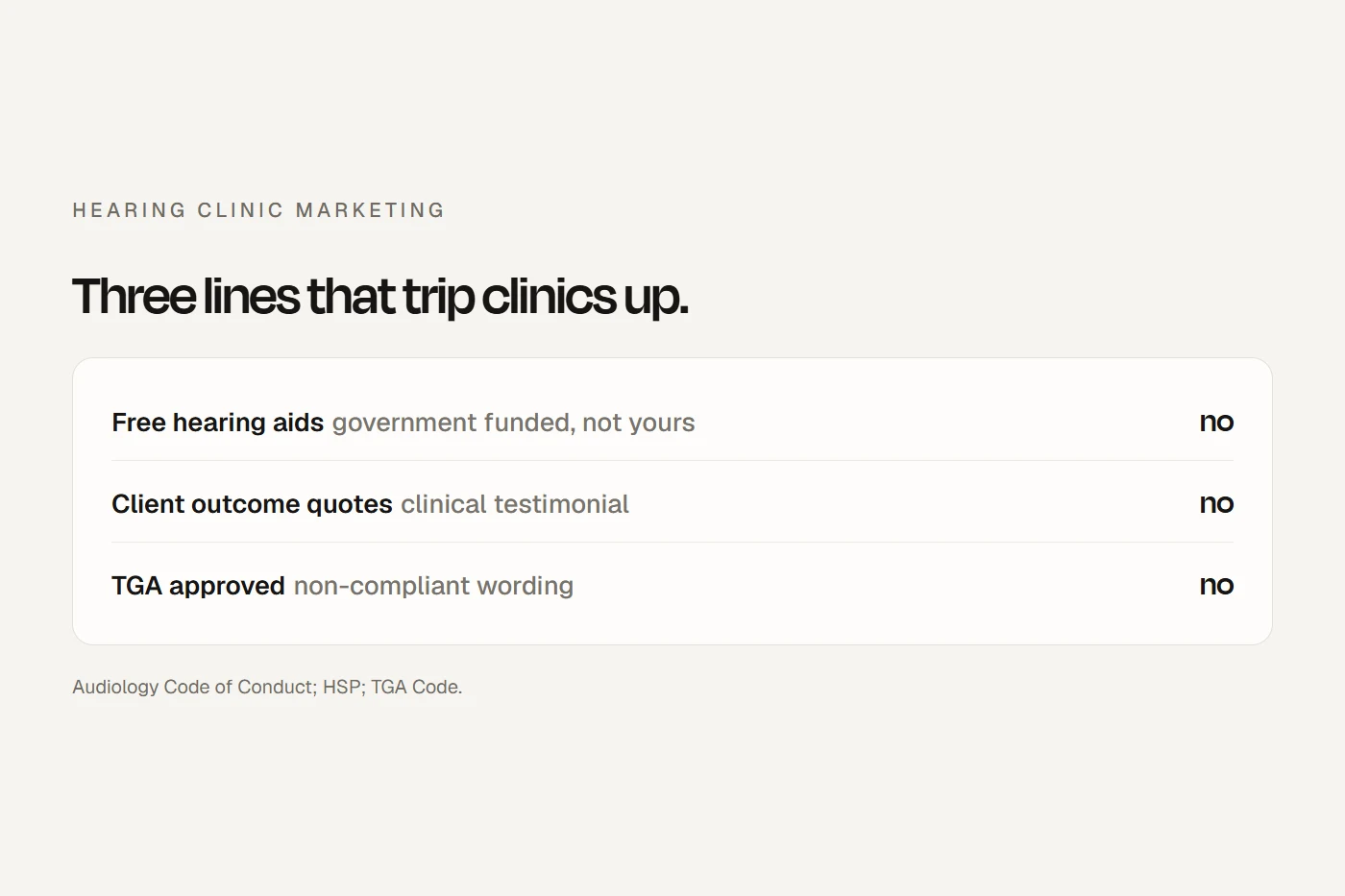
- Never "free hearing aids" from youProgram devices are government funded, not your gift. Use "conditions apply under the Australian Government Hearing Services Program" wherever you mention them, and no government logo.
- No clinical testimonialsThe Code bans them on your website and signs. Reviews about parking or friendly staff are fine, unedited.
- Lead with independence, honestlyPeople worry about sales-driven advice. If you fit several brands and pay no commissions, say so, and keep it true.
Who regulates a hearing clinic's marketing
Audiologists and audiometrists aren't registered with Ahpra today. They belong to two professional bodies, Audiology Australia and the Australian College of Audiology (ACAud), which share one Code of Conduct, enforced by the independent Hearing Professional Conduct and Complaints Body (HPCCB). The HPCCB says calling hearing services "unregulated" "is factually incorrect": on top of the Code, there's the Hearing Services Program contract, the TGA Advertising Code for any ad that promotes a device, the Australian Consumer Law, and your state's code of conduct for health workers. The title "audiologist" isn't legally protected, but the services are regulated.
That's changing. Health ministers have agreed to bring audiologists (not audiometrists) under Ahpra registration. It will take several years. When it happens, Ahpra's advertising rules will apply to audiologists' advertising. A clinic already following the Code is most of the way there, because the Code borrows Ahpra's definitions of testimonials and acceptable evidence. Until then, don't call your site "Ahpra compliant": Ahpra doesn't govern it yet.
The Code of Conduct: advertising rules
The Code binds members and certified practitioners of Audiology Australia and ACAud. Its advertising section says you must advertise "in a way that allows the public to make informed choices about their healthcare based on acceptable evidence". In practice:
- No unprovable claims about the effectiveness of your services, including in lifestyle charts, buyers' guides and questionnaires.
- No clinical testimonials "in advertising materials and public domains developed or controlled by" you, such as your website and signage, "including regarding the efficacy of aids and devices".
- No edited or cherry-picked reviews, even about non-clinical things, and no fictional ones.
- Terms on any offer. You "must not offer a gift or other inducement to attract a person" unless the ad states the terms.
- No cure claims for hearing loss.
- No referral payments. You must not "accept or offer financial inducements or gifts as part of client referral arrangements".
- Disclose supplier arrangements: exclusive supply deals, volume discounts, commissions, gifts or rewards, and devices made by a related party.
- Accurate titles and credentials, and no disparaging other clinicians or the profession.
- Display the Code summary and how to complain, at your premises.
The HPCCB's guidance draws the testimonial line clearly. A testimonial is clinical if it describes a symptom, a diagnosis or treatment, an outcome, or a practitioner's particular skill. It's fine to use one "about a non-clinical aspect of your service, e.g. your building's accessibility or how professional your front-of-house staff are". It isn't fine to "solicit or otherwise encourage your clients to provide testimonials about a clinical aspect of care on another public domain", such as a review site. So you can ask every client for a Google review, neutrally, but not prompt them to write about how well they hear now. I go further on health websites and leave review widgets off entirely.
The HPCCB also says any public comment "promoting your skills and experience is considered advertising", and "You can promote your skills, just not in comparison to others". It has received complaints about how clinics interpret research in their ads. A line like "untreated hearing loss causes dementia" needs the evidence quoted with its limits, not a headline.
The Hearing Services Program's advertising rules
If you're a contracted provider, the program's rules are the ones most often broken, and the program recently re-issued them to every provider. They apply "across all advertising and communication channels, including websites, email marketing, commercials and social media".
- The required phrase. Any ad or statement that refers to a service or device available to voucher-holders must include "conditions apply under the Australian Government Hearing Services Program".
- Not "free" from you. You must not suggest that fully subsidised devices are "provided free by the contracted service provider rather than by the Australian Government". The handbook goes further: "Advertisements for 'free' hearing services or devices are misleading."
- Don't knock subsidised devices. You must not suggest fully subsidised devices "are generally unsuitable", or that they're entry-level or basic. Paying for a partially subsidised device should be the client's choice, not an obligation.
- No government logo. The program's own visual identity graphics can be used to show you're a provider; the Australian Government logo can't.
- No implied endorsement. Don't suggest your accreditation is a Commonwealth recommendation, that the Minister's approval of a device is an endorsement, that you have a special relationship with the Department, or that program services are only available from you.
- Client choice. Clients can choose and change their provider at any time. Attending a screening, open day or promotion doesn't count as agreeing to sign up.
- Disclose supply arrangements. The program contract requires a written device supply disclosure to each voucher-holder, and the client booklet tells clients providers must disclose commissions and sales targets. An independent clinic with nothing to disclose can say so plainly.
Your program site listing is a free directory: clients use it to find providers, so keep hours, services and accessibility details current. DVA sends veterans to the same provider locator.
Advertising hearing aids: the TGA Code
A page that promotes hearing tests and consultations is a service ad. A page or post that promotes particular hearing aids, a brand, or "rechargeable invisible hearing aids" is also an ad for a medical device, and the TGA Advertising Code applies. The program contract also requires you to follow it where it applies. The rules that matter most:
- Every device ad needs the trade name, an accurate description, an accepted intended purpose, and "ALWAYS FOLLOW THE DIRECTIONS FOR USE" (or the longer version), prominently.
- Never "TGA approved". The TGA lists it as non-compliant.
- No guarantees. Not "effective in all cases", and not exaggerated performance, so no "you'll never miss a conversation again".
- No fear. Ads must not cause "undue alarm, fear or distress".
- No clinician endorsements. An ad can't carry an endorsement by "a current or former health practitioner, health professional", or anyone presenting as trained to diagnose or treat. A video of your audiologist saying "I recommend Brand X" is out.
- No paid testimonials, and reviews and user comments linked to your content become part of your advertising, "even if you didn't write" them.
- Free samples are restricted, another reason "free hearing aid" offers are risky. If you offer a trial on loan, describe the conditions, costs and timeframes plainly.
What the ACCC found
The ACCC's report on hearing aid sales found consumers felt "they could not trust clinicians to provide independent advice", concern about clients being offered "only one or a limited selection" of devices, and that "several of the large hearing clinic operators in Australia are owned by hearing aid manufacturers". It said sales targets and commissions "create incentives for clinicians" to supply aids that are "unnecessary or more expensive than a consumer needs", and that commissions were generally not disclosed. One of its examples began at a free seminar at a community organisation.
Two later cases show where the lines are. Two manufacturer-owned chains admitted newspaper ads to pensioners were misleading because they set a booking deadline when there's no deadline for a fully subsidised device, implied wireless features came with the free aid when they cost extra, and promised users would no longer miss any conversations. Separately, the government-owned provider admitted it had called its advice service "unbiased" when it was built to refer people to itself, wrongly said a service was government funded, and sent reminders saying optional maintenance subscriptions were mandatory.
The program's client survey adds one useful line: clients who were offered a range of devices were significantly more likely to be satisfied. Honest choice is good marketing.
Competing as an independent
Independence is the strongest thing an independent clinic can say, and it's a factual claim, so it has to be true and stay true. "Independent", "audiologist-owned", "we fit several brands" and "no sales commissions" are fine when accurate. "The big chains will upsell you" isn't: the Code bans disparaging other clinicians or the profession. A plain "How we choose your hearing aid" page does the work instead: the brands you fit, any supplier arrangements (or that there are none), and for voucher-holders, the full range of fully subsidised options. The HPCCB suggests wording like "We supply the [XX] brand hearing aids at our clinics, but there are other brands that may also meet your needs."
"Free hearing test" offers
Patients search for free tests, and the chains lead with them. What you can say depends on what it is:
- Free for everyone, no purchase needed: fine, but say what it is (a short screen or a full assessment), and state the terms, because a free test is an inducement under the Code.
- Free only for voucher-holders: it's a program service. Use the required phrase and don't present it as your gift.
- Free only if they buy: it isn't free. The ACCC says an ad that calls something free while the fine print mentions a payment is likely to mislead.
- No false deadlines. That was the heart of the ACCC case.
The HPCCB says shopping-centre screening by non-clinical staff is a recurring complaint, partly because people think a screen is a full diagnostic assessment. If you run screenings or community talks, say what the screen is, invite family members, have a member supervising, and never sign anyone up on the day.
GPs, ENTs, Medicare and DVA
GP referrals. Medicare now covers diagnostic audiology tests with a GP's written request, which must name the tests; screenings aren't covered, and only eligible audiologists can provide them. Audiology Australia tells GPs a referral is needed each time to claim, and that clinics may have an online referral form. Put one on your website that names the tests, send a short letter to nearby GPs, and report back to the GP after each referred client. Never pay or give gifts for referrals.
Veterans. DVA tells veterans "do NOT pay for a hearing device", and to ask the provider to seek prior approval if there's a cost. A veterans section that says exactly that matches DVA's own advice.
Funding page. Explain each path in words, with no amounts: the program voucher, Medicare-referred tests, DVA, health fund extras (which depend on the policy, so "check your cover"), and private fees.
What is a new client worth?
Put in your own figures. The defaults are made up, and there are no program, Medicare or fund amounts built in.
On the example figures, a device cycle is worth $2,500, a fitted client about $4,900 over three cycles, an average new client about $2,525, and one GP who refers two people a month about $60,600 a year. The number that moves the result most is how many clients return for their next device, which comes down to aftercare, recalls and honest device choice. And whatever a GP is worth, the Code bans paying for referrals.
Your website, Google profile and recalls
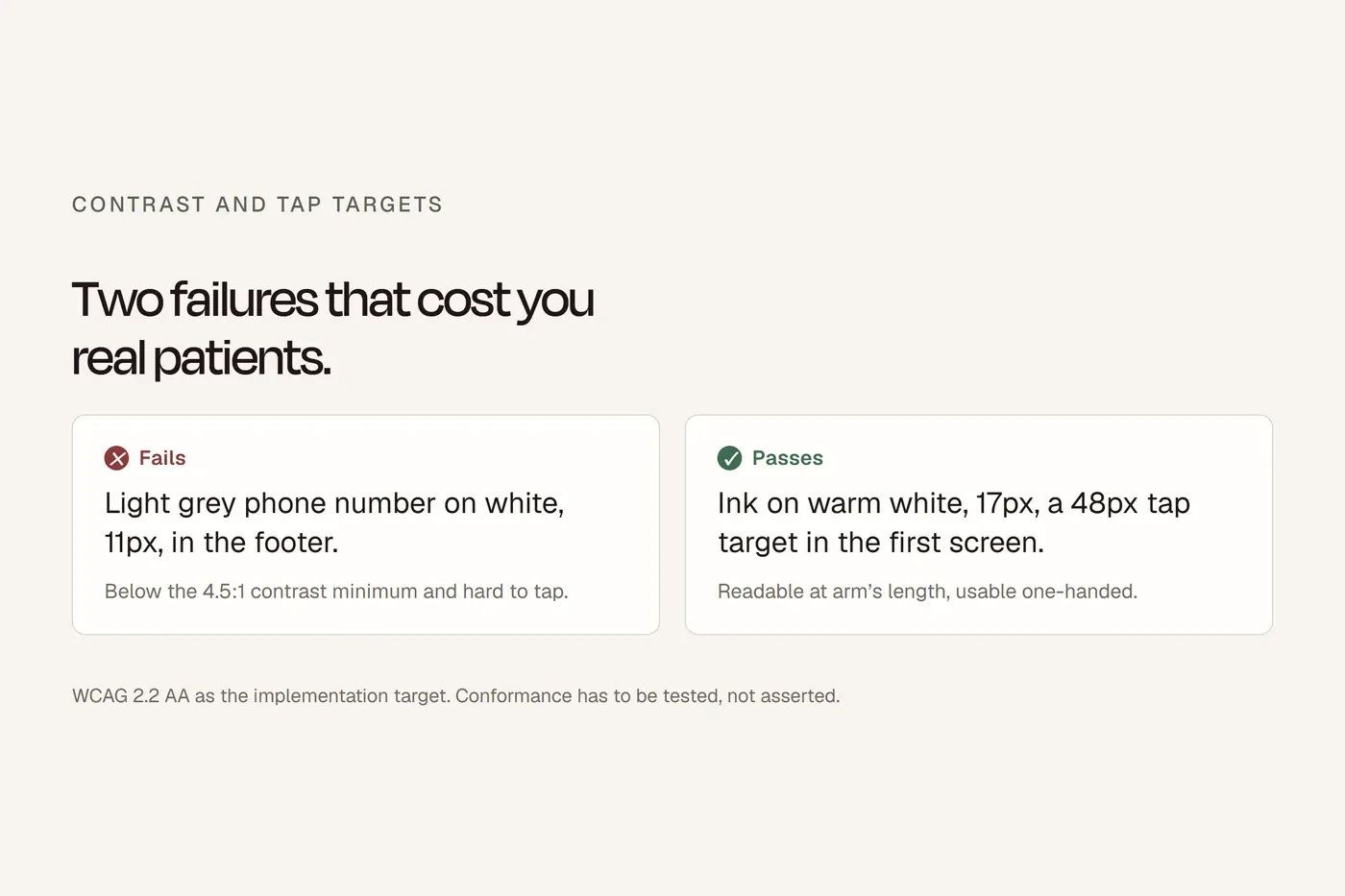
Website. Clinician bios that say "audiologist" or "audiometrist", the professional body and the exact accreditation wording. "Audiology Australia Accredited Audiologist" is a registered trade mark, so only accredited audiologists should use it, and avoid "hearing specialist" unless it's the exact name of a credential. Put text and email contact beside the phone, because some of your visitors can't easily hear it. Add the funding page, the "How we choose your hearing aid" page, the GP referral form, the program phrase wherever vouchers are mentioned, and the Code summary and complaint options. In NSW, the state code for health workers can be displayed on your website; elsewhere it must be displayed at your premises. My guide to clinic website accessibility covers the accessibility side.
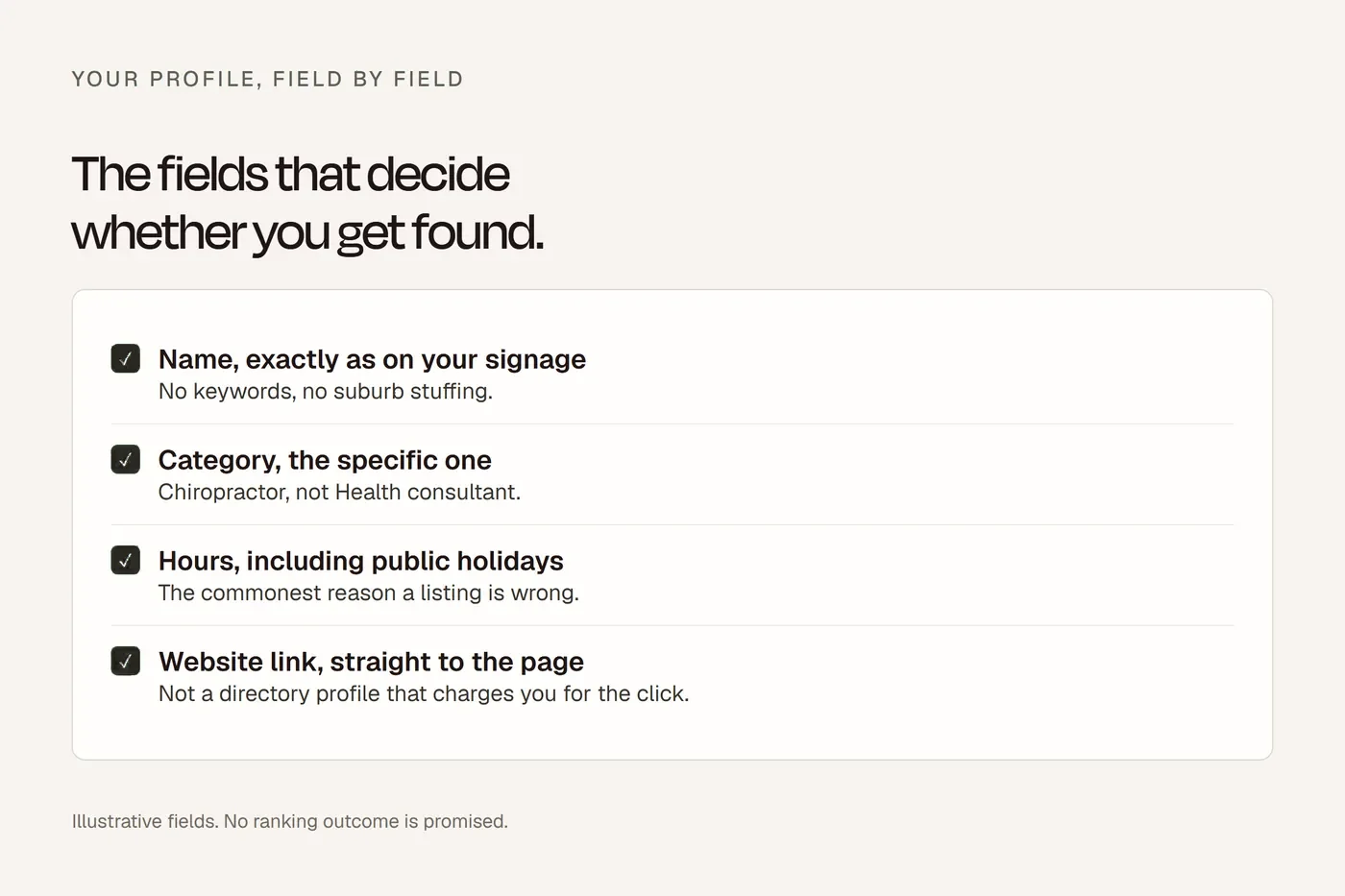
Google Business Profile. In local results, hearing clinics show as "Audiologist", "Hearing aid store" or "Medical clinic". Choose "Audiologist" as primary only if an audiologist practises there, and add "Hearing aid store" only if you really sell devices over the counter. Ask every client for a review the same neutral way, with no incentives and no staff targets. My Google Business Profile checklist for clinics covers the setup.
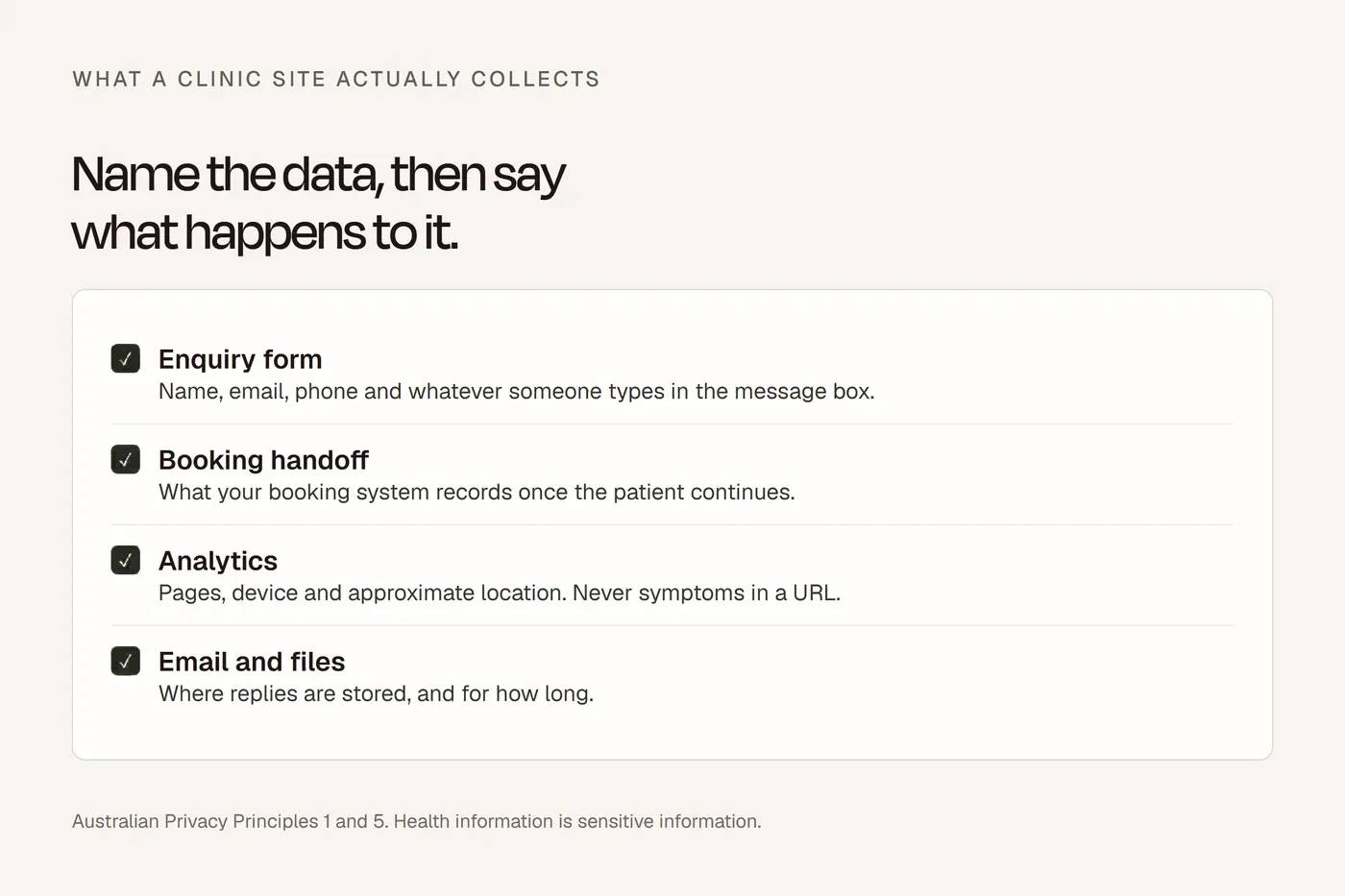
Recalls. Emails and texts are allowed under the program rules, but the Spam Act, Privacy Act and Do Not Call Register apply, and you must stop when a client asks. Describe maintenance as optional when it is.
Ads. On Meta, "Do you have hearing loss?" asserts a personal attribute; "Hearing tests in [suburb]" doesn't. If an ad mentions voucher services, it needs the program phrase. The program hasn't said how that works in a short search ad, so put it in the ad or its assets and on the landing page.
Can I say this?
Tap a card to see the verdict.
Your first 90 days
Tick items off as you go; the list remembers your progress on this device.
- Month 1: every "free" rewritten On the site, ads, Google posts and signage.
- Month 1: the program phrase added Wherever voucher services or devices are mentioned, including social posts and emails.
- Month 1: government logo removed Use the program's visual identity if you want one.
- Month 1: clinical testimonials removed From the site, signage and ads, and review widgets turned off.
- Month 1: device pages fixed Trade name, description, intended purpose and "ALWAYS FOLLOW THE DIRECTIONS FOR USE". No "TGA approved".
- Month 1: clinician bios checked Audiologist or audiometrist, body, exact accreditation wording.
- Month 1: Code summary and complaints displayed And in NSW, the state code on your website.
- Month 1: "How we choose your hearing aid" page Brands you fit and any supplier arrangements, or that there are none.
- Month 2: program site listing updated Hours, services and accessibility.
- Month 2: Google Business Profile The right primary category, services, hours, booking link, calls counted.
- Month 2: directories Audiology Australia, Independent Audiologists Australia if eligible, healthdirect.
- Month 2: GP referral form and letters Naming the tests, with reports back. No gifts.
- Month 2: veterans and funding pages In words, with no amounts.
- Month 3: neutral review requests To every client after the final fitting appointment.
- Month 3: recalls with consent Annual reviews and device-cycle reminders, maintenance described honestly.
- Month 3: the calculator run with real figures And a cost-per-new-client ceiling set for ads.
Questions I get asked
Can audiologists use testimonials?
Not about clinical care. The Code of Conduct for audiologists and audiometrists bans clinical testimonials on websites and signs a member controls, including about how well devices work. Unedited feedback about non-clinical things, like parking or staff, is allowed.
Can I advertise free hearing aids?
No. Fully subsidised devices are provided by the Australian Government, not the clinic, and the program's handbook says ads for "free" devices are misleading. Say "fully subsidised for eligible clients" with "conditions apply under the Australian Government Hearing Services Program".
Are audiologists regulated by Ahpra?
Not yet. Health ministers have agreed to bring audiologists into Ahpra registration, which will take several years. Until then, the shared Code of Conduct, the Hearing Services Program rules, the TGA Advertising Code, the consumer law and state codes apply.
Do hearing aid ads need a warning statement?
Yes. Under the TGA Advertising Code, an ad for a medical device must include its trade name, an accurate description, its intended purpose, and "ALWAYS FOLLOW THE DIRECTIONS FOR USE", prominently.
Can I say my clinic is independent?
Yes, if it's true. "Independent", "audiologist-owned" and "no sales commissions" are factual claims, so keep them accurate. Don't criticise other clinics: the Code bans disparaging other practitioners.
Is a hearing test covered by Medicare?
Diagnostic tests by an eligible audiologist can be, with a written request from a GP or other medical practitioner that names the tests. Screenings aren't covered.
About this guide
Written by Joseph Alzein, founder of bdog. I build websites for hearing clinics and allied health practices, around the audiology Code of Conduct, the Hearing Services Program's advertising rules and the TGA Advertising Code. Sources were checked on 12 October 2026. This is general information, not legal advice. I've left out voucher, Medicare, DVA and fund amounts, prices and penalties.
Main sources:
- HPCCB: Code of Conduct for audiologists and audiometrists
- HPCCB: can I use testimonials?
- HPCCB: ethical online behaviour
- Hearing Services Program (Voucher) Instrument
- Hearing Services Program: provider notice on advertising requirements
- Hearing Services Program: provider handbook
- Hearing Services Program: eligibility
- Therapeutic Goods Advertising Code
- TGA: testimonials and endorsements
- ACCC: issues around the sale of hearing aids
- ACCC: action against hearing aid retailers
- Services Australia: diagnostic audiology items
- DVA: hearing services
- Audiology Australia: regulation