How to get bookkeeping clients
94% of bookkeepers get clients by word of mouth and six in ten through accountants. Here’s how to work those channels, and the BAS line that decides what you can advertise, with a client value calculator and a 90-day plan.
On This Page
Most of what ranks for getting bookkeeping clients is written by software companies and American coaches. It skips the two things that matter most for an Australian bookkeeper. First, there's real data on where Australian bookkeepers' clients come from, and it isn't social media. Second, there's a legal line that decides what you can advertise: BAS services need Tax Practitioners Board registration, and advertising them while unregistered is a breach in its own right, even if you never do the work. This guide covers both, then goes channel by channel, from the Tax Agent Services Act, the TPB, the Institute of Certified Bookkeepers and the software companies' own pages, read on 12 October 2026. It's general information, not legal or tax advice.
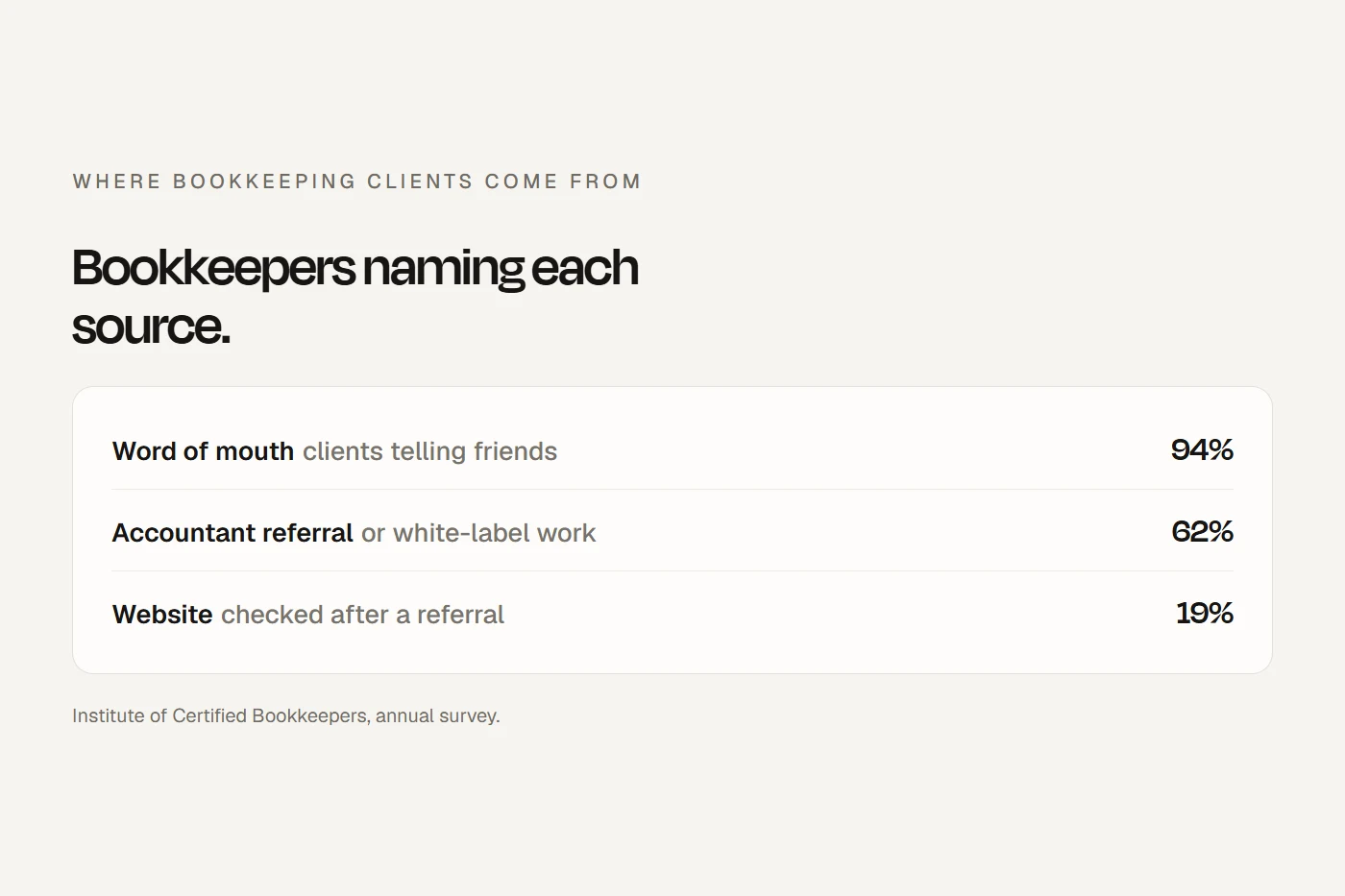
- Clients come through peopleIn ICB's survey of bookkeepers, 94% said clients came by word of mouth and 62% through accountants. Fewer than one in five named their website or Google.
- Know which side of the BAS line you're onData entry and bank reconciliations aren't BAS services. GST coding, activity statements, payroll with STP and super through a clearing house are. Unregistered, you can't advertise them.
- Accountants are your best channelEither they refer clients to you, or you do white-label work they supervise and bill. Each has its own rules.
Where bookkeeping clients come from
The best Australian data is the Institute of Certified Bookkeepers' annual industry survey, answered by more than 800 bookkeepers, nearly all of them ICB members. It asked how their clients found them, and they could pick more than one answer:
ICB's own reading is that digital channels play a role in "discovery and validation", but decisions are still driven by recommendation. In other words, the website's job is to confirm what the referrer said, not to replace the referral.
Two more numbers from the same survey are worth knowing. Finding clients was a problem for about one bookkeeper in four, while managing time was a problem for more than half. And about half were taking on more clients. So for many practices the real question isn't how to get more enquiries, it's how to get better-fitting clients from the channels that already work.
Buyers are being told what to check, too. Xero's guide to hiring a bookkeeper tells business owners to ask their accountant and industry contacts for referrals, check professional associations such as ICB, confirm the bookkeeper is a registered BAS agent with the TPB, call at least two referees, and ask their accountant to meet the shortlist. Every one of those is something your website and your accountant relationships can answer.
The BAS line: what you can advertise
A BAS service, under the Tax Agent Services Act, is a service working out or advising on a client's obligations under the GST, PAYG and other BAS provisions, or dealing with the ATO about them, where the client can reasonably rely on it. Doing that for a fee without being a registered BAS or tax agent is a breach. So is advertising that you'll provide a BAS service while unregistered, separately from doing it. And claiming to be a registered BAS agent when you're not is a third breach.
The TPB publishes a table of what is and isn't a BAS service. The TPB's guidance says "entering data, coding transactions based on instructions provided, processing payments or preparing bank reconciliations" aren't BAS services, because they don't need you to interpret or apply a BAS provision. These are:
- setting up accounting software with GST and other codes tailored to the client;
- coding transactions in a way that requires interpreting a BAS provision;
- working out the figures for an activity statement, or telling the client which figures to include;
- payroll that involves applying a tax law, including Single Touch Payroll reporting;
- super payments through a clearing house;
- the taxable payments annual report;
- advice on registering for GST, PAYG withholding or fringe benefits tax.
The TPB says whether a service is a BAS service "is a question of fact", so the label you give it doesn't decide it. "BAS-ready books" is fine if it really is record-keeping; it isn't if you're working out the figures. Test yourself:
If you're unregistered, every place you describe your services has to stay on the bookkeeping side: website, Google profile, directory listings and social bios. "BAS" in a service list is the usual trap. And if you're a registered BAS agent but not a tax agent, you can't advertise tax returns or income tax advice either.
White-label work for accountants
There's a well-trodden path for unregistered bookkeepers: working as a contractor for a registered agent. The TPB's guidance on contractors says you don't need registration if you're doing the work for the agent, the agent bills the client, and the client relies on the agent, not you. You do need registration if you provide services to the client for a fee "through" the agent; the TPB's own example is a contractor who lodges a client's BAS through a registered agent. On the accountant's side, the TPB expects "substantial supervision" of anyone working on their behalf, and the client's permission before their information is shared with a contractor. So the deal is: the accountant bills and supervises, you don't market that work as your own BAS service, and the engagement covers consent.
If you're registered, show it properly
A registered BAS agent can use the TPB's registered tax practitioner symbol. Each registrant has their own, it must be the version for your registration type, and "When you display your symbol you must include your registration number and type of registration." A company must use its own registration number, not a director's. A subcontractor can't borrow the supervising agent's symbol.
The TPB's code also expects registered agents to tell current and prospective clients, in writing, about the TPB register and how to complain to the TPB. Its example of doing that is a page on the website you use to promote your services. A footer link to "Information for clients" with both links covers it.
If you mention the safe harbour from some ATO penalties, use the TPB's own words: clients of a registered BAS agent "may not be liable to some administrative penalties ... in certain circumstances". "No ATO penalties, guaranteed" is a claim you can't back.
Can I say this?
Tap a card to see the verdict. General information, not legal advice; check the TPB's BAS services table.
The channels, one by one
Word of mouth
The biggest source by far. Make it easy: ask happy clients directly, give them a line they can repeat ("she does my books for a set monthly fee"), and ask for a Google review at the same time, with a link and nothing offered for it. You can reward referrals if you tell the client, but you can't name clients or tell their story without their permission. For registered agents that's the TPB code's confidentiality rule; for ICB members it's ICB's.
Accountants
Six in ten bookkeepers in the ICB survey get clients through accountants, and Xero tells business owners to have their accountant meet their shortlist. So list ten local accountants and offer them either referrals or white-label work. Bring what they'll check: your TPB register entry if you're registered, your professional indemnity insurance, a sample year-end handover checklist, and how you handle client consent. Registered agents mustn't use a disqualified person, and the TPB suggests they check by searching its register and asking for a written declaration, so have both ready. If either side pays a referral fee, the client should be told.
Directories
- Xero advisor directory: free, for Xero partners with staff trained in Xero and eight or more clients on Xero. A Xero staff member has said bookkeepers currently need TPB registration to join the partner program, though Xero's partner page still says "at least one registered accountant", so check before you plan around it.
- QuickBooks Find a ProAdvisor: for certified ProAdvisors. Profiles show ratings and reviews.
- ICB Find a Bookkeeper: lists members with a current ICB practising certificate, which needs professional indemnity insurance and the annual skills review.
- Australian Bookkeepers Association: its "Find a Bookkeeper" link goes to the Australian Bookkeepers Network marketplace, which is for network members, not plain ABA members.
Software partner programs brought clients to about one bookkeeper in eleven in the ICB survey, and the ICB directory to one in fifty. Worth doing, because they're free or included in memberships you may already have, but they won't carry a practice on their own.
Website and Google
Your website is where referred prospects check you out, so it needs what they're looking for: your services described on the right side of the BAS line, the software you support, how you charge, who does the work and where, your TPB registration if you have it, and an easy way to get in touch that doesn't ask for tax file numbers. A Google Business Profile with "Bookkeeping service" as the category, if that's what you are, and services that match your website. More in local SEO for small business.
LinkedIn and cold outreach
ICB says most bookkeepers' online presence is "a website and a LinkedIn profile", with few running active campaigns. LinkedIn works for staying visible to accountants and local business owners. What doesn't work, legally: scraped email lists, which the Spam Act bans separately from the consent rules, and automation tools that send connection requests and pitches, which LinkedIn's terms ban. My reading is that a sales message in a LinkedIn or Facebook inbox is likely a commercial message under the Spam Act too. You can email a business owner at an address they've published for their business about something relevant to their role, if they haven't said "no spam", with your name and an unsubscribe.
Paid ads
Bookkeeping doesn't fall into Google's or Meta's financial services verification categories as far as I can tell, so ads are straightforward to set up. The usual rules apply: nothing BAS if you're unregistered, no comparisons if you're an ICB member, and every claim provable. Start small, on your suburb plus "bookkeeper", and measure it with the calculator below.
A niche
In the ICB survey, construction, trades and retail were the industries bookkeepers most often served. A niche gives your website and your referral line something sharper to say, "bookkeeping for builders", and makes it easier for accountants to send you the right clients.
How you price
About half the bookkeepers in the ICB survey still prefer to bill by the hour, around a quarter combine fixed and hourly fees, and fewer than one in five use fixed fees alone. A fixed monthly fee with clear inclusions is easier for a referrer to repeat and for a client to compare. Say what's in and what's out, and show GST clearly. For prices aimed at sole traders, who aren't companies, it's safest to include it.
What a client costs, and what one is worth
Bookkeeping clients pay monthly for years, so judge a channel on what a client is worth over that time, not on the first month. Put in one channel's numbers; the starting figures are an example, not a benchmark.
Run the same sum for one accountant who sends you three clients a year, and you'll see why the accountant channel is worth a lunch a month.
A 90-day plan
Your ticks save in this browser.
- Decide which side of the BAS line you're on and write every service list to match: website, Google profile, directories and socials.
- If registered, request your own TPB symbol, show it with your number, and add links to the TPB register and complaints process.
- Set up your Google Business Profile with the right category and matching services.
- Join every directory you qualify for: QuickBooks, Xero, ICB or the ABN marketplace.
- Start counting enquiries by where they came from.
- List ten local accountants and offer referrals or white-label work, with your registration, insurance, a year-end checklist and how you handle consent.
- Put white-label terms in writing: the accountant bills the client and supervises.
- Ask every happy client for a referral and a Google review, with no reward for the review.
- Update your engagement letter with a referral fee disclosure and consent to share files with the client's accountant.
- Pick one industry you already serve and give it its own page and referral line.
- Run one small paid test with provable claims and nothing BAS if you're unregistered.
- Email only clients and contacts with consent or a published business address, with your name and an unsubscribe.
- Compare cost and value per client by channel, and drop the worst.
My view
Bookkeeping is a referral business, and the data says so plainly. Spend your time on clients who'll recommend you and accountants who'll send you work, and make sure that when a referral looks you up, your website says exactly what you do, on the right side of the BAS line, with your registration if you have it. Directories and ads are worth testing, but they're the small slices.
Questions I get asked
How do I get my first bookkeeping clients?
Through people: your network, past employers, and local accountants, who send work to six in ten bookkeepers in ICB's survey. White-label work for an accountant is a common way to start.
Do I need to be a BAS agent to be a bookkeeper?
Not for data entry, bank reconciliations, invoicing and bills. You do for GST coding, activity statements, payroll with STP and super through a clearing house, if you charge for them and the client relies on you.
Can an unregistered bookkeeper advertise BAS services?
No. Advertising a BAS service while unregistered is a breach of the Tax Agent Services Act in its own right, even if you never do the work.
How do bookkeepers charge?
About half prefer hourly billing, according to ICB's survey, with a growing share using fixed fees or a mix. A fixed monthly fee with clear inclusions is easier for clients to compare and referrers to repeat.
How do I get listed in the Xero advisor directory?
Become a Xero partner, train your staff in Xero and have eight or more clients on Xero. Xero has said bookkeepers currently need TPB registration to join, so check with Xero first.
About this guide
Written by Joseph Alzein, founder of bdog. bdog builds websites for bookkeepers. The rules come from the Tax Agent Services Act, the Tax Practitioners Board, the Institute of Certified Bookkeepers' code and the platforms' own pages, read on 12 October 2026. The client source data is ICB's survey of its members. This is general information, not legal or tax advice.
Main sources: