Marketing a counselling practice: no Ahpra, but rules that still apply
Why credentials matter more when the title is open, the three sets of rules that apply, what you can call yourself, Medicare versus health funds, where clients come from, your website, testimonials and reviews, and ads. With a directory value calculator, a wording sorter and a 90-day checklist.
On This Page
- Why credentials matter more for counsellors
- The three sets of rules that apply
- Titles: what you can call yourself
- Medicare, health funds and the free alternatives
- Where counsellors’ clients come from
- Is a paid directory worth it?
- What your website needs
- Testimonials and reviews
- Google and Meta ads
- Can I say this?
- Your first 90 days
- Questions I get asked
Can anyone call themselves a counsellor in Australia? Yes. Neither the title nor the practice is controlled by law, so a counsellor's website has to do the work that registration does for a psychologist: show who you are, what you trained in, who you're registered with, and how to complain. This guide covers the three sets of rules that apply to your marketing (consumer law, your state's code of conduct, and the ACA or PACFA code), the titles you can and can't use, Medicare versus health funds, where clients actually come from, and what to put on your website, Google profile and directory listings. It draws on the ACA and PACFA codes, the state codes of conduct, a Department of Health paper on regulating counsellors, PACFA's workforce survey, Beyond Blue and the ATO. It's general information, not legal advice.
- Your website has to prove your credentialsQualification, your registration body and level, supervision and insurance, with a link so clients can check.
- Never "psychologist", never Medicare"Psychologist" is protected by law, and counsellors aren't in Medicare's Better Access program. Health fund rebates may apply instead.
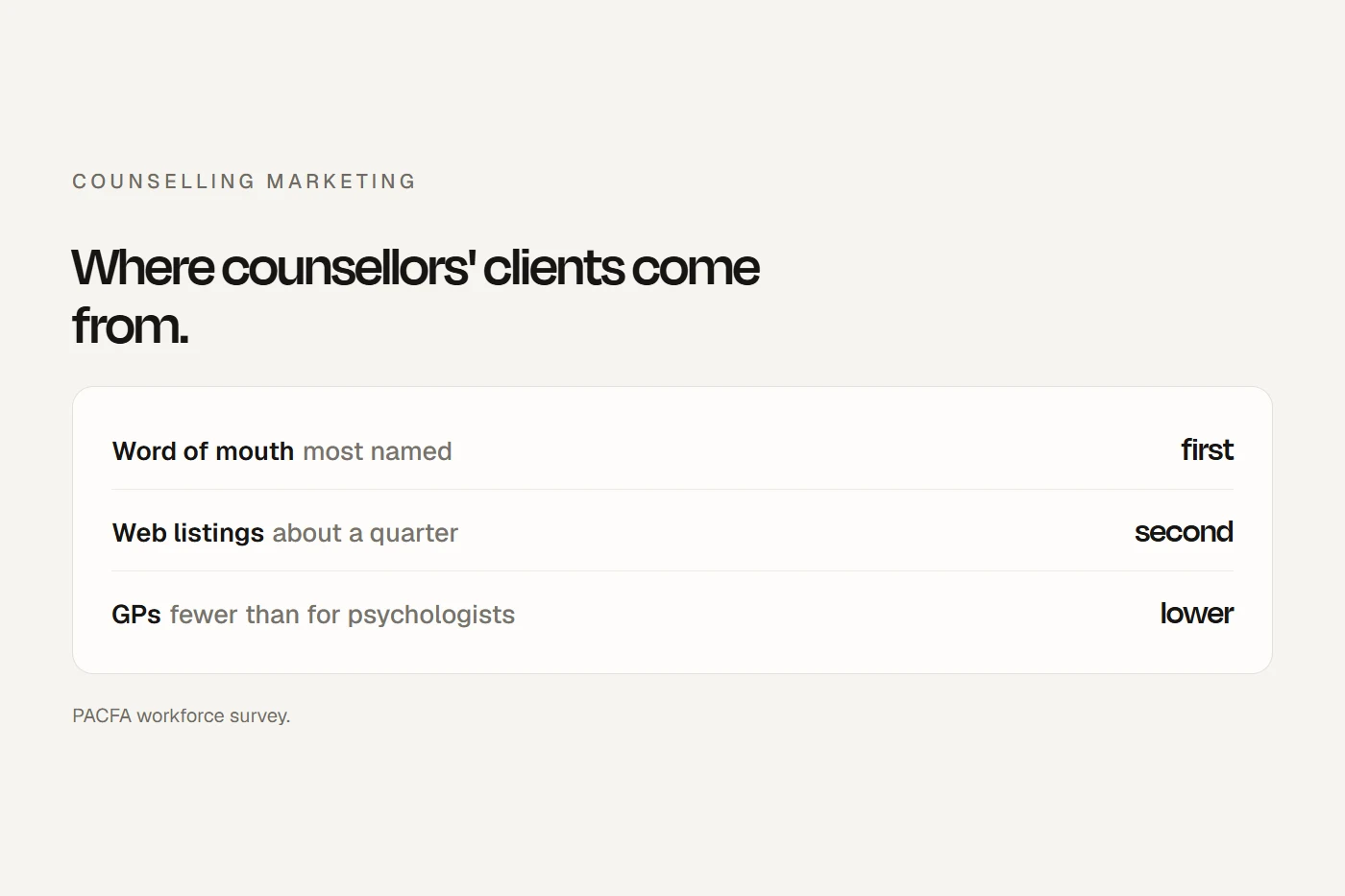
- Word of mouth and web listings bring most clientsIn PACFA's workforce survey, more counsellors named word of mouth than anything else, then web listings and community organisations, ahead of GPs.
Why credentials matter more for counsellors
A Department of Health paper on regulating counsellors put it plainly: "any individual may call themselves a counsellor or psychotherapist and provide talk therapy services, as there is no mandatory credential, licence or restricted act governed in legislation." It added that "consumers cannot reliably differentiate between highly trained practitioners and those with minimal preparation", and that counsellors have faced "issues of legitimacy and trust", including with GPs.
That's the central job of your website. A psychologist's registration does the trust work for them. You have to show it: your qualification and where it's from, whether you're registered with the ACA or PACFA and at what level or category, your supervision, your insurance, and how a client can check you on the Australian Register of Counsellors and Psychotherapists (ARCAP) or your association's directory. Beyond Blue sends the public to ARCAP and the ACA's directory to find "a qualified counsellor or psychotherapist", so link to wherever you're listed.
The three sets of rules that apply
Counsellors are self-regulated, but your marketing still answers to three sets of rules.
1. The Australian Consumer Law. No misleading claims, and fake, edited or selectively displayed reviews and testimonials are misleading.
2. Your state's code of conduct for unregistered health workers. It's in force in every state and territory except the NT, and health complaints bodies can issue prohibition orders under it. The clauses that touch marketing are the same in substance everywhere:
- No "misinformation or misrepresentation" about your services, qualifications, training or professional affiliations.
- No claims "about the efficacy of treatment or services" that can't be substantiated, in person or "in advertising or promotional materials".
- No financial inducements or gifts as part of referral arrangements.
- In NSW, you must not try to dissuade a client from seeking or continuing treatment with a medical practitioner, so no "counselling instead of medication".
- Display the code and how to complain. In NSW, the rule says at your premises or, if you have a website, "on the website". If you practise in NSW, put both on your site. In Victoria, the Health Complaints Commissioner offers text you can copy onto your website.
3. Your association's code. The ACA's Code of Ethics and Practice says "all advertising and public statements should be accurate in every particular", publicity material must reflect "the nature of the service on offer" and your training, qualifications and experience, and you mustn't display an affiliation in a way that "falsely implies sponsorship or validation". PACFA's new Code of Ethics and Professional Conduct, which replaced its 2017 code, says members "accurately disclose and display our qualifications, professional certifications and professional standing", tell clients how to complain to PACFA or a complaints body, and "do not make or receive referrals based on reciprocal arrangements or inducements".
Does Ahpra's section 133 apply? It covers anyone advertising a "regulated health service", which means a service "usually provided by" a registered practitioner. Whether counselling counts is untested; I found no Ahpra, board or court statement either way. If your practice also has psychologists, or you're registered in another profession, assume it applies. Either way, the state codes and the consumer law say much the same thing about misleading claims.
Titles: what you can call yourself
- "Psychologist" is protected. In one case, a man with a psychology degree and a master's in counselling, never registered as a psychologist, was found guilty of holding himself out as one, including on receipts and a clinical report. The board called it "a serious matter". A psychology degree doesn't make you a psychologist; registration does.
- "Counsellor", "psychotherapist" and "therapist" aren't protected, but they must be truthful.
- "Registered counsellor": name who with, such as "Registered Counsellor, Australian Counselling Association, Level 3", so nobody reads it as government registration. ARCAP doesn't confer statutory recognition.
- "Clinical counsellor": only if it matches your registration, such as PACFA Registered Clinical or the ACA level you hold.
- "Specialist": PACFA's advertising guidelines say "specialises in" may mislead, and "substantial experience in" or "working primarily in" are less likely to be misunderstood. "Works primarily with couples" beats "couples specialist".
- "Dr": say your profession if you're not a medical practitioner and your doctorate isn't in counselling or psychotherapy, as in "Dr Sam Lee (Psychotherapist)".
- Students must say "student counsellor".
- Logos: PACFA's FAQ says only clinical registrants may show the PACFA logo.
Medicare, health funds and the free alternatives
Medicare. Counsellors and psychotherapists aren't eligible for Better Access; the eligible allied health professionals are psychologists, social workers and occupational therapists. The ACA and PACFA are still advocating for change. National standards for counsellors and psychotherapists have been endorsed by the Health Minister but not implemented, and the Department has consulted on how they might be regulated. Nothing has changed for your marketing yet. Never imply a Medicare rebate. Beyond Blue tells the public "You don't need a referral to see a counsellor or psychotherapist. Medicare rebates aren't available", and that's the honest answer to put on your site.
Health funds. PACFA and the ACA have agreements that let eligible members get provider numbers with private health funds. PACFA lists Medibank, ahm, Bupa, HCF and the funds in the Australian Regional Health Group, and requires clinical registration. For ACA members, the regional fund group asks for Level 3 or 4. Medibank and ahm recently changed their criteria to line up with the national standards. On your website, write "Rebates may be available through your private health extras with [the funds you're registered with]. Check your cover with your fund." List only funds where you hold a provider number, and never print rebate amounts.
Other schemes. WorkSafe Victoria only pays for counselling by counsellors it has registered, which needs ACA Level 3 or 4 or PACFA clinical membership. NDIS counselling sits under a single counselling item. Say "WorkSafe clients welcome" or "NDIS participants welcome" only when it's true, in words, with no prices.
GST. Counselling isn't on the ATO's list of GST-free health services, and a service "cannot just be similar" to a listed one. If you're registered for GST, your advertised fee must include it.
The free options. Medicare Mental Health Check In offers free guided programs with no referral, and Medicare Mental Health centres and phone support are free too. For early, mild concerns, some people will start there. Don't disparage them. What you offer is choice of practitioner, longer and deeper work, couples and family work, in-person rooms, and fit.
Where counsellors' clients come from
PACFA's workforce survey is the best Australian data. Asked where their clients came from, 57.6% of counsellors named word of mouth, 26.2% web listings, 22.7% community organisations, 18.1% medical practitioners, 15.0% advertising, 14.5% mental health services, 10.9% social media and 8.6% a professional association register. The authors saw "a shift away from referrals through medical practitioners" towards word of mouth and online sources. That's the reverse of a psychologist's mix, where Medicare makes GPs central.
So for a counsellor, being findable online and known locally does more than chasing GPs. Make it easy for people to pass you on, with a plain "who I see and how to book" page and a printable one-pager, never by rewarding clients. Introduce yourself to community organisations, school wellbeing staff and GP practices with a one-page letter: credentials, fees, availability, what you do and don't see, and how you'll keep the GP informed with the client's consent. No gifts or "I'll refer to you if you refer to me" deals.
Is a paid directory worth it?
Your ACA or PACFA listing, ARCAP, your Google profile and healthdirect cost nothing extra. Psychology Today and independent counselling directories charge a subscription. Put in your own numbers; there are no defaults for fees, because I don't print them.
Because one client usually stays for several sessions, a directory doesn't need many clients to pay for itself. The useful questions are whether the enquiries arrive, and whether you have room for them. If your week is already full, fix your availability before you pay for more enquiries.
What your website needs
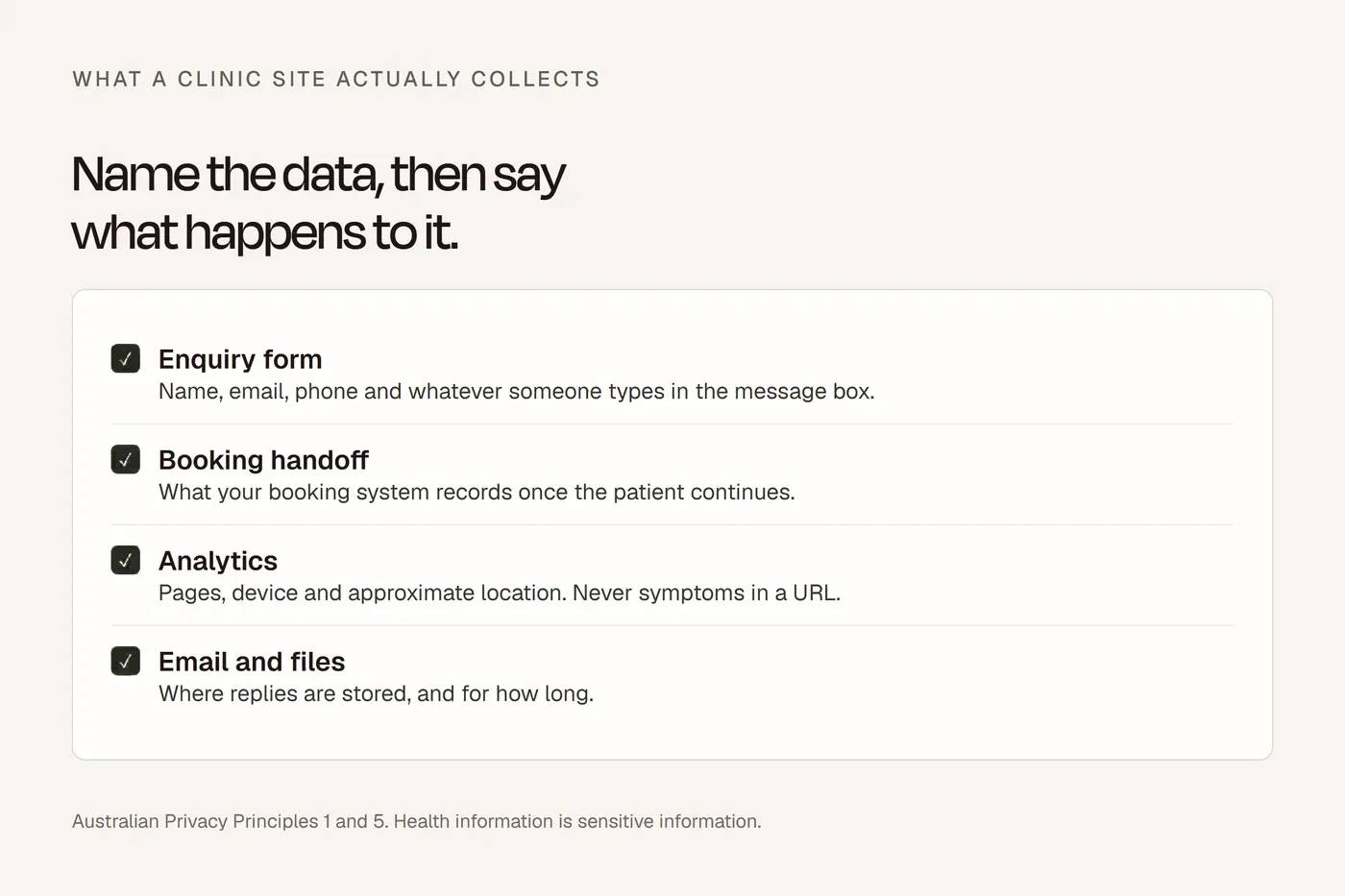
- A credentials block on the About page and every directory profile: qualification, body, level or category and what it means in one line, supervision and insurance, with a link to ARCAP or your association's search. The ACA's code says counsellors "are encouraged to display and/or mention" their accredited qualifications and memberships.
- A complaints line in the footer linking your state's complaints body and your association. In NSW, add the code of conduct and the HCCC complaints notice.
- Fees: exact, with GST if you're registered, your cancellation terms, "No GP referral needed", and the health funds you're registered with, in words.
- Explainer pages: "counsellor, psychotherapist or psychologist: what's the difference?", "do I need a referral, and can I use my health fund?", and "what happens in the first session".
- Claims you can back up. "Helps 9 out of 10 clients" or "proven to fix anxiety" is an efficacy claim. If you mention an approach's evidence, cite a reputable, peer-reviewed source.
- A crisis strip and a "not a crisis service" line on your contact and booking pages, with Lifeline 13 11 14 and 000.
- Short contact forms. The Privacy Act covers health service providers whatever their turnover, so ask people not to send their history through the form.
- No therapy by chatbot. PACFA's code says "We do not delegate therapeutic responsibility to AI tools".
Testimonials and reviews
Counsellors aren't banned from testimonials the way psychologists are. The ACA's code has no testimonials clause; its accuracy, confidentiality and consent rules still apply. PACFA's older advertising guidelines allowed them if truthful, factual and with "clear permission statements". PACFA's new code says "We do not solicit testimonials in exchange for remuneration or where there is potential for exploitation of or harm to a client", and asking a current client sits close to that line given the power imbalance.
I leave testimonials and review widgets off counsellors' websites. One quote about how therapy helped can identify a client to the people who know them, and if section 133 does reach counselling, it's a breach. The ACA's code also requires informed consent and effective disguise for any case material, so "a client I'll call Sam" doesn't belong in promotional posts.
Google reviews. Clients may leave them. If you ask, ask everyone the same neutral way after the work has ended, never in session, and offer nothing in return. Never confirm in a reply that someone is or was a client. A safe reply: "We can't discuss anyone's care, or confirm whether someone has seen us, in a public reply. If you'd like to talk, please call us." The privacy regulator found a business's review reply that disclosed a reviewer's details was an interference with privacy.
Google and Meta ads
Google Ads treats mental health counselling as a sensitive interest category, so no remarketing to your site visitors and no uploading client lists. Plain search ads on "[service] counselling [suburb]" are fine. Alcohol and drug counselling ads need Google's certification.
Meta bans ads that assert or imply a personal attribute. Its own allowed examples include "Depression counseling", and its banned example is "Depression getting you down? Get help now." "Couples counselling in [suburb]" is fine; "Is your relationship falling apart?" follows the banned pattern.
Can I say this?
Tap a card to see the verdict.
Your first 90 days
Tick items off as you go; the list remembers your progress on this device.
- Month 1: title check No "psychologist" or "psychological"; "Dr" with your profession; no "specialist"; "clinical" only if it matches.
- Month 1: credentials block On the About page and every profile, linked to ARCAP or your association.
- Month 1: complaints line Your state body and your association. NSW: the code and HCCC notice on the site.
- Month 1: fees page Exact fee, GST status, cancellation terms, no referral needed, funds you're registered with.
- Month 1: testimonials and review widgets removed And Facebook comments moderated.
- Month 1: every page checked against the sorter Outcome claims, "free", bulk deals, urgency.
- Month 1: crisis strip on contact pages
- Month 2: Google Business Profile The closest category, your booking system linked, calls and bookings counted.
- Month 2: directories ACA Find a Counsellor, PACFA Find a Therapist, ARCAP, then one paid directory decided with the calculator.
- Month 2: health fund provider numbers For every fund you're eligible for.
- Month 2: a pass-me-on page Who you see and how to book, plus a printable one-pager.
- Month 3: introduction letters To nearby community organisations, school wellbeing staff and GP practices. No gifts or swap deals.
- Month 3: EAP and scheme panels EAPs, WorkSafe Victoria if eligible, NDIS only if you can serve participants well.
- Month 3: two explainer pages Counsellor versus psychologist, and referrals and health funds.
Questions I get asked
Can anyone call themselves a counsellor in Australia?
Yes. Neither the title nor the practice is controlled by law. That's why your website should show your qualification, your ACA or PACFA registration and level, your supervision and insurance, and how clients can check you on ARCAP.
How do I get more counselling clients?
Most counsellors' clients come through word of mouth, web listings and community organisations. Make your credentials and fees clear, list on the ACA or PACFA directory and ARCAP, set up your Google profile, and introduce yourself to local organisations and GPs with information, never gifts.
Can counsellors offer Medicare rebates?
No. Counsellors and psychotherapists aren't eligible for Medicare's Better Access program. Clients may be able to claim through their private health extras if you hold a provider number with their fund.
Can counsellors use client testimonials?
The ACA's code has no testimonials clause, and PACFA's new code limits asking for them. I still leave them off: a testimonial can identify a client, and if Ahpra's advertising law reaches counselling, it's a breach.
Do counsellors charge GST?
Counselling isn't on the ATO's list of GST-free health services, so if you're registered for GST, your sessions include it and your advertised price must too.
Can I call myself a clinical counsellor?
Only if it matches your registration, such as PACFA Registered Clinical or the ACA level that uses the term. "Clinical" isn't a legal title, but your code and your state's code of conduct require you to describe your standing truthfully.
About this guide
Written by Joseph Alzein, founder of bdog. I build websites for counsellors and psychotherapists, with the ACA and PACFA codes in mind. Sources were checked on 12 October 2026. This is general information, not legal advice. I've left out rebate amounts, fees and penalties.
Main sources:
- PACFA Code of Ethics and Professional Conduct
- PACFA: guidelines for advertising counselling and psychotherapy services
- ACA Code of Ethics and Practice
- ACA: Find a Counsellor
- Australian Register of Counsellors and Psychotherapists
- Department of Health: regulatory options for counsellors and psychotherapists
- PACJA: the counselling and psychotherapy workforce in Australia
- NSW Health: code of conduct for unregistered health practitioners
- Victorian Health Complaints Commissioner: general health service providers
- Psychology Board of Australia: counsellor posing as a psychologist
- Beyond Blue: find a mental health professional
- ATO: GST and other health services
- WorkSafe Victoria: counselling services policy
- Medicare Mental Health Check In