Squarespace, Wix, WordPress or custom: a website for your psychology or counselling practice
Most advice on website builders for therapists is American. This is the Australian version: what Squarespace, Wix and WordPress cost in Australian dollars, how each connects to Halaxy, Cliniko, Coreplus and Zanda, where your enquiries are stored, and what you can say under Ahpra and the counselling codes.
On This Page
- The options at a glance
- Squarespace
- Wix
- WordPress, self-hosted
- A website from your practice software?
- Connecting your booking system
- Privacy: the part American guides get wrong
- Accessibility
- What you can say: Ahpra for psychologists, codes for counsellors
- Medicare wording
- Directories: Psychology Today and the rest
- Which one should you choose?
- Questions we get asked
Search "best website builder for therapists" and almost everything you'll find is American. US dollars, HIPAA compliance, insurance billing, therapist directories that don't operate here. Useful for a therapist in Ohio. Not much use to a psychologist in Parramatta or a counsellor in Fremantle.
This guide is the Australian version. Prices in Australian dollars as each vendor showed them on 7 October 2026, how each option connects to Halaxy, Cliniko, Coreplus and Zanda, where your enquiries end up being stored, and what Ahpra, the counselling associations and Medicare mean for the words on the page. We build custom websites for practices, so we have a stake in this. We've tried to be fair to the do-it-yourself options anyway, because for plenty of practices they're the right call.
The options at a glance
| Option | What you pay | GST | Who does the work | Best for |
|---|---|---|---|---|
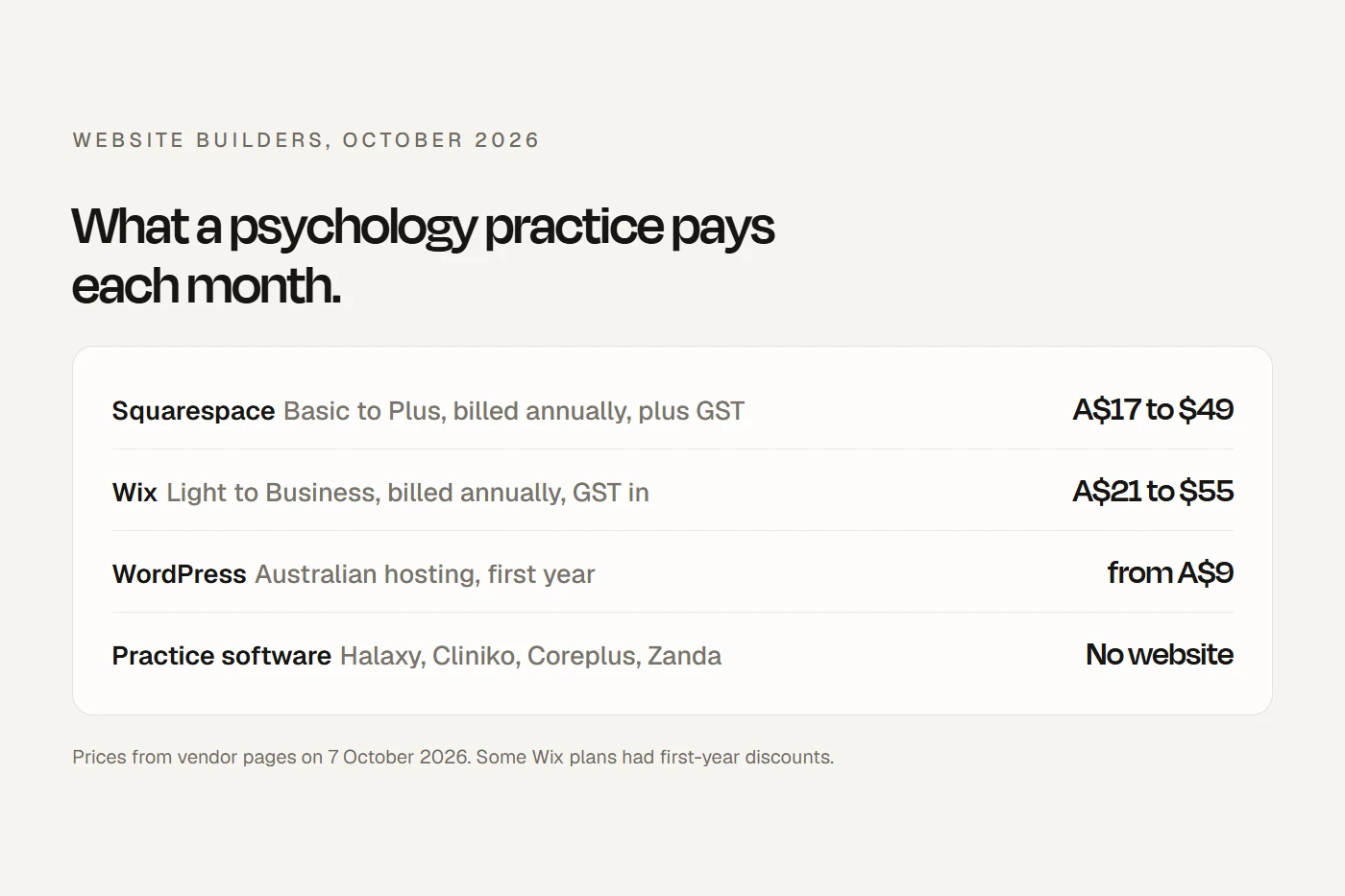
| Squarespace | A$17 to A$49 a month billed annually (Basic to Plus) | On top | You | A polished site with little upkeep |
| Wix | A$21 to A$55 a month billed annually (Light to Business), with first-year discounts | Included | You | The most hands-on editing, lots of templates |
| WordPress, self-hosted | Hosting from about A$9 a month in year one, plus a domain, theme and plugins | Included at the host we checked | You or a developer | Full control, Australian hosting |
| Your practice software | No full website product from Halaxy, Cliniko, Coreplus or Zanda | A booking page or directory profile while you start out | ||
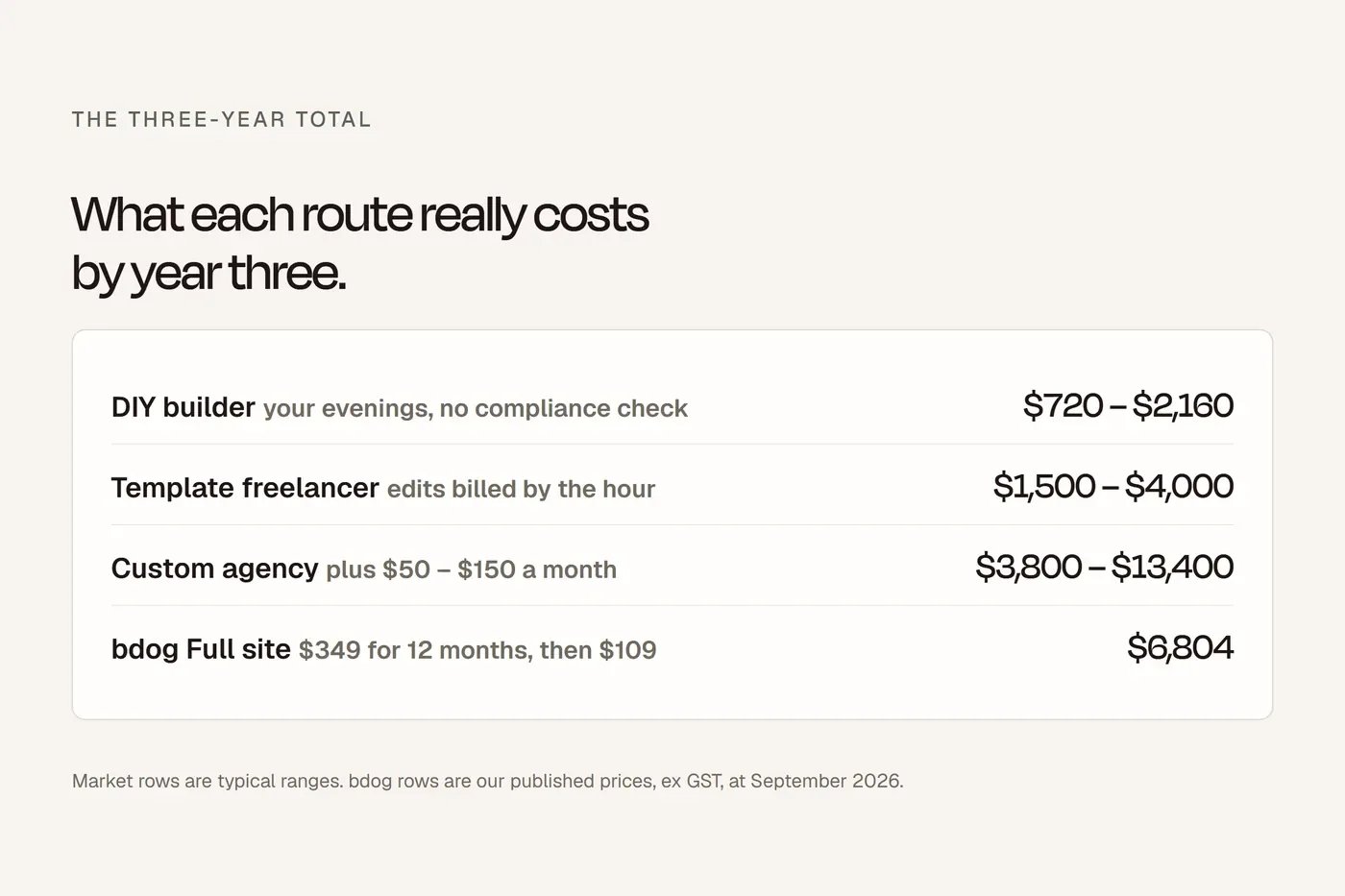
| Custom or subscription build | Agencies commonly $2,000 to $8,000 up front plus hosting; ours is $249 to $449 a month for a year, then $89 to $129 | Ours is plus GST | The studio | Practices that want it done and checked |
Scroll the table sideways to see every column.
The agency range comes from our clinic website cost guide, which works out the three-year total for each route.
Squarespace
Squarespace is the one most psychologists mention first, and for good reason. The templates look calm and professional out of the box, there's a dedicated page of therapist templates, and there's very little to maintain: no plugins to update, no hosting to manage.
Price. Billed annually, Basic is A$17 a month, Core A$28, Plus A$49 and Advanced A$109. Paying monthly costs more, from A$24 for Basic. Squarespace's help centre says listed prices don't include GST, so add 10 per cent. If you're registered for GST you can enter your ABN and skip it; if you have an ABN but aren't registered, you'll pay it. A private practice doesn't need online store features, so Basic or Core covers most.
Bookings. Squarespace's own scheduling tool, Acuity, is priced in US dollars, from US$16 a month on an annual plan. Its top plan advertises HIPAA features, which is a US law and means nothing for an Australian practice. Most Australian psychologists already have a booking system in Halaxy, Cliniko, Coreplus or Zanda, and it makes more sense to connect that (see below) than pay for a second one.
Data. Squarespace says it stores your data in data centres across the United States. That matters for your contact form, which we'll come to.
Wix
Wix gives you the most freedom to drag things around, which is a blessing or a curse depending on how much you enjoy fiddling. It has a "Therapist" template in its health and wellness range, and a built-in bookings app.
Price. On the Australian plans page, billed annually: Light A$21 a month, Core A$42, Business A$55 and Business Elite A$199, each marked "Price includes GST". In October 2026 Core, Business and Business Elite were half price for the first yearly term, so check what you'll pay at renewal. There's a free plan, but it shows Wix branding and doesn't let you use your own domain.
Data. Wix says it stores information in data centres in the United States and Ireland, and that it's based in Israel.
Accessibility. Wix has an Accessibility Wizard that scans your site and suggests fixes. Wix itself says it can't guarantee your site will meet your local accessibility laws after you use it, which is honest and worth remembering.
WordPress, self-hosted
WordPress is free software that runs a large share of the web, and it can do anything. The catch is that you, or someone you pay, keep it running: hosting, a theme, plugins, updates, backups and security. An out-of-date WordPress site is a security risk, and nobody will tell you it's out of date.
Price. At VentraIP, an Australian host, WordPress hosting was A$9.25 a month for the first year in October 2026, normally A$18.50, and a .com.au domain was A$9.95 for the first year, normally A$22.95. VentraIP's terms say published prices include GST. Add a premium theme and any paid plugins, and your time.
What you get for the trouble. You choose the host, so you can choose one in Australia. You own every file. And you can connect any booking system any way you like. If you're comfortable with it, or have a developer you trust, it's a good option. If you aren't, it's the one most likely to break quietly.
A website from your practice software?
We checked the four systems Australian psychologists use most. None of them sells a full practice website as of October 2026, but each gives you something you can point people to.
Halaxy includes a free directory listing and online bookings in its free core software, and lets you embed a branded booking calendar on your own site. Cliniko gives every account a booking page with its own web address, and says so plainly: "No company website? No problem!" Coreplus gives you a client portal to link to from a Book Online button. Zanda doesn't build websites; it lists outside web design partners instead, one of which is a Squarespace studio.
For a brand-new solo practice, a Halaxy profile or a booking page can carry you for a few months. It won't help you show up when someone searches for a psychologist in your suburb, and it doesn't tell a nervous first-time client anything about you. That's what the website is for.
Connecting your booking system
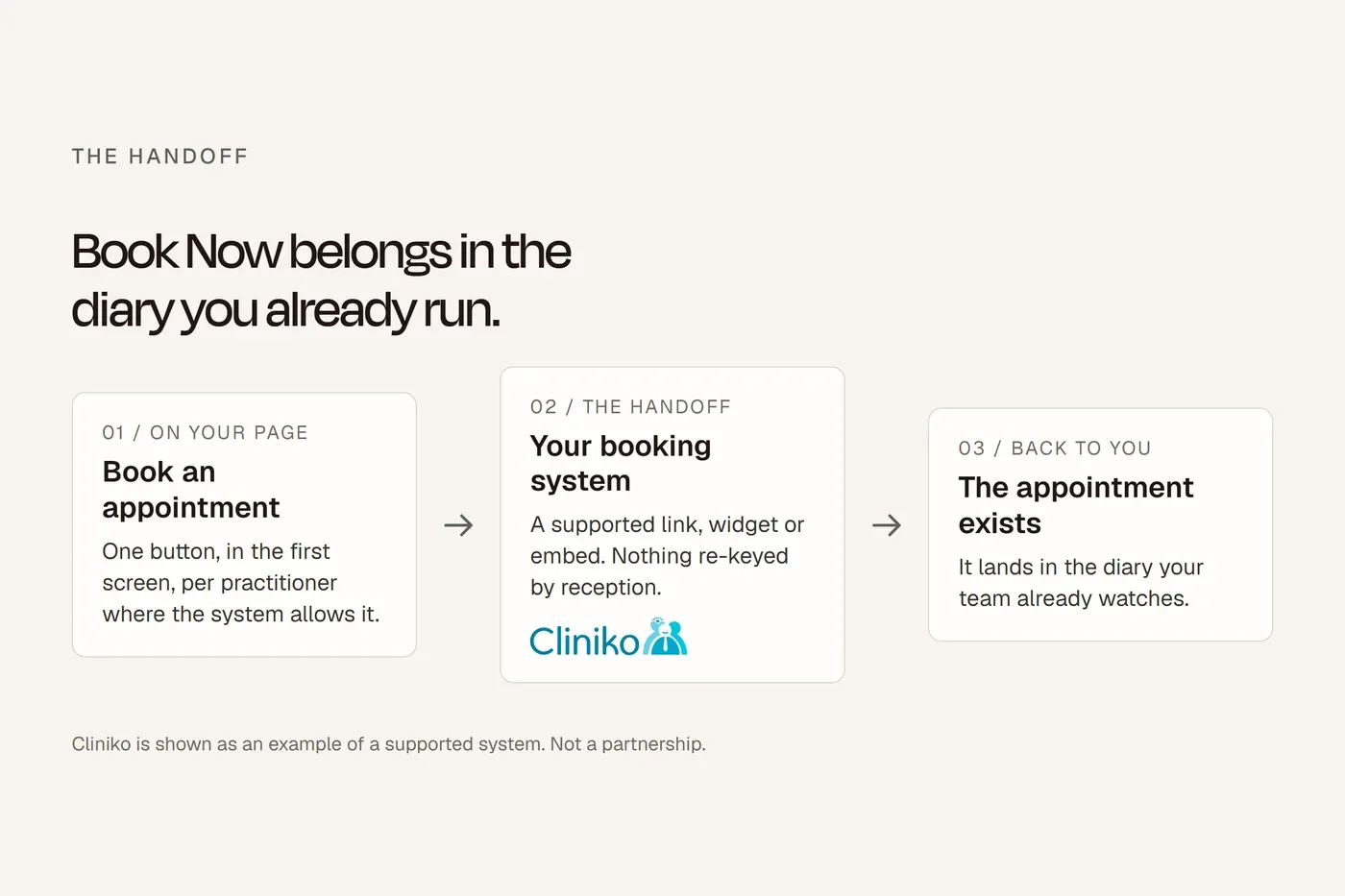
Every builder above can take a "Book now" button that links to your booking page. Embedding the booking calendar inside your own page needs the builder to accept custom code. Here's what each system offers, from its own help pages.
| System | Embed on your page | Button or link | Worth knowing |
|---|---|---|---|
| Halaxy | Yes, HTML embed code | Yes | Part of the free core |
| Cliniko | Yes, from Settings, Online bookings | Yes, with links for each practitioner | Only admins can copy the code |
| Coreplus | Not in the help pages we read | Yes, a Book Online button to the client portal | Coreplus recommends the button |
| Zanda | Yes, iframe | Yes, plus a QR code | Zanda calls the button the most straightforward method |
Scroll the table sideways to see every column.
Our view: a clear button that opens the booking page is usually better on a phone than a cramped embedded calendar, and it's easier to track. Our online bookings guide goes through every system in detail.
Privacy: the part American guides get wrong
American articles talk about HIPAA. It's a US law. A "HIPAA compliant" badge on a builder tells you nothing about Australian law.
Here, the Privacy Act covers every health service provider regardless of turnover, and the OAIC's definition includes services for emotional, psychological and mental health. That takes in counsellors as well as psychologists. Three things follow for your website.
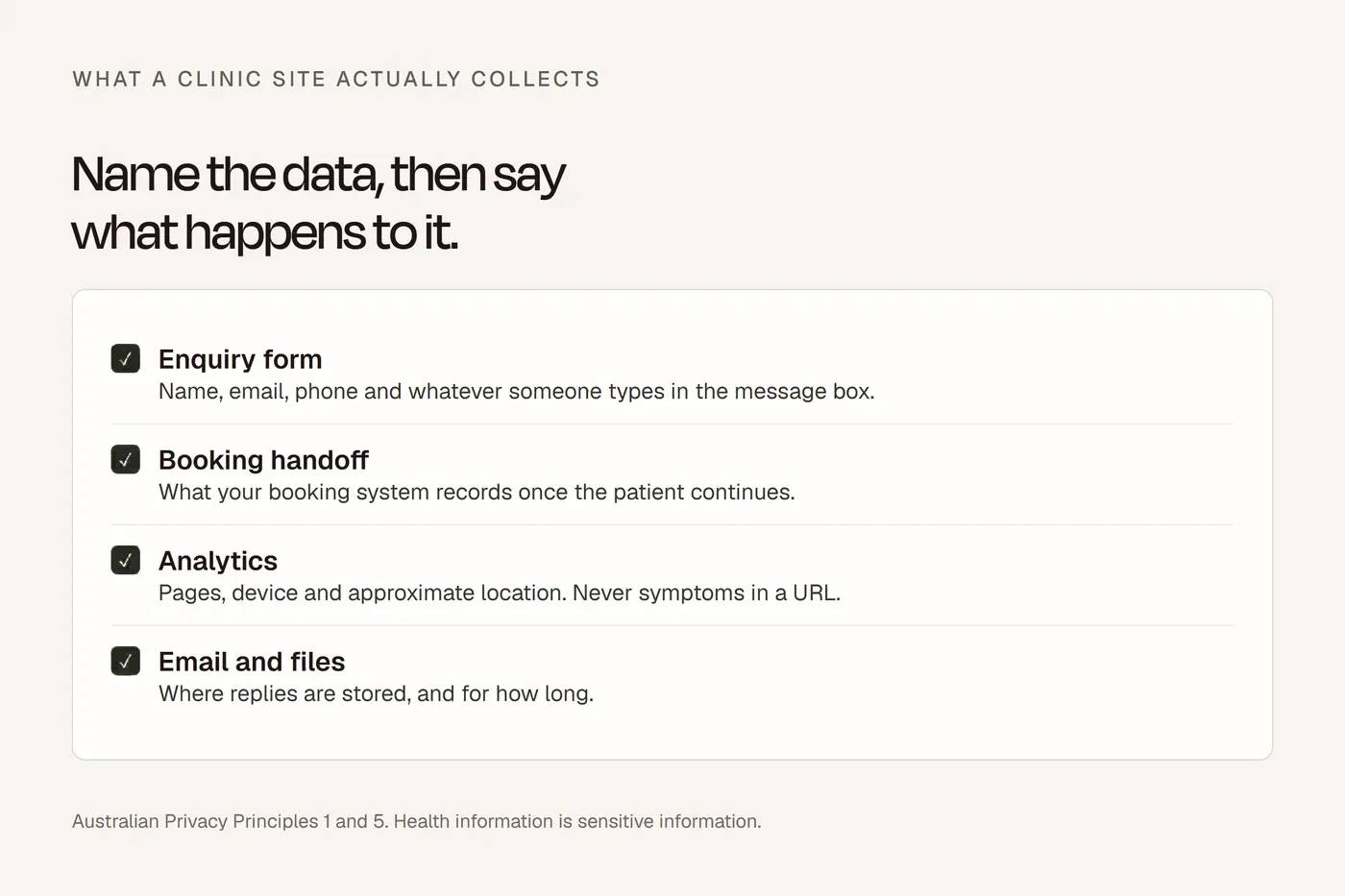
Your contact form is a collection point. Whatever someone types into it is stored by the website platform, which for Squarespace means the United States and for Wix the United States or Ireland. People reaching out to a psychologist often explain why. Keep the form to name, contact details and a preferred time, and add a line asking people not to include details about their mental health. Do intake inside your practice software, which is built for it.
Your privacy policy has to say where data goes. Under APP 1.4, a privacy policy must say whether you're likely to disclose personal information to overseas recipients and, if it's practicable, which countries. If your site runs on a US platform, that belongs in the policy. Our privacy policy guide covers the rest of what goes in it.
Overseas storage has rules. APP 8 makes you accountable for an overseas recipient's handling of personal information you disclose to it. The OAIC says that in limited circumstances, giving information to an overseas cloud provider purely for storage can be a "use" rather than a "disclosure", depending on the contract and how much control you keep. That's a question for your professional association or a lawyer, and a good reason to keep health details out of the website altogether.
Accessibility
None of the builders makes your site accessible on its own. Squarespace's own accessibility page acknowledges that its users have the freedom to build sites that aren't accessible to everyone, and Wix says its wizard can't guarantee compliance. The things that matter most are yours to get right: text contrast, headings in order, image descriptions, form labels, and a booking flow that works without a mouse. Our accessibility guide has the details.
What you can say: Ahpra for psychologists, codes for counsellors
A website builder will happily let you publish things the law won't.
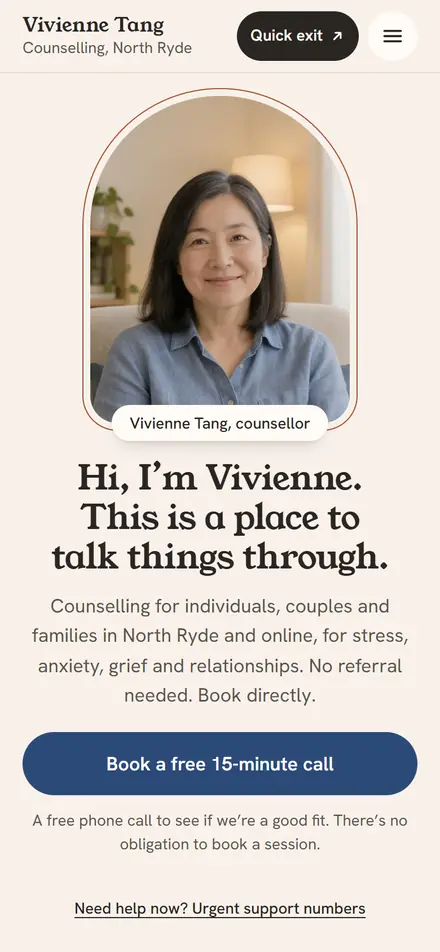
Psychologists are registered under the National Law, so Ahpra's advertising rules apply in full. No testimonials about clinical aspects, which in psychology means almost any client comment about their progress. Many templates include a testimonials section; if yours does, delete it rather than fill it. Psychology has no registered specialties, so "specialist psychologist" is out. "Clinical psychologist" and the other endorsed titles are only for psychologists who hold that area of practice endorsement; the Psychology Board says descriptive titles like "school psychologist" are fine if they don't imply an endorsement you don't hold. If you use "Dr", put "(Psychologist)" next to it unless you're a medical practitioner. Our guide to the Ahpra advertising guidelines explains the whole framework.
Counsellors and psychotherapists aren't registered with Ahpra, but you can't use the protected title "psychologist", and the Australian Consumer Law applies to every claim you make. Your association's code applies too. The ACA's Code of Ethics and Practice (we read version 15; version 16 was published in August 2025) says advertising should be accurate in every particular. PACFA's advertising guidelines, written in 2018 for its previous code, allow testimonials only if they're truthful and factual and carry clear permission statements. PACFA released a new code in September 2026, so check whether its guidance has changed. Our advice is the same for both: leave client testimonials off. The confidentiality risk isn't worth it.
Medicare wording
If you see clients under Better Access, say so near the top, and get the numbers right. Medicare covers up to 10 individual and 10 group sessions per calendar year with a referral and a Mental Health Treatment Plan.
From 1 July 2026, a session of at least 50 minutes with a registered psychologist (item 80110) has a schedule fee of $119.45 and a rebate of $101.55. With a clinical psychologist (item 80010) it's $175.30 and $149.05. If you quote rebates, date them, because they change every July, and state your own fee and the gap so nobody's surprised. Our Medicare, NDIS and DVA guide covers the wording in detail.
Directories: Psychology Today and the rest
Directories are where a lot of people start looking for a therapist, and they often outrank individual practices for "psychologist" plus a suburb. Psychology Today, a US company with an Australian directory, charges A$24.95 a month after six free months. Halaxy's directory listing is free with its software. HotDoc lists psychology practices free and charges $30.92 for each new client who books through its app or website, but nothing for bookings through its widget on your own site.
A directory profile and a website do different jobs. The directory gets you found by people browsing. The website is where they decide, and where your Google Business Profile should point. Our guide to HotDoc and your own website goes into that trade-off.
Which one should you choose?
Starting out on your own, with more time than budget: Squarespace or Wix, a Halaxy or Cliniko booking button, a short contact form, and an afternoon with the Ahpra self-assessment tool. Squarespace if you want it to look good without effort, Wix if you want to tinker.
Comfortable with tech, or have a developer: WordPress on an Australian host, kept updated.
A group practice, or you'd rather spend the time with clients: a custom or subscription build where someone else writes, checks and maintains it. That's what we do, and it's the only one of these options we sell.
Questions we get asked
What is the best website builder for therapists in Australia?
For most solo psychologists and counsellors doing it themselves, Squarespace or Wix. Both have therapist templates and can link to Australian booking systems.
Is Squarespace good for therapists?
Yes, if you want a polished site with little upkeep. Prices are in Australian dollars but exclude GST, and your data is stored in the United States.
How much does Squarespace cost in Australia?
From A$17 a month for Basic, billed annually, plus GST, in October 2026. Monthly billing costs more.
Does Wix have therapist templates?
Yes. Wix has a "Therapist" template in its health and wellness range, and Squarespace has a page of therapist templates.
Can I connect Halaxy or Cliniko to Squarespace or Wix?
Yes. Both work with a Book Now button, and both offer embed code if your plan accepts custom code.
Does Halaxy give you a free website?
No, but its free core includes a directory listing and online bookings you can embed on any website.
Is my website contact form covered by the Privacy Act?
Yes. Health service providers are covered regardless of turnover. Keep health details out of the form and say in your privacy policy where the data is stored.
Can I put client testimonials on my psychology website?
Not ones about clinical aspects, which covers almost anything about a client's progress. Ahpra's testimonial ban applies to psychologists.
Can I call myself a clinical psychologist on my website?
Only if you hold the clinical psychology area of practice endorsement. Otherwise use "psychologist".
How many Medicare sessions can clients get under Better Access?
Up to 10 individual and 10 group sessions per calendar year, with a referral and a Mental Health Treatment Plan.
About this guide
Written by bdog. We build custom websites for psychology and counselling practices on a monthly subscription, which is one of the options compared here. We don't resell or take commissions from Squarespace, Wix, any host or any practice software. Prices are from vendor pages on 7 October 2026 and change, so check before you decide. This is general information, not legal advice.
Main sources:
- Squarespace pricing
- Squarespace, GST and your billing
- Squarespace, where your data is stored
- Wix plans
- Wix Trust Center FAQ
- VentraIP WordPress hosting
- Halaxy, online bookings and directory
- Cliniko, embed online bookings
- Coreplus, connect your client portal
- Zanda, adding your client portal to your website
- OAIC, APP 8 guidelines
- Psychology Board of Australia, FAQ on titles
- MBS Online, item 80110
- MBS Online, item 80010
- Psychology Today Australia, join