How private practice psychologists get more clients
A GP referral doesn’t lock a client to the psychologist it names, so they still search and choose. Here’s how to be the one they pick, within Ahpra’s rules and the Psychology Board’s Code, with a wording check, a cost calculator and a 90-day plan.
On This Page
Search for psychologist marketing and half of page one is about the psychology of marketing, not marketing a psychology practice. The rest is agencies and American therapist advice, much of it about directories and insurance panels that don't exist here. A private practice psychologist in Australia works under Ahpra's advertising rules, the Psychology Board's own Code of conduct, and the confidentiality that comes with the job, and all three shape how you can find clients. This guide covers the channels that bring a small practice its clients, and what the rules allow on each, from Ahpra, the Psychology Board, the Department of Health, the APS and the platforms' own policies, read on 12 October 2026. It's general information, not legal advice. For your website itself, see website builders for psychologists.
- A GP referral doesn't lock the client inClients can see a different psychologist from the one named on the referral, so they still search and choose. Be findable, available and easy to book.
- GPs, directories and availability do most of the workA prompt report after each course of treatment is your best GP marketing. The APS directory and healthdirect are free or included with membership.
- Confidentiality goes further than AhpraNo testimonials, no client stories even de-identified without written consent, and no review replies that confirm someone was a client.
How clients find a psychologist
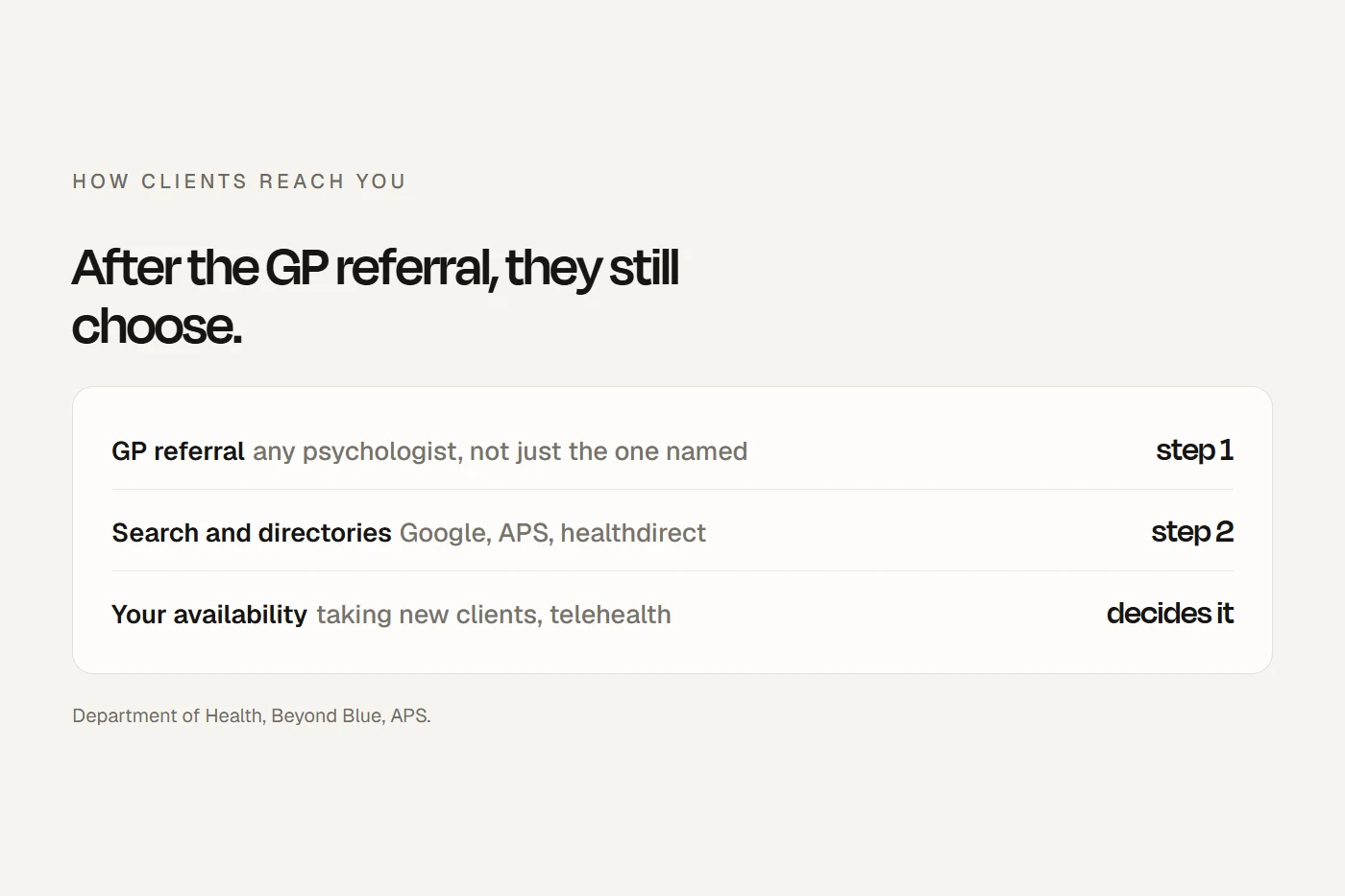
Most people start with their GP. Under Better Access, a client needs a mental health treatment plan and a referral to claim Medicare rebates for psychology. But the Department of Health's guidance says something many practices miss: where a referral names a psychologist, the client "can still choose to see a different allied health professional in that same allied health discipline", without going back to the GP. Beyond Blue tells the public the same thing from the other side: search for your own psychologist, then ask your GP to refer you to that person. A referral is a ticket, not a booking. The client still searches, compares and picks.
The ABS's national mental health study found more people saw a GP about their mental health in a year than saw a psychologist. That makes GPs the biggest referral source, but it also means the search after the referral is where you win or lose the client.
Availability has changed too. In the APS's latest member poll, about three in ten psychologists still couldn't take new clients, but most said waitlists had improved, and cost was now the main barrier clients faced. If your books are open, that's worth saying clearly.
The rules that shape your marketing
Titles and endorsements
There are nine areas of practice endorsement for psychologists: clinical, counselling, forensic, health, organisational, sport and exercise, community, educational and developmental psychology, and clinical neuropsychology. Only psychologists who hold an endorsement can use the matching title, and Ahpra's guidelines say that includes "in the name of the business". So a practice called "[Suburb] Clinical Psychology" implies everyone there is endorsed.
The Psychology Board's FAQ adds some specifics worth knowing:
- Provisionally registered psychologists "must only use the title Provisional Psychologist".
- Registrars use "Registrar" with the area, for example "Clinical Psychology Registrar".
- A public sector "clinical psychologist" job title, without the endorsement, can't be used outside that job, including in private practice.
- "Specialist psychologist" and "specialist clinical psychologist" are the Board's own examples of misleading titles. There's no specialist registration in psychology.
- Descriptive titles such as "school psychologist" are acceptable, as long as they don't overstate your expertise.
Ahpra's own psychology example is "Dr Brown (Psychology), ... Clinical Psychologist and behavioural disorder specialist". The clinical psychologist title is fine if endorsed; "specialist" has to go. If you use "Dr" with a PhD or DPsych, make the profession clear: "Dr Sam Lee (Psychologist)". And instead of "specialises in anxiety", Ahpra's suggested style is "works primarily with" or "has substantial experience in".
Claims about outcomes
Ahpra's mental health example is a practice saying its "long experience of successfully treating patients" shows it "can effectively treat depression, anxiety and many other mental health conditions". Ahpra says that has to be removed: "personal experience and anecdotes are not acceptable evidence". Describe who you see and how you work: "I work with adults experiencing anxiety, using CBT and ACT." Not what will happen.
Testimonials, client stories and reviews
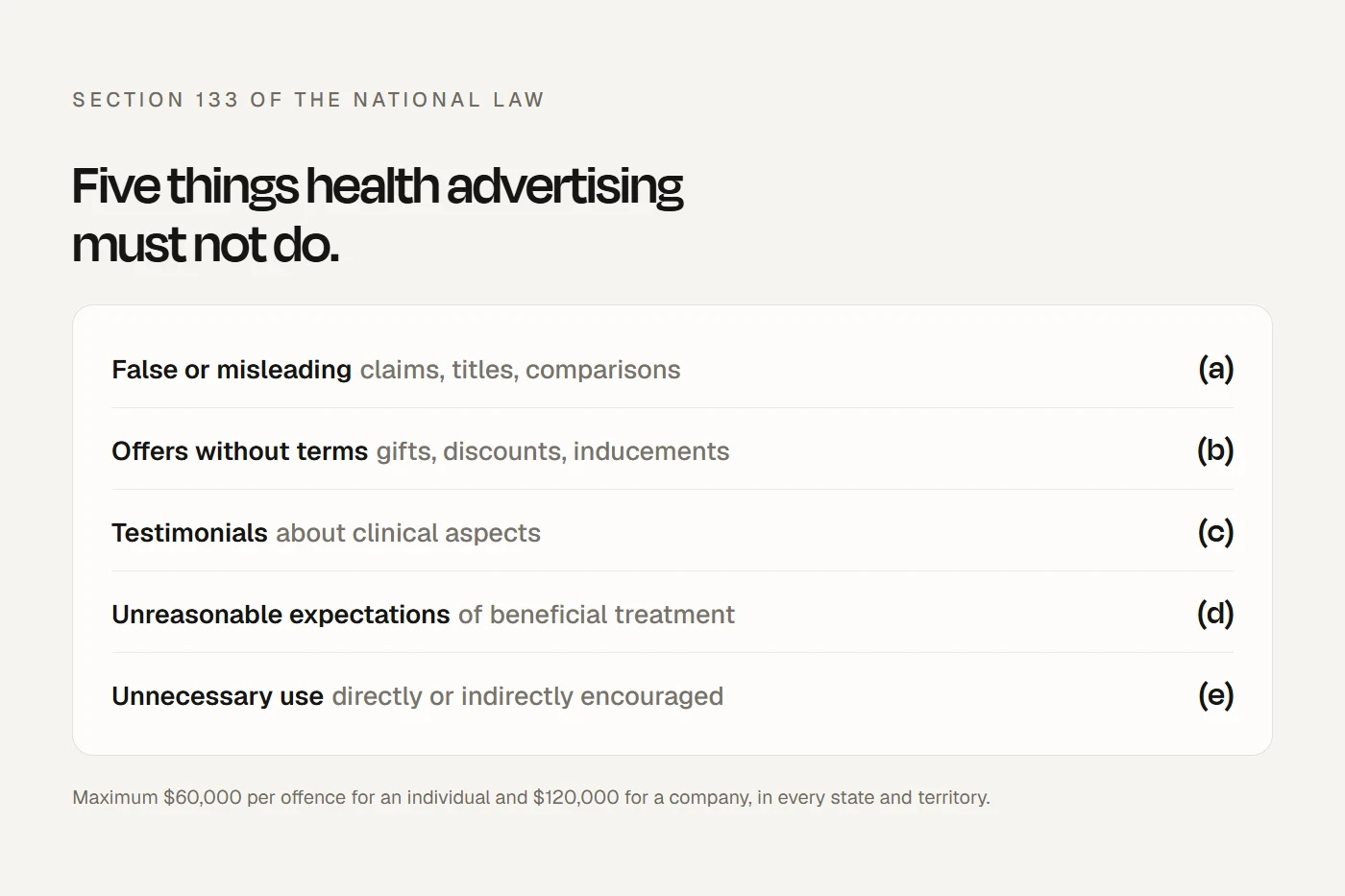
Section 133 of the National Law bans testimonials in health advertising. The Psychology Board's Code of conduct adds a confidentiality layer: psychologists should not share or post "any person's information or images, even if the person is not directly named or identified, without first getting written and informed consent". So a blog post about "a client I'll call Sam" needs written consent, and if it promotes your service it's a testimonial anyway. Leave client stories out.
The same rule shapes review replies. Thanking someone for "our sessions" confirms they saw a psychologist. A safe reply says nothing about anyone's care: "We can't discuss anyone's care, or confirm whether someone has seen us, in a public reply. If you'd like to talk, please call us." Whether to ask clients for Google reviews at all is a judgement call. Google allows it if you ask everyone the same way and offer nothing, but the Code also reminds psychologists of the power imbalance with clients, and many choose not to ask.
GPs and inducements
The Code says psychologists should "not offer inducements to other practitioners, colleagues or enter into arrangements that could be perceived to provide inducements", and the Medical Board's code tells GPs not to accept gifts or hospitality of more than trivial value from anyone whose services could affect how they refer. So no vouchers, gifts or lunches for referrers. Information is fine: an introduction letter, your availability, and above all your reports. Psychologists providing Better Access therapy must send a written report to the referring practitioner after each course of treatment, and a prompt, useful report is the most persuasive thing a GP ever receives from you.
The Code also says not to influence clients "to give, lend or bequeath money or gifts or to undertake services that will benefit you", which rules out rewarding clients for referrals.
Boundaries on social media
The Code asks psychologists to avoid multiple relationships with clients, and Ahpra's social media guidance warns that "the sum of published information online could be enough to identify a patient". A practice Instagram is fine. Following clients back, or replying to a comment in a way that shows the person is a client, isn't.
Check your wording
Paste a page, your Google profile, an APS or Psychology Today profile, a bio or an ad, and I'll flag the patterns above.
It catches common patterns, not everything.
The channels
Directories
- APS Find a Psychologist. Beyond Blue sends the public here, and the APS also takes calls from GPs looking for a psychologist. A premium listing is free with APS membership at Member grade, and it lets clients send appointment requests. The profile is advertising, so the same title and outcome rules apply.
- healthdirect's National Health Services Directory. Free, and it feeds healthdirect's own service finder.
- Psychology Today. A monthly subscription after a free introductory period, and it shows up in Google's "people also search for" on every search in this guide. Measure it by clients, not views.
Your Google profile and website
After a referral, clients search, so your Google profile and website do the converting. Use "Psychologist" as your category, link your booking system, and show who each clinician is with their title exactly as registered, who they see and don't see, how they work, languages, telehealth, fees and how rebates work in words, and when they're next available. Count calls and bookings by where they came from. More in local SEO for small business and psychology practice software for booking.
Availability
"Taking new clients, first appointment within a week" is a strong line, if it's true and kept current. Availability statements are advertising, so they have to be accurate. If you bulk bill some clients, say who's eligible rather than "free sessions", and the Board expects you to tell clients whether they can claim Medicare or private health rebates. Telehealth widens your reach: Medicare telehealth for Better Access is permanent "no matter their location", and your registration is national.
GPs and MHPN
List the twenty nearest general practices and send each a one-page introduction: who you see, your availability, telehealth, your secure messaging details, and how and when you report back. Then make every report prompt and useful. The government-funded Mental Health Professionals' Network runs hundreds of local networks that bring GPs and mental health practitioners together, free to join. It's the government's own answer to "how do I meet local GPs".
Panels
Employee assistance programs fill sessions at their own rates and are a common way to build a new practice; several list how to join on their sites or through PACFA's list. Workers' compensation needs registration first, with WorkSafe in Victoria or SIRA approval in NSW, before you advertise "WorkCover clients welcome". NDIS participants who self-manage or use a plan manager can see unregistered providers.
Content
Explainers do well and fit the rules: how a GP referral works, what to expect at a first session, psychologist or counsellor or psychiatrist. Content on a practice website is advertising, so explain rather than promise. If you write about suicide or self-harm, Mindframe's guidance is to use safe language and include at least two services that run 24 hours a day.
Crisis information
Ahpra doesn't require it, but healthdirect, the ABS and the APS directory all show it, and it belongs on a psychology website: a short line in the footer and on contact and booking pages saying the practice isn't a crisis service, when messages are read, and who to call now. Emergency 000, Lifeline 13 11 14 (or text 0477 13 11 14), the Suicide Call Back Service 1300 659 467, Kids Helpline 1800 55 1800, and 13YARN 13 92 76 for Aboriginal and Torres Strait Islander people. That's a safety line, not a fear line.
Google and Meta ads
Two platform rules matter. Google treats mental health as a sensitive category: counselling services for depression, anxiety and addiction can't use remarketing, customer lists or lookalike audiences, though ordinary search ads on keywords are fine. Alcohol and drug recovery ads in Australia also need Google certification. Meta doesn't allow ads that imply someone's mental health; its own examples are "Depression counseling" (allowed) and "Depression getting you down? Get help now." (not allowed). So "Psychologist in [suburb], telehealth available" beats "Struggling with anxiety?" on both platforms. More in what Google Ads cost and Meta ads for small business.
Can I do this?
Tap a card to see the verdict. General information, not legal advice.
What a new client costs you, by channel
Put in one channel's numbers for a month. The starting numbers are an example. The last line checks whether you can actually see the clients you're paying to find.
A 90-day plan
Your ticks save in this browser.
- Check every title against registration and endorsement: website, Google profile, APS and Psychology Today profiles, and the business name.
- Run every page and profile through the wording check.
- Remove testimonials, review feeds and client stories, and moderate comments on your pages.
- Add crisis information and a "not a crisis service" line to contact and booking pages.
- Set up your Google profile: category, booking link, calls and bookings counted.
- Put an availability line on your homepage and profiles, and keep it current.
- List on healthdirect, and on the APS directory if you're an APS Member. Decide on Psychology Today using the calculator.
- Send a one-page introduction to the twenty nearest general practices, with no gifts.
- Make every GP report prompt and useful.
- Join or start an MHPN network.
- Decide on panels: EAP, workers' compensation, NDIS.
- Write two or three explainers: how a GP referral works, a first session, psychologist or counsellor.
- Run a small Google Ads test on "psychologist [suburb]", with no remarketing or client lists.
- Use Meta only with service-named copy, and no health words in tracking events or page addresses.
- Run the calculator by channel, and fix availability before buying more enquiries.
My view
For most private practices, the marketing that works is unglamorous: be easy to find after a GP referral, say clearly that you're taking clients and when, write reports GPs remember, and list where the public is sent. The rules close off the tactics other businesses lean on, from testimonials to referral rewards to remarketing, so a clear, accurate website and a good relationship with ten local GPs carry more weight here than almost anywhere else.
Questions I get asked
How do psychologists get more clients in private practice?
Mostly through GPs and directories. Be findable after a referral, show your availability, list on the APS directory and healthdirect, and send GPs prompt, useful reports after each course of treatment.
Can a client see a different psychologist from the one on their referral?
Yes. The Department of Health's guidance says a client can choose another psychologist without going back to their GP for a new referral.
Can I call myself a clinical psychologist?
Only if you hold the clinical psychology area of practice endorsement. A hospital job title doesn't count in private practice.
Can psychologists use testimonials or client stories?
No testimonials in advertising, and the Code of conduct needs written consent to share client information, even de-identified. Leave client stories out.
Can I advertise a psychology practice on Google?
Yes, with search ads on keywords like "psychologist [suburb]". Google doesn't allow remarketing or customer lists for mental health services, and alcohol and drug recovery ads need certification.
About this guide
Written by Joseph Alzein, founder of bdog. bdog builds websites for psychologists with Ahpra's advertising guidelines in mind. The rules come from Ahpra, the Psychology Board, the Department of Health, the APS and the platforms' own policies, read on 12 October 2026. Crisis line numbers were checked on each service's own site. This is general information, not legal advice.
Main sources:
- Psychology Board: psychology FAQ
- Psychology Board: advertising
- Ahpra: advertising examples
- Ahpra: social media guidance
- AskMBS: allied health mental health treatment
- Beyond Blue: find a professional
- ABS: National Study of Mental Health and Wellbeing
- APS: Find a Psychologist
- MHPN: networks
- Google: health in personalised advertising
- Meta: personal attributes
- Mindframe: communicating about suicide