Dance studio marketing in Australia: filling classes term after term
The Australian version of dance studio marketing: the numbers to know, what parents need from your website, how to get found on Google, and the rules for vouchers, photos of children and term fees.
On This Page
Most dance studio marketing advice is written for American studios: recital season, Facebook ads, a referral contest with a prize. Some of it doesn't work here, and some of it is against the rules here. Google bans rewards for reviews outright. The ACCC has views on "free" first classes. And whether families can put a government activity voucher towards your fees depends on your state and how your business is set up. This guide is the Australian version: the numbers to know, what to put on your website, how to get found on Google, and the rules for vouchers, photos of children and term fees.
- Know your empty placesCount your places, how many are filled, and how many new students you need each term just to stand still.
- Make the website answer parentsClasses by age and style, the full term price, what the concert adds, and a free first class that really is free.
- Get found and trustedA complete Google Business Profile, reviews from every family with no rewards, teachers' qualifications by name, and a photo consent form at enrolment.
I build websites for dance studios. I haven't run one, so I won't tell you how to teach a class or price your exams. What I can do is set out what parents look for on a studio's website and what the rules say, from the ACCC, Google, the state voucher programs and the child safety regulators, all read on 11 October 2026.
Start with your empty places
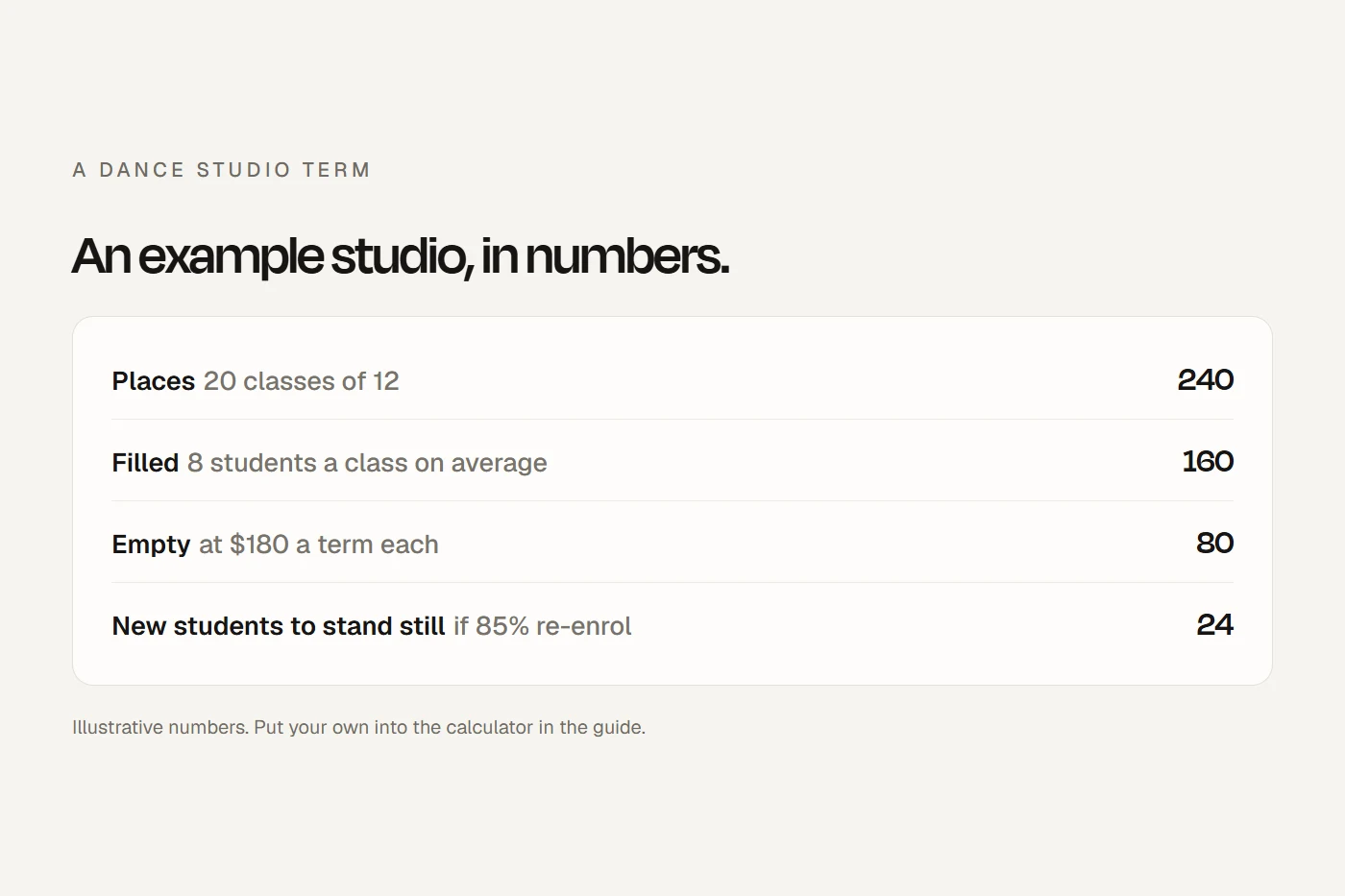
Before any marketing, it helps to know what you're filling. A studio's stock is places in classes, and an empty place this term is income you don't get back. Put your own numbers in.
The starting numbers are an example, not an average. Use your total term fee including any compulsory fees, before GST if you're registered.
With the example numbers: 240 places, 160 filled, 80 empty, worth $14,400 a term. If 85% of students come back next term, you need 24 new students just to stay where you are, and 68 to get to 85% full. That last number is what the rest of this guide is for. Most of it comes from two places: keeping the families you have, and being the studio a new family finds and trusts first.
What your website needs to answer
When I build a studio's site, I build it around four questions a parent needs answered: is there a class for my child's age, when is it, what will it cost all up, and can we try it first.
Classes by age and style
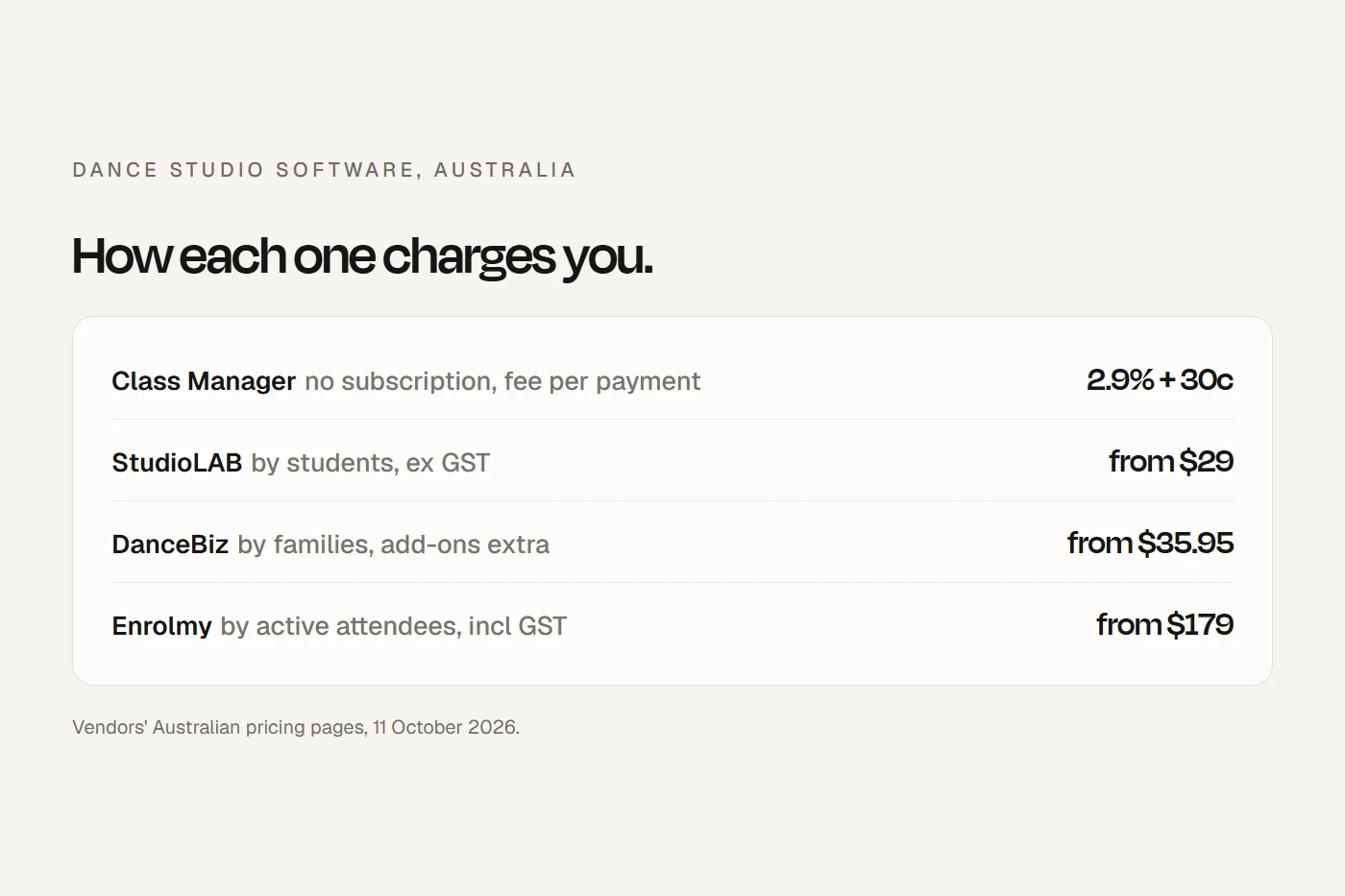
Lay the timetable out the way parents search: by age first, then style, with the day and time and an enrol button beside each class. A PDF timetable doesn't work well on a phone. If you use studio software, most can show the timetable on your site; I compared how in my dance studio software guide.
The total term price
The ACCC's rule is that "Businesses must display a total price that includes taxes, duties and all unavoidable or pre-selected extra fees", as a single figure. If there's a compulsory registration or insurance fee, it belongs in the term price you advertise. If you show a weekly figure, the ACCC says the total must be "at least as prominent as the partial price". So "$18 a class" sits next to "$180 for the 10-week term". Optional costs like costumes and concert tickets aren't part of the minimum price, but the ACCC also says to be upfront "at the start of a purchasing process" about the types of fees that will apply. I'd put a short "what the concert adds" section on the site, so nobody finds out in term three.
A free first class that's actually free
The ACCC gives this as an example of an ad that's "likely to be misleading": "An advertisement states that a product is 'free'. An extra payment is mentioned in the fine print." So if your first class is free, it needs to be free without a compulsory enrolment fee, uniform purchase or card-on-file charge tucked into the terms. If there are conditions, say them in the same place you say "free".
Who's teaching
Parents can check some qualifications themselves, so name them. ATOD's teacher grades require the Certificate IV or the Diploma of Dance Teaching and Management. The Royal Academy of Dance keeps a public register of RAD Registered Teachers. If your teachers hold these, say so by name, and link to the register. And if every teacher holds a current Working with Children Check (or your state's equivalent), say that plainly too. Only say what's true.
Getting found on Google
When a parent searches "dance classes near me", the map results come from Google Business Profiles. Google's advice for local ranking is to verify your profile and keep it complete and accurate: address, hours and category. On categories, Google says to "Use as few categories as possible" and pick ones that complete the sentence "This business IS a", not "HAS a".
Reviews, the Australian way
A lot of overseas advice suggests a prize draw or a discount for reviews. Google doesn't allow it. Its policy says businesses may not offer incentives, "such as payment, discounts, free of cost goods and/or services", in exchange for a review, and may not "selectively solicit positive reviews from customers". It also says businesses "should not require or pressure users to leave ratings or write reviews while on the premises", or ask for specific content, including naming a staff member. Reviews from current or former staff and their family are removed as a conflict of interest.
The ACCC is also clear on its side: incentives must apply "regardless of whether the reviewer leaves a positive or negative review" and be disclosed, and you can't remove genuine negative reviews. Google's rule is stricter, so follow Google's. In practice: send every family the same short email with your review link at the end of term, and leave it at that.
Keeping the families you have
AusPlay, the national survey of what Australians do for sport and activity, puts recreational dance among the most popular organised activities for children, mostly girls, and most of it run by private businesses rather than clubs. Both AusPlay and the ABS show participation peaking in the early primary years and dropping by the early teens. So the five to eight year olds are your main intake, and the risk is losing children at ten to fourteen. Pathways help there: exams, performance and competition groups, and a clear "what's next" for older students on your website.
The cheapest new student is one who re-enrols. Open re-enrolment for current families before you open places to new ones, and make it one click from the email.
Activity vouchers, state by state
Most states run a voucher that families can put towards children's activities. Whether you can accept it depends on your state and, in some states, on your business structure. Pick yours.
New South Wales
- Voucher
- Active and Creative Kids. Dance is listed as a creative activity.
- Who can register
- A business operating in NSW with an active ABN, the right skills and experience, and professional indemnity and public liability insurance. Creative providers are asked for evidence of qualifications, training, accreditation or industry recognition.
- Child safety
- Providers must complete the Office of the Children's Guardian's Child Safe e-Learning Module, and everyone in the program needs a verified Working With Children Check.
- Redeeming
- Vouchers are redeemed in the Service NSW Business Bureau app.
Victoria
- Voucher
- Get Active Kids.
- Who can register
- Only an incorporated association, a company limited by guarantee or a council, affiliated with a recognised body such as Ausdance. The guidelines exclude "An individual or sole trader", and a Pty Ltd company isn't on the eligible list, so most private studios can't register in their own name. Ineligible organisations can nominate an auspice organisation.
- Child safety
- Victoria's Child Safe Standards cover "coaching or tuition services for children". Staff need a Working with Children Check.
Queensland
- Voucher
- Play On! Sports Vouchers.
- Who can register
- An organisation or business affiliated with one of the listed state or national bodies. The dance bodies on the list include DanceSport Australia and Drilldance Queensland; Ausdance isn't listed.
- Child safety
- Providers must meet Queensland's blue card requirements.
Western Australia
- Voucher
- KidSport.
- Who can register
- Clubs and businesses whose activity meets the department's definition of sport, affiliated with the recognised state sporting association. Dance isn't named, so ask the KidSport team before you count on it.
- Child safety
- Working with Children Check screening is required.
South Australia
- Voucher
- Sports Vouchers Plus. Dance is named.
- Who can register
- A registered business with an active ABN (or incorporated), registered with a peak dance association such as Ausdance SA, with public liability insurance and at least 8 weeks of activity.
- Child safety
- Staff need a Working with Children Check.
Tasmania
- Voucher
- Ticket to Play. Dance has its own provider criteria.
- Who can register
- Dance providers need public liability and professional indemnity insurance, and instructors need the right qualifications and Registration to Work with Vulnerable People.
- Child safety
- Providers confirm they comply with the Tasmanian Child and Youth Safe Organisation Framework.
Australian Capital Territory
- Voucher
- I couldn't find an ACT voucher that providers register for. Check with the ACT Government.
- Child safety
- Staff need Working with Vulnerable People registration.
Northern Territory
- Voucher
- Sport Voucher Scheme. Dance counts as a cultural activity: "performance arts such as dance, ballet, music or circus".
- Who can register
- "Individuals, clubs and organisations", including sole traders, through GrantsNT, with public liability insurance and a structured program.
- Child safety
- You and anyone delivering programs need a Working With Children Clearance (Ochre Card).
Rules and rounds change. Check the official page before you tell families they can use a voucher with you. If you can take one, say so on your website near the term price.
Photos and video of children
Concert photos do more for a studio's website than anything I could write, and they're where I'd be most careful. The OAIC treats photos and video of people as personal information, says it's good practice to get express consent, and to take "particular care" with children, involving their parent or guardian. Most small studios aren't covered by the Privacy Act (the threshold is $3 million in turnover), but parents expect consent anyway, and ATOD's own safeguarding policy for its members says: "Always obtain permission of a child's parent or guardian before using the child's name or image in any report, website or other publication."
eSafety's checklist for schools sharing images works just as well for a studio. It asks whether consent is "active, informed and current", whether a post includes "a name, uniform, location or routine" that could identify a child, and whether close-ups are needed at all. A studio's name, uniform and class timetable are exactly that kind of detail.
- Ask at enrolment, with separate boxes for your website, social media and paid ads.
- Ask again for anything bigger, like an ad campaign or a special event.
- Use first names or no names, and don't put a child's class day and time next to their photo.
- Prefer wide shots to close-ups for public posts.
- Keep a list of who has opted out, make sure teachers know it, and take a photo down when a parent asks.
Term fees, refunds and your enrolment terms
Three points from the ACCC that apply to term enrolments:
- "No refunds" doesn't override the law. The ACCC says it's illegal to rely on policies that deny consumer guarantee rights, "For example, policies which say 'no refunds'". Change of mind isn't covered, but if you have a change-of-mind policy, you have to follow it.
- Say what happens when a class doesn't run. If you can't provide a class, the ACCC's guidance points to a refund for that portion or a replacement. Make-up class, credit or part refund: pick one and put it in your terms.
- Standard terms can't be unfair. A take-it-or-leave-it enrolment form is a standard form contract, and penalties now apply for unfair terms in one. Terms the ACCC gives as examples of possibly unfair include letting only one side end the contract, penalising the other for ending it, or letting one side change the terms.
Before each term
- Update the timetable and the total term prices on your website.
- Open re-enrolment for current families first.
- Check your voucher registration is current, if your state lets you take one.
- Check every teacher's Working with Children Check (or your state's equivalent) is current.
- Refresh photo consent at re-enrolment and update the opt-out list.
- Make sure the free first class has no hidden conditions.
- Update your Google Business Profile with term dates and any new classes.
- Send every family the same review request, with no rewards.
Questions I get asked
How do I get more students for my dance studio?
Know how many empty places you have and how many new students you need each term. Then make your website answer parents' questions, keep your Google Business Profile complete, ask every family for a review, and re-enrol current families first.
Can I offer a discount for Google reviews?
No. Google's policy bans incentives such as discounts or free classes in exchange for reviews, and bans asking only happy customers.
Can my dance studio accept Active and Creative Kids vouchers?
In NSW, dance is listed as a creative activity, so an eligible NSW studio with an ABN, insurance and the child safety requirements can apply to be a provider.
Can I post photos of students on social media?
Get a parent's consent first, separately for your website, social media and ads. Use first names or no names and avoid details that identify where a child will be.
Do I have to show the full term price on my website?
The ACCC says businesses must show a total price including all compulsory fees, as a single figure, and a weekly or per-class price can't be more prominent than the total.
About this guide
Written by Joseph Alzein, founder of bdog. I build websites for dance studios. Everything here comes from the ACCC, Google, the state voucher programs, the child safety regulators, the OAIC, eSafety, AusPlay and the dance associations named, read on 11 October 2026. Voucher rules and rounds change, so check the official page. This is general information, not legal advice.
Main sources:
- ACCC: price displays
- ACCC: false or misleading claims
- ACCC: online reviews
- ACCC: repair, replace, refund, cancel
- ACCC: supplying services that are paid for
- ACCC: contracts and unfair terms
- Google: fake engagement policy
- Google: guidelines for representing your business
- Google: improving your local ranking
- Service NSW: Active and Creative Kids guidelines
- Get Active Kids provider guidelines
- Play On! provider terms
- KidSport: information for clubs
- Sports Vouchers Plus: provider eligibility
- Ticket to Play: provider information
- NT Sport Voucher Scheme: activities
- Victoria: who the Child Safe Standards apply to
- OAIC: posting photos and videos
- eSafety: sharing school imagery
- ATOD teacher qualifications
- RAD professional register
- AusPlay results
- ABS: cultural and creative activities