Do I need a website for my business?
I sell websites, and the honest answer is: not always. Here’s the Australian evidence both ways, what you can do without one, when you really should have one, and a quiz that’s allowed to tell you no.
On This Page
I sell websites, so you'd expect me to say yes. The honest answer is: not always. Plenty of Australian businesses trade well without one, and some shouldn't spend the money yet. Every other result on page one for this question is selling websites or website builders, and they all say yes. Here's the evidence both ways, with a quiz that's allowed to tell you no.
- You probably don't need one yetif your diary is full from repeat customers and referrals, and you have a complete Google Business Profile.
- You probably doif you never meet customers in person, if you sell online, or if most of your work comes through one social media account you could lose.
- Either wayown your domain name and your logins. That costs a few dollars a year and protects you whatever you decide.
How many businesses have one
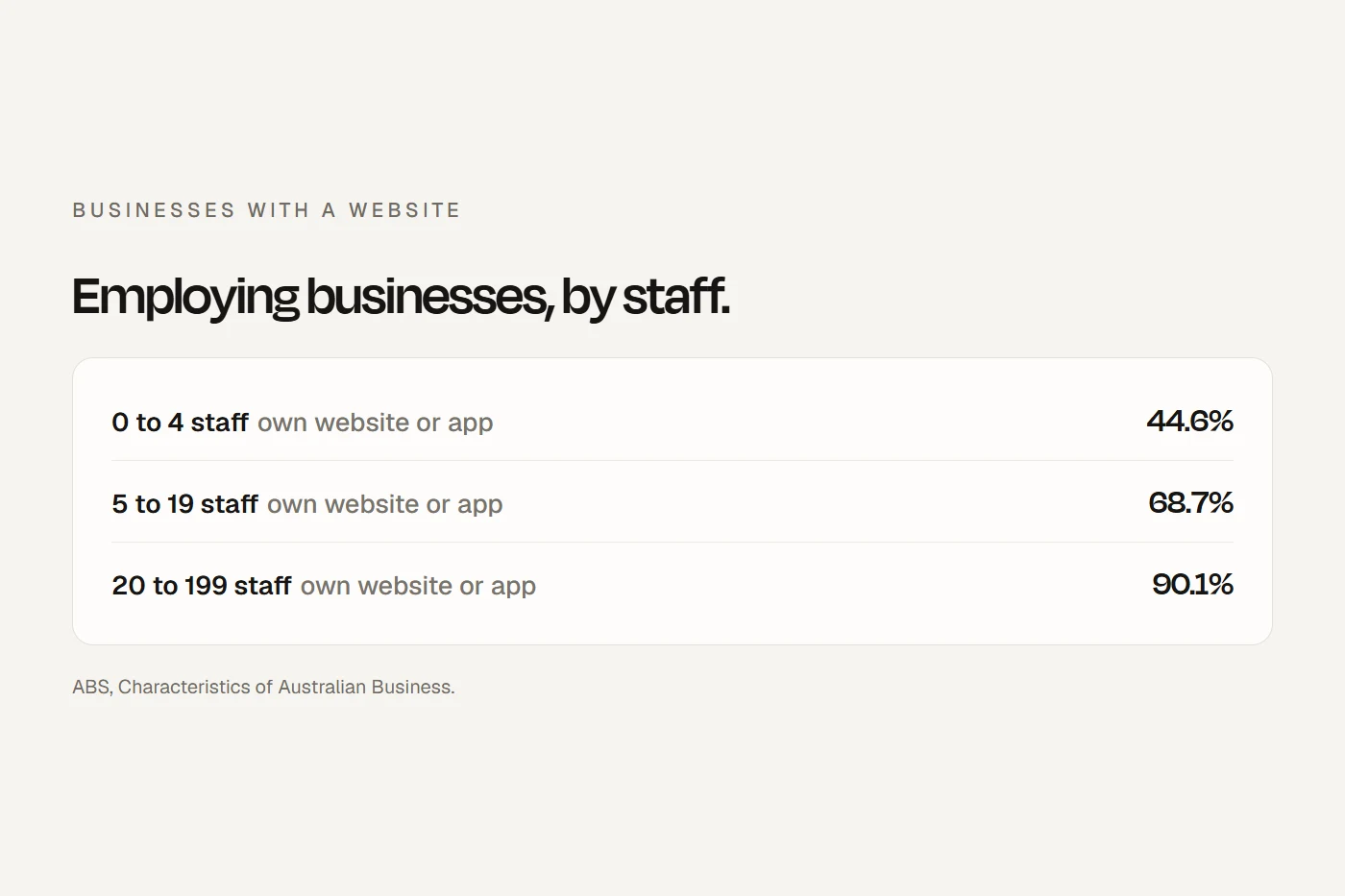
The ABS's latest survey of Australian businesses with staff found 55.1% have their own website or app, and 71.0% have some online presence, including social media. The smaller the business, the lower the figure.
Two things the headline number hides. First, the ABS only counts businesses with staff. About two in three Australian businesses employ no one, so most sole traders aren't in the figure at all. Second, it varies a lot by industry: 39.8% of construction businesses with staff have their own website, against 68.4% in health care and 73.9% in arts and recreation. In retail and hospitality, more businesses use social media than have a website.
So if you don't have a website, you're far from alone, and plenty of busy businesses are in the same position.
What you can do without one
A Google Business Profile
It's free, and for a local business it's the most important thing online. Google's guidelines ask for "a phone number that connects to your individual business location, or provide a website", so a phone number is enough. You can show up on Maps, collect reviews and get calls with no website at all. Google Ads can even send clicks to your profile instead of a site.
Two limits. Only businesses that meet customers face to face can have a profile, so an online-only business can't. And Google used to build free basic websites from profiles; it switched them off in March 2024, and the redirects stopped working that June. If you had one, it's gone.
Facebook and Instagram
Many businesses run entirely from social media, and it works until it doesn't. The Small Business Ombudsman said in 2024 that platform disputes had more than doubled in two years, that two-thirds involved Meta, and that "after being locked out of your account, you need to access your account to make a complaint." The Ombudsman's advice is to "Consider expanding your business online presence to more than one platform", so that if one account is disabled you can keep trading. That doesn't have to be a website. A Google Business Profile plus Instagram is two platforms. But a website is the one nobody can switch off for you.
Marketplaces
Booking and job marketplaces bring you customers you'd never find yourself, and charge for it:
| Marketplace | What it costs you |
|---|---|
| Fresha (salons, beauty, wellness) | 20% of a new marketplace client's first booking, minimum A$8, plus GST. Nothing for returning clients, or for new clients who find you through your own website, Instagram or Facebook |
| hipages (trades) | $139 to $649 + GST a month for lead credits, starting on a six-month term that renews for twelve. Credits per lead aren't published |
| Airtasker | 12.5% to 20% of each task, plus GST, depending on your tier |
Scroll the table sideways to see every column.
Notice Fresha's own rule: clients who book through your own channels cost nothing. That's the strongest argument for a website I can give a salon, and Fresha wrote it. business.gov.au makes the general point: marketplaces are "less flexible than your own ecommerce site" and "Fees also tend to be higher".
When you really should have one
- You never meet customers in person. You can't have a Google Business Profile, so a website is your main free way to be found on Google.
- You sell products online and don't want to rely on a marketplace.
- You're a registered tax or BAS agent. The Tax Practitioners Board expects the register and complaints information on the website you promote your services from.
- Most of your new work comes through one social account. If you lose it, you lose the business's front door.
- You run ads and want to know what they bring in. Without your own site, you can only measure calls and taps on your profile.
- Each new customer is worth a lot to you. For a clinic, a trade or a firm, one extra client a month often covers a simple site.
Does a website build trust? The research is thin and mostly from people with a stake. auDA, which runs .au domains, found 72% of consumers will only buy from a business online if it has a website. That's about buying online, not calling a plumber off Google Maps. I couldn't find any Australian study showing a local service business without a website loses enquiries. I won't pretend there is one.
Do you need one? The quiz
Eight questions. It will tell you if you don't.
Is it worth the money?
The fairest test for a business already on a marketplace: how many new clients would need to book with you directly, instead of through the marketplace, to cover the website? Put in your own numbers. The starting ones use Fresha's fee and my Single Page plan, which is $249 a month for 12 months, then $89, plus GST.
On those numbers, 17.8 new clients a month would need to book direct to cover the site in its first year, and 6.4 after that. For a busy salon, that's realistic; for a quiet one, it isn't. A website doesn't bring customers by itself, either. It has to be found, which is what local SEO is about.
If you do get one: the minimum
A first website doesn't need to be big. One page that does these things well is enough. Your ticks save in this browser.
- Your business name, what you do, and the areas you serve.
- A phone number you can tap to call on a phone.
- Your opening hours, or "by appointment".
- One clear way to book or ask for a quote.
- Works well on a phone.
- Readable by people with disability.
- A domain name in your business's name, not your designer's.
- Linked from your Google Business Profile.
- A privacy policy, if the Privacy Act covers you, or you collect details through a form or Meta lead ads.
- Terms and consumer guarantee information, if you sell online.
- Your profession's rules, if you're in health, law or finance.
Whatever you decide, own these
A .com.au domain needs an ABN, costs a few dollars a year, and gives you a professional email address even with no website. Register it in your business's name. If someone builds or manages anything for you, make sure the domain, the logins and the content are handed over to you. The Small Business Ombudsman found almost 70% of small businesses last less than a year with their digital marketing provider, so assume you'll need to take things with you.
My view
If your diary is full from referrals and your Google profile is complete, keep your money for now. If you rely on one social account, never meet customers in person, or pay a marketplace for every new client, a simple website is one of the cheaper ways to own your front door. It doesn't have to be expensive or big. It has to be yours.
If you want to compare what it costs, I've laid out the options in how much a website costs in Australia.
Questions I get asked
Do I really need a website for my small business?
Not always. If you meet customers in person, have a complete Google Business Profile and a full diary from referrals, you can do without one for now. Online-only businesses, online sellers and tax agents are the clearest cases for one.
What can I use instead of a website?
A Google Business Profile, which is free, plus a social media account and any marketplace that suits your trade. The Small Business Ombudsman suggests being on more than one platform in case you lose access to one.
Can I have a Google Business Profile without a website?
Yes. Google asks for a phone number or a website. You need to meet customers in person to be eligible.
Does Google still give you a free website?
No. Google switched off the basic websites it built from Business Profiles in March 2024.
How much does a small business website cost?
From about $17 to $70 a month for a builder you run yourself, to a few thousand dollars for a site built for you. I compare the options in how much a website costs.
About this guide
Written by Joseph Alzein, founder of bdog. bdog sells websites on subscription, so I have an interest in your answer; I've tried to give you both sides. Figures come from the ABS, auDA, the Small Business Ombudsman, Google and the marketplaces' own pages, read on 12 October 2026. Marketplace fees change, so check before you decide.
Main sources:
- ABS: Characteristics of Australian Business
- ABS: Counts of Australian Businesses
- business.gov.au: set up a business website
- business.gov.au: ecommerce
- Google: guidelines for representing your business
- Google: get started with Business Profile
- Google Ads: create a website or landing page
- Small Business Ombudsman: using social media securely
- Fresha pricing
- hipages membership costs
- Airtasker service fees
- auDA: Why .au?