The Financial Services Guide: what it must contain and where it goes online
Who gives one and when, every required item with its section number, the ways of giving it that count, the website route and its traps, keeping it current, and the other items an adviser’s or broker’s site needs. With a quiz, a delivery sorter and a website check.
On This Page
A Financial Services Guide tells a retail client who you are, what you can help with, how you and others are paid, and how to complain, before you provide a service. This guide is for financial advisers, insurance brokers and small licensees or authorised representatives who need to get one right and work out what goes on the website. It covers who must give one and when, every item it has to contain with its section number, the ways it can be given (and the ones that don't count), the website route, keeping it current, and the other items your site needs. It comes from the Corporations Act and Regulations, ASIC's instruments and ASIC's own FAQs. It's general information, not legal advice.
- Every licensee and representative gives oneTo a retail client, as soon as it's clear you're likely to provide a service, and before you provide it.
- Yes, it usually belongs on your websiteIf you give advice and don't hand an FSG to every client in time, the law requires the information on your website: public, current and dated.
- A link isn't always "giving" itFor advice, the website route works. For anything else, hand it over, email it to the address they gave you, or use ASIC's publish and notify method.
Who gives one, and when
Every AFS licensee (s 941A) and authorised representative (s 941B) that provides a financial service to a retail client must give them an FSG. It isn't only for advice: arranging, dealing and representing an insured client in a claim count too. An authorised representative can only give an FSG its licensee has authorised.
The timing is in s 941D(1): "as soon as practicable after it becomes apparent" that the service will be, or is likely to be, provided, "and must in any event be given to the client before the financial service is provided." In practice, that's usually when a first appointment is booked. ASIC encourages giving it early enough that clients can actually read it, and giving it whenever a client asks.
You don't need one for:
- Wholesale clients, or retail clients outside Australia.
- Loans. Credit isn't a financial product. Mortgage brokers give a credit guide instead, and if you do both, the Regulations let you combine the FSG and credit guide in one document.
- A client who already has your current FSG. If they have an older one missing something, give a Supplementary FSG with the rest.
- General advice to the public on a website, in a video, at a seminar or in a social post. Instead, before the advice, give your name and contact details, how you're paid and your links to product issuers (for a representative, also the licensee's details), in the same form as the advice. The general advice warning goes beside the advice too.
If a client needs the service immediately, for example cover today on the phone, you can first give a short statement of how you're paid, your links to product issuers, any "not independent" statement and any binder, even out loud, and then give the FSG within 5 days.
What it must contain
The same items make up the website version. Section numbers are the Corporations Act unless marked "Regs".
| Item | What it says | Where the rule is |
|---|---|---|
| Title | "Financial Services Guide" on the cover or at the start, or at the top of the web page | s 942A |
| Date | The date it was prepared | s 942B(5), 942C(5) |
| Purpose statement | At the front and standing out: it's to help the client decide whether to use your services, it covers remuneration and complaints, and when they'll get a Statement of Advice or PDS | Regs 7.7.03, 7.7.06 |
| Name and contact details | Yours | s 942B(2)(a), 942C(2)(a) |
| Licence numbers | Your AFSL; for a representative, your AR number and the licensee's AFSL | s 912F; Regs 7.7.05A, 7.7.06A |
| Licensee details | For a representative: the licensee's name and contact details, and that you're its authorised representative | s 942C(2) |
| Instructions | Any special instructions on how clients give you instructions | s 942B(2)(b) |
| Services and products | What you'll provide and the kinds of products, or what your licence covers | s 942B(2)(c); Regs 7.7.10AB |
| Who you act for | The client, or an insurer under a binder, for example | s 942B(2)(d) |
| Remuneration | Fees, commissions and other benefits for you, your licensee, staff and associates, including referral payments | s 942B(2)(e); Regs 7.7.04, 7.7.07 |
| Associations | Relationships with product issuers that could influence you | s 942B(2)(f) |
| "Not independent" statement | If you give personal advice and can't use the word "independent": boxed, bold heading, first substantive page | s 942B(2)(fa); ASIC Instrument 2021/125 |
| Record of advice | How to ask for a record of further advice, and the time limit | s 942B(2)(g); Regs 7.7.05 |
| Complaints | Your process and how to reach AFCA | s 942B(2)(h) |
| Binder or market participant | If either applies | s 942B(2)(i), (j) |
| Compensation arrangements | The kind you have (usually professional indemnity insurance) and whether they meet s 912B | Regs 7.7.03A, 7.7.06B |
| Distribution authorised | For a representative: that the licensee authorised it | s 942C(2)(l) |
Scroll the table sideways to see every column.
Two rules shape how it reads. It must be "worded and presented in a clear, concise and effective manner" (s 942B(6A)), which is the law, not a style tip. And on pay, ASIC says remuneration "should be presented in one location", using ranges, rates, simple tables or formulas where the exact amount isn't known yet, and that it is "not acceptable to merely state that a benefit will or may be received and that the client can ask for further details."
The "not independent" statement
If you give personal advice and receive commissions, volume payments or other benefits, or are owned by a product issuer, you can't call yourself independent, and the FSG must say so and why. ASIC's instrument sets the format: in a box, under a bold heading that includes "Not Independent" or "Lack of Independence", in at least the body font size, never a footnote. On the website it must be in a prominent position. ASIC says headings like "Statement of independence" aren't appropriate because they imply the opposite. ASIC's own example starts: "ABC Adviser Firm is not independent, impartial or unbiased because we", followed by the reasons.
Ways to give it that count
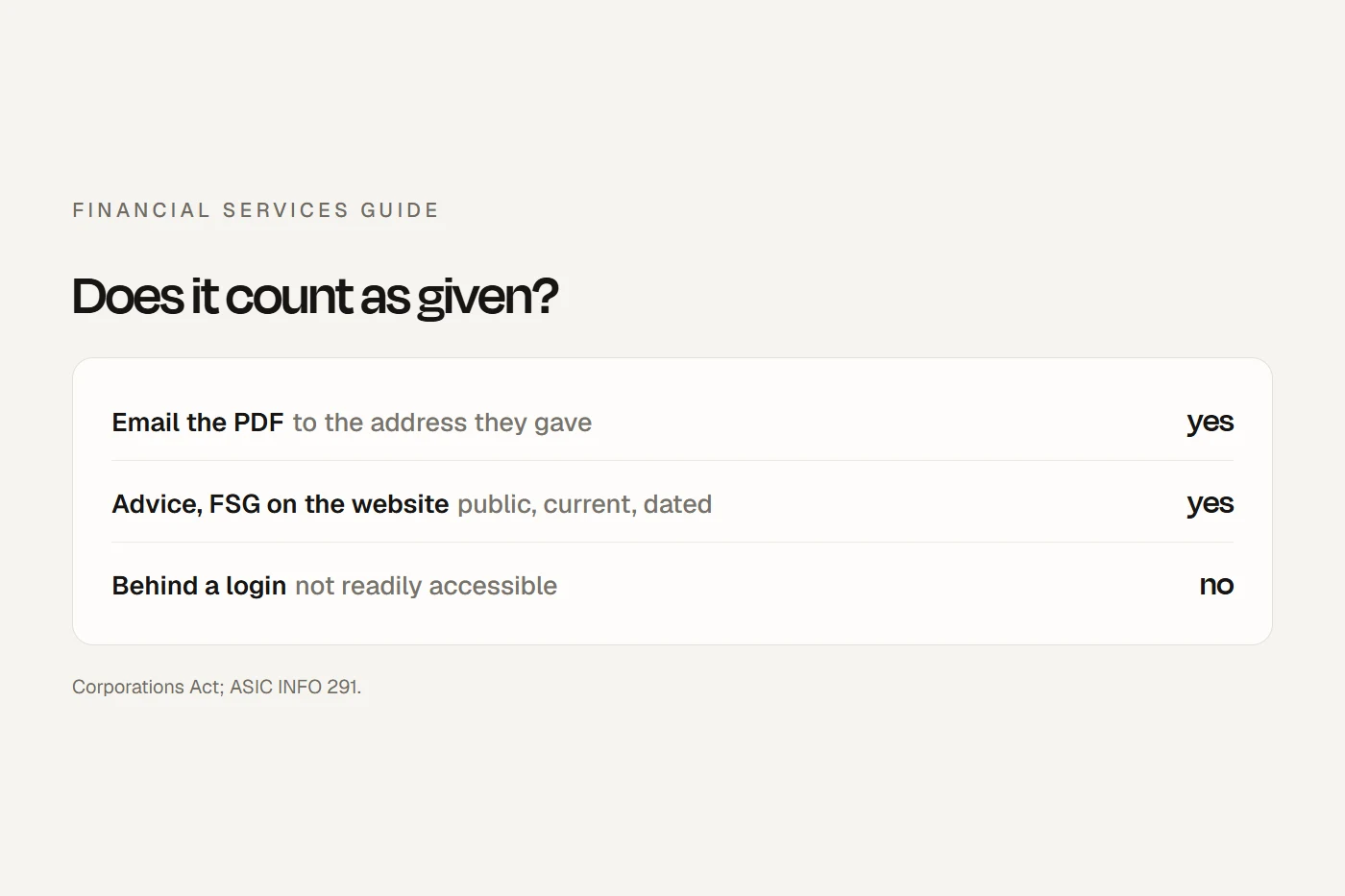
Section 940C lists the only ways an FSG is "given": personally; sent to an address, including an email address, the client or their agent nominated; or made available in a way you both agreed. It has to be printed or electronic, and an electronic copy should be something the client can keep. ASIC's electronic disclosure instrument adds a fourth: publish and notify. You make the FSG available online and tell the client it's there and how to get it, each time. That works if the client agreed to it, or if you've sent a notice that you'll use that method unless they opt out and 7 days have passed without them opting out.
The 7 days matter for a first meeting booked this week. The simple fix is to ask for agreement at booking ("we'll send our documents by email") or to email the FSG itself.
Tap a card to see whether it counts.
Do you need an FSG on your website?
Usually, yes. If you give financial product advice to retail clients and don't give each of them an FSG by the time it's due, s 943G (licensees) and s 943H (representatives) require you to put "website disclosure information" on your website: the same contents as the FSG. ASIC has extended the website route to dealing in a product to put your own advice in place. ASIC's consumer site, Moneysmart, also tells people an adviser's FSG "should be on their website (or ask them for a copy)", so clients look for it.
The website version must be:
- Readily accessible by the public (s 943K). ASIC says it isn't if it's password protected, needs an account, or sits behind a paid subscription.
- Kept up to date, and dated with the day it was prepared or last updated (s 943L).
- Authorised by the licensee, for a representative, before it goes up and before any change (s 943H(3), 943M).
Two traps from ASIC's FAQs. If you publish your FSG on your website without giving it to the client, it is website disclosure information and those rules apply, "also the case if a hyperlink to the content is then circulated to a client." And the website route only works if you haven't already given that client an FSG for the service. ASIC still encourages emailing clients a link so they know it's there, and suggests labelling the page "Website disclosure information".
A sample page outline
This is my outline, not an ASIC template. Each line maps to a row of the table above.
- "Financial Services Guide", then "Website disclosure information. Last updated [date]. Version [n]."
- About this guide: the purpose statement.
- The boxed "Not independent" statement, if it applies.
- Who we are: name, ABN, contact details, AFSL, or AR number with the licensee's details.
- What we can help with, and the kinds of products.
- Who we act for, and how to give us instructions.
- How we're paid: fees, commissions, other benefits and referral payments, all in one place.
- Our relationships with product issuers.
- Records of advice: how to ask for one.
- Complaints: our process, then AFCA.
- Compensation arrangements.
- Binder or market participant statements, if they apply.
- For representatives: "[Licensee] has authorised the distribution of this guide."
- Download or print this guide, or ask us for a paper copy.
An HTML page is easier to keep current, read on a phone and link to section by section; a PDF is easier to archive by version. You can do both, with the same date.
Keeping it current
The FSG must be up to date when it's given (s 941E), and out-of-date information is treated as misleading. A material change needs a new date (s 942E, 943M), and a representative needs the licensee's authority for any change. If something changes before you provide the service in a way a client would care about, give a new FSG, a Supplementary FSG, or update the website version (s 941F).
Two tools make this easier. A Supplementary FSG corrects or updates an existing one: it must say it's supplementary, identify the FSG it supplements and be read with it. And the Act allows a multi-part FSG, with its own example: a core document that rarely changes, and a separate remuneration document updated more often, each part dated. ASIC expects every version kept, and licence conditions can require keeping each version for 7 years.
The other items your website needs
- Licence line in the footer. The law puts licence numbers in the FSG; it's common to also put "[Business] (ABN) holds Australian Financial Services Licence [number]" or "is an authorised representative (AR [number]) of [Licensee], AFSL [number]" in the footer.
- The Financial Advisers Register. Advisers giving personal advice on investments, super and life insurance must be on it, and "financial adviser" and "financial planner" are restricted titles (s 923C). Put each adviser's representative number on their profile so a client can find them in one search.
- The general advice warning beside any advice on the site. My guide to the general advice warning covers where it goes.
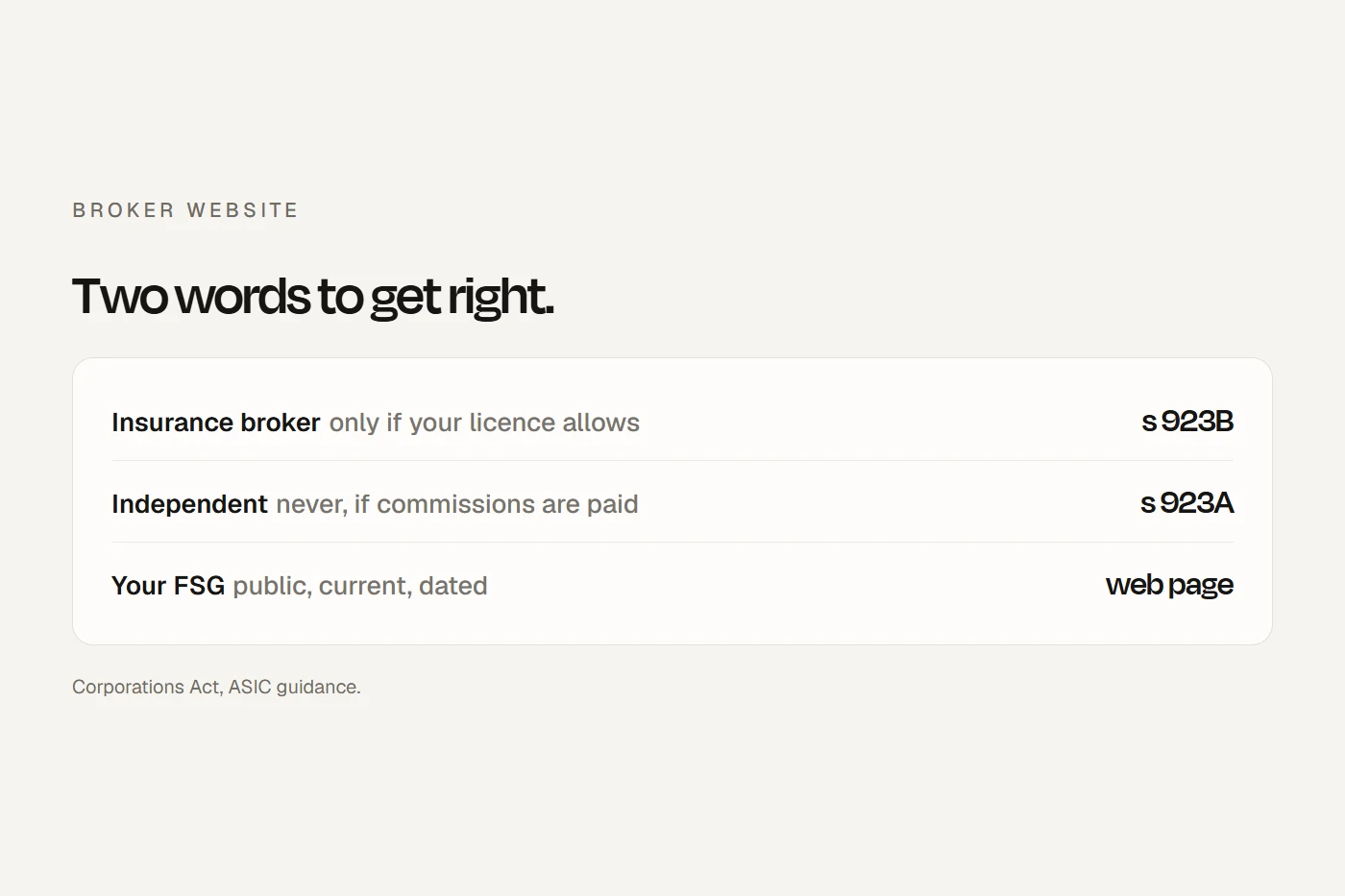
- No "independent" unless you meet s 923A. ASIC has checked advisers' and brokers' websites for "independent", "independently owned" and "non-aligned", and made firms remove them.
- Product promotion that names the issuer and says where the PDS and target market determination are (s 1018A).
- Complaints and AFCA, and a privacy policy.
- A contact form that asks for agreement to receive documents by email, so your FSG counts as given from the first email.
Insurance brokers have a few extra items, covered in my insurance broker website guide.
Check your website
Your ticks save in this browser.
- An FSG or website disclosure page exists if you give advice and don't hand an FSG to every client in time.
- It's public: no login, no paywall.
- "Financial Services Guide" is at the top, not after scrolling.
- A "last updated" date is shown, and changes with every material change.
- The purpose statement is at the front and stands out.
- Name, contact details and licence numbers are there, with the licensee's details for a representative.
- Pay is in one place, with ranges or rates, not "ask us".
- Relationships with product issuers are listed.
- The "Not independent" box is prominent, if it applies.
- Complaints, AFCA and compensation arrangements are covered.
- For a representative, the licensee authorised this version.
- A printable or downloadable copy is offered.
- The footer links the FSG, complaints and privacy, with your licence line.
- The general advice warning sits beside every piece of advice.
- No "independent" or "non-aligned", unless you qualify.
- The contact form asks for agreement to receive documents by email.
- Every version is archived with the dates it was live.
My view
Treat the FSG page as a real page on your site, not a PDF buried in the footer. Clients are told to look for it, and ASIC's own research found people choose advisers on experience, reputation and being spoken to in a way they understand. A clear FSG that says how you're paid, in one place, does that job. Date it, version it, link it from every first email, and if you're a representative, let your licensee sign off every change.
Questions I get asked
What is a Financial Services Guide?
A document an AFS licensee or authorised representative gives a retail client before providing a financial service. It sets out who you are, what you do, how you're paid, your links to product issuers and how to complain.
Do I need an FSG on my website?
If you give advice and don't give every client an FSG by the time it's due, yes: the law requires the same information on your website, public, current and dated. ASIC's Moneysmart also tells clients to look for it there.
Is there an FSG template?
ASIC doesn't publish one, only an example "not independent" statement. Your licensee usually provides the FSG for its representatives. The table above lists every required item.
Can an FSG be combined with a Statement of Advice?
No. A Statement of Advice can't be combined with an FSG. An FSG can be combined with a credit guide, and in limited cases with a PDS.
How often should an FSG be updated?
Whenever something material changes, with a new date. It must be up to date when given, and the website version must be kept current and show when it was last updated.
About this guide
Written by Joseph Alzein, founder of bdog. bdog builds websites for advisers and brokers. The rules come from the Corporations Act and Regulations, ASIC's instruments, ASIC's FAQs on FSGs and website disclosure information, ASIC's guide to digital disclosure, and Moneysmart. This is general information, not legal advice.
Main sources:
- Corporations Act 2001
- Corporations Regulations 2001
- ASIC INFO 291: FAQs on FSGs and website disclosure information
- ASIC RG 221: digital financial services disclosures
- ASIC Electronic Disclosure Instrument 2025/447
- ASIC Instrument 2025/234
- ASIC Disclosure of Lack of Independence Instrument 2021/125
- Moneysmart: choosing a financial adviser