The general advice warning: when you need one and what to say
Who needs it, the three things it must say, where it goes on each kind of page, post, video and email, the spoken short version, and the cases where a warning doesn’t help. With a warning builder, an advice sorter and a wording check.
On This Page
The government's own review of financial advice found general advice warnings are often stuck on content that isn't advice at all, and sometimes used to dress personal advice up as general. This guide is for advisers, insurance brokers, accountants and anyone publishing money content who wants to get it right: when the law needs the warning, what it has to say, where it has to go on each kind of page, post, video and email, and the cases where a warning doesn't help. It comes from the Corporations Act, the regulations, ASIC's instruments and regulatory guides, and ASIC's own examples. It's general information, not legal advice.
- It's for licensed general adviceThe law requires it when a licensee or authorised representative gives general advice to retail clients. If you aren't licensed, a warning doesn't make advice legal.
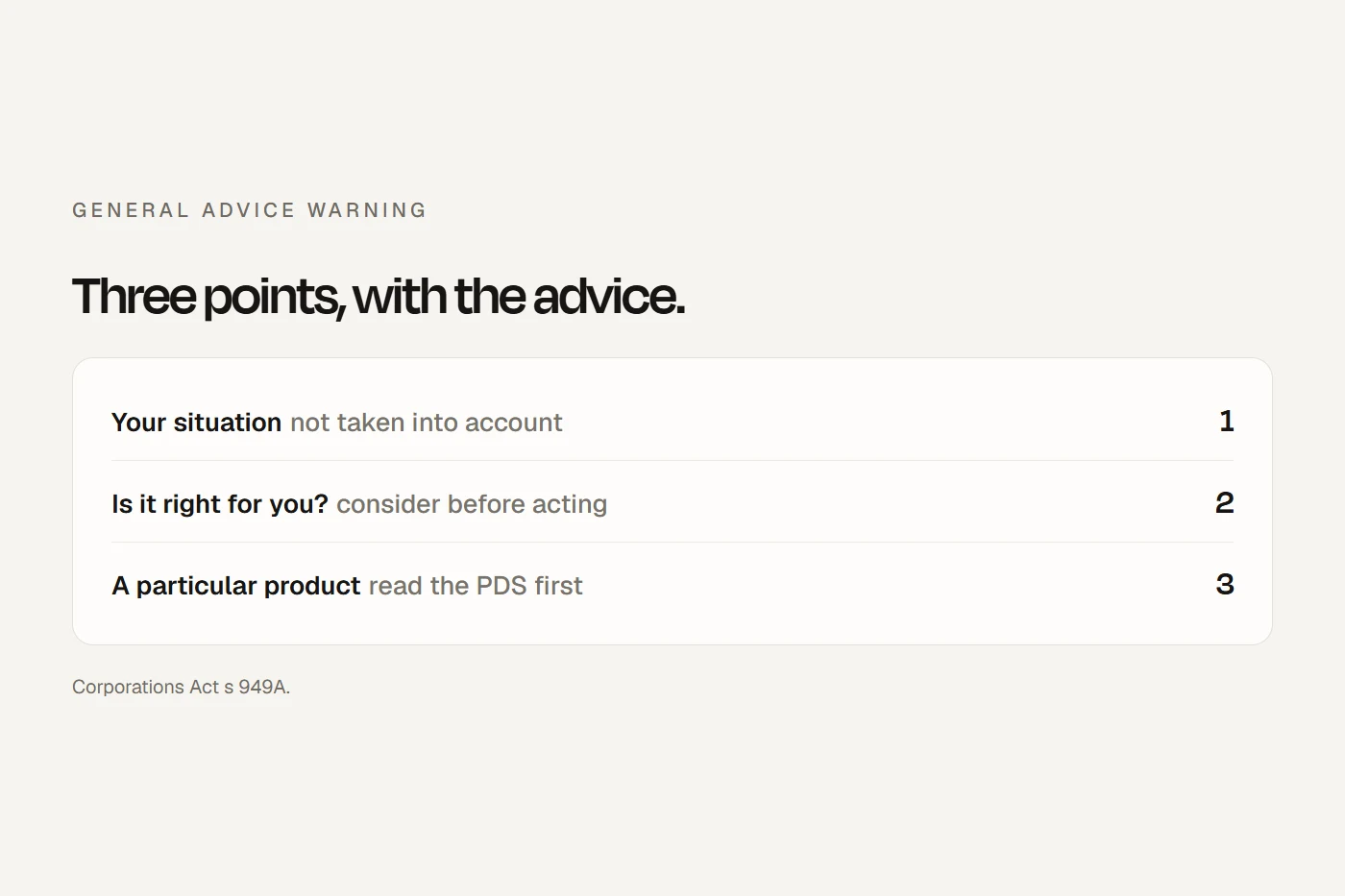
- Three points, in your own wordsThe advice doesn't consider the reader's objectives, financial situation or needs; they should think about whether it suits them; and for a particular product, read the PDS first.
- Same time, same meansThe warning goes in the post, video or email that carries the advice, not only in a footer or a bio.
When you need one
Section 949A of the Corporations Act applies when general advice is given by a financial services licensee or an authorised representative of one, to a retail client. General advice is financial product advice (a recommendation or opinion meant to influence a decision about a financial product or a class of them) that isn't personal advice. Personal advice is advice where you considered at least one part of the person's objectives, financial situation or needs, or where a reasonable person might expect you had.
Anything on a public website or social feed reaches retail clients, so in practice assume it does. You don't need the warning for:
- Factual information. ASIC calls it "objectively ascertainable information, the truth or accuracy of which cannot reasonably be questioned". How a product works, what a rule says, or a table of features with no ratings isn't advice, and needs no licence and no warning.
- Loans and credit. Credit isn't a financial product under the Corporations Act, so there's no general advice warning for home, car or personal loans. Credit has its own rules, covered below.
- A product issuer's own ads on billboards or in the media, if the ad tells people to consider whether the product is appropriate for them. This helps insurers and fund managers, not brokers or advisers advertising someone else's product.
- Generic calculators that meet ASIC's conditions, covered below.
One narrow point: the "read the PDS" part only applies where a Product Disclosure Statement exists. Listed shares generally don't have one, so general advice about shares needs the first two points but not the third.
What it must say
The Act lists three things the client must be warned about. ASIC's guidance says you don't need the Act's words; what matters is that the substance comes across, given at the same time and by the same means as the advice.
- The advice was prepared without taking account of the client's objectives, financial situation or needs.
- So before acting on it, they should consider whether it's appropriate for them.
- If it's about acquiring a particular financial product, they should get and read the PDS before deciding.
ASIC's own example, from its guide on disclosure: "This brochure doesn't take into account what you currently have, or what you want and need for your financial future. It is important for you to consider these matters and read the Product Disclosure Statement (PDS) before you make an investment decision." ASIC also says good practice is to work the warning into the advice itself rather than reciting the Act in fine print at the end, and to write for the people reading it. If the content is in another language, the warning should be in that language too.
There's no short written version for social media. ASIC has only ever sanctioned a short spoken one. Its advertising guide says that if a format doesn't leave room for the information people need, reconsider the format.
The written lines are my wording, not ASIC's. The spoken one is ASIC's own example.
Spoken advice: the short warning
For general advice given orally, ASIC's relief lets a licensee or authorised representative simply warn that the advice is general and may not be appropriate for the client. ASIC's examples:
- "This advice is general, it may not be right for you."
- "This advice is not tailored, so you can't assume it will be suitable for you."
- "This advice may not be suitable for you because it is general advice."
- "You will need to decide whether this advice meets your needs because I haven't considered this."
ASIC's guidance talks about phone calls and meetings, where once per conversation is enough. Nothing I found says whether the short version covers a pre-recorded video or a podcast. Until ASIC says, I'd say the short warning when the advice starts and also show or link the full written one.
Where it goes, channel by channel
The Act says the warning must be given "at the same time as the advice is provided and by the same means". That has practical consequences.
- Web pages and blog posts: on the page with the advice, near it, not only on a disclaimer page. If a particular product is named, link the PDS there too, and the target market determination is easy to add because the issuer must publish it.
- Written social posts: in the post or caption itself. A line in your bio isn't the same means as the advice in a post.
- Carousels and image posts: on the slide with the advice, readable without zooming.
- Short videos and reels: say it, and show it on screen long enough to read. ASIC's advertising guide notes that people don't pay attention to disclaimers that are "barely visible in real time". The caption carries the full version and any PDS link.
- Long videos and webinars: when the advice starts, and again if the topic moves to a particular product. Full written version in the description.
- Podcasts: read at a pace an average listener can follow, with the written version in the show notes.
- Email newsletters: in the email near the advice. ASIC warns against relying on click-through links for warnings.
- Paid ads: the same rules. ASIC says space limits are no reason to leave out balanced information.
Calculators and quizzes
ASIC's generic calculators instrument removes the need for a licence and the warning for a calculator that only does a numerical calculation (super calculators are excluded), doesn't promote a particular product, lets users change the assumptions, and shows clear statements: its purpose and limits, its assumptions, the present value of any estimate two or more years out, and that it "is not intended to be relied on for the purposes of making a decision" about a financial product. Users must be able to print or save the result, and you keep a copy for seven years. A calculator that ends with "this product is right for you" isn't a calculator any more.
Quizzes are riskier. ASIC's own example: a web tool that asks detailed questions about you and lands on a product recommendation is personal advice, and "the presence of a general advice warning does not alter this."
When a warning doesn't help
When the advice is really personal. In the Westpac super rollover case, the High Court found phone campaigns gave personal advice even though a general advice warning was given. It was given once at the start of each call; members were then asked about their own objectives and weren't encouraged to get personal advice. In ASIC's research on the label, most participants said they didn't notice it, and people were more likely to think general advice was tailored to them when it was one on one, when they'd asked what was best for them, or when they'd shared something about their situation. Replies to comments and direct messages carry the most risk.
When you aren't licensed. A "not financial advice" line doesn't change what the content is. ASIC's template letter to finfluencers says conduct "may still constitute financial product advice despite it being described as not being financial advice or being for educational purposes only." The Federal Court found one share-tips finfluencer was running an unlicensed financial services business through Instagram, paid seminars and a paid chat group, and that it didn't matter his Instagram stories had no overt recommendation. ASIC has since sent warning notices to more finfluencers and is reviewing the licensees that authorise them.
When the content is misleading. A warning meets the advice rule; it doesn't excuse a claim like "guaranteed returns". ASIC says you don't need a licence to breach the misleading conduct rules.
Information, general advice or personal advice?
Tap a card to see the verdict. Most come from ASIC's own examples.
Mortgage brokers and accountants
Mortgage brokers don't give general advice warnings on loan content, because loans aren't financial products. What they give instead is a credit guide as soon as it's likely they'll help a consumer with credit, and, in any ad that shows a rate, the comparison rate with the prescribed warning. The short version reads: "WARNING: This comparison rate is true only for the examples given and may not include all fees and charges. Different terms, fees or other loan amounts might result in a different comparison rate." If a broker's post moves into insurance, super or investments, that part is financial product advice, and only someone licensed or authorised for it should give it. My guide to mortgage broker websites covers the credit guide.
Accountants giving tax advice that's a necessary part of their work as a registered tax agent aren't giving financial product advice at all. Advice on the tax implications of a financial product, from someone not licensed for it, needs a written statement that you aren't licensed, that tax is only one of the matters to consider, and that the client should consider advice from a licensee. Advice on setting up or running an SMSF needs a similar statement. Accountants with a limited AFS licence give the normal warning when they give general advice, and ASIC's suggested spoken line for them is: "You will need to decide whether this advice meets your needs because I haven't considered this."
Check your copy
Paste a post, script or page. It flags the phrases most likely to turn content into personal advice, or to mislead.
It catches common patterns, not everything, and it can't see whether your warning is in the right place.
The government kept it
The Quality of Advice Review recommended removing the general advice warning, and the reviewer noted it's often stuck on content that isn't advice, which confuses people. The government said it would not proceed with that recommendation, and the advice reforms announced since don't change it. So the warning stays, and the practical fix the review pointed to still holds: use it where there's advice, and leave it off plain information.
Getting it right
Your ticks save in this browser.
- Sort your content types into information, general advice and personal advice.
- Confirm your licence or authorisation covers every product type you talk about.
- Write one written and one spoken warning in your own words.
- Put the warning beside the advice on every page, post, video and email, not only in the footer or bio.
- Link the PDS, and the TMD, wherever a particular product is named.
- Show your licence details and your FSG or website disclosure information on the site.
- Check each calculator against ASIC's conditions, or add the warning.
- Take recommendations out of quizzes that ask about people's circumstances.
- Label paid partnerships clearly as advertising.
- Keep copies of ads and their warnings.
- Leave the warning off plain information, or use an "information, not advice" line instead.
My view
The warning is the easy part. Write it once in plain words, then put it where the advice is, every time, including in captions and videos. The harder discipline is not drifting into someone's personal situation in replies and messages, because there the warning stops working. And if you're not licensed, the fix isn't a better disclaimer: it's keeping your content to information.
Questions I get asked
What is a general advice warning?
A warning that advice hasn't taken account of your objectives, financial situation or needs, that you should consider whether it suits you, and, for a particular product, that you should read the PDS. Licensees and their representatives must give it with general advice to retail clients.
What is an example of a general advice warning?
ASIC's spoken example is "This advice is general, it may not be right for you." Its written example tells readers the brochure doesn't take into account what they have or want, and to consider that and read the PDS before deciding.
Does a "not financial advice" disclaimer protect me?
No. ASIC says content can still be financial product advice whatever it's labelled. If you're not licensed, keep to factual information.
Do mortgage brokers need a general advice warning?
Not for loan content: loans aren't financial products. Brokers give a credit guide and the comparison rate warning instead.
Can the warning go in my Instagram bio?
The law says it must be given at the same time and by the same means as the advice, so put it in the post or caption with the advice.
About this guide
Written by Joseph Alzein, founder of bdog. bdog builds websites for advisers, brokers and accountants. The rules come from the Corporations Act and Regulations, ASIC's instruments and regulatory guides, the National Consumer Credit Protection Regulations and ASIC's published research and media releases. This is general information, not legal advice.
Main sources:
- Corporations Act 2001
- ASIC Instrument 2025/234 (FSG, general advice warning and advertising relief)
- ASIC Generic Calculators Instrument 2026/41
- ASIC RG 175
- ASIC RG 244
- ASIC RG 234
- ASIC INFO 269: discussing financial products online
- ASIC research on the general advice label
- ASIC: the Westpac High Court decision