What naturopaths can say in advertising: the TGA and the ACL
Why Ahpra’s rules usually don’t apply and what does: the Consumer Law, your state’s code of conduct, the TGA Advertising Code for products and your association’s code. Product endorsements, your own blends, evidence wording, health funds, testimonials, titles and what regulators have acted on. With a wording checker, a sorter and a 90-day checklist.
On This Page
- How clients find and choose a naturopath
- Which rules apply to a naturopath
- Products: what the TGA allows
- Testimonials and reviews
- Evidence-based wording
- Health funds: back, with conditions
- Titles, “Dr” and “specialist”
- What regulators have acted on
- Channels that work inside the rules
- Check your wording
- Can I say this?
- Your first 90 days
- Questions I get asked
Search for advertising rules as a naturopath and you'll mostly find Ahpra's guidelines, which don't govern you. Naturopathy isn't an Ahpra-registered profession. What does govern your marketing is the Australian Consumer Law, your state's code of conduct for unregistered health practitioners, the TGA's Advertising Code whenever you mention a product, and your association's code. Some of those are stricter than people expect: a naturopath can't endorse a product at all, and the clinic's own herbal blends can't be advertised to the public. This guide covers each layer, health funds, testimonials, titles, and what regulators have acted on. It's general information, not legal advice.
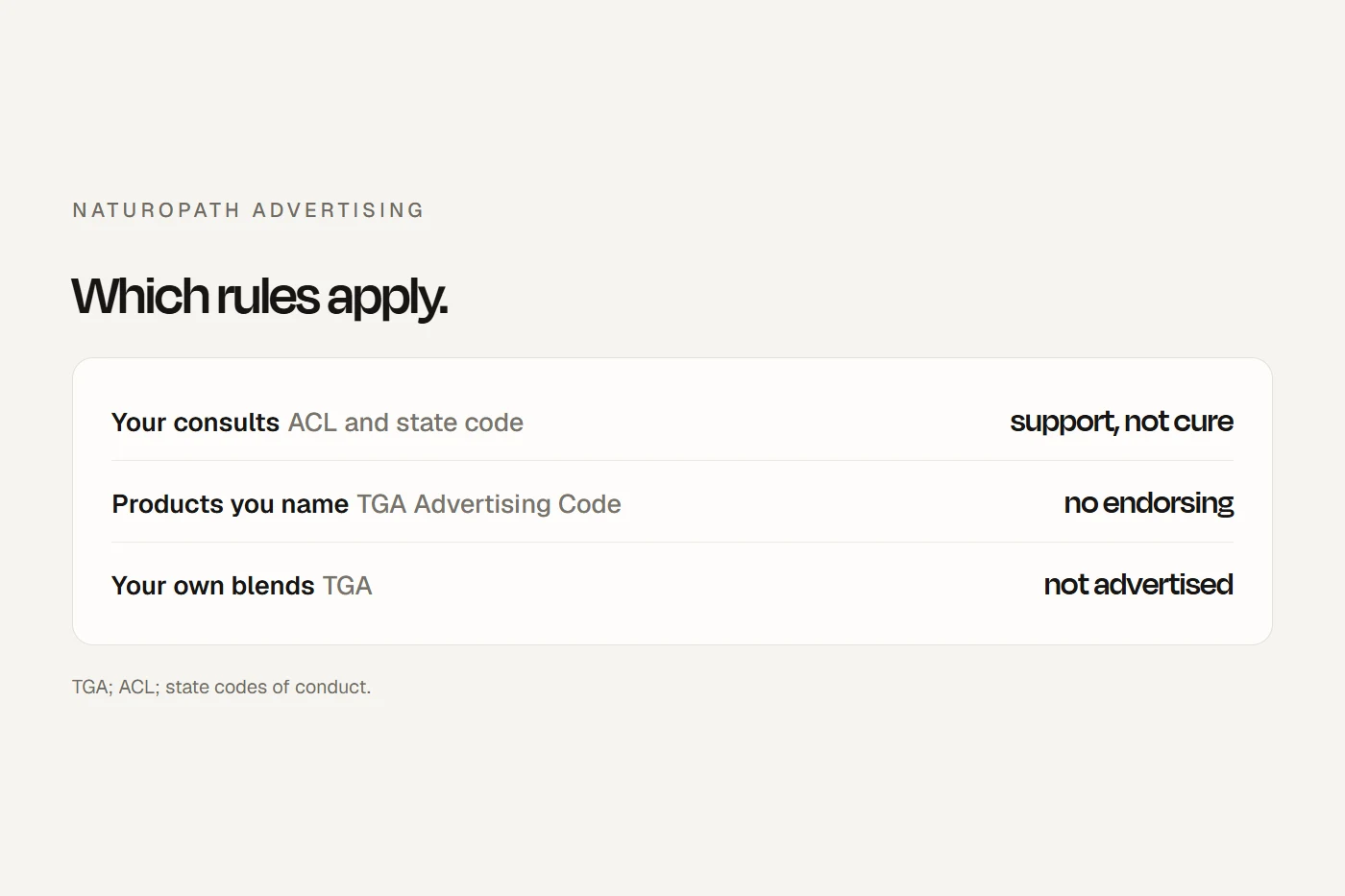
- Services: support, not cureDescribe your consults and who they suit. Never claim to cure, and be able to back any claim that you help.
- Products: the TGA rules applyAny post that names a product is a therapeutic goods ad. You can't endorse products, and you can't advertise your own blends.
- Health funds are back, with a catchSome funds pay for naturopathy again, but not for iridology, kinesiology or homeopathy advertised as such.
How clients find and choose a naturopath
There's no survey of how Australians find a naturopath. The research that exists is about why. In one study of clients with chronic conditions, the top reasons for seeing a complementary practitioner were that the practitioner was supportive and compassionate, that the care felt safe, and that it might improve general wellbeing; most had been to five or more consultations. Another found that fewer than four in ten people who saw a Western herbalist told them which conventional medicines they were taking.
That points the website away from outcome claims and toward how you work: what a first consult involves, what it costs, how long a plan usually runs, and that you'll ask about medicines and work alongside the GP.
Which rules apply to a naturopath
Not Ahpra, usually. The National Law's advertising section covers "a regulated health service", one usually provided by a registered practitioner, and naturopathy, Western herbal medicine and nutrition aren't registered professions. Two exceptions: if your clinic also offers a registered profession's service, such as a physio, a nurse or a registered Chinese medicine practitioner, the clinic's ads fall under the National Law too, including its ban on testimonials. And "Chinese herbal medicine practitioner" and "acupuncturist" are protected titles. Never say "registered naturopath" or "Ahpra registered".
The Australian Consumer Law, always. No misleading claims about your services, their benefits or your affiliations. A testimonial that's challenged is presumed misleading until you produce evidence that it's genuine.
Your state's code of conduct. Every state and the ACT has a code for unregistered health practitioners, and NSW names naturopathy. The clauses that matter for marketing: don't claim you can cure cancer or other terminal illnesses; only claim to treat or relieve symptoms if you can back it; don't try to talk clients out of medical treatment; no misinformation about your products, services or qualifications; and no gifts or payments for referrals from other practitioners. Commissioners can ban practitioners for life. In NSW, if you have a website, the code and the Health Care Complaints Commission's complaints notice go on it.
The TGA Advertising Code, for products. The TGA's guidance is that promoting your consultations, or the conditions you see people for, without referring to products is unlikely to be a therapeutic goods ad. Name or show a herb, supplement or product, link to buy one, or film your dispensary, and the Code applies in full.
Your association's code. The NHAA, ANTA, ANPA and CMA now share one code of conduct. Its advertising clause says never claim to cure, never guarantee an outcome, keep claims "factual and verifiable", don't compare yourself with other practitioners in a misleading way, make any use of "Dr" clear, and state offer terms in plain language. ATMS has its own code with the same core rules.
Products: what the TGA allows
You can't endorse products. The Code bans endorsements by health professionals and by anyone who presents as trained to diagnose or treat, which includes every naturopath. Members of ANTA, ATMS, the NHAA and several other associations also count as "health professionals" under the Therapeutic Goods Act. So "naturopath recommended", "my favourite probiotic" and affiliate or ambassador posts for supplement brands are out, and a "paid partnership" label doesn't fix them.
But you can advise your own patients. If you're a member of one of those associations, advice you give a patient directly during their treatment is outside the advertising rules. The TGA says that exception doesn't cover content that's publicly accessible or mass communications, so the same recommendation in a newsletter, blog or Instagram post is advertising.
Your own blends can't be advertised. Naturopaths can make preparations for a particular client after a consultation. The TGA says plainly that "you cannot advertise compounded medicines to the public", but "you can advertise your compounding service". So "custom herbal formulas made for you after your consult" is fine; "my signature sleep tonic, DM to order" isn't.
Claims are capped by the product. Listed medicines can only make claims from the TGA's list of permitted indications. "Detox" is allowed only as support for the body's natural detoxification processes, with no implication of organ disease, and preconception products can't imply infertility. Claims about cancer, mental illness, sexually transmitted diseases, HIV and hepatitis C are prohibited outright. Claims about serious forms of disease, and any reference to COVID-19, need TGA approval.
Other Code rules that catch naturopaths: no "safe" or "no side effects", no "guaranteed", no "miracle", nothing that discourages medical treatment, research cited properly or not at all, no free samples of herbal or vitamin products, and the mandatory statements, such as "Always read the label and follow the directions for use", on product ads. A practitioner-only product shown publicly also needs "This product is not available for purchase by the general public".
Testimonials and reviews
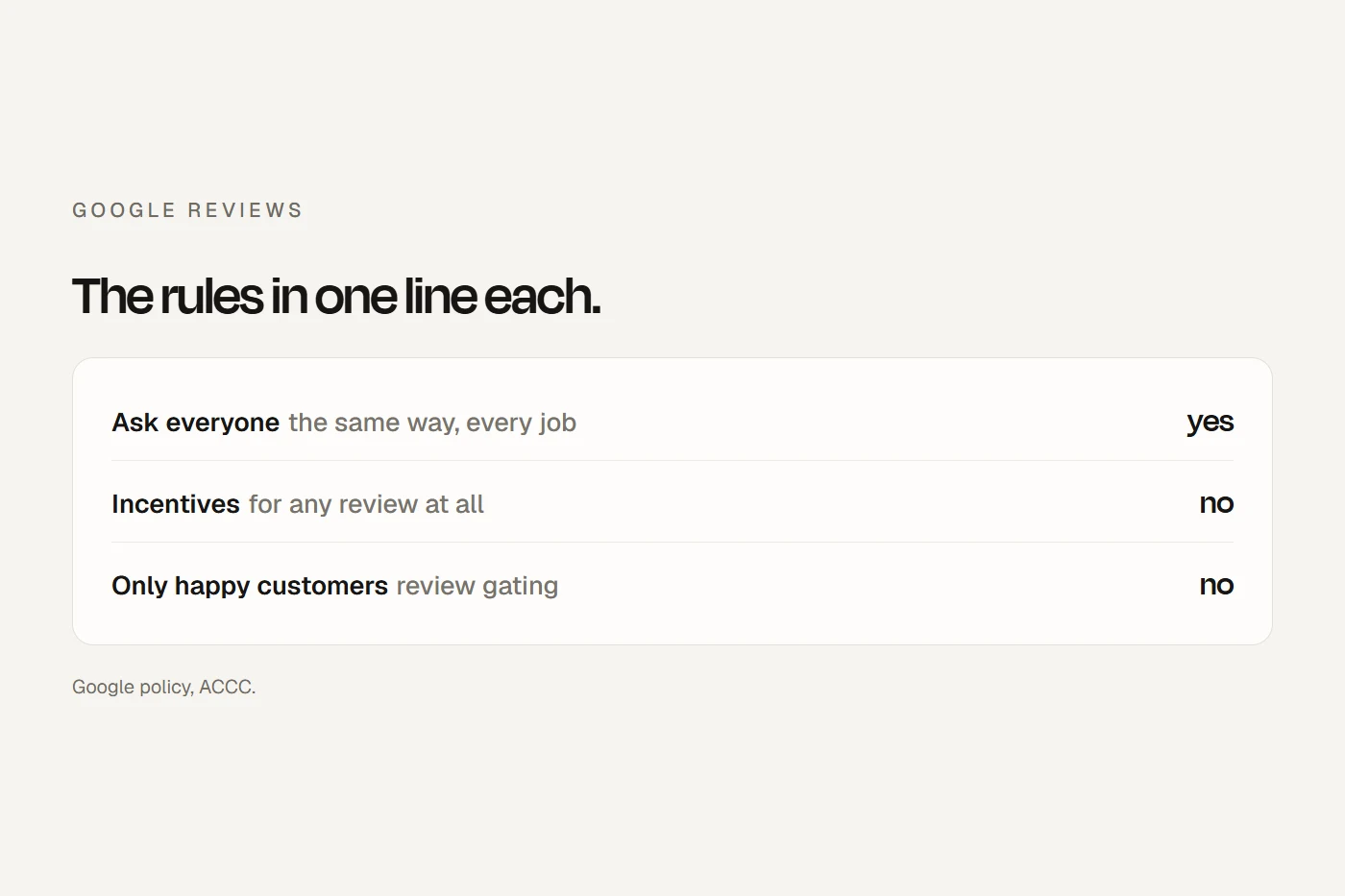
Naturopaths aren't banned from testimonials the way registered practitioners are. But the layers stack up against them. ANTA advises members not to use them. A client's "my eczema cleared up" is a health claim you'd have to be able to prove. For products, the TGA bans testimonials from anyone engaged in supplying the product, including a client given a discount or gift, and requires you to verify the rest, so for a clinic that sells the product almost every testimonial is unusable. And the Federal Court has held that a business that leaves clients' testimonials on its Facebook page becomes their publisher. My rule for health sites is no testimonials: ask every client for a Google review, offer nothing for it, and don't quote reviews on your site.
Evidence-based wording
The government's Natural Therapies Review is the best reference for how strong a claim can be. It found low certainty that naturopathy helps for a handful of conditions, and that for most conditions the effect is very uncertain or unknown. It found moderate certainty for a few specific supplements in specific conditions. So "may help" and "support for people with" are honest; "clinically proven" or "evidence-based treatment for anxiety" claims more than the review found, and mental illness claims are prohibited for products anyway.
Health funds: back, with conditions
Naturopathy and Western herbal medicine were dropped from private health insurance general treatment for several years and have since been re-included. Each insurer decides whether it covers them and at what level. Most of the smaller and regional funds now recognise naturopaths through the associations; the big funds' provider lists I checked don't yet. Check your association's current list before you write anything.
The catch is in the Department of Health's own circular: if a naturopath provides aromatherapy, homeopathy, iridology, kinesiology or reflexology "advertised or promoted as such", health insurance benefits can't lawfully be paid. So a services page that lists iridology next to "health fund rebates" is a problem. Say "rebates for naturopathy consults with many funds, depending on your extras cover", never "all funds" or "fully claimable", and don't use fund logos without permission. Rebates usually cover the consult, not medicines.
Titles, "Dr" and "specialist"
Anyone can call themselves a naturopath, which is why your qualification and association membership are your credibility. Write the association's full name and your membership level, and only claim accreditation in the modalities you're accredited in. If you hold a doctorate, the associations' codes require you to make clear you're not a medical doctor: "Dr Sam Lee (PhD), naturopath, not a medical doctor". "Naturopathic doctor" and "ND" are North American titles that imply a licence that doesn't exist here. "Specialist" isn't protected for naturopaths, but it implies a recognised specialty, so "works mainly with gut health" is the safer line.
What regulators have acted on
- The NSW Health Care Complaints Commission permanently banned a naturopath who claimed cancer could be treated with bicarbonate soda, discouraged vaccination and antibiotics in pregnancy, and gave unsafe infant nutrition advice.
- It banned another for overstating his qualifications to the public and making efficacy claims he couldn't substantiate.
- It banned a naturopath running a "detox" business who gave IV infusions without training or medical supervision; two clients needed hospital care.
- The TGA fined a herbal medicine practitioner over a "miracle covid treatment" social media post.
- The Federal Court found a homeopathy website's claims about an "alternative" to the whooping cough vaccine misleading.
Channels that work inside the rules
Your website. One page per main concern you see people for, in "support for" language, with what a consult involves, how you work with the GP, and no product names. A fees page with packages and refund terms. An about page with your qualification and association. In NSW, a code of conduct and complaints page in the footer. My guide to privacy policies for health websites covers the health information you collect.
Google Business Profile. "Naturopath" as the primary category, services in the same wording as your site, and a booking link. My Google Business Profile checklist goes field by field.
Instagram and Facebook. Educational posts about conditions and lifestyle, with research cited properly if you cite it. Every post naming a product is a product ad. Comments under your posts become part of the ad, so moderate them. Your professional channels are read as speaking for the profession, even personal opinions.
Meta ads. Health and wellness ads must be targeted at people over 18, and Meta bars copy that asserts a health condition, like "Struggling with bloating?". Australian law applies on top.
GPs. There's no Medicare pathway, but a short GP information page or letter explaining your training, that you check medicines, and that you refer on builds trust. No payments or gifts for referrals.
Check your wording
Paste a page, a post or a bio. It flags words that tend to cause trouble; it can't judge context, so read each flag.
Can I say this?
Tap a card to see the verdict.
Your first 90 days
Tick items off as you go; the list remembers your progress on this device.
- Month 1: every product mention found Pages, posts, bios and ads. Add the accepted indication and mandatory statement, or remove the product.
- Month 1: blend posts deleted Replaced with one line about custom formulas after a consult.
- Month 1: claims cleaned No cure, guarantee, miracle, "no side effects" or uncited "proven"; no cancer, COVID, vaccine or mental illness product claims.
- Month 1: endorsements removed "Naturopath recommended" lines, affiliate codes and ambassador posts.
- Month 1: titles fixed Association in full, "Dr" with "not a medical doctor", no "registered" or "ND".
- Month 1: NSW code page The code and the complaints notice, linked in the footer. Elsewhere, displayed at the clinic.
- Month 1: comments moderated On product posts, non-compliant comments removed.
- Month 2: concern pages One per main concern, in "support for" language, with how you work with the GP.
- Month 2: fees page Consult fees, packages with refund terms, and that medicines usually aren't claimable.
- Month 2: health funds checked Your association's current list; no logos or amounts; excluded therapies kept away from rebate wording.
- Month 2: Google profile and reviews "Naturopath" category, the same service wording, a neutral review request to every client.
- Month 2: a GP information page Your training, medicines checks and how you refer on.
- Month 3: an education plan Monthly posts on conditions and lifestyle, research cited properly, no product angle.
- Month 3: Meta ads, if any 18+ targeting, no health-condition questions, no outcome-in-a-timeframe promises.
- Month 3: a quarterly wording check Everything run through the checker above.
Questions I get asked
Do Ahpra's advertising rules apply to naturopaths?
Not usually. Naturopathy isn't a registered profession. They apply if your clinic also offers a registered profession's service. The Consumer Law, your state's code of conduct and the TGA Code apply either way.
Can naturopaths use testimonials?
The law doesn't ban them for naturopathy services, but they must be genuine and you must be able to back the claims in them. ANTA advises against them, and product testimonials are almost impossible to use lawfully. I leave them off health sites.
Can I recommend supplements on Instagram?
Not as an endorsement. The TGA Code bans endorsements by anyone trained to treat, and a public post is advertising. You can recommend products to your own patients during treatment.
Can I sell my own herbal blends online?
No. The TGA says compounded medicines can't be advertised to the public. You can advertise that you make custom formulas after a consultation.
Is naturopathy covered by health funds again?
It's eligible again, at each fund's discretion. Many smaller and regional funds recognise naturopaths; check your association's current list, and don't advertise excluded therapies with rebate wording.
Can I call myself Dr?
Only if you hold a doctorate, and you must make clear you're not a medical doctor.
About this guide
Written by Joseph Alzein, founder of bdog. I build websites for health and wellness practices, with the TGA Advertising Code, the Australian Consumer Law and your state's code of conduct in mind. Sources were checked on 12 October 2026. This is general information, not legal advice. I've left out penalties and rebate amounts.
Main sources:
- TGA: advertising health services that involve therapeutic goods
- TGA: manufacturing, supplying and advertising compounded medicines
- TGA: testimonials and endorsements
- TGA: restricted and prohibited representations
- TGA: permitted indications for listed medicines
- Code of Conduct for Australian Naturopaths and Western Herbal Medicine Practitioners
- ATMS Members' Code of Conduct
- ANTA: frequently asked questions
- Department of Health: natural therapies re-included
- Department of Health: excluded natural therapies
- Natural Therapies Review report
- ACCC: testimonials left on a business's Facebook page
- Study: why people with chronic conditions see complementary practitioners