Marketing a private school: lifting enrolments
For small independent and Catholic schools: what Australian parent research says about how and when families choose, the rules on results, rankings and My School, fees, building funds and enrolment contracts, and the channels that fill places. With an enrolment funnel calculator, a can-I-claim-this sorter and a year by term.
On This Page
Search for private school marketing and page one is American and British software vendors with "10 strategies" lists, plus Australian agencies selling ads. Almost none of it uses what Australian parents have said about how they choose a school, and none of it mentions the rules that catch Australian schools out: NSW's law on publishing rankings, the strings on My School data, what the ATO says about building fund "donations", or a tribunal decision voiding a school's notice clause. This guide is for the principal, business manager or enrolments lead at a small independent or Catholic school, the kind with a few hundred students rather than a few thousand. I build school websites, and everything below comes from the ABS, Independent Schools Queensland and Independent Schools Australia research, the NSW Education Act, ACARA, the ATO and the Australian Education Regulations.
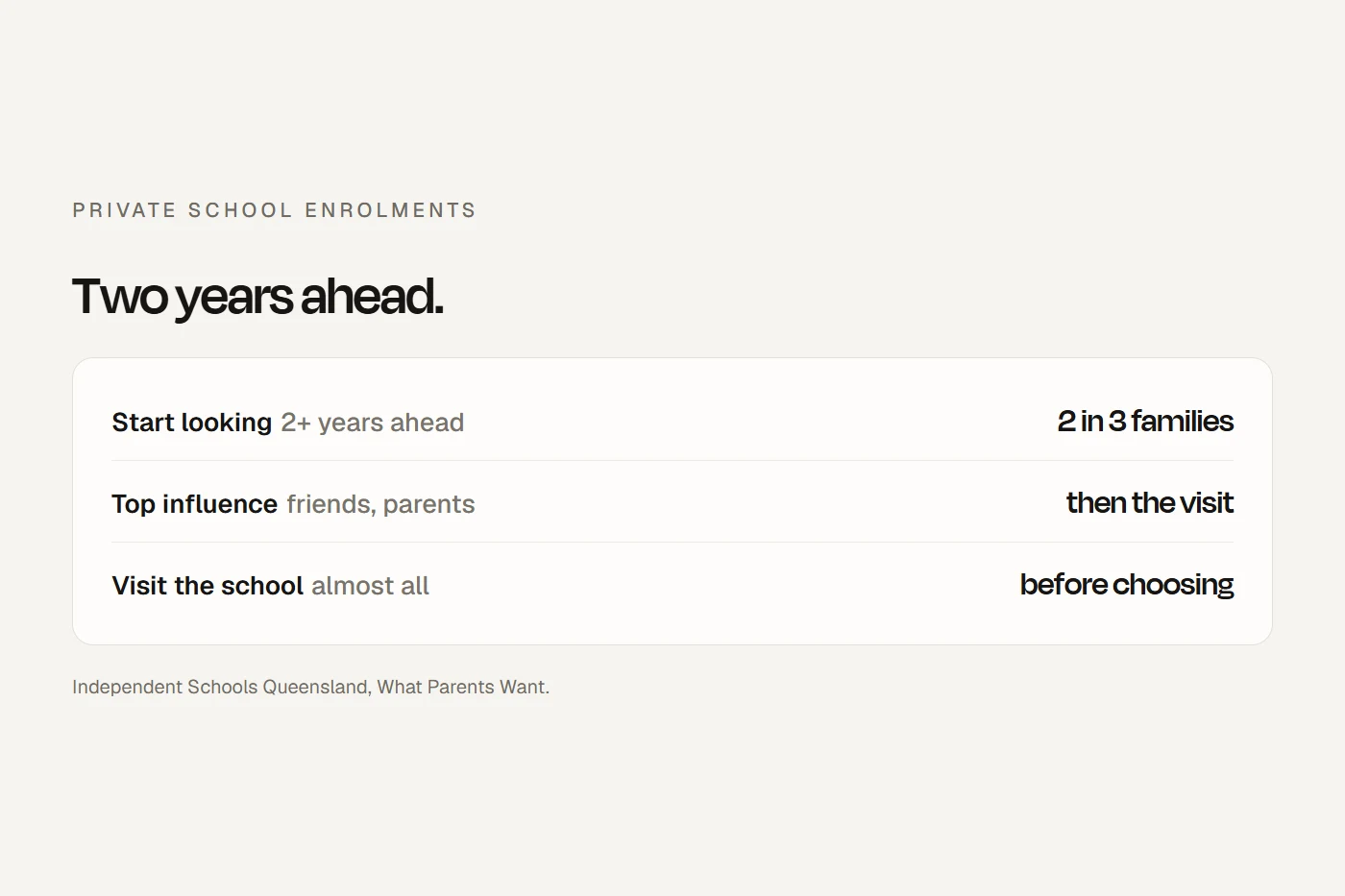
- Parents decide early, ask friends, then visitIn Independent Schools Queensland's parent survey, two in three families started looking at least two years ahead, friends and current parents were the top influence, and almost every family visited the school. The website's job is to get the tour booked.
- Don't rank yourself against other schoolsIn NSW it's an offence to publish a ranking or comparison of particular schools by NAPLAN, HSC or report results without every principal's permission, with one carve-out for top 10% HSC rankings. Elsewhere, My School's terms and the consumer law still bite.
- Your fees page and enrolment contract are marketingShow the total compulsory cost, keep the building fund optional and outside the total, and put the notice terms on the website before families pay anything.
The market you're in
About one in three Australian students is in a Catholic or independent school, and that share has been rising for twenty years. In the latest ABS figures, independent schools were the fastest-growing sector over the past five years and government school numbers had flattened. The growth has been mostly in lower-fee schools and in growth suburbs and regional areas, according to Independent Schools Australia, Independent Schools NSW and a recent NSW study. More than a third of independent schools have fewer than 200 students.
The best evidence on how parents choose comes from Independent Schools Queensland's long-running "What Parents Want" survey, answered by more than 3,000 parents at independent schools:
- They start early. Two in three started looking at least two years before their child started, and almost a quarter from or before birth.
- They ask people first. The top three influences were family, friends and colleagues; the open day or school visit; and other parents at the school. The school website and social media came next.
- They visit. Almost every family looked at school websites, most at two or more, and almost every family did a one-on-one visit or open day. One-on-one visits were rated most useful, and parents most wanted to meet classroom teachers and the principal.
- They're swayed by what they see. Most said the look of the school and its facilities strongly influenced them.
- They waitlist. Most put their child on a waiting list, and many were on more than one school's list.
- They choose on fit. The top reasons were preparing their child to fulfil their potential, high-quality teachers, the school suiting their child's needs, and reputation.
Independent Schools Australia's national research found the same: educational excellence, good teachers, facilities and a caring environment, with word of mouth the biggest influence. Price and closeness to home barely registered for independent school parents, unlike government school parents. And in the Queensland survey, the most common reason families considered leaving was being unhappy with school management, then money. The cheapest enrolment is the one you keep.
How many enquiries you need
I found no Australian benchmarks for school conversion rates, so use your own. Put in an entry year and see how many enquiries you need to fill it. The fee field starts empty.
Change one rate at a time to see where the leverage is. At the example rates, lifting tours-to-applications from 60% to 70% saves 28 enquiries. That's usually cheaper than buying more enquiries, and it's about the tour: who takes it, whether the principal says hello, and how quickly the follow-up comes.
Results, rankings and My School
Results are where school marketing most often goes wrong.
- NSW law on rankings. Section 18A of the NSW Education Act makes it an offence to publish, in any publicly available document in NSW, a ranking or other comparison of particular schools by school results without the permission of the principals of the schools involved. School results include NAPLAN, HSC and even school report results. There's a carve-out for publishing the ranking of schools in the top 10% on HSC results, built from the merit lists NESA publishes. I read a school website, prospectus or social post as a publicly available document, and I'd get advice before quoting any ranking that isn't a top 10% HSC one.
- Named students. Under the same section, an identified student's results can only be revealed with the student's or a parent's consent. NESA's merit list isn't consent for your ad, and students can ask NESA to keep their names off the lists.
- My School. ACARA's terms let a non-government school use My School content for non-commercial educational use, but that permission doesn't extend to reproducing it on a publicly accessible website, and content can't be used to create comparative lists for a commercial purpose or in a misleading way. ACARA says it has long discouraged league tables. Link to your My School page; don't screenshot it into your prospectus without ACARA's written consent.
- NAPLAN over time. NAPLAN moved to a new scale and proficiency levels, and results from then on can't be compared with earlier years. "Our NAPLAN results are up since 2019" isn't a fair comparison.
- ATARs. Schools only learn the ATARs of students who choose to share them; in Queensland, students consent through QTAC. Any ATAR figure should state its base: "of the students who shared their ATAR with us".
- Promises. "Guaranteed ATAR" or "every student gets into university" is a claim about the future that needs reasonable grounds under the consumer law, and no school has them.
The good news is that you already have to publish honest results. The Australian Education Regulations require every school's approved authority to put information online each year, within six months of the year's end: NAPLAN results, attendance, parent, student and teacher satisfaction, income by funding source, and for secondary schools, senior outcomes and post-school destinations. NSW registration also requires an annual report. Make that page findable and readable: it's the results page parents want, and it's already compliant.
Can I claim this?
Tap a card to see the verdict.
Fees, waitlists and the enrolment contract
I found no rule that requires a school to publish its fees, but most families plan the cost years ahead and money is the second most common reason they consider leaving. Publish them, properly:
- The total. Under the consumer law, an advertised price has to include all unavoidable charges as a single figure. Put the total compulsory annual cost for each year level up front, then list the levies that make it up. Optional costs, such as uniforms, optional excursions and instrumental lessons, go separately.
- The building fund. The ATO says a payment to a school building fund instead of a fee increase, or for a place on a waiting list, isn't a gift and isn't deductible. Show it as optional, outside the total due, and never tied to a place or a discount.
- The waitlist. Say what a waitlist place means (no guarantee), how offers are decided (siblings, faith, date of application), and whether there's a fee.
- The contract. An ACT tribunal found a school's "a term's notice or a term's fees" clause void as unfair, because the school could change fees and terms while parents had no matching right to leave. Using unfair terms in standard form contracts now attracts penalties. Get advice on your notice clause, and put the application fee, deposit, notice period and refund terms on the website before families pay anything.
- Scholarships. Say what each covers and for how long, the conditions to keep it, which test and who charges for it. ACER says short-term training for its scholarship tests is unlikely to improve performance, so don't imply coaching will.
The channels, one by one
Tours and open days
One-on-one visits are what parents rate most useful. Make tours bookable online all year, not "call the office", and have the principal or a classroom teacher meet every family. Answer enquiries within a working day. The open day is the second event, not the only one.
Your website
Almost every family looks at school websites, most at several. It needs: fees as above; the enrolment steps from enquiry to start; key dates by term; the waitlist explanation; the annual report and required information; and, in NSW, links to your enrolment, complaints, discipline, anti-bullying and child protection policies. Show the school as it is: parents told the Queensland researchers the look of the school and its facilities strongly influenced them. Enquiry and tour forms need a collection notice, a separate tick for newsletters, and to work with a screen reader. Most private schools are covered by the Privacy Act.
Current families and alumni
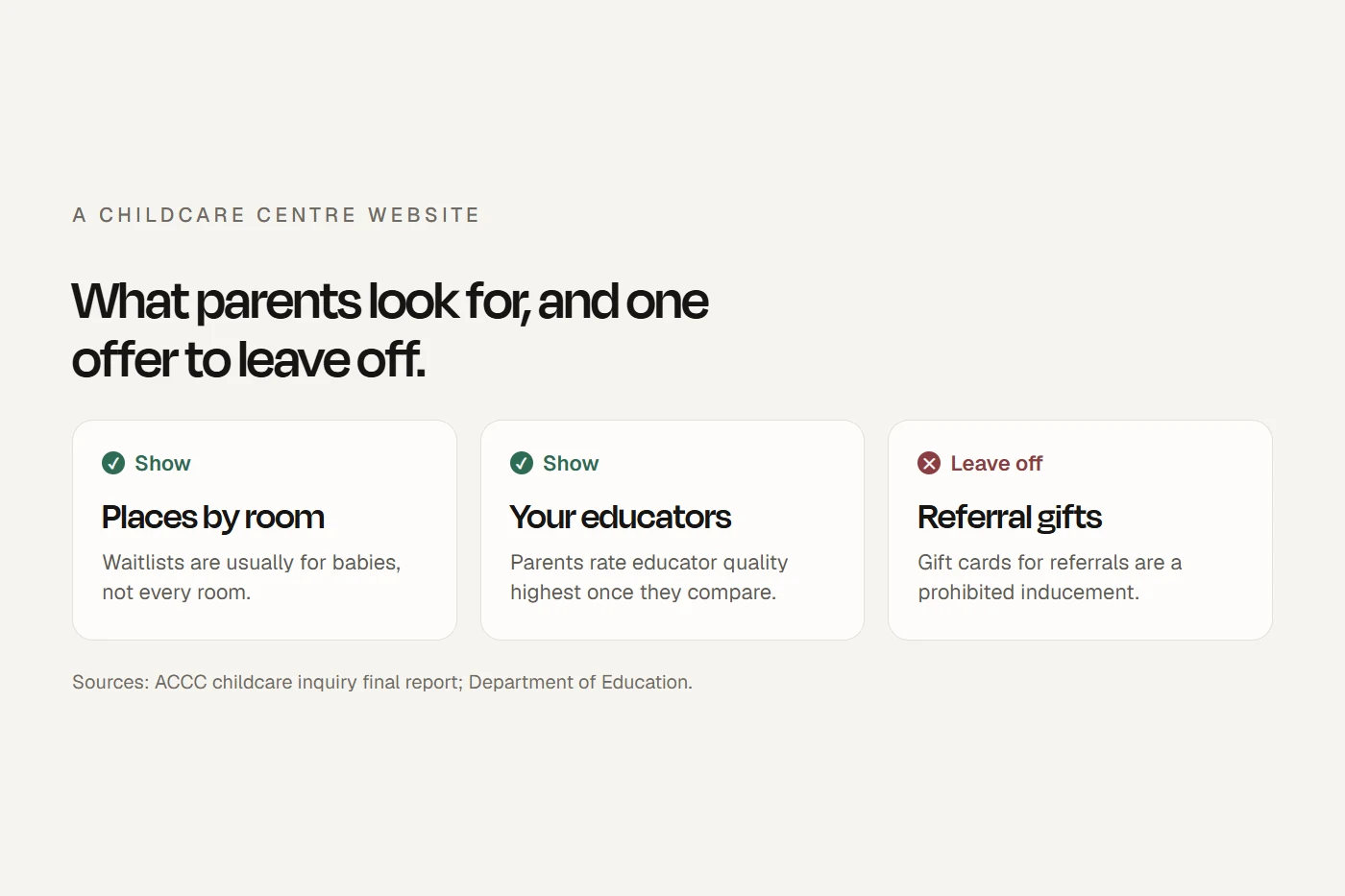
Friends and current parents are the most influential source in every survey. Give families something easy to pass on: a link to book a tour, an open day invitation. Fee credits for referrals are lawful if the terms are written and honoured, but don't collect friends' phone numbers to message them. Name alumni only with their agreement.
Feeder preschools
Most Prep children came from kindergarten, and families start looking two years ahead, which is often while their child is at preschool. Information sessions and transition programs with local preschools and long day care centres reach them at the right time. For a K to 12 school, your own Year 6 is the first Year 7 feeder.
Google Business Profile
Google says schools shouldn't show opening hours. One profile per campus; a separately run early learning centre or OSHC with its own entrance can have its own profile and category. Ask happy families for reviews at natural points such as the end of term, and never offer anything for one.
Meta ads
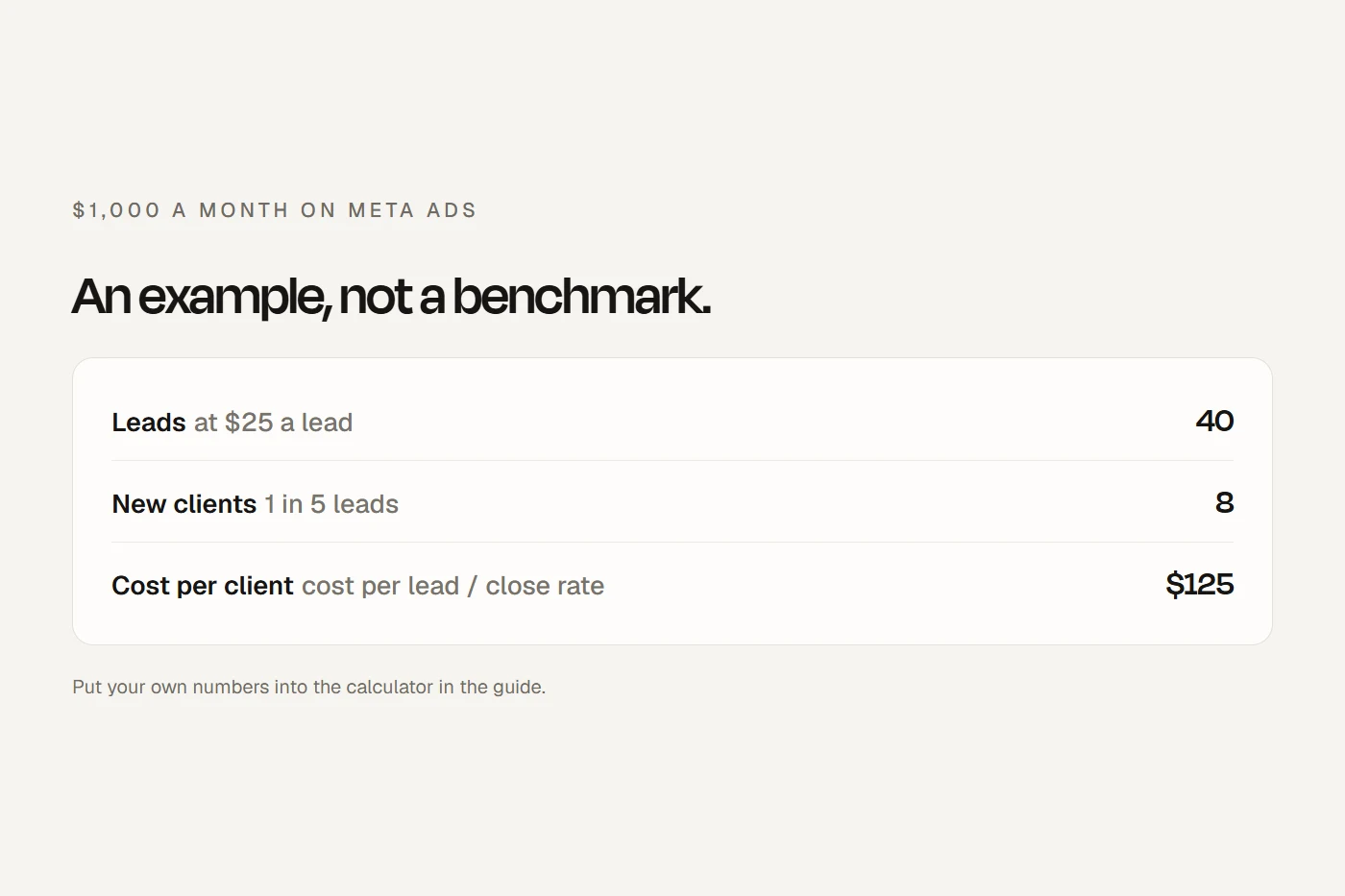
Education isn't one of Meta's special ad categories, so a school's enrolment ads to Australian parents use normal targeting. Advertise to parents in your catchment suburbs, with the year level and entry point in the creative. Meta limits teen targeting to age and location, and under-16s can't hold accounts on the major platforms, so don't target students. Paid ads mostly drive tour bookings at decision times; your own accounts' posts do the social proof.
Photos of students
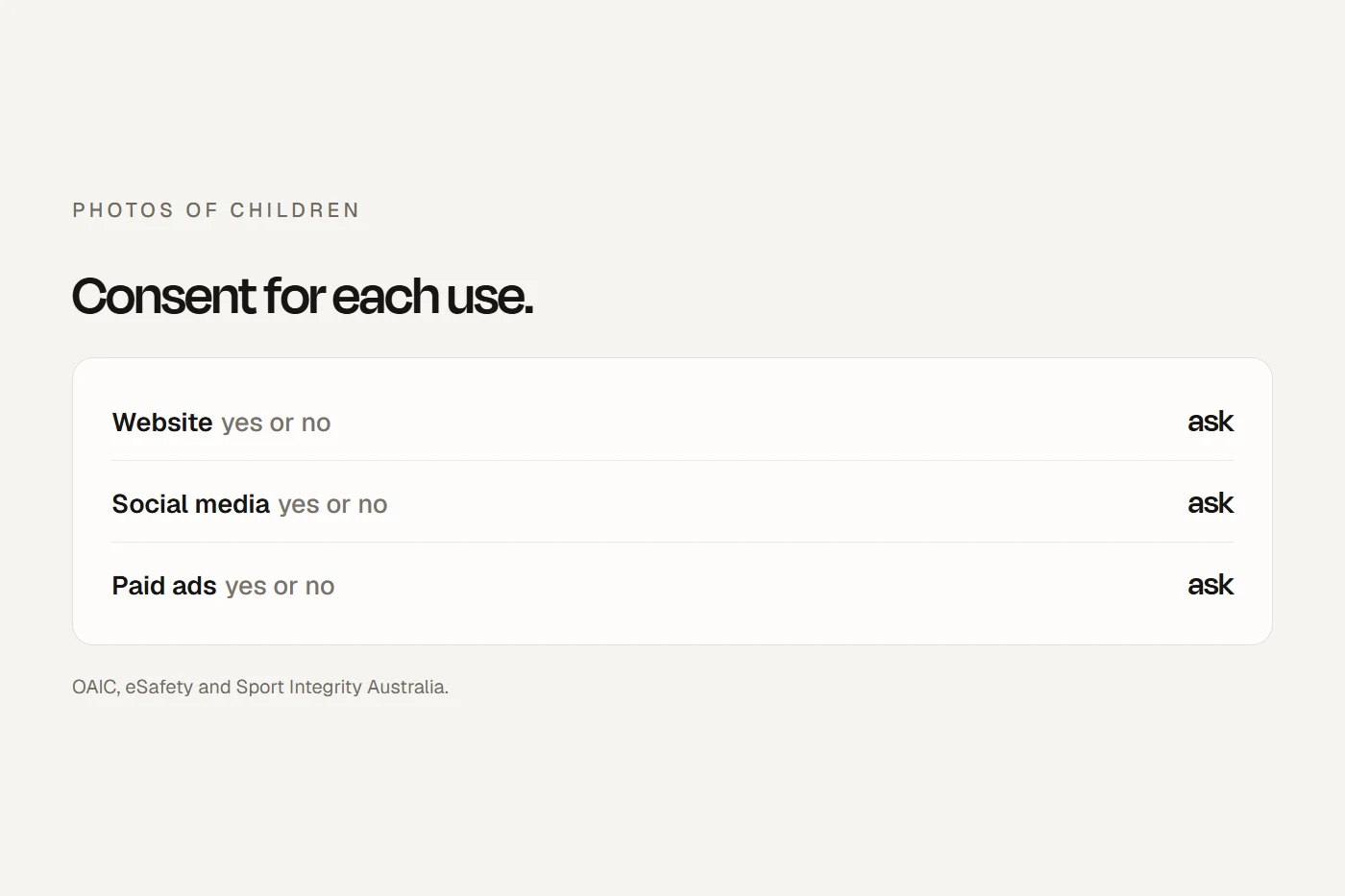
Get marketing-specific written consent, separate from general school publications, and renew it each year. No names with faces, and remember a uniform identifies the school. My guide to photos of children on your website and socials has consent wording you can adapt.
An enrolment year, by term
Dates move every year, so this goes by term. Your ticks save in this browser.
- Term 1: know your numbers per year level after the census, and plan how you'll describe NAPLAN honestly.
- Term 1: the cooperative ACER scholarship test is on a Saturday in February; most Victorian schools use a different date.
- Term 1: in NSW, Year 6 families in government schools state their high school plans early in the year. Year 7 offers that arrive first get considered.
- Term 2: publish last year's annual report and required information on the website within six months of year end.
- Term 3: check your Year 7 timing against the Catholic systems and other schools in your area.
- Term 3: applications open for next year's scholarship test, so update your scholarship page first.
- Term 4: orientation days, re-enrolment and notice-period reminders to current families.
- Term 4: check your My School profile when ACARA updates it, and that your website matches.
- Term 4: renew photo and marketing consents for next year.
- All year: book tours online, answer enquiries within a working day, and ask for reviews at natural points.
- All year: keep the fees, enrolment steps, waitlist explanation and policies current.
My view
Small schools don't win enrolments with clever ads. They win them with a tour that families remember, a website that answers the money and process questions a friend can't, and current parents who talk them up. Put the effort into the tour-to-application rate and into keeping the families you have, publish your fees and terms honestly, and leave rankings alone. Families will look you up on My School and ask their friends anyway; make sure what they find on your own site is clear, complete and current.
Questions I get asked
How do you increase enrolments at a private school?
Make tours easy to book and memorable, follow up quickly, publish clear fees and enrolment steps, work with feeder preschools, and give current families an easy way to recommend you. Then measure where enquiries are lost and fix that step first.
Why are parents choosing private schools?
In the research, parents of independent school students chose on preparing their child for later life, the quality of teachers, the school suiting their child's needs, facilities, values and a caring environment. Word of mouth was the biggest influence.
When do parents choose a school?
Early. In Independent Schools Queensland's survey, two in three families started looking at least two years before their child started school.
Can a school publish NAPLAN or HSC rankings?
In NSW, publishing a ranking or comparison of particular schools by results is an offence without every principal's permission, except a top 10% HSC ranking built from NESA's merit lists. Elsewhere, ACARA's My School terms and the consumer law limit what you can publish.
Do private schools have to publish their fees?
I found no rule requiring it, but if you advertise fees, the total compulsory cost has to be shown as a single figure. Schools must publish other information each year, including NAPLAN results, attendance and income by funding source.
About this guide
Written by Joseph Alzein, founder of bdog. bdog builds school websites. The data comes from the ABS, Independent Schools Queensland, Independent Schools Australia, Independent Schools NSW and the National Catholic Education Commission; the rules from the NSW Education Act, the Australian Education Act and Regulations, ACARA, NESA, the ATO, the Disability Standards for Education and the ESOS National Code. Sources were checked on 12 October 2026. This is general information, not legal advice.
Main sources:
- ABS: Schools
- Independent Schools Queensland: What Parents Want key findings
- Independent Schools Australia: School Choice research report
- Independent Schools Australia: Snapshot
- NCEC: Australian Catholic school statistics
- My School: terms of use
- NESA: HSC copyright and privacy
- QTAC: ATAR
- ATO: school fees and building funds
- ACER: scholarship tests for parents
- Google: guidelines for representing your business
- Meta: special ad categories