Starting a bookkeeping business in Australia: registration and website
What you can sell on day one without registering, where the BAS line sits, the new offence for advertising BAS work unregistered, how to get the hours and register with the TPB, setting up the business, and what your website needs. With a BAS line sorter, an hours calculator, a copy check and a 90-day checklist.
On This Page
Search for how to start a bookkeeping business in Australia and page one splits in two. Software companies and a franchise tell you to get an ABN and some clients. Training colleges and the Tax Practitioners Board tell you how to become a BAS agent. Nobody joins them up, and the line between the two is where new bookkeepers get into trouble: what you can sell on day one without registering, how you get the hours to register, and when your website is allowed to say "BAS". This guide walks through it in order. I build websites for bookkeepers and accountants, and everything below comes from the Tax Agent Services Act and Regulations, the TPB, the ATO, ASIC, AUSTRAC and the Privacy Commissioner.
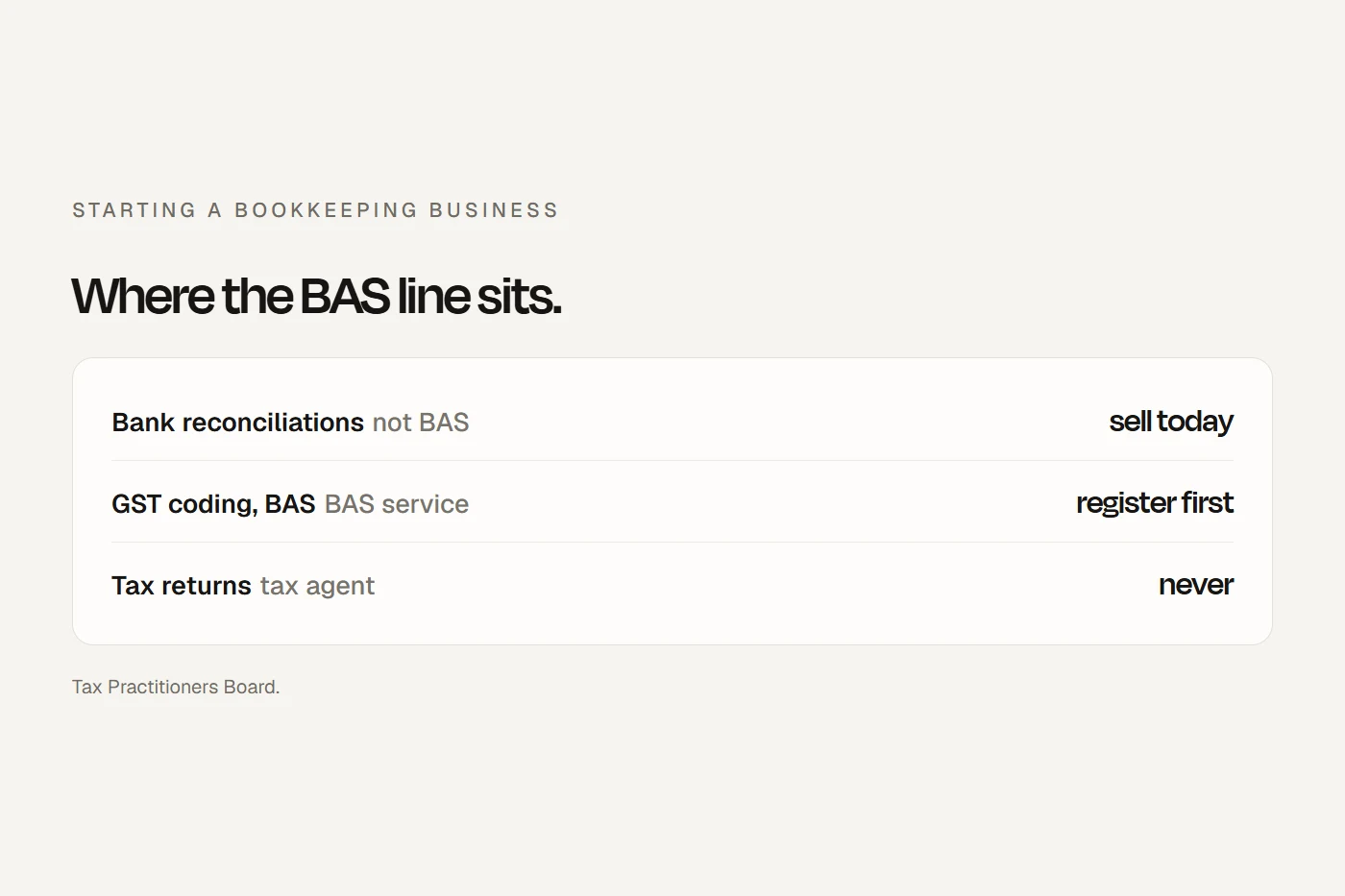
- You can start as a bookkeeper todayData entry, bank reconciliations, invoicing, reports and software training don't need registration. Choosing GST codes, preparing a BAS, payroll that applies withholding, super through a clearing house and talking to the ATO for a client do, if you charge for them.
- Advertising BAS work before you're registered is now a crimeNot just doing it: advertising it. Keep "BAS", "GST" and "payroll and STP" off your website, Google profile and business name until your registration number is real.
- Registration takes a qualification, a course and supervised hoursA Certificate IV in Accounting and Bookkeeping or higher, a Board approved GST/BAS course, and 1,400 hours of BAS work in four years, or 1,000 if you're a voting member of a recognised association. Then you renew every year.
Pick your lane
There are three ways to start, and most people move through them in order.
Bookkeeper, unregistered
- You can sell
- Data entry, bank reconciliations, accounts payable and receivable, invoicing, reports, software set-up with default codes only, and general software training.
- You can't sell or advertise
- GST coding decisions, BAS or IAS preparation, payroll that applies withholding or STP, super through a clearing house, taxable payments reports, ABN or GST registrations for clients, or dealing with the ATO for them.
- Good for
- Getting started while you study, and businesses whose accountant does the BAS.
Contractor to a registered agent
- You can do
- BAS work, as an employee or contractor of a registered tax or BAS agent, as long as you don't provide it in your own right and don't bill the client separately. The agent supervises and takes responsibility.
- Why it matters
- It's how most people build the supervised BAS hours they need to register. Ask the agent up front whether they'll sign your statement of relevant experience.
- Watch for
- If you bill the client yourself, even through the agent, you need your own registration.
Registered BAS agent
- You can sell
- All of the above plus BAS services: GST coding, activity statements, payroll and STP, super, taxable payments reports, ABN and GST registrations, and dealing with the ATO.
- You still can't
- Prepare or advertise income tax returns. Only registered tax agents can.
- You must
- Hold PI insurance to the TPB's standard, do continuing professional education, follow the Code of Professional Conduct, and renew every year.
The BAS line: what needs registration
The TPB keeps a table of tasks that are and aren't BAS services. The test is whether the work needs you to interpret or apply a BAS provision, and the TPB says it's a question of fact. Tap a task to see where it falls.
Software set-up is the one people get wrong most. Google's own AI answer for "can I do bookkeeping without being a BAS agent?" lists setting up Xero, MYOB or QuickBooks as fine, but the TPB's table says tailoring the GST codes to the client is a BAS service. Set up the file; leave the tax codes to a registered agent until you are one.
Advertising before you're registered
Under the Tax Agent Services Act, advertising that you'll provide a BAS service when you're not registered has long been a civil contravention. It's now a criminal offence as well, and the "not registered" part is strict liability: it doesn't matter whether you meant to. So is claiming to be registered when you aren't.
The offence is the advertising itself, separate from doing the work. For a new bookkeeper, the trap is the word "BAS" on a website, a Google Business Profile, a Facebook page, a directory listing or in the business name. Until your registration number is real:
- Write "bookkeeping", "bank reconciliations", "accounts payable and receivable", "invoicing" and "reporting".
- Leave out "BAS", "GST coding", "payroll and STP", "lodgement" and "ABN and GST registrations".
- Don't register a business name with "BAS" in it. It advertises BAS services every time you use it.
- Never mention tax returns, registered or not, unless you're a registered tax agent.
Paste your website or profile copy here to check it.
Becoming a registered BAS agent
The Tax Agent Services Regulations set the recipe for an individual. You need all of these:
- A qualification: a Certificate IV in Accounting and Bookkeeping (or Certificate IV Bookkeeping or Accounting), or higher. Some TPB pages and older guides still say "Certificate IV Financial Services"; the Regulations use the newer names. The TPB has an online tool to check your qualification before you pay for a course.
- A Board approved course in basic GST/BAS taxation principles, plus a Board approved unit on the Tax Agent Services Act and the Code of Professional Conduct if your course didn't include one.
- Relevant experience: 1,400 hours in the last four years, or 1,000 hours if you're a voting member of a recognised BAS or tax agent association (the Institute of Certified Bookkeepers, the Australian Bookkeepers Association, CPA Australia, CA ANZ and the Institute of Public Accountants are recognised).
- Fit and proper: the Board looks at your character and, over the past five years, things like tax, fraud or dishonesty convictions and undischarged bankruptcy.
- Aged 18 or over, with professional indemnity insurance that meets the TPB's requirements.
The hours are the hard part
Relevant experience has to include substantial involvement in BAS services, done as a registered agent or under the supervision and control of one, or another kind of work the Board approves. Preparing a business's books for its BAS and PAYG obligations generally counts; payroll tax work doesn't. Simulated programs count for no more than 15% of the hours. If you were supervised, the registered agent verifies your hours in a statement of relevant experience, one per employer or supervisor, and the TPB treats an agent refusing to verify as a possible Code breach.
This works out how long you have left.
The hours have to fall within the last four years when you apply, so log them as you go, with each supervising agent's name and registration number. Joining a recognised association early can save you 400 hours.
Applying and keeping it
- Apply online through a TPB My Profile account, with proof of identity, certificates, your statements of relevant experience and any association membership. The fee is small and indexed every July. The TPB aims to decide complete applications within 30 days, or up to 60 when it's busy.
- Within 14 days of registering, tell the TPB how you meet the PI insurance requirements. Then arrange access to the ATO's Online services for agents; each user needs their own Digital ID.
- PI insurance: the TPB sets minimum cover by turnover: $250,000 up to $75,000 turnover, $500,000 up to $500,000, and $1,000,000 above that. The excess can't be more than 4% of turnover (or $1,000, if 4% is less), and the policy needs retroactive cover. The TPB suggests thinking about fraud and cyber cover too.
- Renew every year. Registration used to run three years; it's now renewed annually. Apply between 30 and 90 days before it expires.
- Continuing professional education: 90 hours over a three-year period, with at least 20 hours each year, pro rata if your period is shorter. Some guides still say 45 hours; that's the figure for some conditional registrations. Keep your records for five years.
Setting up the business
- ABN: free from the Australian Business Register, if you're carrying on an enterprise. Not if you're really an employee.
- Business name: if you trade under anything other than your first name and surname, register it with ASIC. "Jane Citizen" doesn't need one; "Jane Citizen Bookkeeping" does. Registering a name doesn't stop others using similar words or protect you from a trade mark claim. Put the name and ABN on every invoice.
- Sole trader or company: a sole trader is personally responsible for everything; a company is a separate legal entity with its own ASIC fees. If a company provides BAS services, the company itself must be registered with the TPB, with enough registered individuals to do and supervise the work.
- GST: register within 21 days of reaching, or expecting to reach, the GST turnover threshold. Bookkeeping fees are ordinary taxable supplies.
- Engagement letter: the TPB recommends one before you start: what you'll do and what you won't, client obligations, how fees are calculated and billed, consent to share data with the accountant and software, PI arrangements, ending the engagement and complaints. It doesn't provide templates; your association may.
- Privacy and TFNs: most small businesses are exempt from the Privacy Act, but the Tax File Number Rule applies to anyone holding TFN records, whatever their size. Keep TFNs in the payroll software, never in email or a website form. Turn on multi-factor login everywhere and keep backups.
Does the new anti-money laundering law apply to you?
AUSTRAC's regime now covers some accounting services, but it's decided by the service, not the job title. AUSTRAC's own example: a bookkeeper who pays payroll, suppliers, rent, loan repayments, GST and PAYG from a client's account on fixed instructions, without discretion to redirect the money, is less likely to be managing the client's money, and incidental payments fall within an exception if no other designated service is provided. You're more likely to be caught if you:
- register companies, or business names as part of setting up a structure, with ASIC for clients;
- let a client company use your address as its registered office;
- act, or arrange for someone to act, as a director, secretary or nominee;
- hold client money in your own account and decide how it's spent.
If any of those are on your list, read AUSTRAC's professional services guidance before you start. Becoming an AUSTRAC reporting entity also brings you under the Privacy Act whatever your turnover.
Software partner programs
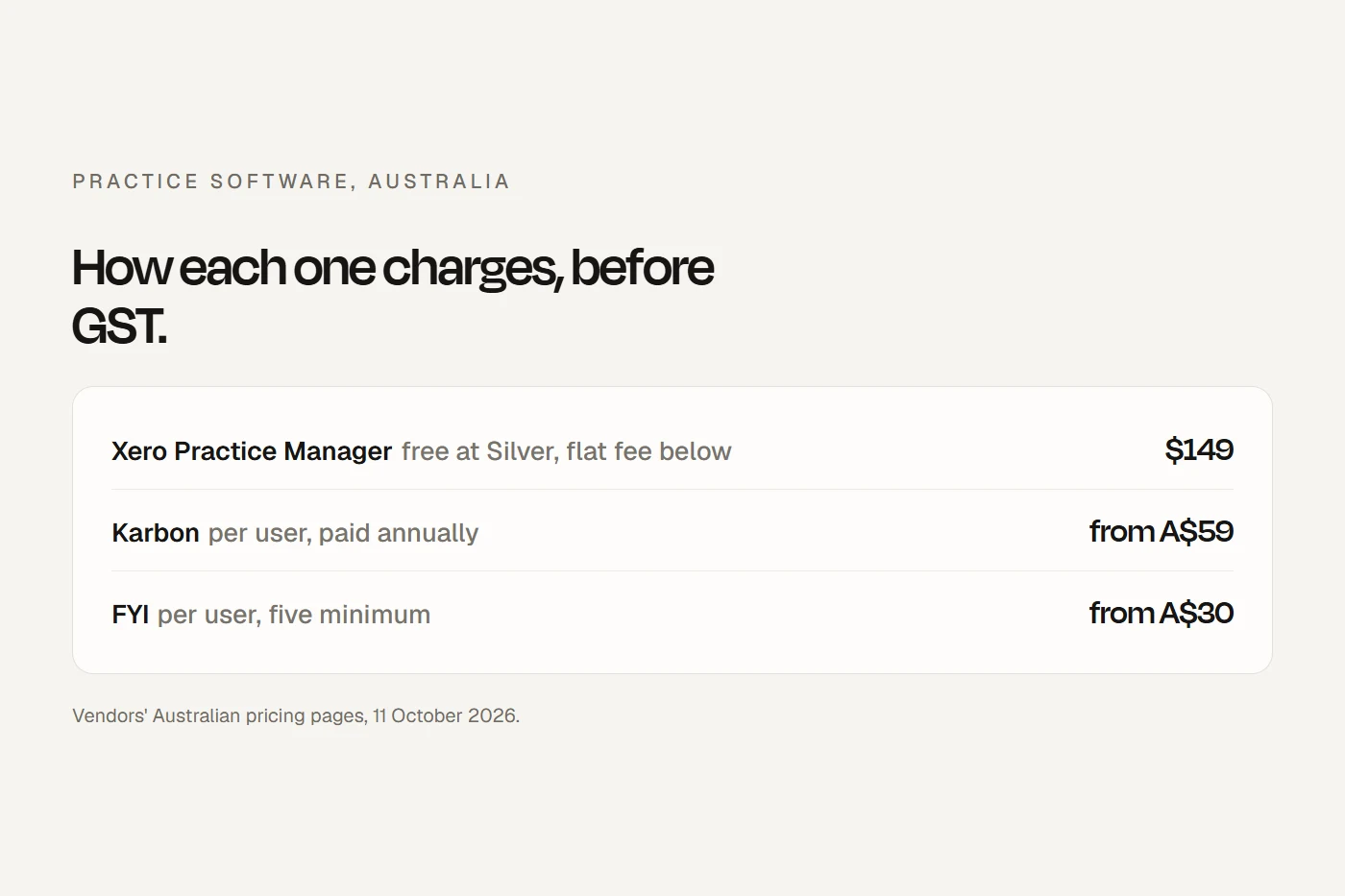
Xero, MYOB and QuickBooks all run free programs for bookkeepers, with a free subscription for your own books and training. The entry rules differ. Xero says you need your own BAS or tax agent registration to become a partner, and if you're working under supervision you wait until that's finished; its advisor directory listing starts at Bronze status. MYOB asks for an ABN and at least one client using MYOB. QuickBooks Online Accountant is free to join, and a Find-a-ProAdvisor listing needs certification. Lodging BAS through any of these tools for a fee still needs your own registration, and you can't put "Xero" in your business name or domain.
What your website needs
Before registration, the website's job is to sell bookkeeping clearly and stay on the right side of the BAS line. After registration, a few things become required.
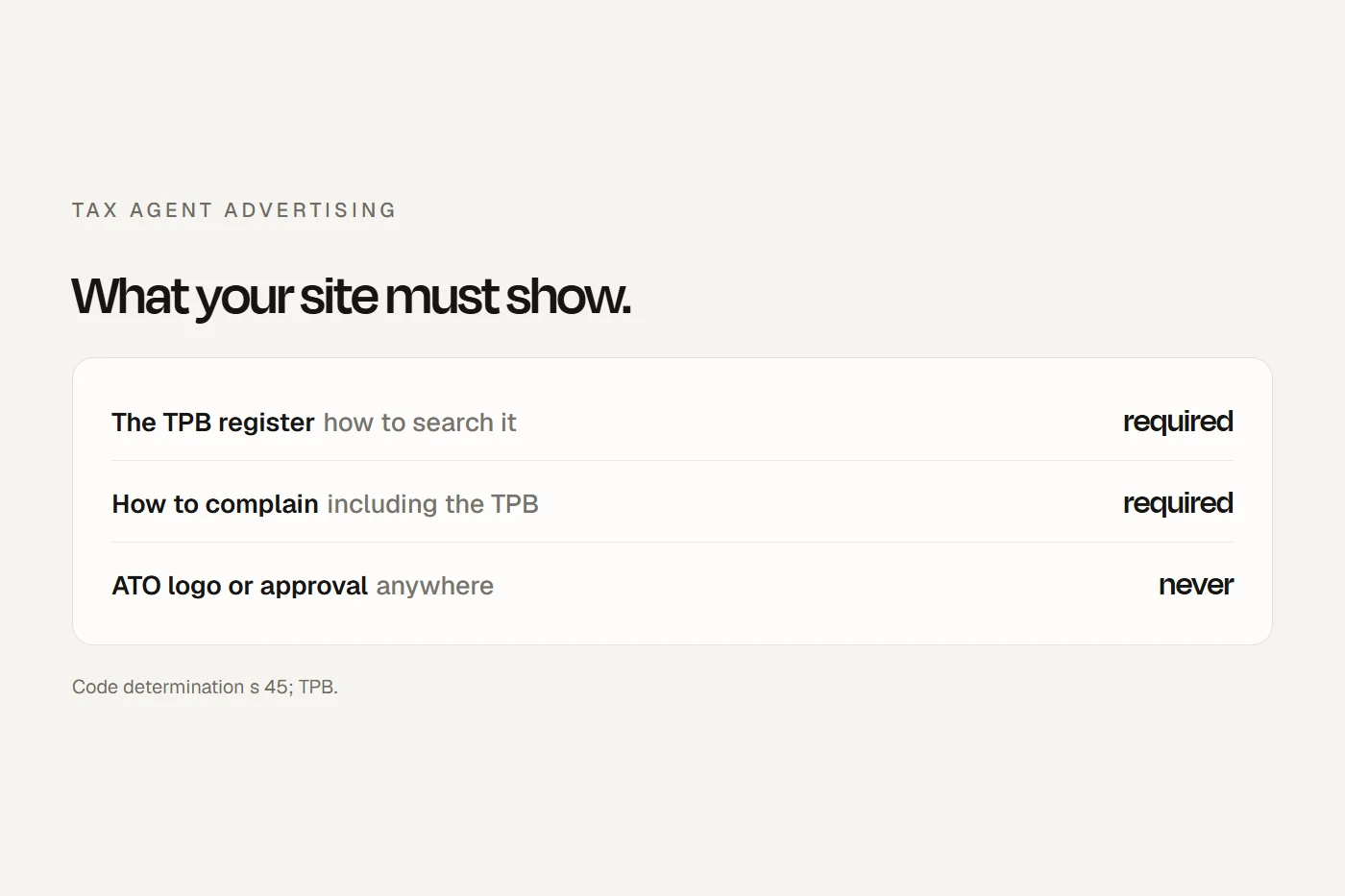
- Registered BAS agents must tell current and prospective clients about the TPB register and how to search it, how to complain (including to the TPB), and their general rights and obligations, clearly and prominently. The TPB's example of doing that is a page on the website you use to promote your services. It also recommends a direct link to your entry on the register.
- The TPB symbol is optional. If you use it, use your own unaltered file with your registration number and the BAS agent version. A company uses the company's number.
- Show your software and associations only while they're current. Use each vendor's badge for the tier you actually hold, and an association line only while you're a member.
- Split your services clearly into bookkeeping and, once registered, BAS services, with what each package includes and what costs extra, and whether prices include GST.
- Keep the contact form simple: name, business, software and what help is needed. Never ask for TFNs or bank details.
Buyers are told to check you: Xero's and QuickBooks' buyer guides both tell business owners to confirm a bookkeeper's TPB registration. A link to your register entry next to your number answers that before they ask.
Google Business Profile
Google only gives a profile to businesses that make in-person contact with customers. If you visit clients or meet them, set up as a service-area business and hide your home address; Google says your service area shouldn't stretch beyond about two hours' drive. If you work only remotely and never meet clients, you're not eligible, so lean on referrals, directories and your website. And keep BAS services off the profile until you're registered.
Where the first clients come from
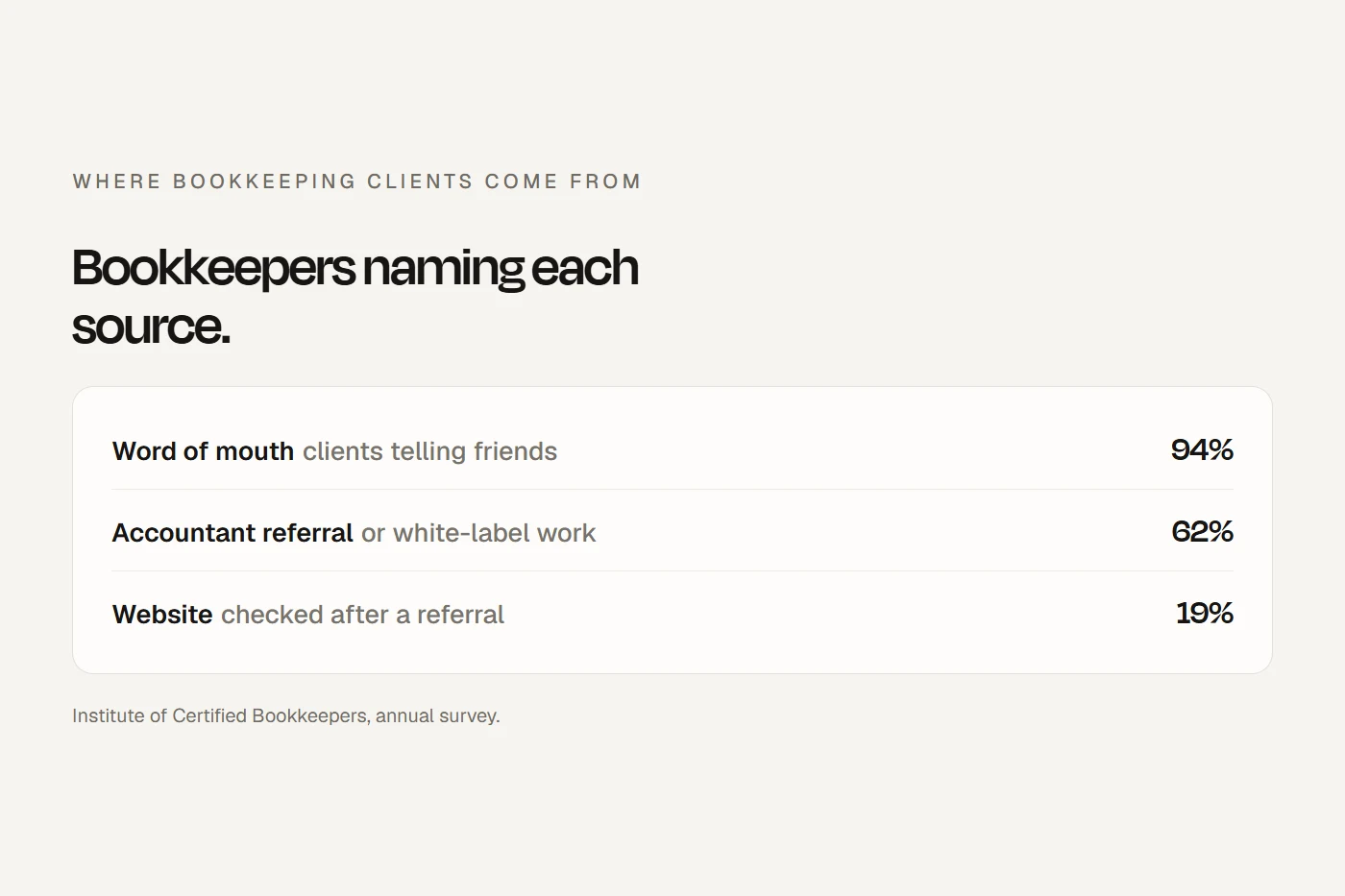
In the Institute of Certified Bookkeepers' member survey, almost every bookkeeper said clients came through word of mouth, and most through accountant referrals. Websites, social media and Google came well behind. So the first 90 days are about people: tell local accountants what you do and what you don't, and offer to take on the bookkeeping their clients keep handing them in a shoebox. My guide on getting bookkeeping clients goes through each channel, and the TPB advertising rules guide covers what registered agents can say.
A 90-day launch checklist
Your ticks save in this browser.
- Pick your lane: bookkeeping only, contractor to a registered agent, or registered BAS agent.
- Write your service list against the TPB's table, and take out anything on the BAS side until you're registered.
- On the BAS path: check your qualification with the TPB tool, then book the GST/BAS course and the Code unit if you need it.
- Start a log of supervised BAS hours, with each supervising agent's details.
- ABN, business name and structure sorted, and a separate business bank account.
- GST: register once you reach or expect to reach the threshold.
- PI insurance quotes: if registering, match the TPB minimum for your turnover, and consider cyber cover.
- An engagement letter covering scope, exclusions, fees, data sharing, ending the engagement and complaints.
- TFNs in the payroll software only, multi-factor login on everything, and backups.
- Check AUSTRAC's guidance if you'll set up companies, lend your address or hold client money.
- Join the free software programs you'll use, and get certified.
- Website live with services on the right side of the BAS line; once registered, add the register link and how to complain.
- Google Business Profile as a service-area business, if you meet clients in person.
- Tell ten local accountants what you do.
- Once registered: renewal in the calendar 30 to 90 days before expiry, and at least 20 CPE hours a year.
My view
Start with what you can sell legally today, and be precise about it. A website that says "bookkeeping, bank reconciliations and reports, with your accountant doing the BAS" wins accountant referrals, because it shows you know where the line is. Build your hours under a registered agent you get on with, join an association early to save 400 of them, and the day your number comes through, add the BAS services, the register link and the complaints information in one go. The bookkeepers who get into trouble are usually the ones whose website got ahead of their registration.
Questions I get asked
Can I do bookkeeping without being a BAS agent?
Yes. Data entry, bank reconciliations, invoicing, reports, software set-up with default codes and general training aren't BAS services. Tailoring GST codes, preparing a BAS, payroll that applies withholding, super through a clearing house and dealing with the ATO are, and need registration if you charge for them.
How long does it take to become a BAS agent?
Mostly as long as it takes to get the experience: 1,400 hours of supervised BAS work in the last four years, or 1,000 as a voting member of a recognised association, plus the qualification and the GST/BAS course. The TPB aims to decide complete applications within 30 days, or up to 60 when it's busy.
Do I need insurance to be a bookkeeper?
Registered BAS agents who charge for BAS services must hold PI insurance that meets the TPB's minimums. I found no law requiring it for unregistered bookkeepers, but associations such as the ICB require it for members in practice, and most clients will expect it.
How often do BAS agents renew their registration?
Every year. Apply between 30 and 90 days before your registration expires, with your CPE and PI insurance up to date.
Can a BAS agent do tax returns?
No. Income tax returns are tax agent services, and only registered tax agents can provide or advertise them.
About this guide
Written by Joseph Alzein, founder of bdog. bdog builds websites for bookkeepers and accountants. The rules come from the Tax Agent Services Act 2009 and Regulations, the Tax Practitioners Board, the ATO, ASIC, AUSTRAC and the Privacy Commissioner; the partner program details from each software company's own pages. Sources were checked on 12 October 2026. This is general information, not legal or tax advice.
Main sources: