Website rental in Australia: how it works, what it costs and what you own
How rental deals from directories, agencies and small studios are structured, what they cost over time and if you leave early, what you own at the end, the domain trap, which laws protect a business buyer (and which don’t), and the questions to ask. With a rent-vs-own calculator, a contract red-flag sorter and a checklist.
On This Page
Website rental means paying a monthly fee for your business website instead of buying it outright: the build, hosting and changes come in one payment, with little or nothing upfront. This guide is for an Australian small business owner who's been offered one by an agency, a directory such as Yellow, Localsearch or LocaliQ, a franchisor or a phone salesperson, and wants to know what they're signing. It covers how rental deals are structured, what they really cost over time and if you leave early, what you own at the end, the domain trap, which laws actually protect a business buyer, and the questions to ask. bdog sells a monthly website plan too, so I've put it through the same checklist further down. The facts come from the providers' own published terms, the Australian Consumer Law, auDA and the small business ombudsman.
- Renting can be good valueAt the cheapest tiers, a rented site can cost less over three years than a custom build plus hosting. The cost of renting shows up when you leave.
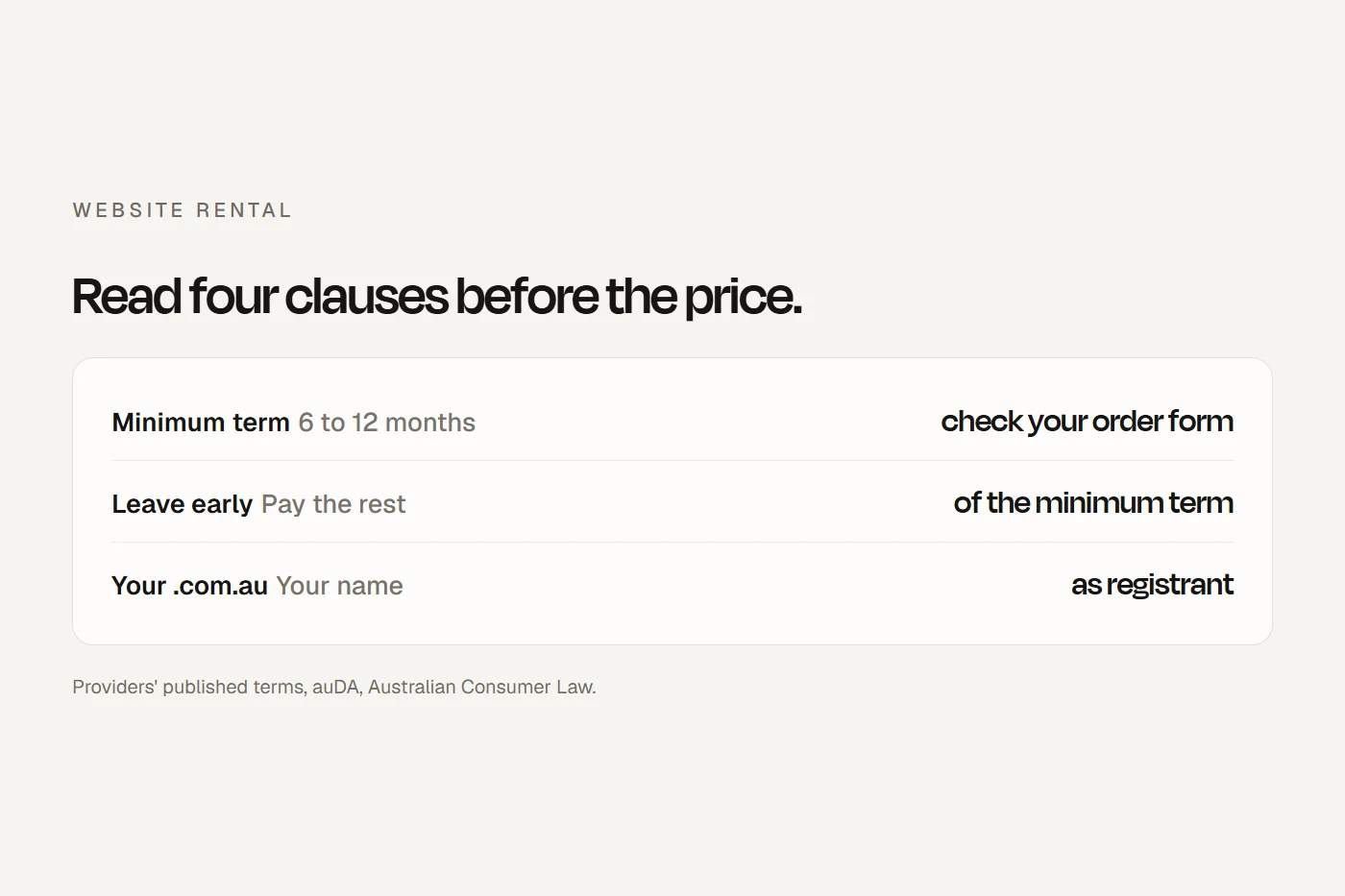
- Four clauses decide itThe minimum term, the exit fee, who holds the domain, and whether you can take the site with you. Read those before the price.
- No phone cooling-off for most businessesThe 10-business-day cooling-off for phone and door-to-door sales usually doesn't cover a business buying a business website. Unfair contract terms law and consumer guarantees still do.
How rental deals are structured
The national sellers' own terms follow the same shape:
| Minimum term | After that | Leave early | Taking the site with you | |
|---|---|---|---|---|
| Yellow (Thryv) | The product page says 12 months; the customer terms say 6 "unless Your Order says otherwise" | Continues at the latest price until cancelled | "the total remaining price of the Contract for the Minimum Period"; setup fee non-refundable | Subdomains aren't transferred; a domain "may" be, possibly for an admin fee |
| LocaliQ | 12 cycles of about 30 days | Renews one cycle at a time; 30 days' notice | "the balance of fees owing for the subscription period" | A licence "for the purpose of the ReachSite website only"; site files only once balances are paid |
| Localsearch | 12 months for subscription websites | Month to month; 30 days' written notice | "all fees owing for the remaining term", and early exit is at their discretion | Its HTML5 platform websites "cannot be exported or hosted elsewhere" |
Scroll the table sideways to see every column.
Smaller providers range from no lock-in with no exit fees, to a short minimum, to "12 months and then the site is yours", to a paid buyout of the code. The common thread: what you rent is the design, the code and the platform. Your own words, photos and logo stay yours under every set of terms I read.
A few clauses to know about:
- Deemed approval: some terms let the provider publish the site and start billing if you don't send content or approve it in time.
- Your content after you leave: one provider may delete your materials if you don't ask for them within 10 days of termination. Download everything before you cancel.
- Price and service changes: the better terms let you cancel without a fee if a change hurts you. Terms that let the provider change prices with no way out for you are on the ACL's list of possibly unfair terms.
- Selling your business doesn't end the contract under Yellow's terms. Plan for it.
- Your contract can move. Telstra's small business websites page now redirects to Online Essentials, and Telstra moved its domain customers to that company's contracts. Ask who actually builds and hosts the site.
What it really costs
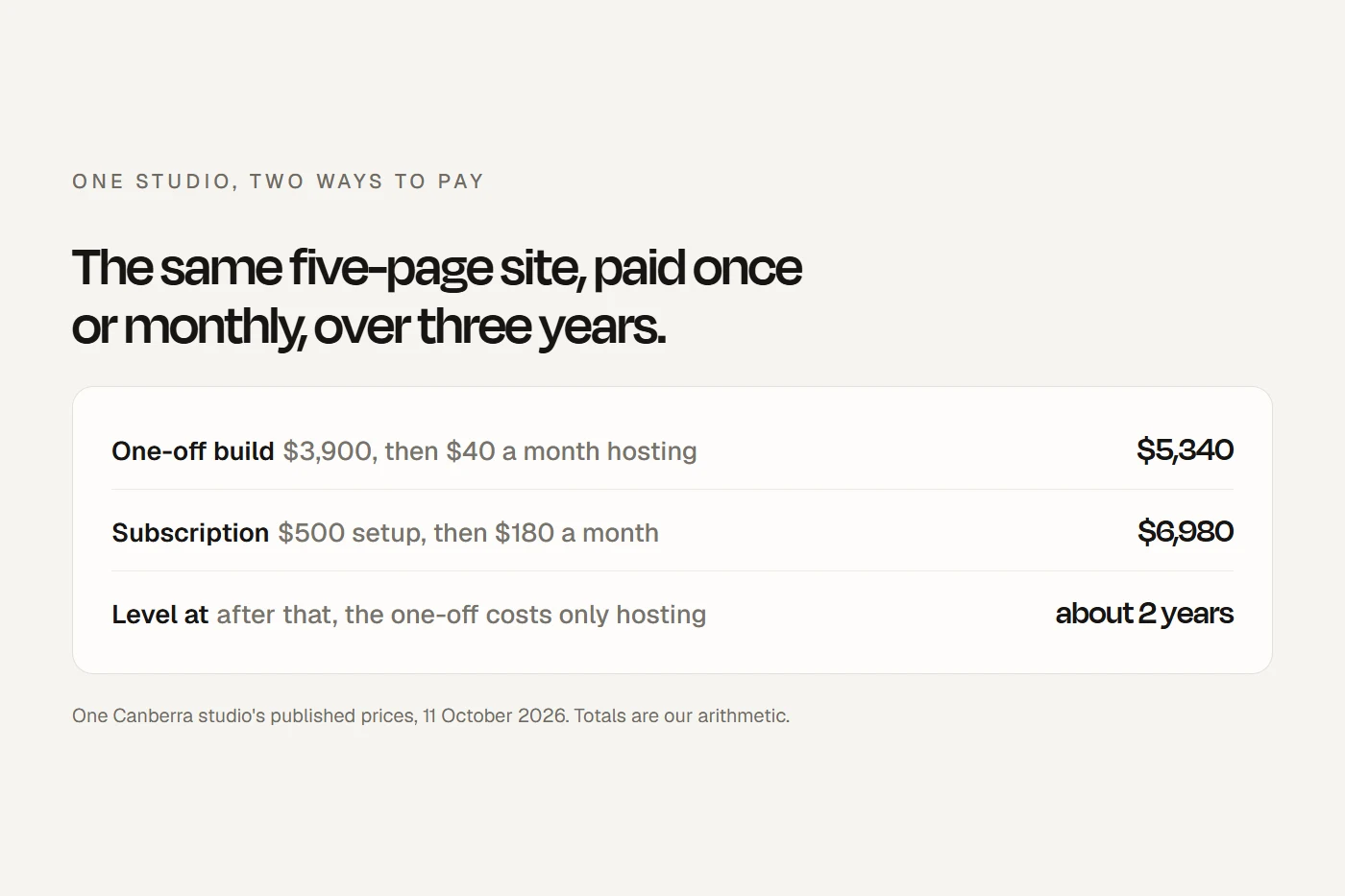
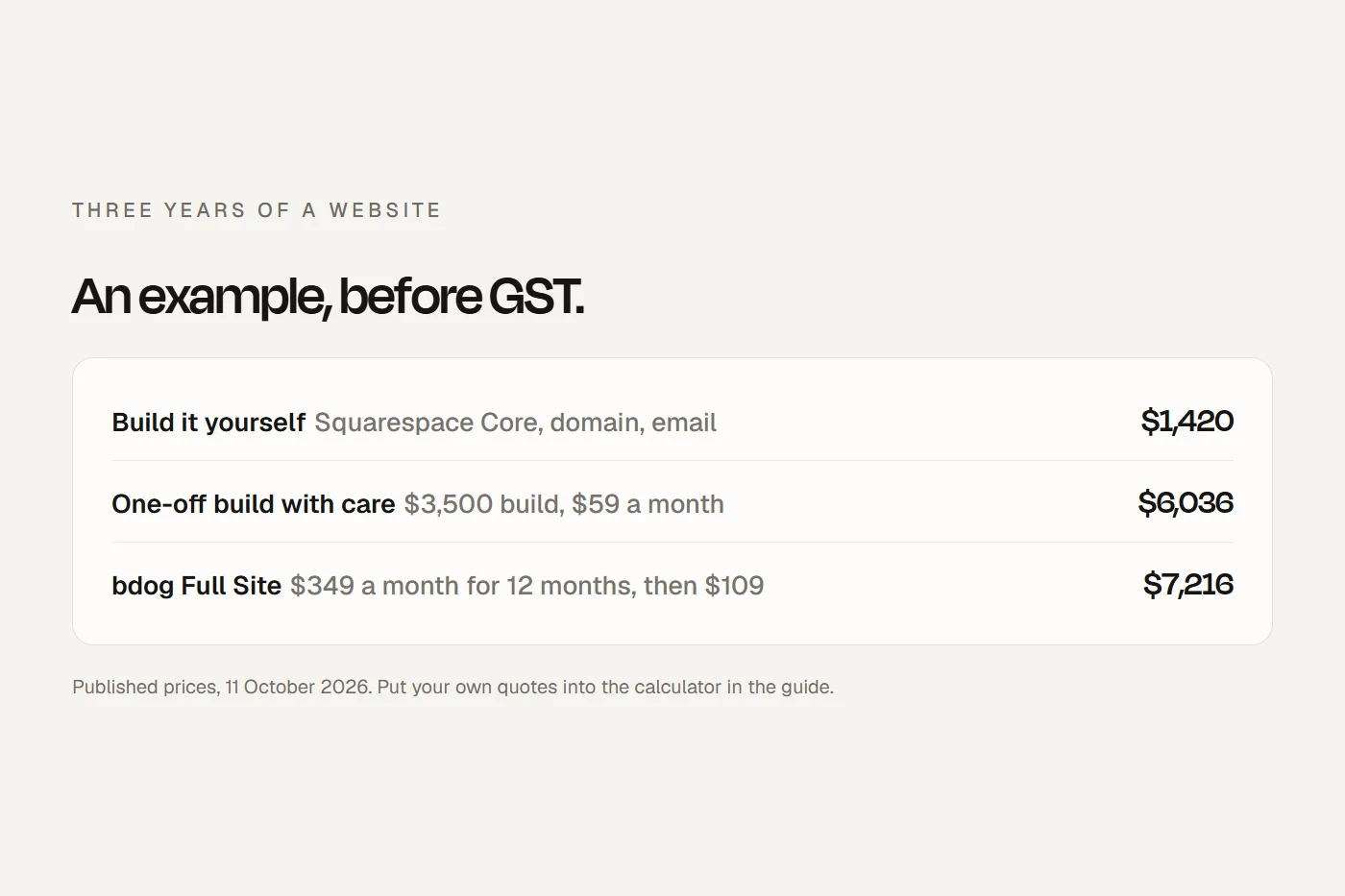
Compare three things: renting for as long as you'll keep the site, owning it, and renting but leaving early. Put in the numbers from the offer you've been given.
The example numbers are made up. With the cheapest published rental tiers, renting can come out ahead over three years. Where it costs you is leaving: an exit fee plus a rebuild if the site can't move. So the question isn't just the monthly fee; it's what happens in the month you want out.
What you own at the end
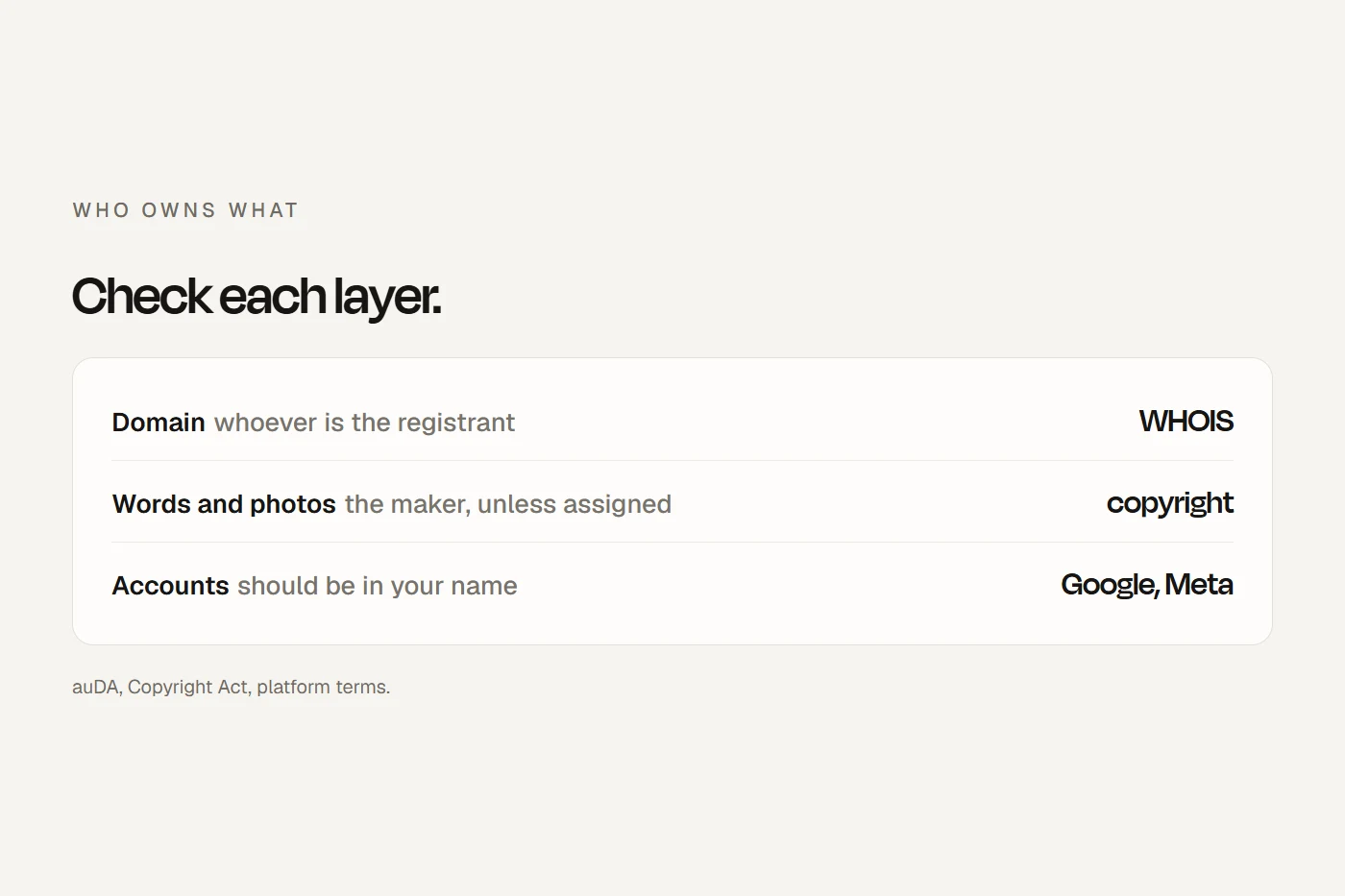
Copyright in a design belongs to whoever made it unless a signed written agreement assigns it. In a rental, the contract usually says the provider owns the design and code and gives you a licence while you pay. That's what renting means, so ask the useful question: what do I get if I leave? Answers range from nothing, to the domain, to a copy of the site once the balance is paid, to a paid buyout, to the whole site after the minimum term.
Watch the licence going the other way too. Rental terms often take a perpetual licence over the content you supply. That's normal for a directory listing; for your website copy and photos, ask that it ends with the contract. Stock photos the provider supplies are its licences, and they won't come with you.
The domain: get this right on day one
For a .com.au, auDA says that when a web developer registers it for you, "you or your organisation must be listed as the registrant of the domain name, not the developer", and a .au licence can't be leased to someone else. If yours was registered in the developer's name, you can ask for a correction. Check your domain on auDA's .au WHOIS: if your business name isn't there, you're not the licence holder, even if you have the logins.
A domain a provider "will not transfer to you" is a domain in their name. That's fine for a short campaign address, and a real problem if it becomes the address on your van, your cards and your Google profile.
Which laws actually help a business
- Phone cooling-off: usually not. The 10-business-day right to cancel a phone or door-to-door sale doesn't apply to a "business contract", meaning services not ordinarily bought for personal or household use. A business website is exactly that. If you want a cooling-off period, get it written into the contract.
- Unfair contract terms: yes. Most small businesses are covered, and rental terms are almost always standard form. One-sided termination, one-sided penalties, one-sided price changes and automatic renewals are the law's own examples. The monthly price itself generally can't be challenged, but an exit fee isn't "the upfront price", so it can be tested. Cancellation terms are an ACCC priority.
- Consumer guarantees: usually yes. Most small business website contracts fall under the consumer threshold, so the work must be done with due care and skill, be fit for the purpose you told them, and be done in a reasonable time. A contract can't exclude these, though for business services the provider can limit its liability to redoing the work if that's fair and reasonable. Tell them in writing what the site must do.
- What the ACCC has acted on: the closest case is hipages, a tradie leads platform rather than a website seller. It admitted it likely misled subscribers about automatic 12-month renewals and early termination fees; the ACCC said people trying to cancel "were told they would have to pay out the full 12-month term".
- Finance deals: if the payments go to a finance company, you're signing a finance contract that usually keeps running even if the website fails, under different laws. Get advice first.
The Australian Small Business and Family Enterprise Ombudsman's research on digital marketing providers, which includes website work, found almost three quarters of small businesses don't stay with a provider for more than a year, and one third need help resolving disputes. If it goes wrong, raise it in writing, then go to the ombudsman or your state small business commissioner.
Red flags in the contract
Tap each clause.
Questions to ask before you sign
Your ticks save in this browser.
- What will I pay in total over the minimum term, including setup and GST?
- What's the minimum term on my order form, and does it start when I sign or when the site goes live?
- What happens after the minimum term, and how much notice do I give?
- If I leave early, exactly what do I pay?
- Can I leave without a fee if you change the price or the service?
- Whose name will be the domain registrant? Show me the WHOIS once it's registered.
- If I leave, what do I get: the domain, my content, the design files, a copy of the site, or nothing?
- Is the site built on a platform that can be moved, or on yours?
- Can I keep using the photos?
- How many changes are included, and who decides what counts as a big one?
- Are my Google Business Profile, analytics and ad accounts in my name, with you as a manager?
- Who actually builds and hosts the site, and can you transfer my contract?
- Is any part paid to a finance company?
- Is there a cooling-off period in the written contract?
- Is everything the salesperson promised written into the contract?
bdog's own plan, through the same checklist
bdog sells monthly website plans, so here they are on the same terms. All prices +GST: $249 a month for 12 months then $89 (Single Page), $349 a month for 12 months then $109 (Full Site), or $449 a month for 12 months then $129 (up to 15 pages). That's a 12-month commitment. Your domain and content are yours from day one. Design files and a static export come to you at month 12, or when the build is paid out. That's a licence to use and adapt the design, not ownership of the copyright. After that there's no lock-in. Run it through the calculator like any other offer.
My view
Renting a website isn't a trap in itself; plenty of small businesses are better off paying monthly for a site someone else keeps working. The trap is a contract you can't leave, a domain in someone else's name, and a site you can't take with you. Get the minimum term, the exit fee, the domain and the exit handover in writing before you look at the design. If those four are fair, the monthly fee is just a price.
Questions I get asked
What is website rental?
A monthly fee that covers the build, hosting and changes to your business website, with little or nothing upfront. The provider usually owns the design and code; your content stays yours.
Is renting a website a good idea?
It can be, especially at the cheapest tiers. Check the minimum term, the exit fee, who holds the domain and whether you can take the site with you.
Can I cancel a website contract I signed over the phone?
The 10-business-day cooling-off usually doesn't apply to a business buying a business website. Check your written contract for a cooling-off or cancellation term.
Who owns my domain if my web designer registered it?
For a .com.au, auDA requires your business to be the registrant, not the developer. Check the .au WHOIS and ask for a correction if it's wrong.
Can I take my rented website to another provider?
It depends on the contract. Some give you files once paid up, some offer a buyout, and some say the site can't be exported at all.
About this guide
Written by Joseph Alzein, founder of bdog. bdog sells monthly website plans, which are described above on the same terms as everyone else's. The providers' terms were read from their own published documents; the rules from the Australian Consumer Law and Competition and Consumer Regulations, auDA and the Australian Small Business and Family Enterprise Ombudsman. Sources were checked on 13 October 2026. Terms change, so read your own order form. This is general information, not legal advice; have a lawyer read a large contract.
Main sources:
- Thryv Australia customer terms
- LocaliQ website product terms
- Localsearch subscription agreement
- Localsearch digital marketing services module
- auDA: third party use of .au domain names
- ASBFEO: getting the most out of your digital marketing provider
- Competition and Consumer Act 2010 (Australian Consumer Law)
- ACCC: hipages subscription terms