Who owns your website? Domain, content, design and the contract
The domain, the words and photos, the design and code, the licences behind them and the accounts, one at a time, with how to check each in a few minutes and what to ask for. With an ownership audit, a contract clause sorter and a handover checklist.
On This Page
"Do I own my website?" is usually asked too late: when a designer stops answering, a subscription ends, or someone tries to move to a new platform. The honest answer is that nobody owns a website as one thing. The domain, the words and photos, the design and code, the licences for themes and fonts, and the accounts behind it each have their own owner, and each can be lost on its own. This guide takes them one at a time, with how to check each in a few minutes and what to ask for. It's from the .au domain rules, the Copyright Act, two High Court cases, the platforms' own terms, Google's and Meta's account rules and the unfair contract terms law, read on 12 October 2026. It's general information, not legal advice.
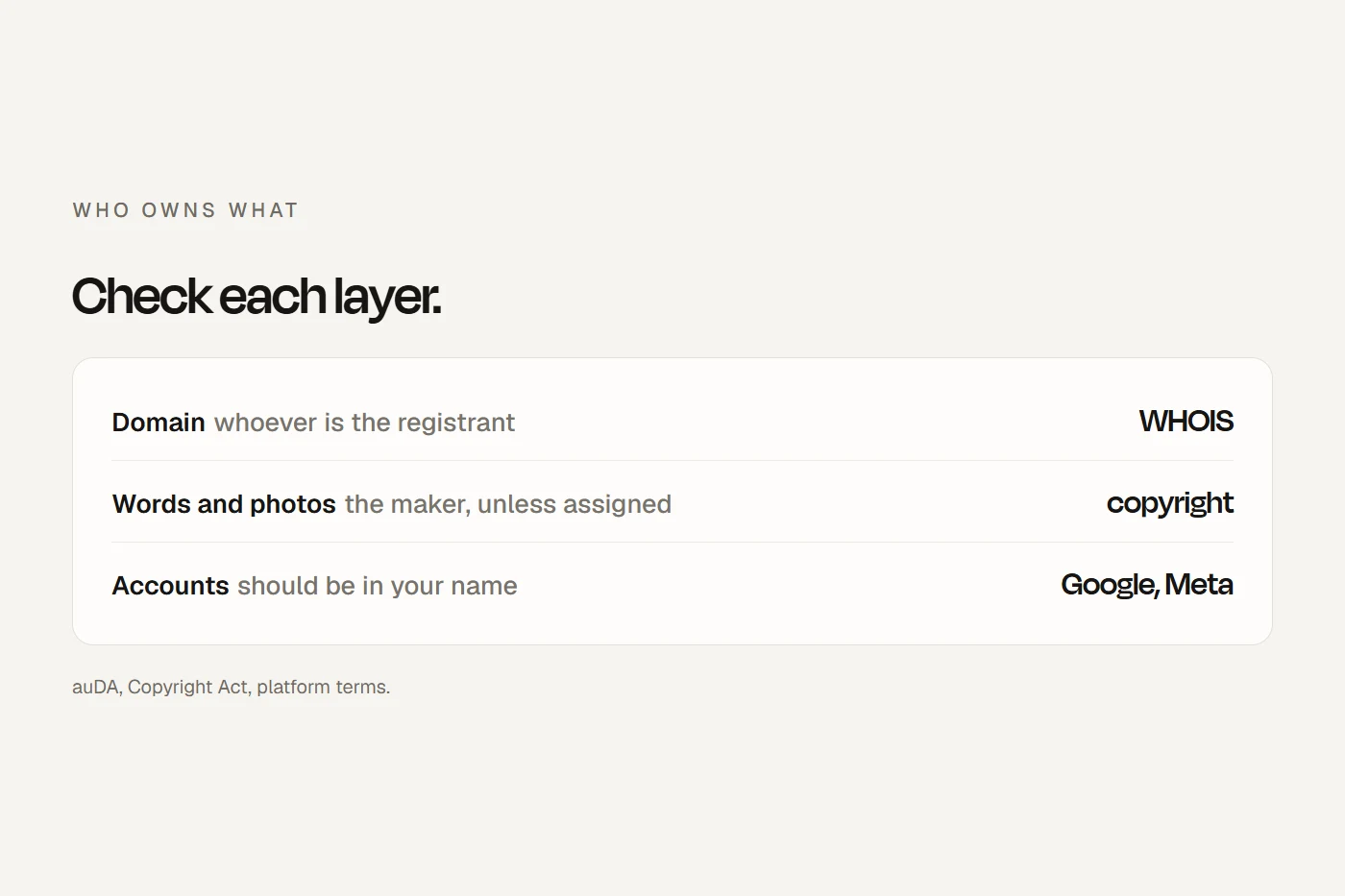
- The domainWhoever is the registrant controls it. Check the .au WHOIS: your business should be the registrant, with your own email as the contact.
- Words, photos, designWhoever made them owns the copyright unless a signed written assignment says otherwise. Paying for it isn't enough.
- AccountsYour Google profile, analytics, ads and Meta pages should be in your business's name, with your designer added as a manager.
The domain name
For .au names, you don't legally own the name: auDA's rules say the registrant holds a licence to use it. Whoever is recorded as the registrant controls it. auDA's rules also say an agent who registers a name for you must record you as the registrant, and that a .au licence can't be leased to someone else. In auDA's words: "if someone like a web developer is registering or renewing your .au domain names on your behalf, you or your organisation must be listed as the registrant of the domain name, not the developer."
- Check it in a minute. The .au WHOIS on auDA's website shows the registrant, the registrant ID (often your ABN) and the registrant contact email. If your business name isn't there, you're not the licence holder, even if you have the passwords.
- Check the contact email. The transfer code goes only to the registrant contact email on the record, and renewal reminders go there too. If it's your designer's address, they control any move and you may never see a renewal notice.
- Don't let it lapse. A .au name that isn't renewed within 30 days of expiry becomes available to anyone.
- Fixing it. If the name was registered in the wrong name, auDA says to ask your domain provider for a correction, and to contact auDA if that doesn't work. Moving a .au name between registrars is free under the rules.
For a .com, most public records now hide the registrant's name, so log in to the registrar account and check whose name is on it. A .com usually can't move to another registrar for a period after it's registered, transferred or changes hands; ask the registrar.
Words, photos, design and code
Under the Copyright Act, the person who makes a work owns the copyright. Employees' work belongs to the employer, but contractors keep theirs: IP Australia names websites, designs and logos as things a contractor owns "unless otherwise stated in the contract". Two exceptions surprise people:
- Photos you commission for your business belong to the photographer. The Act gives the person paying copyright only for photos taken for a private or domestic purpose, like a wedding.
- Videos you commission belong to you by default, unless the contract says otherwise. The music in them has its own licence.
To own copyright you didn't create, you need an assignment in writing, signed by the owner. An email saying "it's all yours" may not do it. A contract signed before the work starts can assign copyright in work not yet made.
Without a written agreement, you probably have an implied licence to keep using what you paid for, for the purpose it was made. But a licence is narrower than ownership, and its limits get worked out after the fact. Two High Court cases show how: one over who could use architectural plans, and one over listing photos that ended up on property data websites, where the parties litigated to the top court over a licence nobody wrote down.
Creators also keep moral rights, including the right to be credited and to object to derogatory treatment of their work. These can't be assigned; only a written consent covers changes. A good website contract includes the designer's and photographers' consent to edit and adapt their work.
Licences that don't move with you
- Stock photos: iStock licences can be used by the client a designer buys for, but the agreement can't be assigned without iStock's consent.
- Envato: an item stays usable in the finished site, but can't be pulled out and reused, and fonts and add-ons can't be passed to a client at all.
- Themes: a Shopify Theme Store theme is licensed to one store; a ThemeForest regular licence is for one end product.
- Fonts: Adobe web fonts stop working on sites if the subscription behind them is cancelled. Google Fonts are open source.
- Premium plugins are often licensed to the developer, and stop updating when they leave.
Ask for a list of every paid licence in your site and whose name it's in.
Wix, Squarespace, Shopify and WordPress
| Platform | Your content | Template and design | Can you take the site? | Who it treats as owner |
|---|---|---|---|---|
| Wix | Yours | Wix's | No. Content only, by copying and exports | The account email, then billing, then the domain registrant |
| Squarespace | Yours | Squarespace's | Partly, as a WordPress file | Squarespace decides, and names "a web designer and a client" disputes |
| Shopify | Yours | A theme is licensed to one store | Theme code and data exports | The single Store Owner; Shopify decides disputes |
| WordPress.com | Yours | Per the theme's licence | Content export; full backup on higher plans | Not stated |
| Self-hosted WordPress | Yours | The theme customisation is the maker's unless assigned | Yes, whole | Whoever holds the hosting account |
Scroll the table sideways to see every column.
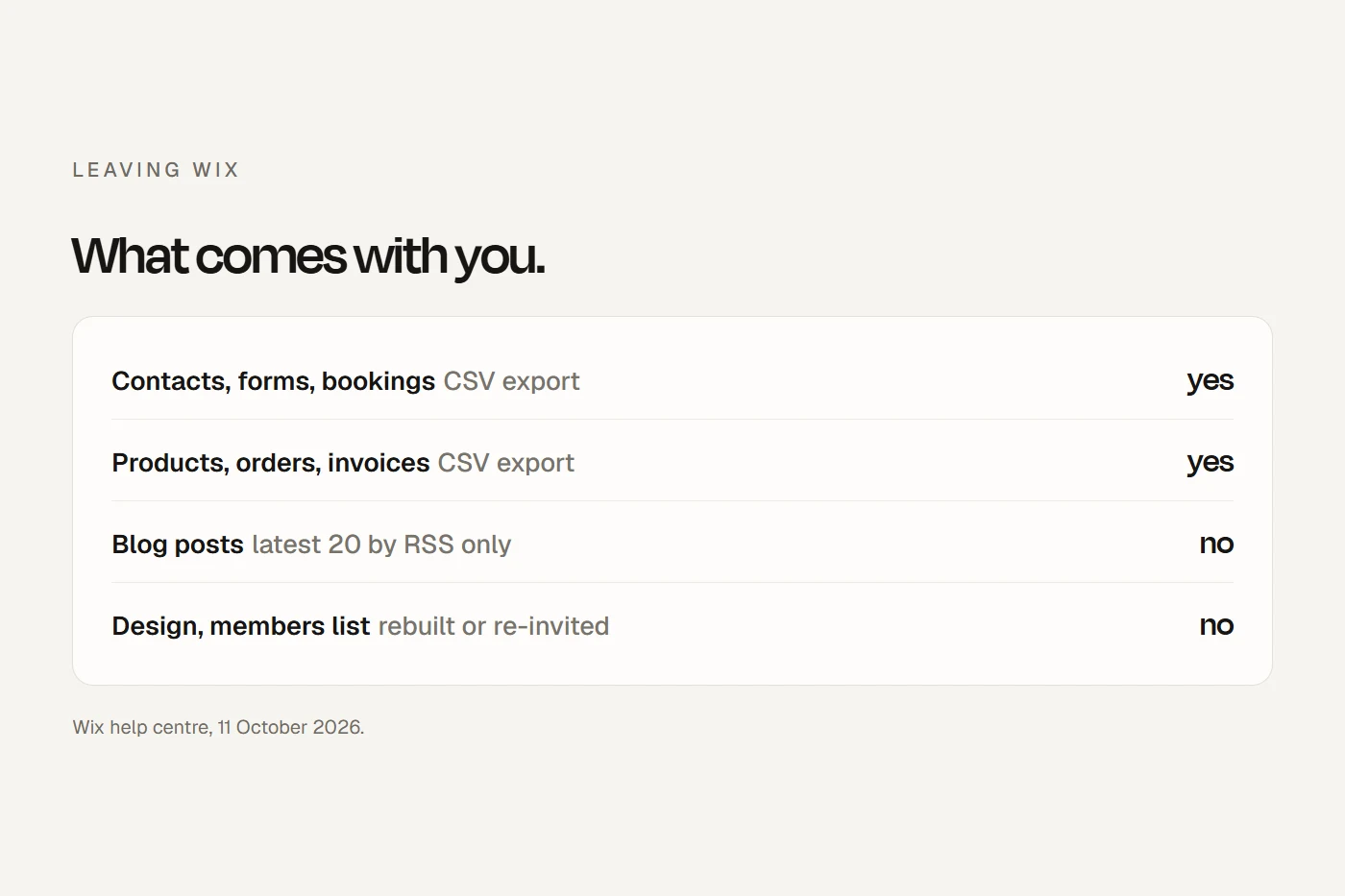
So the answer to "do I own my website on Wix?" is: you own your words, photos and logo; Wix owns the template, code and platform; the site can't leave Wix; and Wix treats whoever holds the account email as the owner. If a developer built your Shopify store, check it was transferred to you as Store Owner, not just shared.
The accounts behind it
- Google Business Profile: Google's rules say businesses must keep ownership of their profile, agencies should be added as managers, and an agency must hand back control within seven working days of being asked. Holding a profile "hostage in exchange for money" is banned. If someone else owns yours, you can request ownership through Google.
- Google Analytics: if no administrator is left, Google will only restore access if you prove you control the website, by putting a file it specifies on the site. If your designer controls the hosting, you can't recover your analytics without them.
- Search Console: ownership follows whoever can verify the site through the domain or site files, which is another reason the domain must be yours.
- Google Ads: in your business's Google account and billing, with the agency added as a user.
- Meta: Meta says it is "unable to reveal" who controls the business portfolio that owns your Page. Make sure it's yours.
- Hosting and email: whoever controls the domain's settings controls where your website and email point.
Check what you own
Tick what's true today. The weights reflect how hard each is to get back. Your ticks save in this browser.
- Your business is the registrant on the domain's WHOIS.
- The registrant contact email is one you control.
- You can log in to the registrar account.
- You own the hosting or platform account, not just a contributor login.
- You have a signed assignment or written licence for the design and code.
- You own or hold written licences for your photos and logo.
- You're the primary owner of your Google Business Profile.
- Your own Google account is an Administrator on Google Analytics.
- You're a verified owner in Search Console.
- Your Facebook Page is in your own business portfolio.
What the contract should say
Website contracts usually take one of three routes on design and code: you own it outright on full payment; you have a licence while you subscribe and a licence or transfer at the end; or the provider keeps it and offers a paid buyout. Content is nearly always yours. The unfair contract terms law reaches most small businesses' standard form contracts: an unfair term is void, and proposing or relying on one can attract penalties. Its examples include terms that let only one side end the contract, penalise only one side for leaving, or let only one side change the terms or price. The ACCC is focusing on auto-renewals, early termination fees and non-cancellation clauses.
Tap a clause to see the verdict.
How bdog does it
Since you may be weighing us up: under our Terms, your domain, content, trade marks and logo are yours from day one, and your domain, Google Business Profile, analytics and ad accounts are held in your business's name, with us added as a manager. We give you what you need to move your domain within two business days of asking, and export your content within five, whether or not anything is owed. We own the design and code we create. Once the Build Fee is paid in full, at the end of the first twelve months or up front, you get a permanent, non-exclusive, royalty-free licence to use and adapt your site's design, the design files and a static export of your finished pages, including hosting it elsewhere or having another developer rebuild from it. That's a licence, not ownership, and it doesn't cover our platform, build tools or reusable components. You can leave at any time with 14 days' notice, and leaving early costs nothing more: no unpaid build instalments and no exit fee. If you want the design files and export when you leave early, you can choose to pay the instalments you haven't paid. You get them straight away if we end the agreement, or if you end it because we didn't fix a serious problem.
What to ask for at handover
Whoever built your site, ask for these. Your ticks save in this browser.
- Domain: your business as registrant, your ABN as the ID, your own email as the contact, and the expiry date checked.
- Registrar login, or the transfer code sent to your email.
- Hosting account in your business's name, with your card.
- Platform account: you as owner or Store Owner, not a contributor.
- Copyright: a signed assignment, or a written licence that says what you can do.
- Moral rights consent from the designer, copywriter and photographers.
- Photos: who owns them, the licence, and how to credit the photographer.
- Video: who owns it, and the music licence.
- A list of paid licences: stock, fonts, themes, plugins, and whose name each is in.
- Google Business Profile: you as primary owner.
- Google Analytics: your account as Administrator, plus a second admin.
- Search Console: you as a verified owner.
- Google Ads and Meta: in your business's name and billing.
- Email on your domain: the admin account in your name.
- An export: your content, and the site files if your contract gives you them.
- The contract: minimum term, exit fees, renewal, who can change prices, and what happens to your files at the end.
My view
Start with the domain, because everything else hangs off it: your website, your email, your Search Console and even your analytics recovery. Make sure your business is the registrant with your own email on the record, then get the platform and Google accounts into your name. After that, get the design question in writing before you sign, whichever way it goes. Owning it outright, a clear licence, and a provider who keeps it can all be fair deals, as long as you know which one you have.
Questions I get asked
Do I own my website if I paid a designer?
You own your own content. The designer owns the copyright in their design and code unless a signed written assignment says otherwise, though you probably have a licence to keep using what you paid for.
Do I own my website on Wix?
You own your words, photos and logo. Wix owns the template, code and platform, and the site can't be moved off Wix.
How do I find out who owns my domain?
For .au names, use the WHOIS on auDA's website. It shows the registrant and the registrant contact email.
My designer won't give me my domain. What can I do?
If they registered it in their own name, auDA says you should have been the registrant: ask the domain provider for a correction, then contact auDA.
Who owns photos taken for my business website?
The photographer, unless your contract says otherwise. Commissioned video is different: it's yours by default.
About this guide
Written by Joseph Alzein, founder of bdog. bdog builds websites for small businesses on subscription, so this guide describes our own terms too. The rules come from auDA's Licensing Rules, the Copyright Act, IP Australia, the High Court, the Wix, Squarespace, Shopify and WordPress.com terms, Google's and Meta's account help, and the Australian Consumer Law, read on 12 October 2026. This is general information, not legal advice.
Main sources: