Ahpra and social media: what practitioners can post
What Ahpra’s social media guidance says, testimonials on social media and the control test, titles, claims and offers, influencers and paid posts, posts that mention medicines, the cosmetic layer, and how complaints are handled. With a testimonial quiz, a caption check, a post sorter and a monthly checklist.
On This Page
- What Ahpra’s social media guidance says
- Testimonials on social media
- Titles, claims and offers
- Check your caption
- Influencers and paid posts
- Posts that mention medicines and devices
- Cosmetic procedures: the extra layer
- Can I post this?
- What happens if someone complains
- A monthly check
- My view
- Questions I get asked
Ahpra's social media guidance comes down to one line: the National Law, your Board's code of conduct and the advertising guidelines apply online "just as when you interact in person". What that means in practice is less obvious: whether you can repost a patient's story, what to do with a glowing comment under your post, whether a like counts, what goes in your bio, and what your personal account has to do with your registration. This guide is for practitioners and clinic owners who run their own Instagram, Facebook, TikTok, LinkedIn or YouTube. It covers the guidance, testimonials on social media, titles, claims, offers, influencers, the extra rules for cosmetic procedures and for posts that mention medicines, and how Ahpra handles a complaint. It's general information, not legal advice; Ahpra itself says it can't check or pre-approve your advertising.
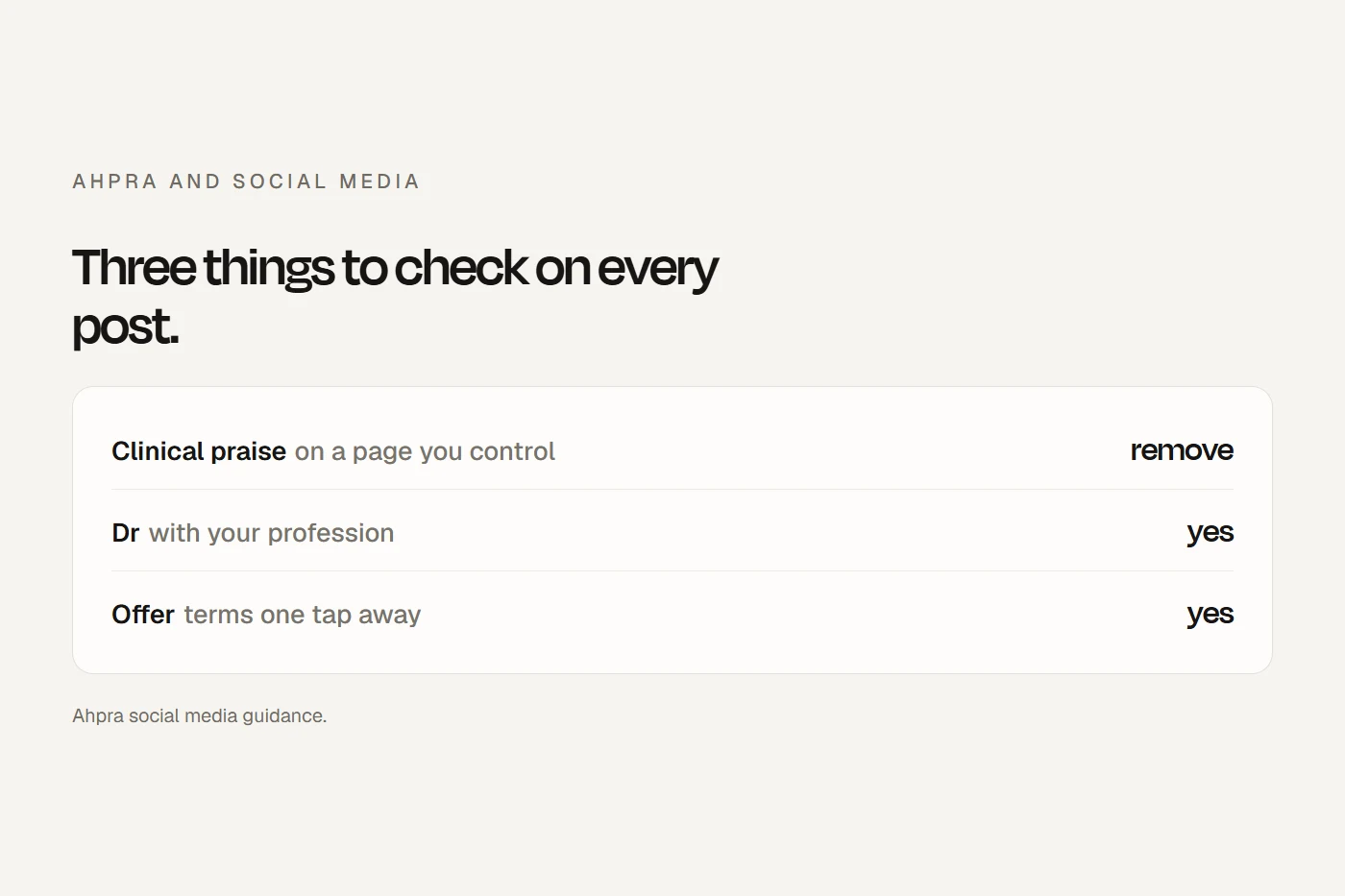
- Your practice page is advertisingSo clinical praise can't stay on it. Remove comments and reviews about symptoms, treatment or outcomes, and don't share, screenshot or repost them.
- Say what you do, not what it curesClaims need acceptable evidence, "Dr" needs your profession beside it, and "specialist" is only for specialist registration.
- Your personal account counts tooBoards may consider private social media use. Discrimination, anti-evidence health claims and attacks on colleagues are where most trouble starts.
What Ahpra's social media guidance says
Ahpra lists five ways to meet your obligations on social media, and they make a good checklist for any post:
- Comply with confidentiality and privacy obligations.
- Comply with your Board's code of conduct.
- Maintain professional boundaries.
- Communicate professionally and respectfully.
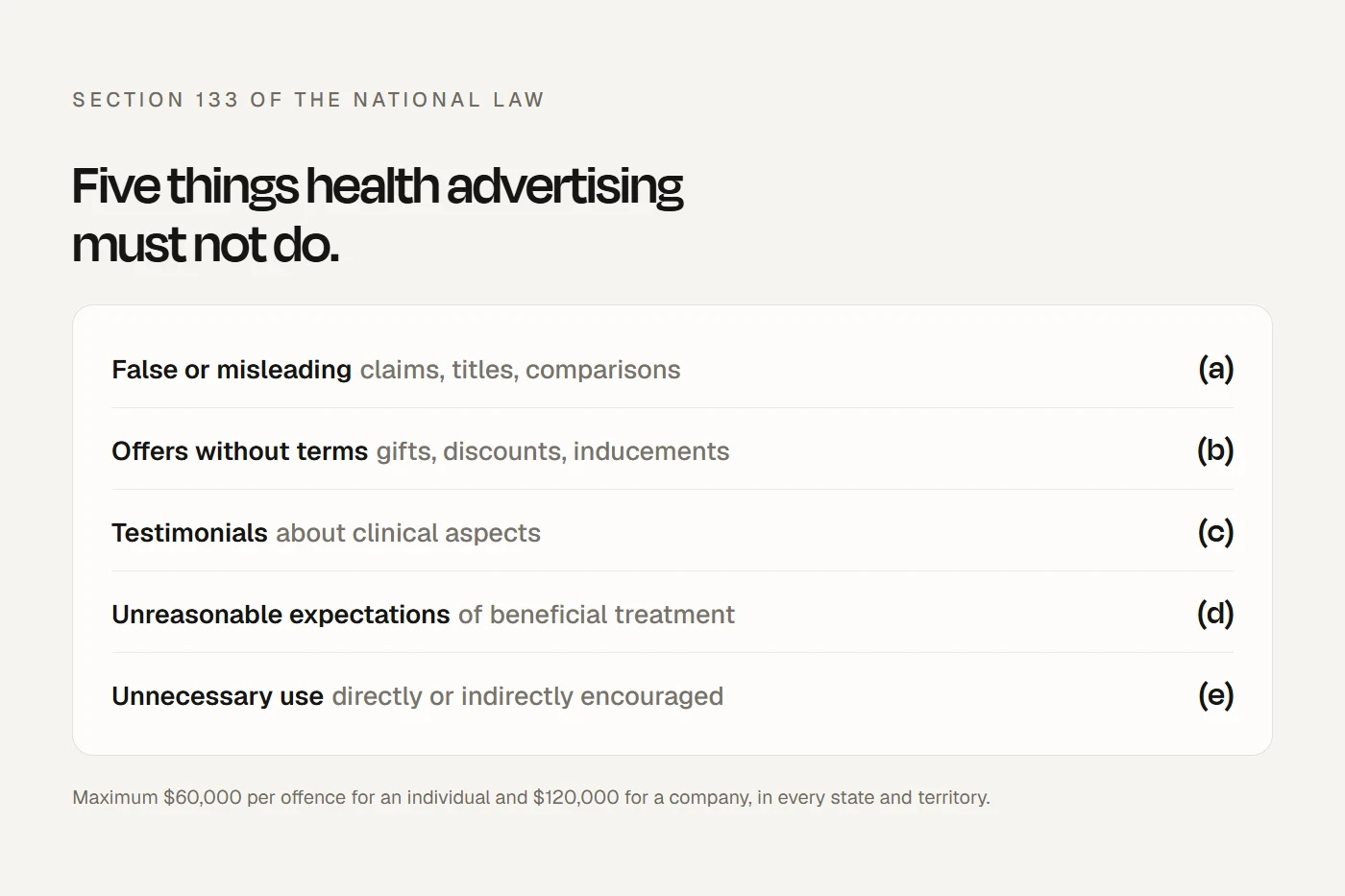
- Don't present information that is false, misleading or deceptive, and only advertise claims supported by acceptable evidence.
Ahpra's list of social media covers networks, messaging apps, forums, YouTube, Instagram, LinkedIn and booking sites, and says it isn't exhaustive. TikTok isn't named, but the same rules apply.
Confidentiality. Check the background of every photo. Ahpra's examples include a first-day selfie with a patient's name readable on an x-ray, and a practitioner who replied publicly to a parent's thank-you post thinking it was private. Ahpra notes that pieces of information that don't identify anyone on their own can do so together. The codes of conduct require written and informed consent before posting anyone's information or images, even if they aren't named.
Personal accounts. Ahpra says Boards may consider your private social media use "even where there is no identifiable link to you as a registered health practitioner", and that anyone can find you on the register. You won't be investigated just for holding or expressing views, and advocating for causes is recognised. But discrimination, content that contradicts public health evidence, and grievances about colleagues aired online are where trouble comes from. Ahpra warns practitioners to take care when "commenting, sharing or 'liking'" content that contradicts the evidence. Ahpra doesn't require separate personal and professional accounts. Keeping them separate, and not following current patients from a personal account, is my recommendation, not its rule.
Colleagues and boundaries. Behave courteously to colleagues "including when using social media", and resolve grievances privately. Language that's overly personal or familiar with patients can breach boundaries.
Testimonials on social media
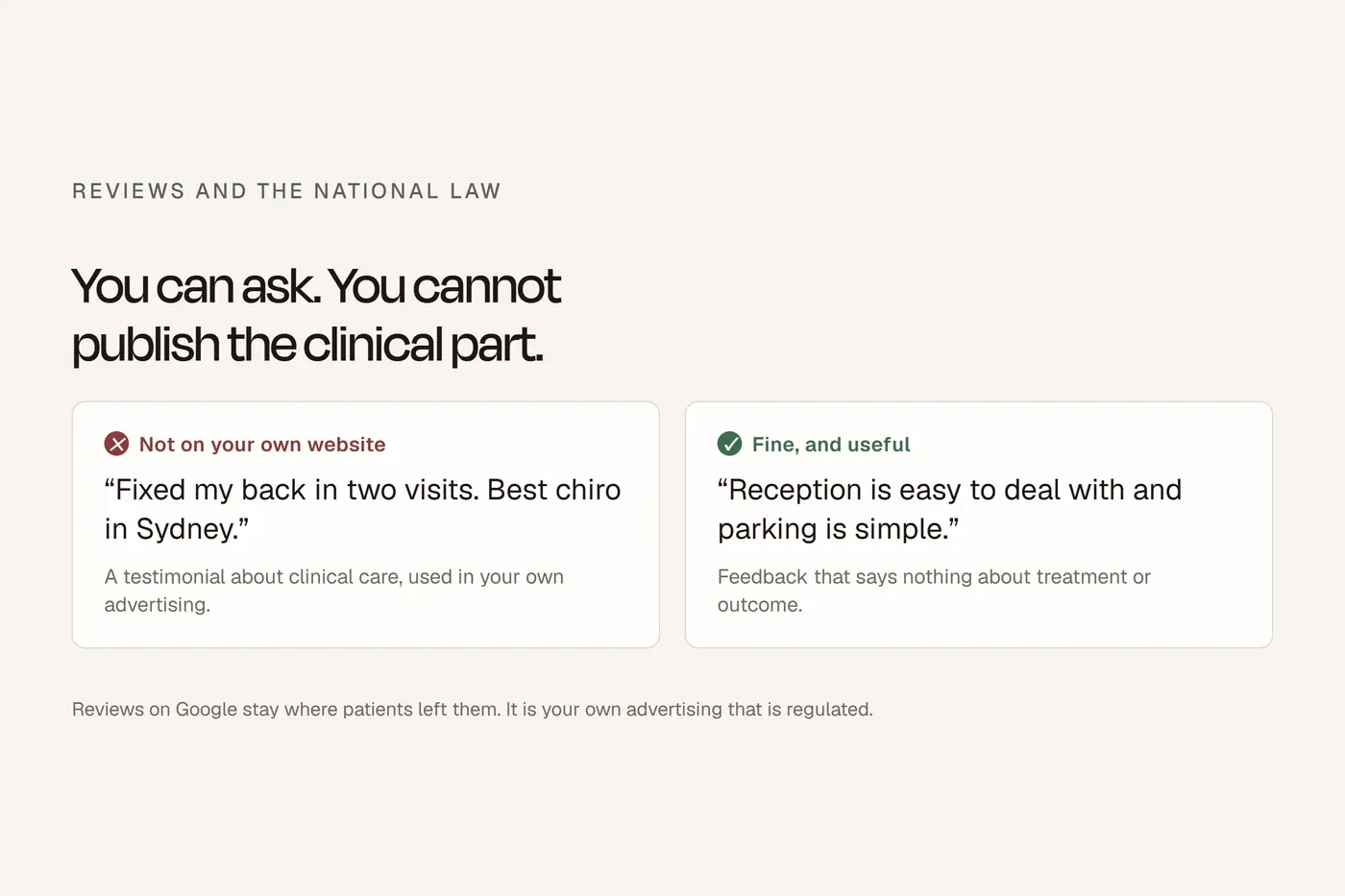
A testimonial is a positive statement about a clinical aspect of a regulated health service used in advertising: the symptom or reason someone came in, the diagnosis or treatment, or the outcome or the practitioner's skill. Comments about customer service, like friendly staff or easy parking, aren't testimonials.
Ahpra's testimonial tool asks three questions. Is it about a regulated health service? Is it used in advertising? Does it refer to a clinical aspect? Three yeses means it isn't permitted. The key is the second question, and Ahpra answers it with a control test: content is your advertising if you publish it, authorise it, direct someone else to post it, or can modify or remove it.
- Your own page. A clinic's Facebook or Instagram page that promotes its services is advertising. Ahpra says you must remove testimonials there, including ones a patient posts, and if the platform won't let you, disable the reviews function.
- Sharing. Ahpra says not to share or retweet someone's comment about a clinical aspect of your service. A patient's story on their own account isn't a testimonial; the moment you reshare it, it is.
- Engaging. Take care engaging with reviews elsewhere, because responding can amount to using the testimonial. For higher-risk cosmetic procedures, the guidelines say liking or responding to a patient's post counts.
- Sites you don't control. You don't have to remove reviews on Google or other sites you don't control, and Ahpra doesn't expect you to monitor the internet.
- Editing. Cutting a mixed review down to its non-clinical part, or keeping only the positive bits, is misleading.
Titles, claims and offers
"Dr". If you use "Dr" and aren't a registered medical practitioner, make your profession clear, as in Ahpra's example "Dr Lee (osteopath)". Handles can't hold brackets, so put the profession in your display name or the first line of your bio.
"Specialist". Only for specialist registration in a recognised specialty, and that includes "specialises in". Ahpra suggests "working primarily in" or "substantial experience in" instead. "Surgeon" is restricted for medical practitioners to specialist registration in surgery, obstetrics and gynaecology or ophthalmology.
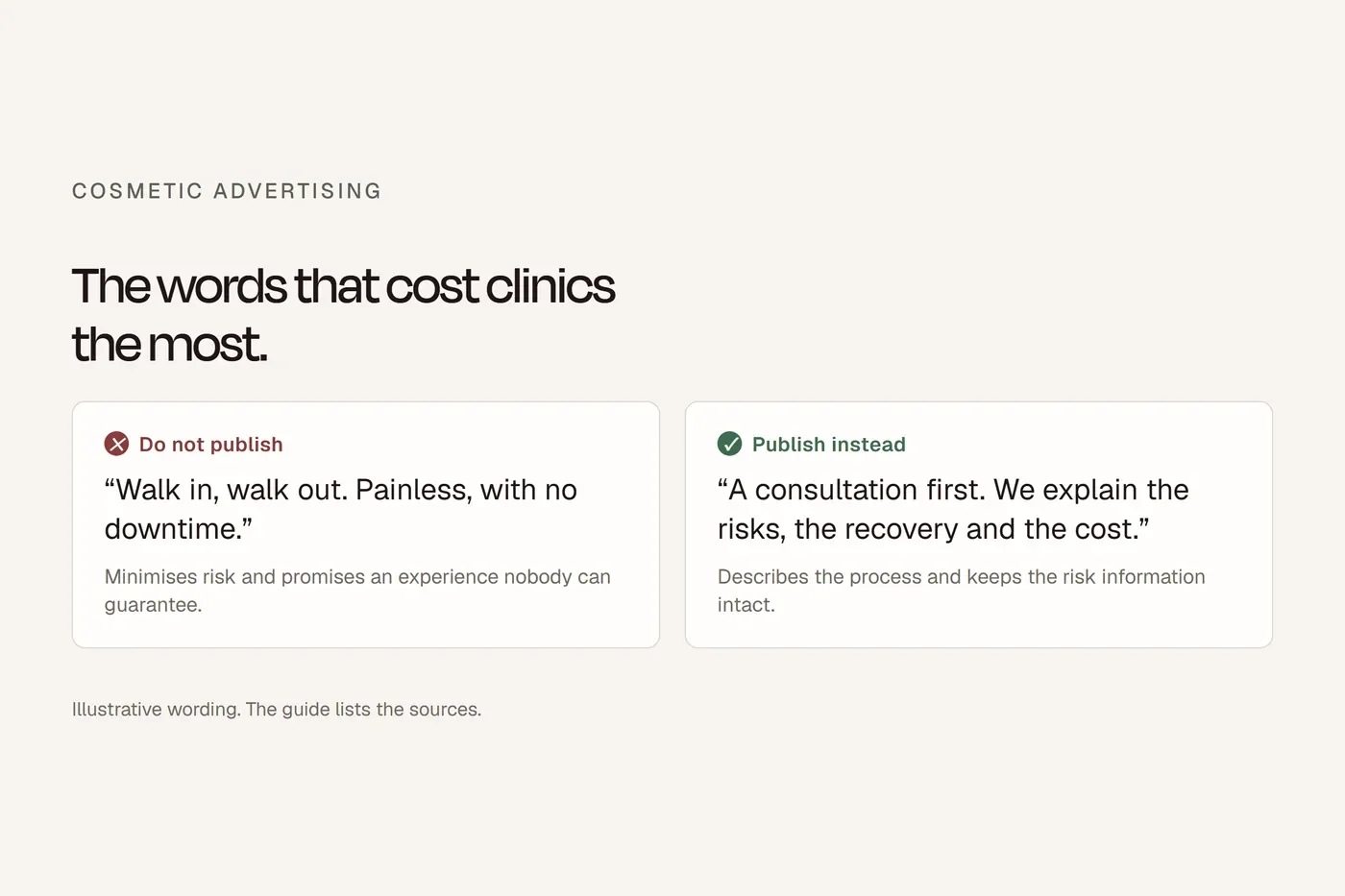
Claims. Ahpra's own social media example corrects "proven to be a very safe and effective healthcare modality" to "may help patients to manage a range of symptoms", with a note that treatments can occasionally cause adverse reactions. Avoid "cure", "guaranteed", "miracle", and "safe" or "pain-free" without the risks. Every advertising case Ahpra lists as heard by a court or tribunal involved cure claims, claims without evidence, or testimonials about curing serious illness.
Urgency. Ahpra says to amend phrases like "don't delay", "act now before it's too late" and "for a limited time only" where they suggest someone's health will suffer without your service. Posts urging regular visits need clinical support, though public health-endorsed check-ups and screenings, such as routine dental check-ups, are excluded.
Offers. Any discount, gift or prize needs its terms in plain language, or a direct link to them. "T&Cs in bio" works if the link goes straight to the terms. "DM us for details" doesn't, because Ahpra says people shouldn't have to contact you to find them.
Check your caption
Paste a caption with its hashtags. It's a first pass, not legal advice.
It catches common patterns, not everything.
Influencers and paid posts
Ahpra's general guidance doesn't use the word "influencer", but the control test does the work: content you pay for, gift or direct is your advertising, so an influencer's story about their treatment at your clinic is a testimonial you're using. Disclose any paid or gifted content clearly; the TGA says people should recognise advertising immediately, and TikTok requires its content disclosure setting when you promote your own business.
If you post as a practitioner-influencer, there's a further limit. The TGA's advertising code says current and former health practitioners can't give testimonials or endorsements for therapeutic goods, and paid testimonials are banned for anyone. A gifted "I use and recommend this" post about a supplement or a device is outside what that allows. The codes of conduct also say not to accept inducements from companies that sell products affecting how you treat patients, and the Medical Board's code says to declare your financial interest in anything you endorse or sell.
Posts that mention medicines and devices
The TGA treats any post that promotes the use or supply of a therapeutic good as advertising, including images, hashtags, tags and links. Prescription medicines can't be advertised to the public at all. That includes naming them, nicknames, hashtags like #botox or #ozempic, and before-and-after images that imply their effect. The TGA's guidance for health services says to talk about the consultation instead, such as "weight management consultations" or "general skin health". All posts, old and new, must comply. Comments on your posts are your responsibility too, and the TGA suggests an acceptable use policy that says non-compliant comments will be removed.
Cosmetic procedures: the extra layer
The guidelines for higher-risk non-surgical cosmetic procedures go further on social media. Liking, responding to or resharing a patient's post counts as using a testimonial, and a patient's tag puts their post on your page. Posts must be marked as adult content and not target under-18s, including through hashtags and algorithms. Video is for information and education, without music, dancing, comedy or montage, and emojis count as trivialising. A named injector needs their registration details, and posts should link to the risks. Free or discounted treatment in exchange for promotion is banned. Past posts must comply too. Ahpra doesn't ban influencers outright, but those rules leave little room. My guide to cosmetic advertising rules covers them in full.
Can I post this?
Tap a card to see the verdict.
What happens if someone complains
Ahpra says most advertising cases start with a letter telling the advertiser what breaches the law and asking them to correct it within 30 days, and in most cases the matter is closed once the advertising is corrected. Practitioners who don't fix it can face conditions that restrict their advertising, and very serious breaches can be prosecuted even if they're corrected. Ahpra also says most health practitioners want to comply. It is trialling AI to spot problem advertising, and its recent prosecutions have mostly been about people holding themselves out as registered when they aren't. On personal accounts, Ahpra's review of racism and discrimination notifications found nearly half came from social media, and most were closed without regulatory action.
A monthly check
Your ticks save in this browser.
- Read every new comment, review and tag on accounts you control, and remove clinical praise.
- Turn off review functions where you can't remove clinical reviews.
- Check the month's reposts, shares and likes, and undo any that amplify clinical praise.
- Check bios and display names on every platform: "Dr" with profession, no "specialist" or "surgeon" unless registered.
- Check every offer has its terms in the post or one tap away.
- Run captions and hashtags through the caption check.
- Confirm written consent for every identifiable patient image, and check backgrounds.
- Label paid or gifted content, and make sure no practitioner endorses a therapeutic good.
- Sign off anything posted for you by staff, an agency or a creator.
- For cosmetic: adult content setting, registration details, risk links, no music-and-montage reels or emojis.
- Look over personal accounts for anything that discriminates, attacks colleagues or contradicts public health evidence.
- Re-check one older month of posts, since old posts must comply too.
My view
Social media for a practice works best as education and introduction: the practitioner explaining one thing well, the rooms, what a first visit is like, opening hours, and offers with their terms one tap away. That's also the content the rules leave wide open. What gets practices into trouble is the content that feels most persuasive: patient praise, results and urgency. Leave those to the patients' own accounts, and send people to a website that does the explaining. My guide to Ahpra's advertising guidelines covers the rules behind all of this.
Questions I get asked
Do Ahpra's rules apply to social media?
Yes. Ahpra says the National Law, your code of conduct and the advertising guidelines apply on social media just as in person, and a practice page that promotes its services is advertising.
Can I share a patient's post about their treatment?
Not if it mentions a symptom, treatment or outcome. Their post on their own account is fine; sharing it makes it a testimonial in your advertising.
Do I have to delete patient comments on my page?
Comments about clinical aspects, yes, because you control the page. Comments about customer service, like friendly staff, can stay.
Can Ahpra look at my personal Instagram?
Yes. Boards may consider private social media use if it raises concerns about your fitness to practise, even if you don't say you're a practitioner.
Can I use "Dr" on social media?
Yes, but if you're not a medical practitioner, make your profession clear, as in "Dr Lee (osteopath)".
About this guide
Written by Joseph Alzein, founder of bdog. bdog builds websites for health practices. The rules come from Ahpra's social media guidance, testimonial tool, advertising FAQs and guidelines, the codes of conduct, the guidelines for higher-risk non-surgical cosmetic procedures, the TGA's social media guidance and the platforms' own policies. This is general information, not legal advice.
Main sources: