ASIC RG 234 explained: advertising financial products and advice
What RG 234 is and who it covers, the law underneath, what it says section by section with paragraph numbers, the hard rules for interest rates, what ASIC has acted on, and how to check your own ads. With a wording check, a headline rate quiz and a pre-publication checklist.
On This Page
RG 234 is ASIC's regulatory guide on advertising financial products and services, including credit. It applies to anyone promoting money products or advice: lenders, mortgage and finance brokers, financial advisers, insurance brokers, fintechs, and the agencies, lead generators and influencers who make their ads. This guide walks through what it is, the law under it, what it says section by section with paragraph numbers, the hard rules for interest rates, what ASIC has acted on, and a checker for your own copy. It's general information, not legal advice.
- It's guidance on the law, not lawRG 234 tells you how ASIC reads the misleading conduct rules. Break those rules and the penalties are real, and ASIC says it takes more interest in ads that don't meet its guidance.
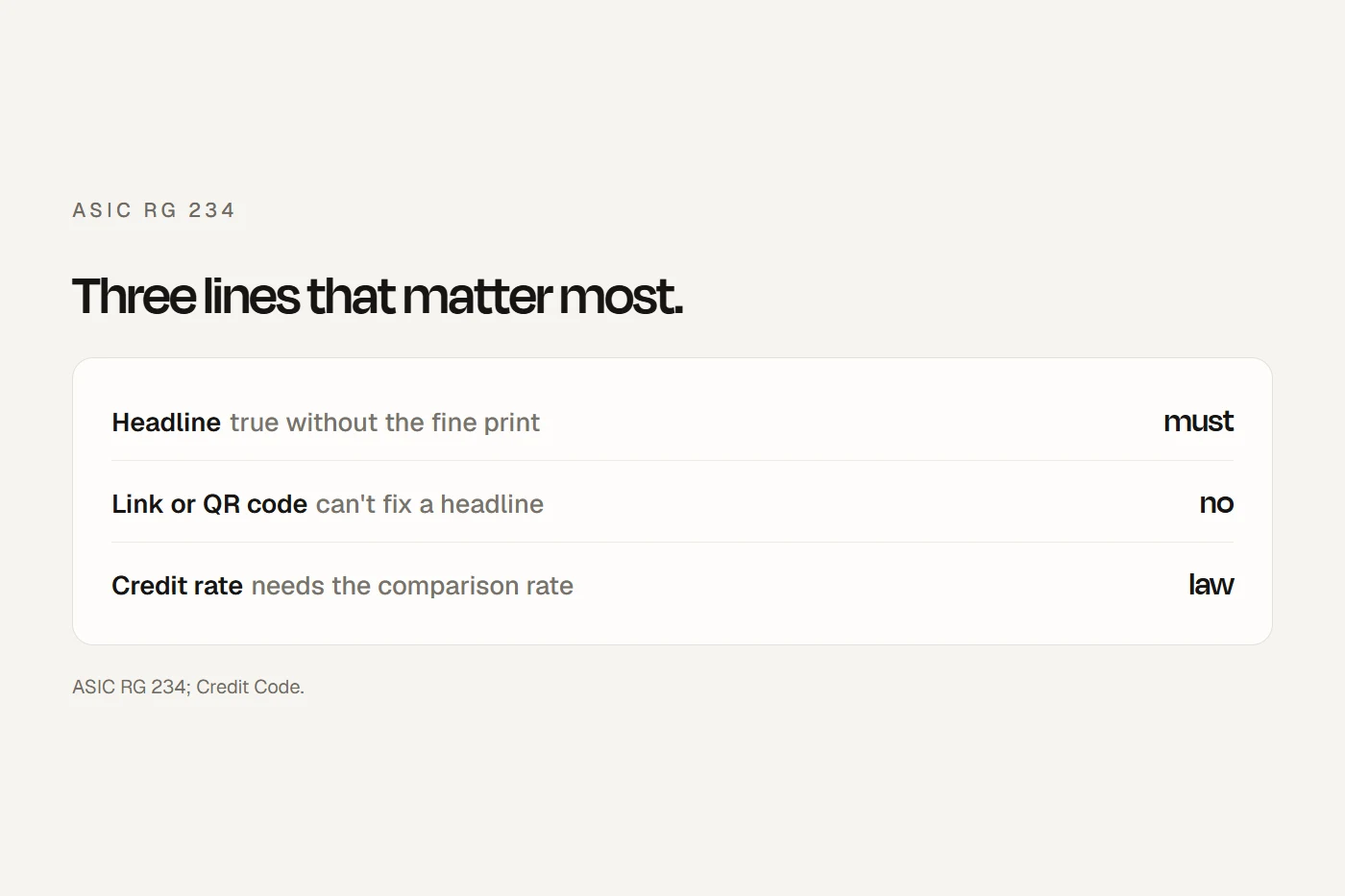
- The headline must be true on its ownA link, a QR code or the PDS can't fix a misleading headline. The test is what an ordinary person takes from the ad the first time they see it.
- Credit rates have hard rulesIf a credit ad shows an annual percentage rate, it must show the comparison rate, at least as prominently, with the prescribed warning straight after.
What RG 234 is
RG 234, "Advertising financial products and services (including credit)", explains how ASIC applies the laws against misleading advertising. ASIC says it "may take a greater interest in advertisements that do not meet our guidance when considering whether to make further inquiries or to exercise our regulatory powers" (RG 234.15).
Who it covers. Promoters, which ASIC says includes product issuers and credit providers but also "a financial adviser, credit service provider, distributor, intermediary (e.g. lead generators), or agent", and publishers including social media and digital platforms (RG 234.3). ASIC treats an influencer promoting a product as being in the same position as the promoter (RG 234.186).
What it covers. "Any communication whose purpose is to inform consumers about or promote" financial products, advice, credit products or credit services (RG 234.4), in any medium, "regardless of any specific technologies that may be used, including artificial intelligence (AI)" (RG 234.5). Telemarketing and on-hold messages count (RG 234.165). Regulated documents such as a PDS or FSG don't.
What changed in the current version. ASIC rewrote RG 234 and says "there are no new policy positions or changes to advertising laws", so there was no transition period. It added newer enforcement examples, folded in and withdrew RG 53 on past performance, dropped "good practice guidance" from the title, and added explicit lines on lead generators, AI-written ads and AI tools, finfluencers, reels and TikTok, podcasts, search and in-app ads, QR codes and greenwashing. If your compliance manual still cites RG 53, update it.
The law underneath
| Law | What it says, in short |
|---|---|
| ASIC Act s 12DA | No misleading or deceptive conduct in relation to financial services |
| ASIC Act s 12DB | No false or misleading representations about quality, price, benefits, endorsements or testimonials. A testimonial is taken to be misleading unless evidence shows otherwise |
| ASIC Act s 12DF | No conduct liable to mislead the public about the nature, characteristics or suitability of financial services |
| Corporations Act s 1041H | No misleading or deceptive conduct about a financial product or service |
| Corporations Act s 1018A | An ad for a product that needs a PDS must name the issuer, describe the target market or say where the TMD is, and say where to get the PDS and that people should consider it |
| Credit Code s 150, s 160 to 164 | Credit ad rules: fees and charges, and the comparison rate |
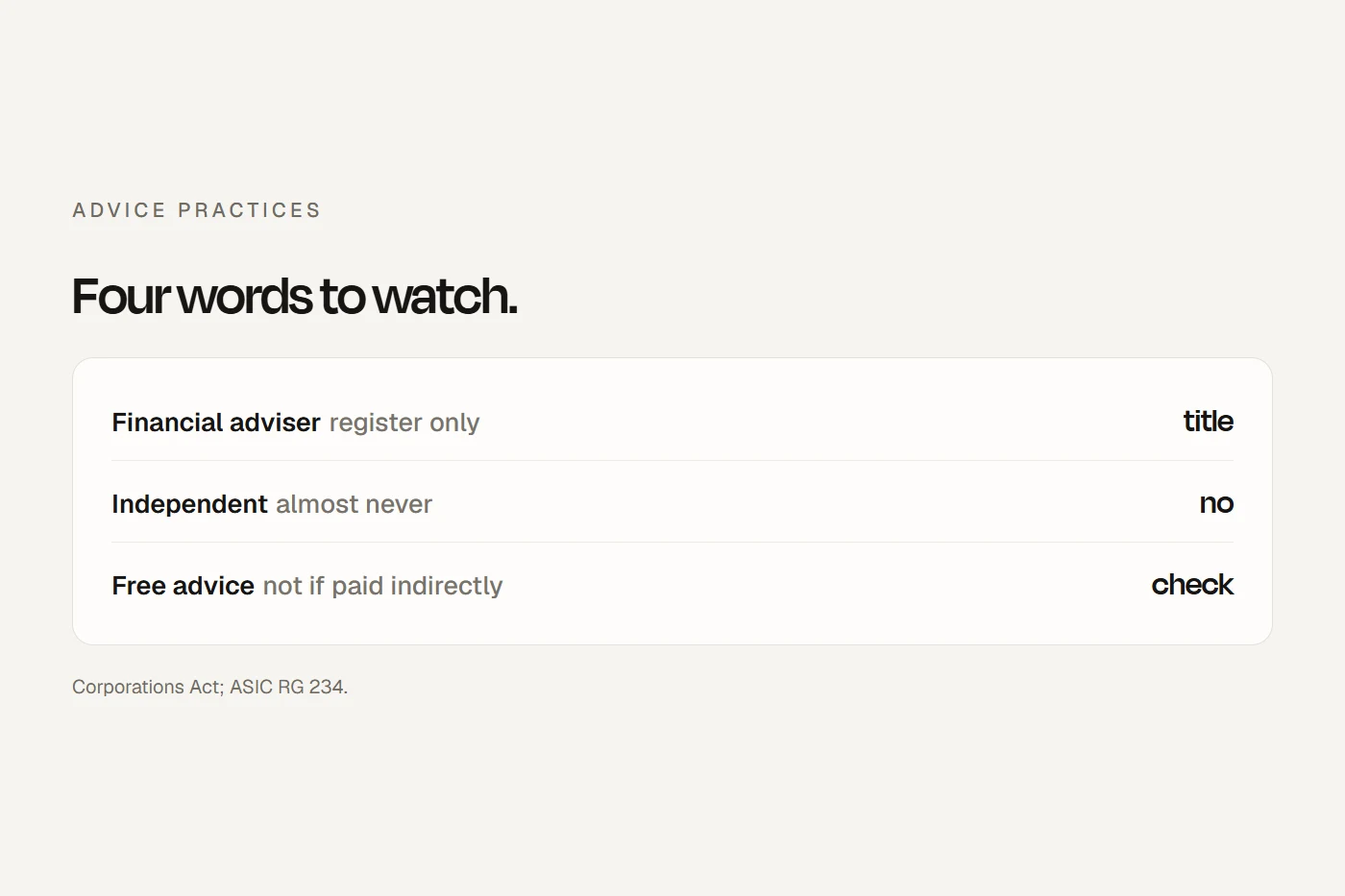
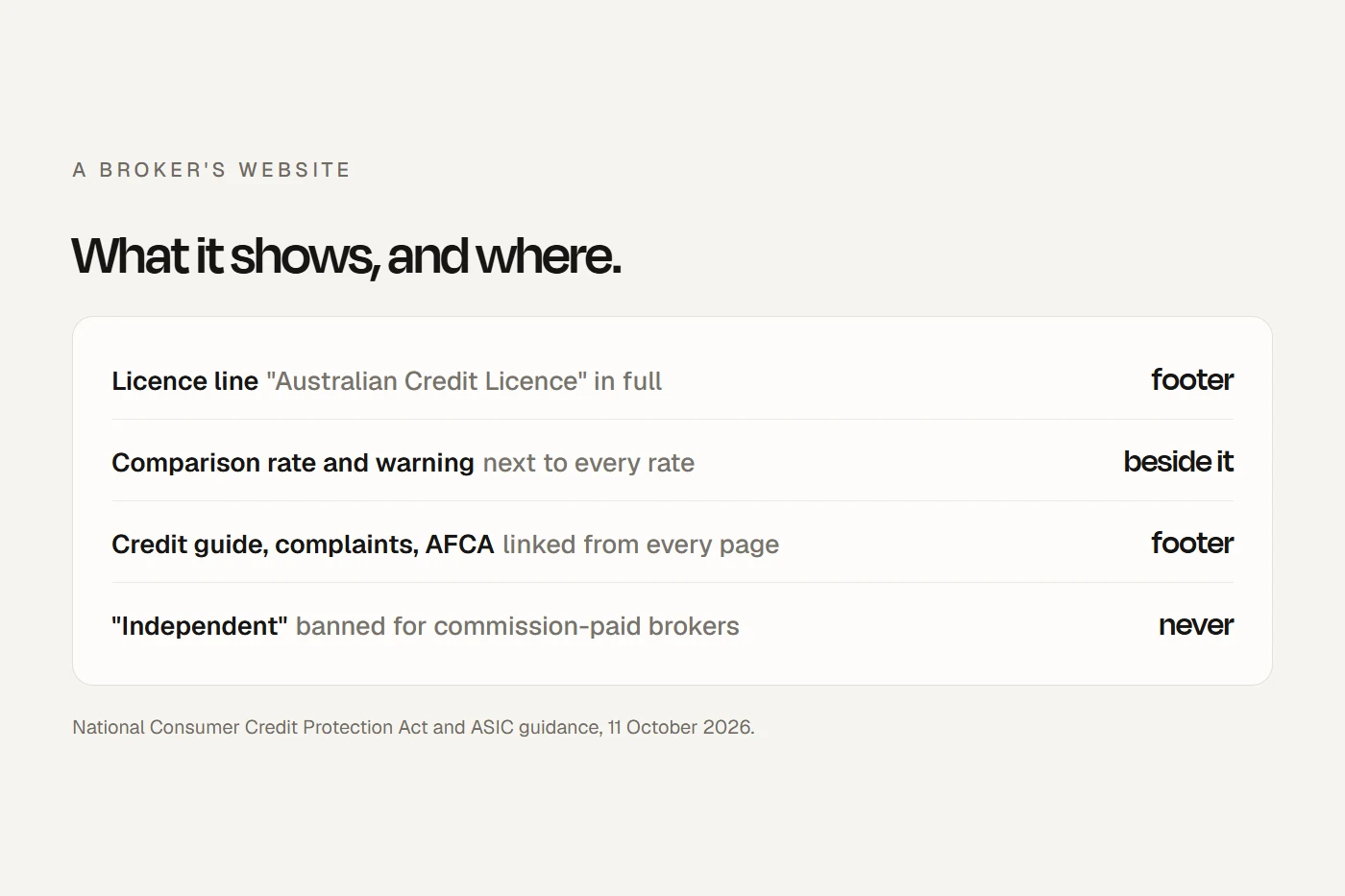
| Corporations Act s 923A, NCCP Act s 160B | "Independent", "impartial" and "unbiased" restricted for anyone paid commissions |
Scroll the table sideways to see every column.
For financial services, the misleading conduct rules sit in the ASIC Act, not the Australian Consumer Law, and ASIC enforces them. ASIC can issue infringement notices, and courts can order corrective advertising.
What RG 234 says, section by section
Balance (RG 234.16 to 234.33)
Ads "should give a balanced message about the returns, features, benefits and risks", and shouldn't create unrealistic expectations by giving the benefits more prominence than the risks (234.17). If a benefit is likely, say the risk and the assumptions (234.18). Claims about outcomes must be substantiated, and you should keep the records that back them (234.19). Deliver any advertised discount (234.24). Don't overstate how green or ethical a product is (234.25). Ads must match the PDS, FSG and contract (234.27). "There are very few products that can claim that they are fully insured or guaranteed" (234.30).
Warnings and fine print (RG 234.34 to 234.43)
"The headline claim must not itself be misleading" (234.34). Qualifications need enough prominence to be understood "on first viewing", and fine print, dense text, brief on-screen text or distracting content work against that (234.35). A link, QR code or PDS "will not be sufficient to correct a misleading or deceptive headline claim" (234.36). Disclaimers belong in the same language as the ad (234.38) and at the same time (234.39). "Some headline claims are so strong that any separate qualification will not correct any misleading impression" (234.40). Intermediaries such as brokers and advisers should make sure the product features and fees they describe match the current product information (234.42).
Fees and costs (RG 234.44 to 234.49)
Fee claims should give a realistic impression of the overall cost (234.44). "The word 'free' conveys a strong impression and should not be used where there is any charge to use the product." If you mention fees, say whether other costs apply (234.45). Returns should be shown net of fees (234.47). And don't call an advice service "free" or "low cost" if the client pays for it through product or admin fees (234.49).
Interest rates (RG 234.50 to 234.62)
This part rests on the Credit Code, so the core is law, not guidance. If a credit ad states an annual percentage rate, it must include the comparison rate for the prescribed amount and term, identified as a comparison rate, no less prominent than the rate or any repayment amount, and followed immediately by the prescribed warning. The short version reads: "WARNING: This comparison rate is true only for the examples given and may not include all fees and charges. Different terms, fees or other loan amounts might result in a different comparison rate." ASIC says a comparison rate is less prominent if it's smaller or fainter, needs a click or hover to see, or isn't close to the rate (234.58 to 234.59). For a honeymoon rate, show the discount period with equal prominence and name the revert rate (234.53 to 234.54). Credit cards and other continuing credit, and low cost credit contracts, which can include buy now pay later, are outside the comparison rate rules, but other credit advertising rules and the misleading conduct laws still apply.
"Up to", "from", and strong words (RG 234.120 to 234.127, Example 22)
ASIC says "up to" and "from" "should generally be approached with caution", because the overall impression may be that the best figure is widely available. Take care with "free", "secure" and "guaranteed" (234.120): some words have "such a strong connotation for consumers that they should only be used in advertising with great care" (234.121). For credit, don't use "guaranteed acceptance" or "pre-approved" (234.141), and think hard about "no credit checks", "no-doc" and "instant" approval (234.140).
Comparisons, ratings and awards (RG 234.63 to 234.80)
Compare like with like, keep comparisons current, and say what a rating means, that it's only one factor, and who granted any award and whether they're related to you (234.80). Comparison sites should disclose commissions and paid placements and warn if not every provider is covered (234.190 to 234.194).
Past performance (RG 234.81 to 234.119)
Put the warning "in close proximity" to the figures, on the same page, readable and not buried (234.83 to 234.85). ASIC's preferred wording is "Past performance is not a reliable indicator of future performance" (234.86); it calls "Past performance is not a guarantee of future performance" and "Future returns may vary" weaker (234.87 to 234.88). The standard period is the per annum return over five years, or the whole history if shorter (234.93). In easily updated media, figures more than three months old aren't up to date (234.82, 234.102). Simulated or back-tested returns need "extreme care".
Testimonials and endorsements (RG 234.128 to 234.132)
Testimonials must be authentic and attributed (234.130). Don't imply endorsement you don't have, and never use ASIC's logo, though you can mention Moneysmart (234.128 to 234.129). If you leave someone else's comment up on your own page, ASIC treats it as yours (234.187).
Audience and target market (RG 234.133 to 234.144)
Consider who will actually see the ad, not just who you meant it for (234.133 to 234.134). What an ad says about who a product suits should match its target market determination (234.135). "The more complex the product, the less likely it can be advertised in limited space" (234.143).
Advice and credit assistance (RG 234.151 to 234.155)
Don't promise "full financial plans" or "comprehensive financial advice" if you can only advise on a narrow range (234.151). Describe experience and qualifications accurately (234.152). Don't overstate AI or digital advice tools, and give their limits the same prominence as their benefits (234.153). Be clear about scope: don't claim a "wide range of lenders" if you use one or two (Example 64).
Each medium (RG 234.156 to 234.182)
The guidance applies to every format, including stories, reels and short clips (234.158). Mark sponsored content clearly (234.160 to 234.162). Audio disclaimers should be read at a speed an average listener can follow (234.164). In video, disclaimers must be understood on first viewing, and ASIC cites the court finding that people may not notice disclaimers "barely visible in real time" (234.167 to 234.168). Online, don't over-rely on click-through links or QR codes, especially on social platforms where people won't stop to click (234.173 to 234.174). "The physical limitations of a particular medium are not a reason for producing an advertisement that might mislead"; if the format can't carry the balance, pick another format (234.175 to 234.176). Keep a record of every ad (234.177).
What ASIC has acted on
The biggest recent case was Harvey Norman and Latitude. Their national "interest free" ads masked that customers had to take out a credit card with fees. The Federal Court ordered penalties and corrective advertising on both companies' website home pages for 90 days, and found their compliance processes "wholly inadequate". ASIC also acts on small ads. In recent cases it has issued infringement notices over:
- a small lender's "no credit check loans" website claim;
- a performance chart on a fund manager's site that combined two track records;
- super funds' website descriptions of investment options that didn't match the holdings, even though the PDS-linked guide was right;
- a super fund's paid search ads describing an emissions target inaccurately.
The Federal Court has also found that an insurance comparison service misled people about how many insurers it compared. ASIC has said misleading pricing is one of its enforcement priorities.
Check your ad
Paste your copy. It flags common risks with the RG 234 paragraph behind each one. The safer wording is my suggestion: ASIC publishes no approved wording apart from the comparison rate warnings and the past performance line.
It catches common patterns, not everything. If the ad isn't in English, the disclaimers must be in the same language (234.38).
Does your rate need a comparison rate?
Before an ad goes out
Built on ASIC's own questions in Appendix 1 (RG 234.196 to 234.199). Your ticks save in this browser.
- The headline is true on its own, with nothing that relies on a link, QR code or the PDS.
- Conditions sit beside the claim, at the size the claim needs.
- Benefits come with risks and assumptions.
- Fees are realistic, and the ad says whether other costs apply.
- Any credit rate has its comparison rate and warning.
- Past returns carry the warning, the standard period, net of fees and up to date.
- Nothing implies credit for everyone: no "pre-approved" or "guaranteed".
- No restricted words if you're paid commissions.
- The scope of advice or your lender panel is accurate.
- It matches the PDS, FSG, contract and target market, and PDS products name the issuer and the TMD.
- The format can carry the balance. If it can't, change the format.
- Paid content is marked as advertising.
- Someone outside the business has seen it for five seconds and can repeat the conditions (my suggestion, not ASIC's).
- A person checked every claim, especially if AI drafted it.
- The evidence for each claim is filed, and a dated copy of the ad is kept.
My view
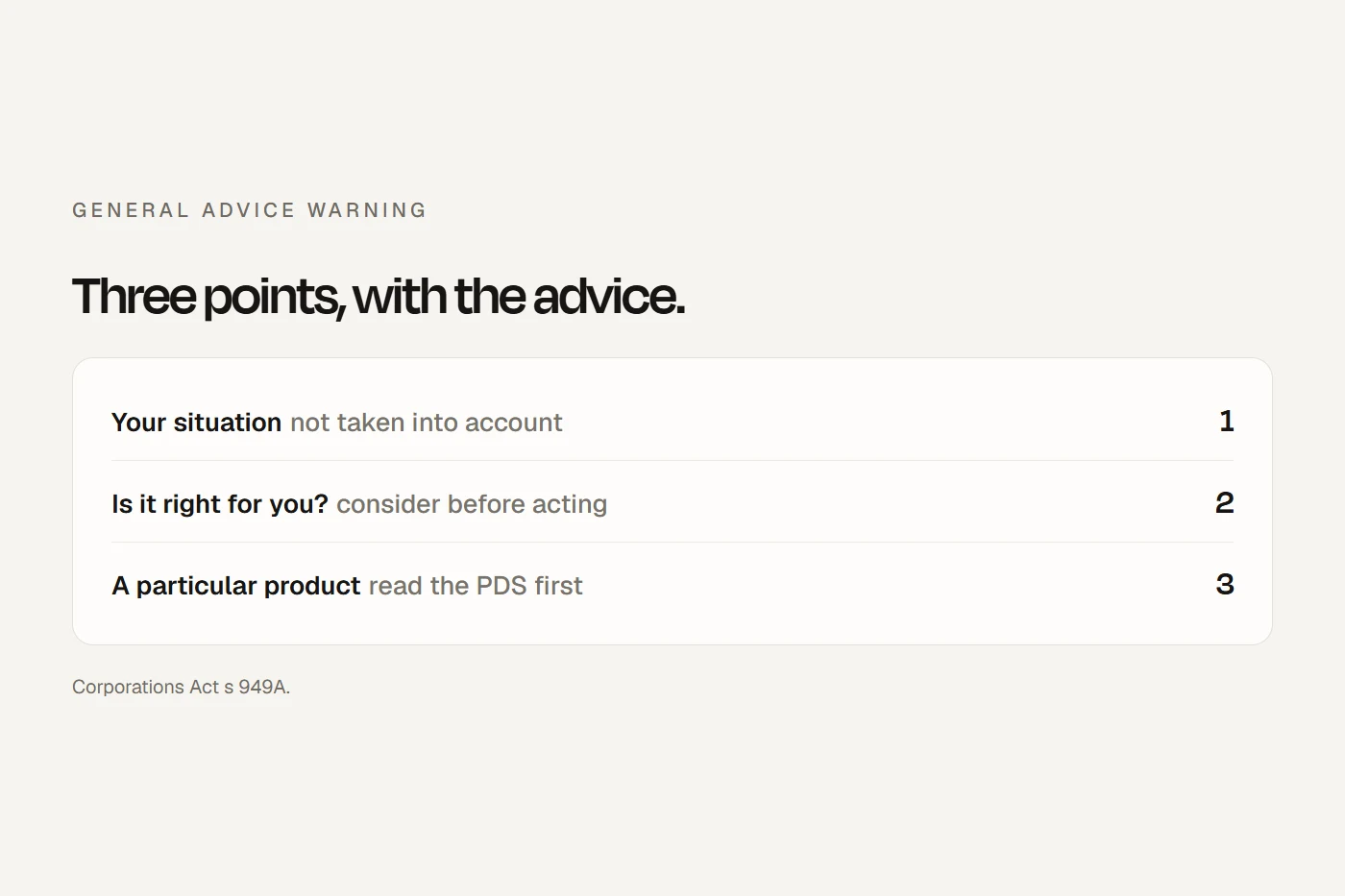
The single most useful line in RG 234 is that the headline has to be true on its own. Most problems ASIC acts on are headlines that only work with the fine print: "interest free", "no credit check", "up to". Write the headline you could defend without the asterisk, keep the evidence, and if a banner or a reel can't carry the balance, use a format that can. My guides to the general advice warning and financial adviser marketing cover the advice side in more detail.
Questions I get asked
What is ASIC RG 234?
ASIC's regulatory guide on advertising financial products and services, including credit. It explains how ASIC applies the laws against misleading advertising, section by section.
Is RG 234 law?
No, it's guidance. But the laws it explains are real, the credit advertising rules are statutory, and ASIC says it takes more interest in ads that don't meet the guide.
Does RG 234 apply to mortgage brokers?
Yes. It covers intermediaries such as brokers, advisers and lead generators, and says they must make sure the features and fees they describe match the current product information.
Do I need a comparison rate in my ad?
If it's a consumer credit ad showing an annual percentage rate, yes, unless the product is continuing credit, like a credit card, or a low cost credit contract.
Can I use "free" in a financial ad?
Only if there's no charge at all, direct or indirect. ASIC says "free" conveys a strong impression and shouldn't be used where there's any charge.
About this guide
Written by Joseph Alzein, founder of bdog. bdog builds websites for brokers, advisers and other financial businesses. This guide is based on ASIC's current RG 234, the ASIC Act, the Corporations Act, the National Consumer Credit Protection Act and Credit Code, and ASIC's media releases. Paragraph numbers are ASIC's; a few are cited as ranges where the guide prints them together. This is general information, not legal advice.
Main sources: