Marketing a financial advice practice within the rules
How people choose an adviser, the titles and words that are restricted, what ASIC’s advertising guide says about advice, which referral payments are fine and which aren’t, lead generation and cold calls, and each channel. With a wording check, a referral sorter, a client cost calculator and a 90-day plan.
On This Page
Marketing a financial advice practice runs into rules most small businesses never meet: restricted job titles, a banned word, limits on who can pay you for a referral, ASIC's advertising guide, and a regulator watching how advice firms buy leads. This guide is for practices, usually authorised representatives of a licensee, that want more clients from referrals, their website, Google, seminars and content, and want to do it within those rules. It covers how people choose an adviser, the rules that bite, each channel, and the referral arrangements that are fine and the ones that aren't. It's general information, not legal advice, and your licensee has the final word on your marketing.
- Build on referrals, and keep them cleanPractices say existing clients and accountants bring most new clients. Never take money from product issuers, developers or agents for clients.
- Make the website answer Moneysmart's checklistExperience, specialty, how you charge, links to product providers, your register entry and your FSG. That's what prospects are told to check.
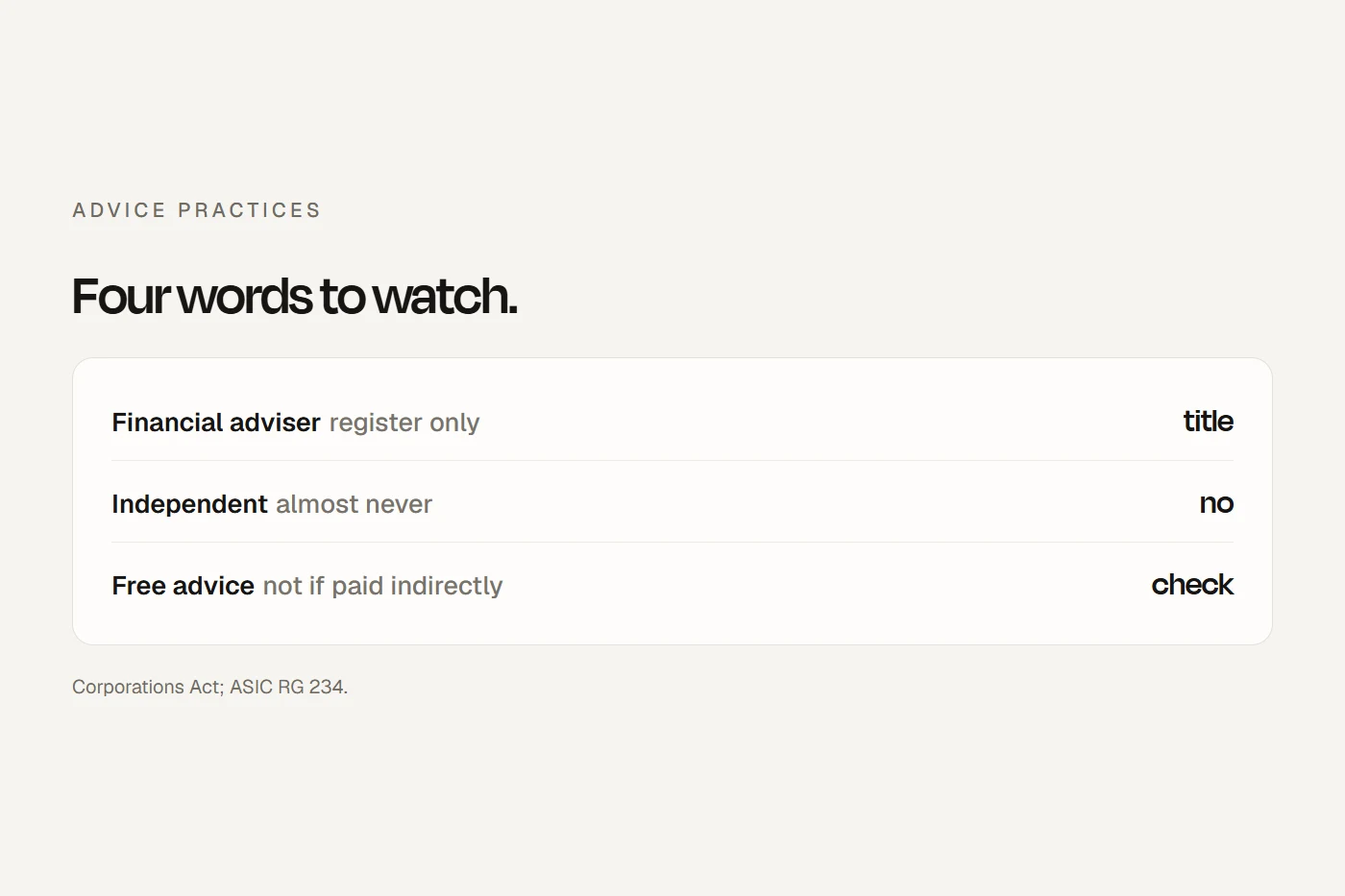
- Watch four words"Financial adviser" and "financial planner" are restricted titles, "independent" is off limits for almost everyone, and "free" can't hide indirect fees.
How people choose an adviser
There are far fewer registered advisers than there were a few years ago, and numbers have been roughly flat since. ASIC's research on what consumers think of financial advice found people choose on the adviser's experience, their reputation and whether they talk in a way people understand, followed by taking the time to understand their goals. People who had recently had advice cared much less about low cost and much more about being understood and feeling comfortable.
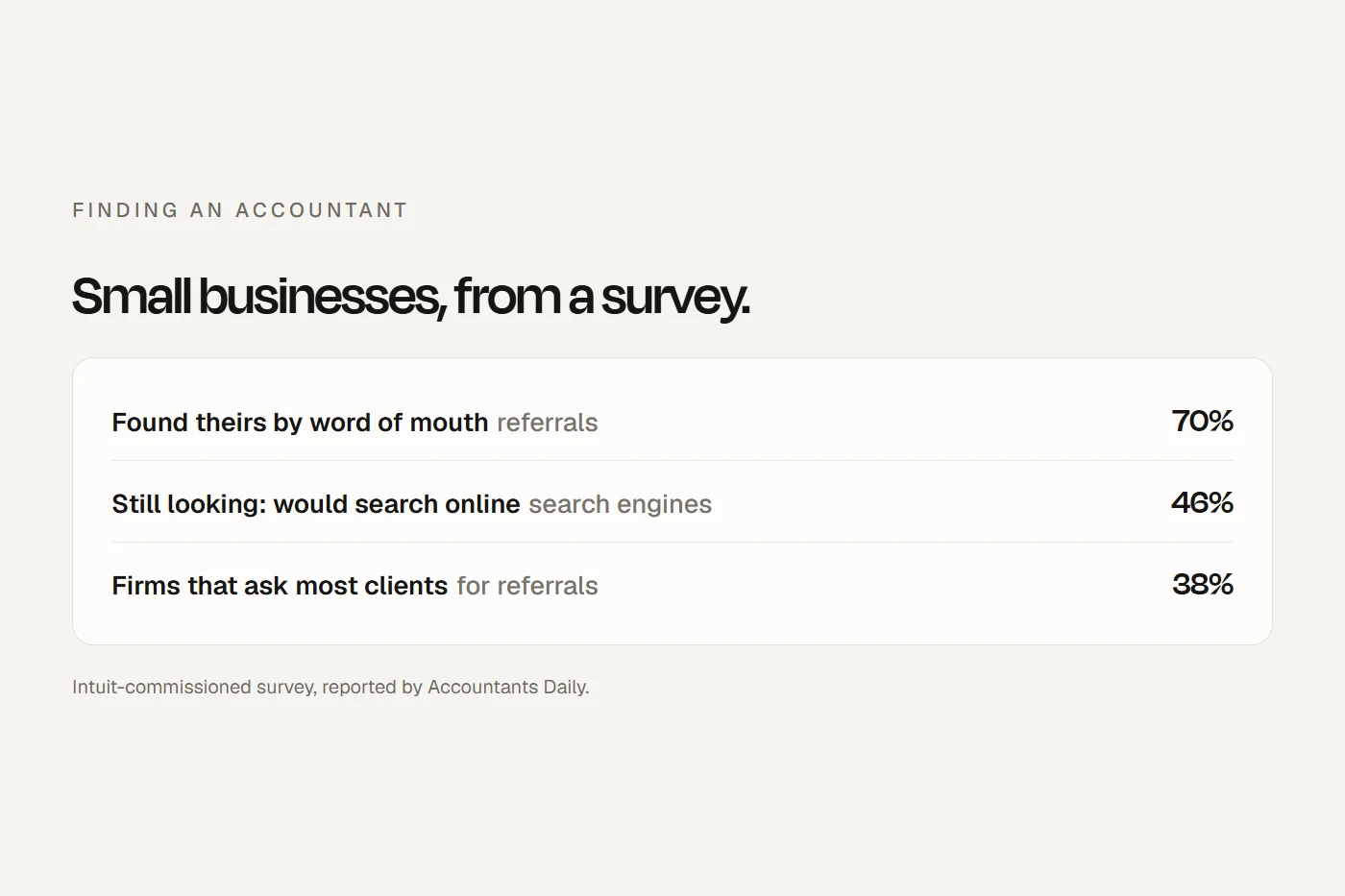
The same research found most people can't judge an adviser's expertise, so they rely on what they can see: who recommended the adviser, years of experience, whether the adviser specialises in people like them, and how they come across. Personal recommendation was the strongest signal. In an industry survey, most practices said their best source of new clients was existing clients, with accountants a clear second and digital channels well behind.
ASIC's consumer site, Moneysmart, tells people to find an adviser through a professional association, their super fund or recommendations, to check the Financial Advisers Register, to read the adviser's Financial Services Guide (which "should be on their website"), and to ask about qualifications, specialty, fees, commissions, how products are chosen, complaints and how to end the agreement. It also notes that advisers "don't usually charge you for the first meeting". A website that answers that list is answering the questions a careful prospect has been told to ask.
The words that are restricted
"Financial adviser" and "financial planner". Section 923C restricts these titles, and any words "of like import", to relevant providers: people on ASIC's Financial Advisers Register authorised to give personal advice on relevant products. Provisional advisers in their supervised year use "provisional financial adviser". The professional association has cautioned that even the "FP" in its own CFP designation could be read as "of like import". So check every place a title appears: the business name, the Google profile, LinkedIn headlines, ads. A coach or bookkeeper without that authorisation can't use them.
"Independent", "impartial" and "unbiased". Section 923A bans these unless you, your employer and your licensee receive no commissions (unless fully rebated), no volume-based payments and no other issuer benefits, and you work free of product restrictions and conflicts. ASIC also catches "independently owned" and "non-aligned", and gives "privately owned" and "locally owned" as terms that may be acceptable. A practice giving personal advice that can't use the words must instead say it isn't independent, in a boxed statement in its FSG. My guide to the Financial Services Guide covers that box.
"Free". It isn't banned. ASIC's advertising guide says an ad shouldn't suggest advice is "free" or "low cost" if the client pays for it indirectly through product or admin fees. A first meeting that really is free, with how you charge afterwards made clear, is normal.
What ASIC's advertising guide says about advice
ASIC's Regulatory Guide 234 has paragraphs written for advice services, and they apply to your website and social posts as well as ads.
- Scope: don't promise "full financial plans" or "comprehensive financial advice" if you can only advise on a narrow range, and don't imply you consider every product in the market if you choose from an approved list.
- Experience and qualifications: describe them accurately, and don't present experience from another field as advising experience.
- AI and digital tools: don't overstate them, and give their limits the same prominence as their benefits.
- Testimonials: allowed for advisers, unlike health practitioners, but they must be real and attributed. ASIC says if you leave someone else's comment up on your own website or Facebook page, you're responsible for it.
- Endorsements: don't imply ASIC endorses you, and don't use ASIC's logo.
ASIC gives four questions to ask of any advice ad: does it create realistic impressions of what the advice will achieve, are its limits clear, does it give a realistic impression of cost, and if it claims impartiality, does it describe your relationships accurately?
It catches common patterns, not everything. Run your licensee's approval process as well.
Referral money: what's fine and what isn't
This is the biggest trap. A benefit that could reasonably be expected to influence your advice is conflicted remuneration (s 963A), and an authorised representative must not accept it. ASIC's own example is a property developer paying an adviser a commission each time an SMSF client buys one of its properties. The Federal Court has found an authorised representative breached the ban by taking referral fees from a real estate business for SMSF property clients, and its licensee breached its duty to stop it.
Paying a referrer works differently. An unlicensed referrer, such as an accountant, needs no licence if they only tell the client you can help and give your contact details, and they must disclose any benefit at the time and in the same form as the referral. Your FSG and Statement of Advice must then disclose what you pay referrers. The accountant has their own professional obligation to tell the client in writing. And the Code of Ethics says you "must not advise, refer or act in any other manner where you have a conflict of interest or duty", and bars benefits from third parties other than your licensee except where the Corporations Act expressly permits them.
Tap a card to see the verdict.
Lead generation and cold calls
ASIC is reviewing advice licensees that use lead generation services and publishes a list of lead generators, referral partners and licensees that acquired leads, while saying being on it isn't a finding of wrongdoing. Its warning signs include pressure to act immediately, claims that someone's fund is underperforming, free super health checks and prizes on social media, offers to find lost super for free, and little contact with an actual adviser. Moneysmart warns consumers that clicking an ad or doing an online quiz can put them on a lead list.
The hawking ban (s 992A) stops offering a financial product in an unsolicited real-time contact, such as a call, meeting or live chat. It covers product offers, not an invitation to book a meeting, and there's an exception for offers made in the course of personal advice. The government has said it will limit that exception to existing client relationships. Telemarketing calls to numbers on the Do Not Call Register need consent, and calling hours apply to everyone. A web form that says "call me about my retirement" is the safe front door; a bought list isn't.
The channels
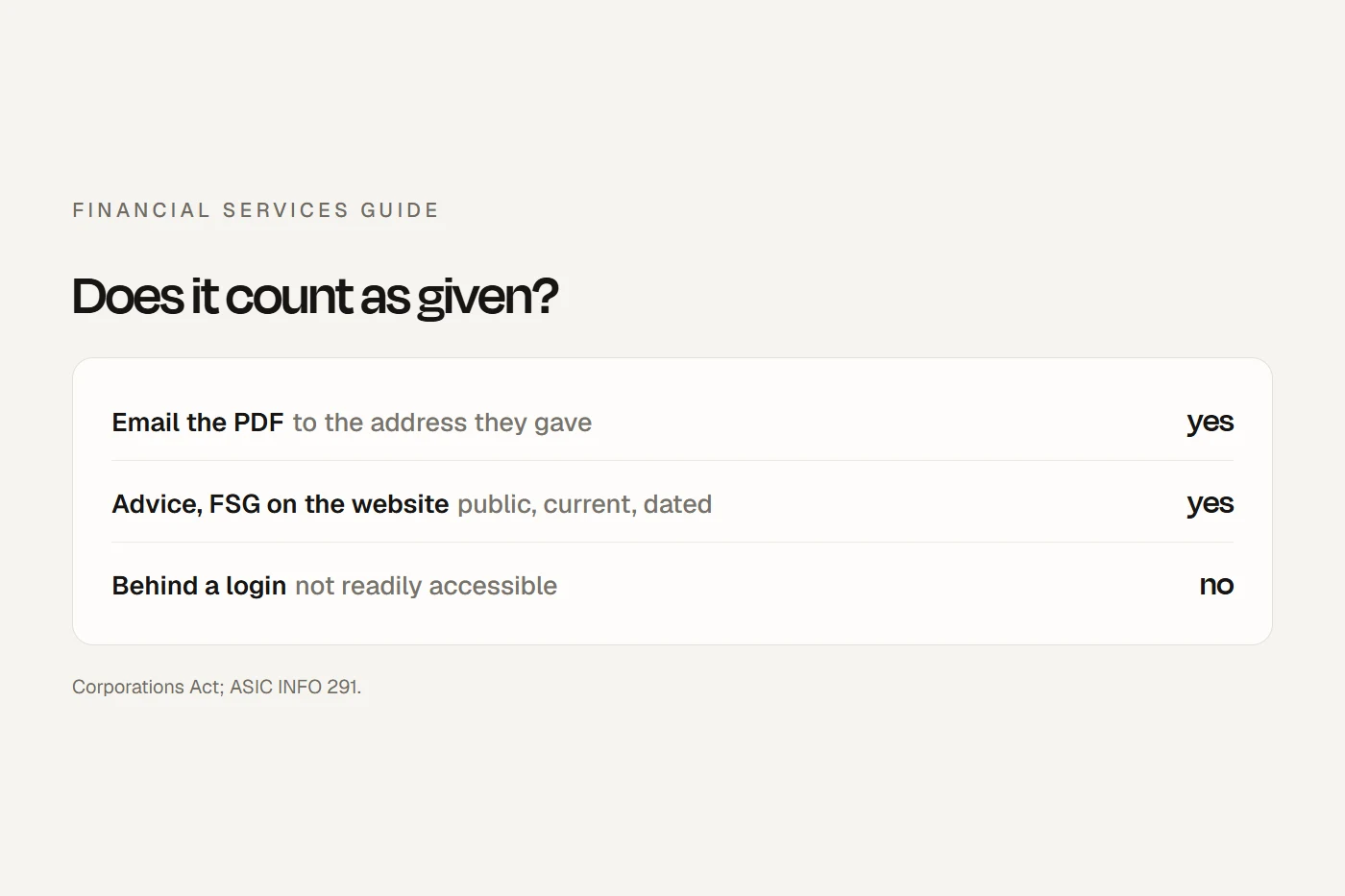
- Website. Each adviser named as on the register, with their representative number, specialty, years advising and who they help; how you charge and what the first meeting costs; what you advise on and what you don't; how you choose products; the FSG one click from every page; the licensee line, complaints and AFCA, and privacy policy. Keep lead forms short: a quiz that takes detailed circumstances and outputs a recommendation is personal advice.
- Google Business Profile. Google lists financial planners as individual practitioners who can have their own profile alongside the practice's, titled with only their name. A solo adviser under a licensee's brand shares one profile named "[brand]: [name]". Ask every client for a review the same way, with no incentive, and reply without confirming anyone is a client.
- Accountants and other referral partners. The channel practices rank second only to existing clients. A written arrangement approved by your licensee, nothing from anyone tied to products, any fee disclosed, and client consent before sharing information either way.
- Seminars and webinars. Say on the invitation exactly what it covers and that you're an adviser; ASIC's hawking guide gives the example of free movie tickets used to lure people to a sales pitch. Give the spoken general advice warning when advice starts, take personal questions to a one-on-one meeting, and accept no product sponsorship.
- LinkedIn and content. Factual explainers, "what happens in a first meeting" and checklists of questions to ask are safest. Anything that recommends a product or class needs the general advice warning in the post itself. My guide to the general advice warning covers each channel.
- Email newsletters. Consent first, the warning near any advice, and an unsubscribe honoured within 5 working days.
- Paid ads. Google requires financial services advertisers in Australia to verify their ASIC licensing, and Meta has its own verification for some financial ads. Your licensee usually handles this, so ask first.
What a client costs you, by channel
Run each channel separately. The default numbers are a made-up example, not typical fees or conversion rates. Count your time: it's the main cost of referral channels.
The calculator models your own practice costs, not a financial product, so it isn't advice. Don't add a referral fee to it quietly: if you pay one, it belongs in your FSG.
Your next 90 days
Your ticks save in this browser.
- Check every adviser's register entry and make the website match it.
- Search your site, Google profile, LinkedIn and ads for "independent", "unbiased", "impartial", "non-aligned" and "independently owned", and replace them.
- Check titles: "financial adviser" and "financial planner" only for relevant providers, "provisional" where it applies.
- Put the FSG one click from every page, with the "not independent" box and referral payments disclosed.
- Add the licensee line, complaints and AFCA page, and privacy policy.
- Rewrite the homepage around experience, specialty, who you help, how you explain things and how you charge.
- Run the wording check on every page, and get your licensee's sign-off.
- List your referral sources, decide no-fee or disclosed-fee for each, and get licensee approval in writing.
- End any arrangement where money comes from a product issuer, developer or agent.
- Set up Google profiles for the practice and each adviser, with accurate categories.
- Ask every client for a review the same way, with no incentive, and keep written consent for any testimonial.
- Check email consent records and add a consent tick box to your enquiry form.
- Publish two factual explainers and a "what happens in a first meeting" page.
- Run one honest seminar or webinar, with no sponsorship and the spoken warning.
- Verify for Google or Meta ads through your licensee before running any.
- Measure each channel with the calculator, and drop anything built on bought leads or free check hooks.
- Keep copies of every ad, post and email with its warning.
My view
An advice practice grows the way ASIC's research says people choose: through someone they trust, and a first impression that says experienced, specialised and plain-speaking. So the work is making referrals easy to act on and the website easy to trust: real names, register numbers, how you charge, what you do and don't advise on, and an FSG that's easy to find. Stay well clear of anything that pays you for where clients end up, and of leads you didn't earn.
Questions I get asked
How do financial advisers get clients?
Mostly through referrals: practices name existing clients first and accountants second. A website built around what Moneysmart tells people to check, a Google profile with steady reviews, and honest content and seminars add to that.
Can financial advisers use testimonials?
Yes, unlike health practitioners. They must be real and attributed, and you're responsible for comments you leave up on your own pages.
Can I call my practice independent?
Only if no one in the chain receives commissions, volume payments or issuer benefits, and you're free of product restrictions and conflicts. Almost no practice qualifies. "Privately owned" may be fine if it's true.
Can I pay an accountant for referrals?
Yes, with conditions: they only introduce you and disclose the fee at the time, you disclose it in your FSG and Statement of Advice, and your licensee approves.
Can I offer a free first meeting?
Yes, if it's really free and you explain how you charge after it. Don't call advice free if clients pay for it through product or admin fees.
About this guide
Written by Joseph Alzein, founder of bdog. bdog builds websites for advisers and has no arrangement with any licensee, lead generator or platform. The rules come from the Corporations Act and Regulations, the Code of Ethics, ASIC's regulatory guides and media releases, Moneysmart, ACMA and Google's policies. ASIC's consumer research and an industry survey are described without dated figures. This is general information, not legal advice.
Main sources: