Buyers’ agent licence and rules, state by state
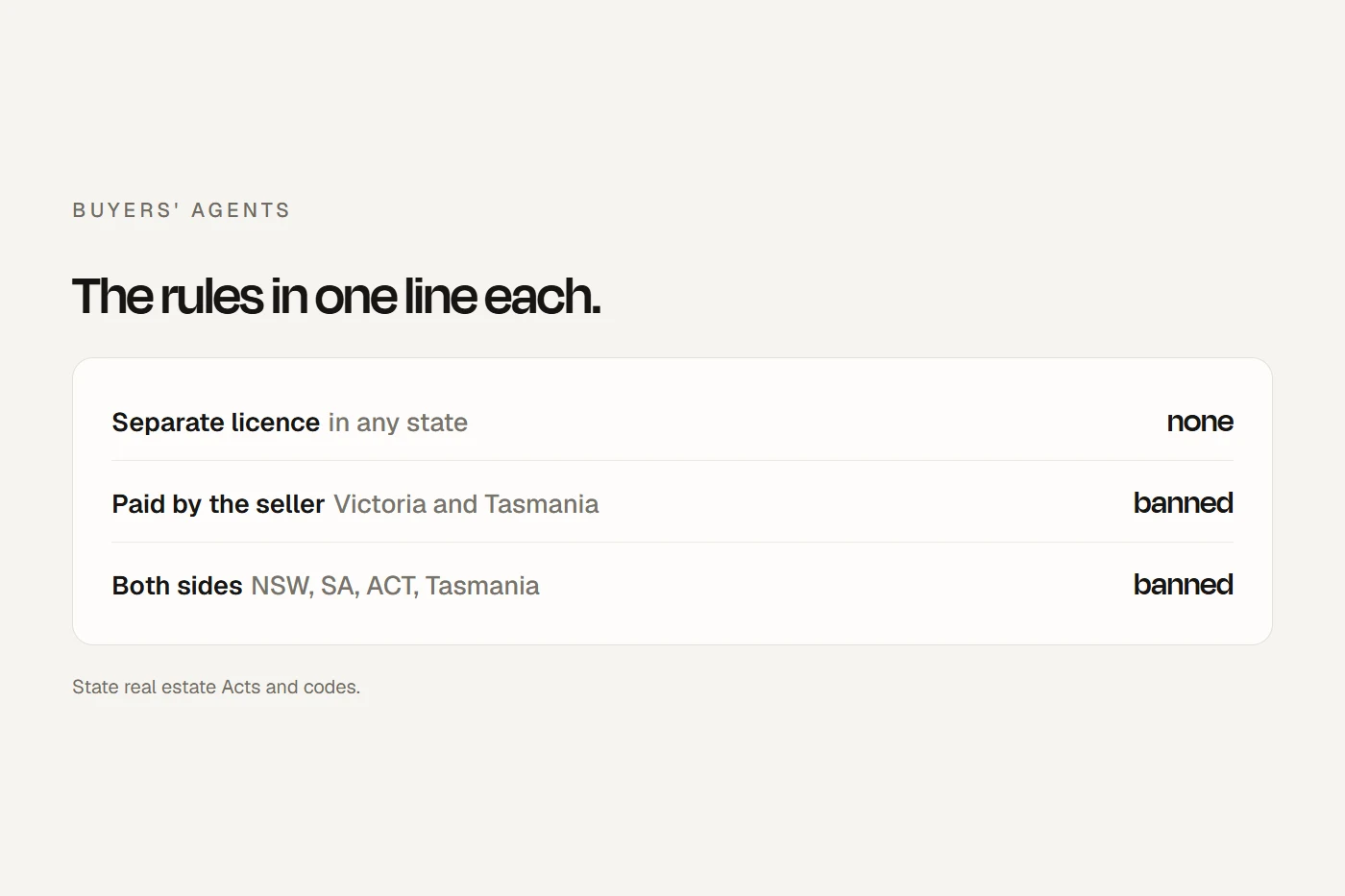
There’s no separate buyers’ agent licence anywhere in Australia. What differs by state is who may pay you, whether you can act for both sides, what goes in the agreement and what your ads must show. With a state quiz, a who’s-paying-you sorter, a wording check and a 90-day checklist.
On This Page
If you're starting a buyers' agency, or a sales agent thinking of adding buyer work, the first question is usually which licence you need. The plain answer surprises people: no state or territory has a separate buyers' agent licence. What does differ by state are the rules that decide whether your business model is legal: who may pay you, whether you may act for both sides, what goes in the agreement, and what your ads must show. This guide sets those out state by state from the Acts, regulations and regulator pages. It's general information, not legal advice, so check with your state regulator before you rely on any of it.
- You need a real estate licenceOr a registration that lets you work under someone else's licence. There is no buyers' agent class anywhere in Australia.
- Be paid only by the buyerVictoria and Tasmania ban taking money from the seller, and NSW, SA, the ACT and Tasmania ban acting for buyer and seller of the same property.
- Put your name in every adThe licensee's name in most states, with an address in Tasmania and the NT, and "RLA" plus your number on SA sale ads.
There is no buyers' agent licence
Every state treats buying for someone else as real estate agency. The NSW Act says its real estate functions extend to "an agent acting on behalf of the buyer of land (a buyer's agent)". Victoria's Act covers anyone negotiating the purchase of real estate for another person. Consumer Affairs Victoria puts it simply: a buyer's agent is a licensed estate agent. Queensland, WA, SA, Tasmania, the ACT and the NT are the same.
So the path is the ordinary one. You complete real estate units from the Certificate IV in Real Estate Practice (CPP41419), register or take an entry-level licence, work under a licensee, and then take the full licence if you want to run your own agency. The certificate includes a unit on establishing buyer relationships, but there's no buyers' agent qualification on its own. NSW once had a licence condition restricting a holder to acting for buyers. It no longer exists.
Advertising counts too. In every state the licensing section catches anyone who advertises or holds themselves out as ready to act without a licence, so a website offering buyers' agent services in a state where you aren't licensed is a risk in itself.
The licence, state by state
| State | To work under a licensee | To run your own agency | Worth knowing |
|---|---|---|---|
| NSW | Certificate of registration (assistant agent): five core units from CPP41419. It lasts four years and can't be renewed | Class 1 licence, or employ a class 1 licensee in charge | Class 2 needs 12 months as an assistant agent and a logbook; class 1 needs two years on class 2 and the Diploma of Property (Agency Management). Class 1 agents do CPD every year |
| Vic | Agent's representative, employed by a licensed estate agent | Estate agent's licence: the Certificate IV and the Diploma within the last five years | Plus at least one year's full-time experience in total as an agent's representative in the last three years |
| Qld | Real estate salesperson registration | Real estate agent licence: 19 units from the Certificate IV and the Diploma | Annual CPD. Not in automatic mutual recognition |
| WA | Sales representative registration, supervised by a licensed agent | Licence with a current triennial certificate | You can't be paid without a current triennial certificate and a signed written appointment |
| SA | Sales representative registration: 19 units, or a restricted registration while you're enrolled | Land agent registration: 36 units | Sale ads carry "RLA" and your registration number |
| Tas | Property representative licence, employed by a real estate agent | Real estate agent licence: the Board's qualifications plus two years' full-time work as a property manager or representative in the last five | Ads show your name and place of business |
| ACT | Registered assistant property agent | Class 1 licence to be the licensee in charge | Buyer agreements must state the most the client will pay |
| NT | Registered agent's representative, employed by a licensed agent | Real estate agent licence: Board-approved training and indemnity insurance | Ads say you're licensed and give your business address |
Scroll the table sideways to see every column.
In NSW, then, a class 2 licensee or an assistant agent can do buyers' agent work only inside someone else's licensed business. To put your own name on the door, you need class 1 or a class 1 licensee in charge.
Buying in another state
Investor-focused agencies often buy interstate. Automatic mutual recognition covers NSW, Victoria, SA, Tasmania, WA, the ACT and the NT, so a licence in one usually lets you work in the others. Victoria wants you to notify its regulator before you start there. Queensland isn't in the scheme, and the Queensland Government says a NSW or ACT class 2 licence isn't equivalent to a Queensland licence, so you apply there separately. Wherever you buy, that state's agreement, disclosure and conduct rules apply, not your home state's.
Who can pay you
This is where the states really differ, and where the "free buyers' agent paid by the developer" model runs into trouble.
| State | Act for buyer and seller of the same property | Take money from the seller, selling agent or developer | Referral fee from the selling agent |
|---|---|---|---|
| NSW | No | No express ban, but the both-sides and conflict rules apply, and the buyer must be told the arrangement exists | No |
| Vic | No, says Consumer Affairs Victoria | No commission from the seller when the buyer engaged you | Not expressly; the commission and conflict rules apply |
| Qld | Conflict rule applies | The developer must disclose the payment, its amount and who gets it to the buyer on the approved form | No rule found |
| WA | Only with both clients' fully informed written consent | Nothing above the amount agreed in writing with the client, from anyone | Disclose in writing |
| SA | No | Disclose the source and amount of any benefit anyone receives | Disclose |
| Tas | No | No: paid only by your client, and never negotiate payment from the vendor | No |
| ACT | No | Disclose any benefit anyone else receives, before the contract | No |
| NT | No express ban; your duty to the client still applies | No fee from anyone else for work your client pays for | No express rule |
Scroll the table sideways to see every column.
Someone a developer pays to bring in buyers is working for the seller. Calling that person a buyer's agent or buyer's advocate is likely to mislead under the Australian Consumer Law, whatever the state rule on payments. CHOICE lists a "free" buyers' agent as a red flag for exactly this reason: someone else is paying, and the cost may be in the price.
In NSW, the Fair Trading Act also requires an agent paid an incentive by a third party to make the buyer aware of the arrangement. That's a minimum, not a cure for the rule against acting for both sides. The simplest position, and the only one that works in every state, is to be paid by the buyer and nobody else, and to say so on your website.
The buyers' agents' association, REBAA, goes further in its own code, which binds members only: no selling, no stock lists, no marketing new or off-the-plan property to clients, and no undisclosed benefits of any kind.
Who's paying you?
Tap a card to see the verdict across the states.
The agreement with your buyer
Everywhere I checked, you need a written agreement signed by the client before you act or can be paid. What has to be in it varies.
- NSW: written and signed by both, with a copy given within 48 hours. It must name the source and estimated amount of any rebates on expenses, and come with a signed statement of the property details (the type of property and any special instructions). You can't sign a buyer you know is already under another agent's exclusive agreement.
- Victoria: before the client signs, tell them the commission is negotiable. A percentage fee must also be shown as a dollar amount on the price set out in the engagement, with a rebate statement and a complaints statement. Rebates on the client's outgoings belong to the client.
- Queensland: the approved appointment form, given before you do any work, with a prominent line that the client should get independent legal advice. Either side can end it on 30 days' written notice.
- WA: a signed written appointment setting out how your pay is worked out and stating that commission isn't fixed by law. You can't take more than the amount the client initialled.
- Tasmania: the services, how your pay is calculated, the expenses, and how either side can end it, explained to the client before they sign.
- ACT: your licence number, the statement of property details, the most the client will pay, and any percentage fee shown in dollars too. At auction you stop at that limit unless the client agrees in writing.
I found no cooling-off period for buyer agreements in any state. The NSW cooling-off rule is for agreements to sell residential property or rural land.
Your ads and website
The name rules first. NSW and Victoria want the licensee's or business name in ads, and Queensland the licensee's prescribed particulars. Tasmania wants the name and your place of business, including on social media. The NT wants your address and a statement that you're licensed. WA wants enough to identify the agent, and sales representatives can't call themselves agents. SA requires "RLA" and your registration number on ads about the sale of land; a buyers' agency's own ads may not strictly be covered, but adding it costs nothing.
Then the claims. The Australian Consumer Law treats a claim about a future result as misleading unless you had reasonable grounds, and that catches a lot of buyers' agent marketing. Paste your copy below to check it.
It catches common patterns, not everything. Two more points it can't check. Case studies with a client's address or price need their written consent, because that's confidential client information. And when you pass on a selling agent's price or claim, say whose figure it is.
What buyers are told to ask
Consumer Affairs Victoria and the NSW Government both publish questions for buyers to ask a buyers' agent: are you licensed, how is the fee worked out, what do I pay if you don't find a property, can I end the agreement and at what cost, do you get rebates or benefits from anyone else, and do you also act for sellers. A website that answers each of those in plain words is answering the regulator's own checklist. In a survey of property investors by PIPA, buyers' agents came just behind mortgage brokers among the professionals investors had asked or planned to ask, so those visitors arrive with questions. My guide to real estate marketing covers the selling side's rules.
Your first 90 days
Your ticks save in this browser.
- Confirm the licence you need in every state you'll buy in, including the Victorian notice and a separate Queensland application.
- Draft the buyer agreement for each state, with that state's required contents.
- Write your payment policy: paid by the buyer only, with no money from sellers, selling agents or developers.
- Get the disclosure forms ready for any referral relationship, such as NSW's approved form.
- Take out professional indemnity insurance.
- Add your licence line to the footer for every state you advertise in.
- Write "How we're paid" and "We never act for sellers" on the website.
- Explain your fee: the structure, what happens if no property is found, how to end the agreement, and any percentage as a dollar amount.
- Run every page and ad through the wording check.
- Get written consent before using a client's suburb or price in a case study.
- Add a separate, unticked marketing consent to your enquiry form.
- Set up referral agreements that share no fees with unlicensed people in NSW and the NT.
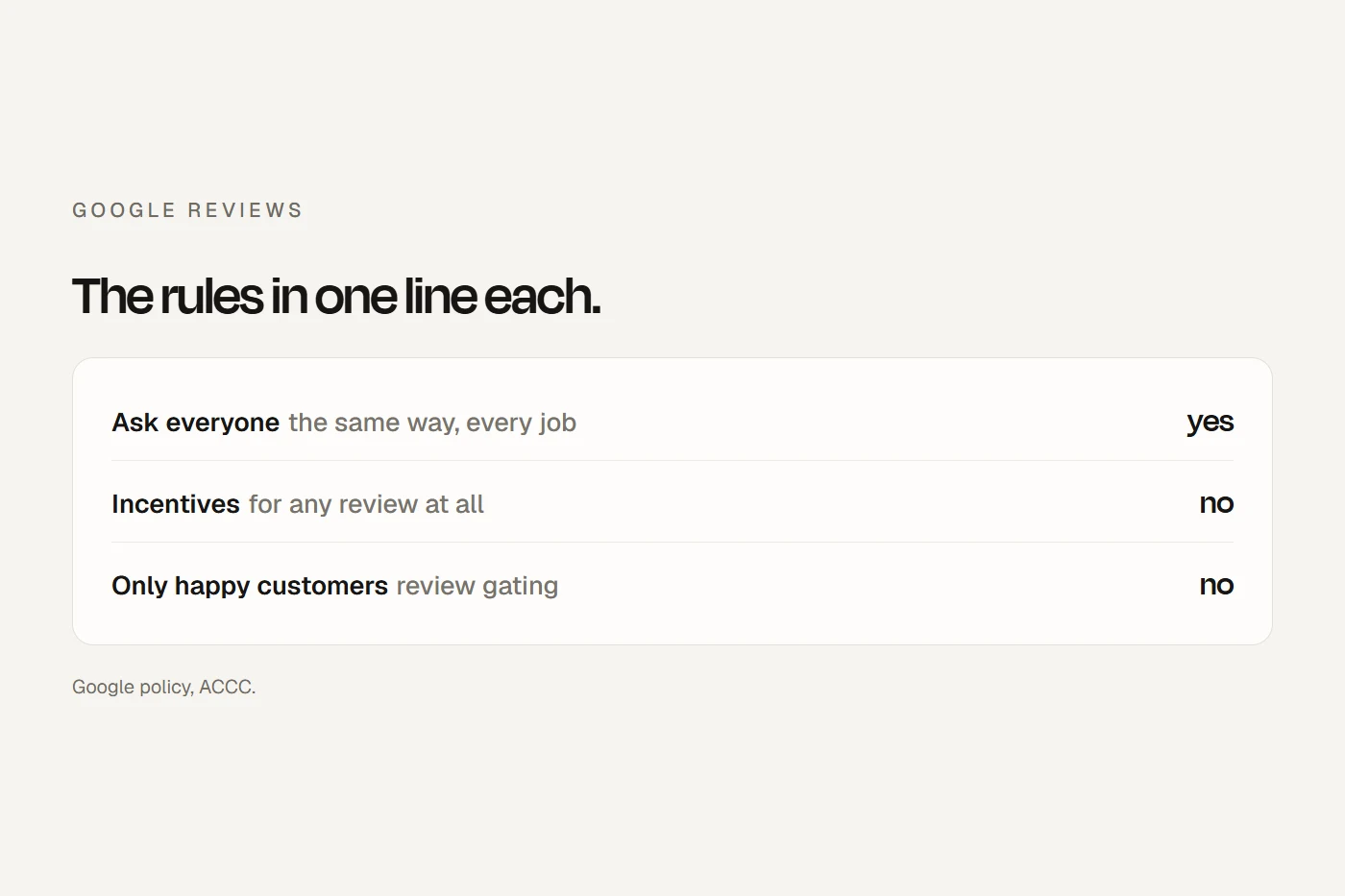
- Set up your Google Business Profile and ask every client for a review after settlement, with no incentive.
My view
The licence is the easy part: it's the same real estate licence a selling agent holds. What makes a buyers' agency trustworthy, and legal in every state, is being paid by the buyer and nobody else, never acting for sellers, and saying both on your homepage. The agencies that can't say those things are the ones the regulators and CHOICE warn buyers about.
Questions I get asked
Do you need a licence to be a buyers' agent?
Yes. Every state treats buying for others as real estate agency, so you need a real estate licence or a registration that lets you work under a licensee. There's no separate buyers' agent licence.
What licence do you need to be a buyers' agent in NSW?
To start, a certificate of registration as an assistant agent, working under a licensed agency. To run your own buyers' agency, a class 1 licence or a class 1 licensee in charge.
Can a buyers' agent be paid by the seller?
Not in Victoria or Tasmania. In the other states it runs into the rules against acting for both sides or must be disclosed, so the safe model is to be paid only by the buyer.
Can a buyers' agent work in any state?
Automatic mutual recognition lets a licence in one state work in the others, except Queensland, which needs its own licence. Victoria wants notice before you start there.
Do buyers' agents have to join REBAA?
No. REBAA membership is voluntary, and its code binds members only. It requires, among other things, that members don't sell property.
About this guide
Written by Joseph Alzein, founder of bdog. bdog builds websites for real estate businesses, buyers' agencies included. The rules come from each state's real estate Act and regulations, the regulators' pages, the Australian Consumer Law, ASIC, CHOICE and the REBAA Code of Conduct. Licence requirements change, so check with your state regulator. This is general information, not legal advice.
Main sources: