Real estate agency marketing that wins listings
How vendors actually choose an agent, what each state lets you say about price, what vendors are owed on marketing costs, which claims about your results hold up, and the channels that win listings. With a wording checker and a listings calculator.
On This Page
Most real estate marketing advice is a list of ideas from American CRM vendors: drone shots, video tours, a newsletter, a social calendar. Some of it works here. But an Australian agency's marketing runs into something those lists never mention: every ad, flyer, social post and website listing is covered by your state's price advertising rules, and every vendor marketing budget is covered by disclosure rules. This guide is for a principal or sales agent at a small independent agency. It covers how vendors actually choose an agent, what each state lets you say about price, what vendors are owed on marketing costs, which claims about your own results hold up, and the channels that win listings. It's from each state's agents law, the Australian Consumer Law, the ACCC and the portals' own research, read on 12 October 2026. It's general information, not legal advice.
- Vendors pick the agent they've seen sell nearbyRecent local sales, reviews and a clear plan, found on the portals and your own site, and a reply within two days.
- Price rules reach every ad you runNo "offers over" in NSW, Victoria or South Australia, no auction price guides in Queensland, and Victoria's price statement next to every online price.
- Prove every claim about yourself"No. 1", "sold", "award-winning" and "98% above reserve" each need the measure, the place, the period and the records behind them.
How vendors choose an agent
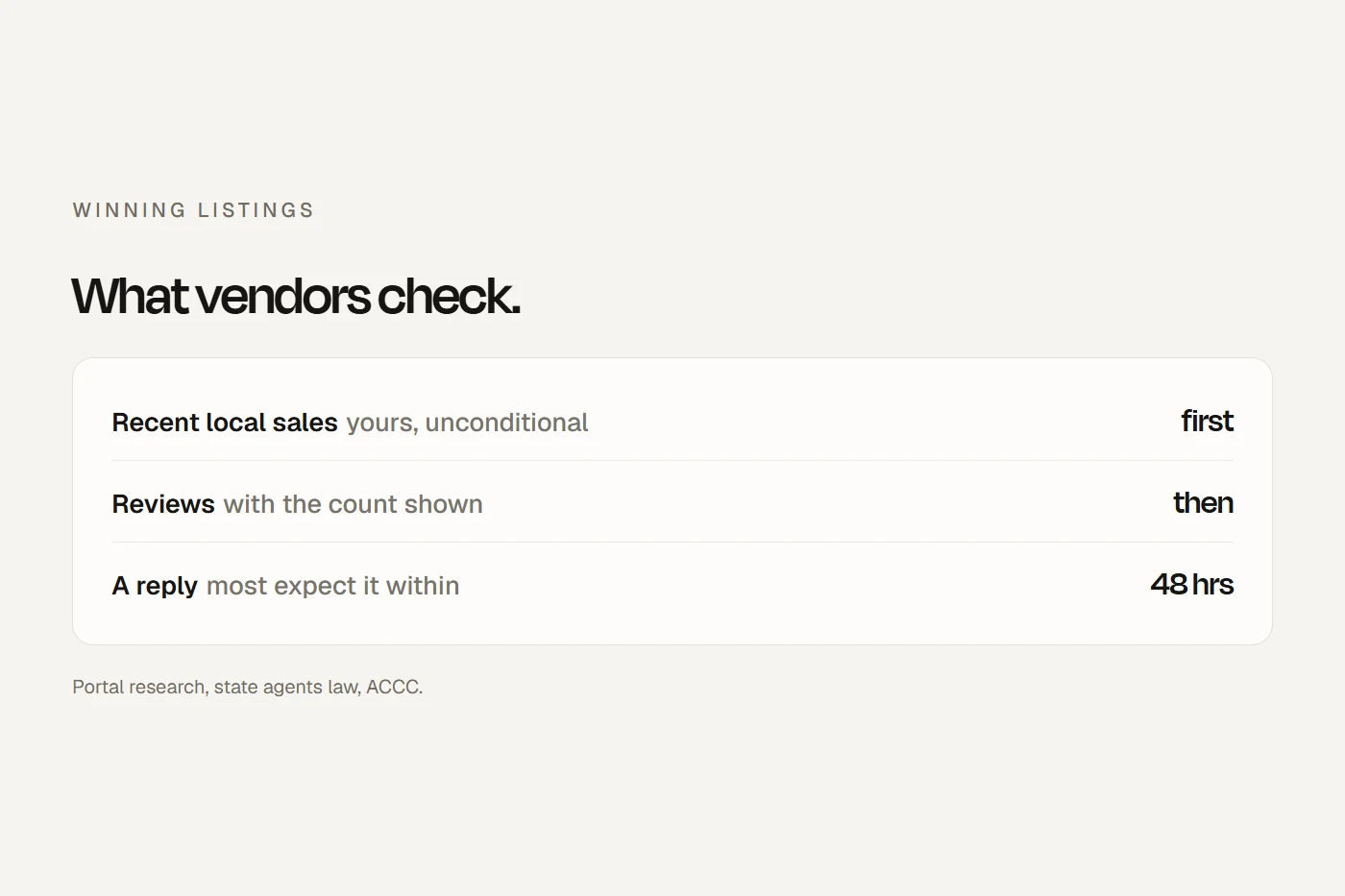
There's no regulator or industry-body survey of how Australian vendors choose an agent. The best data is the portals' own research, so treat it as that. A realestate.com.au study of about 1,000 sellers found they find agents through past dealings, recommendations and searching online, mostly on the portals. They research for about two weeks, look at what the agent has recently sold, what they have for sale now and their reviews, and most expect a reply within 48 hours. The qualities they rated highest were getting the best outcome, a clear plan to find buyers, clear communication with transparent fees, and local expertise. Competitive fees didn't make the top eight. An older survey of vendors found the same thing in a different way: seeing the agent sell a property nearby came first, and a friend's recommendation second.
So the marketing that wins listings is mostly proof: your recent sales in the suburb, your reviews, a clear plan, shown where vendors look, and a fast reply when they ask.
Price rules, state by state
These apply to portal listings, your own website, social posts, flyers and signboards. NSW's law counts a leaflet left in a letterbox and anything on a website as an advertisement, and Victoria's covers ads on "any Internet site".
| State | The main rules |
|---|---|
| NSW | No advertised price below your estimated selling price. No "offers over" or "offers above". A passed-in bid can only be mentioned if it says it was a vendor bid. Keep a written record of every price quote. A law has passed that will require a price in most sale ads and fixes to online ads within a business day; check whether it has started. |
| Victoria | A property price statement must sit "immediately adjacent to the advertised price" on the first screen of every online listing, including your own website. An indicative price must show online, with no "from", "over" or "+". Physical ads that describe the property need a QR code or link to the statement. The reserve must be published 7 days before an auction, and the sale price stays online afterwards. Ranges no wider than 10%. |
| Queensland | No price guide for auctions. If a website filters an auction or no-price listing into a price bracket, it needs the prescribed statement. If a seller asks what their property will sell for, give a comparative market analysis. |
| South Australia | A single figure with no qualifying words, or a range of two figures with the top no more than 110% of the bottom, never below the agent's estimate or the vendor's price. An agent who breaches it loses the commission. |
| WA | Advertise only at the price and terms the client authorised, and only with their written consent. |
| ACT | A dishonest representation about your estimate in an ad is an offence, and the regulator can ask for the evidence behind it. |
Scroll the table sideways to see every column.
Everywhere, the consumer law bans false or misleading representations about the price of land. Tasmania and the NT rely on it; I didn't find a specific underquoting rule there.
What vendors are owed on marketing costs
A lot of the searches for "real estate marketing" are vendors asking what it costs. No regulator publishes typical costs, and they vary too much to quote. What the law does say is who pays, what must be disclosed and who keeps any rebate:
- NSW: you can't recover expenses unless the agency agreement lists them, with the source and estimated amount of any rebate, discount or commission you'll get on them.
- Victoria: you can't keep a rebate on the vendor's outgoings; it goes straight to the client. The authority must name who gives any rebate and the amount, and you must say commission and outgoings are negotiable before signing.
- Queensland: the appointment states the advertising expenses you're authorised to incur, and the source and estimated value of any rebate.
- WA: no reimbursement of advertising unless the client agreed in writing to a maximum amount and initialled it.
- South Australia: you can't ask the vendor for more than you paid, and benefits you receive must be passed on unless disclosed.
- ACT: the seller must be told of any benefit anyone receives for promoting the sale.
The ACCC has also accepted an undertaking from realestate.com.au that stops it requiring or incentivising agencies to list all or most of their properties there, and its Chair encouraged vendors to talk to agents about listing options and fees on different portals. A marketing proposal that shows the vendor the options, itemised and negotiable, is both what the rules point to and what a nervous first-time seller wants to see.
- Every expense itemised in the agreement, with amounts.
- Any rebate named, with who gives it and the estimated amount.
- Rebates passed to the vendor in Victoria and South Australia.
- A maximum amount written and initialled in WA.
- The vendor told costs are negotiable before signing (Victoria).
- Portal options and fees discussed, not one default package.
- The signed agreement given to the vendor promptly.
Claims about your own results
"No. 1 agent in the suburb", "sold in 7 days", "award-winning" and "98% sold above reserve" are the lines most agency marketing leans on, and they're the ones the consumer law catches. A claim about your services must be true, and a claim about the future made without reasonable grounds is treated as misleading. Victoria makes it an offence to falsely say you've sold a property. The ACT makes it an offence to publish a misleading statement about your business. Queensland puts the onus on the agent to show reasonable grounds.
- Rankings: say what was measured, where, over what period and from what source, such as "most sales recorded on realestate.com.au in this suburb over the last 12 months", and keep the evidence.
- Sold pages: only your own sales, only once unconditional, assigned to the agent who sold them.
- Awards: name the program, the place and the year. A suburb award doesn't make you the best in the region.
- Statistics: give the base, such as "of the 46 auctions we ran last year".
- Reviews: real, with permission, and a star rating shown with the number of reviews it's based on, as the ACCC asks.
Photos, staging and copyright
NSW's guidelines for agents say photos mustn't add or remove features, hide problems, zoom a view to make it look closer, or use old photos that no longer show the property; lighting fixes are fine, and photos taken nearby should be labelled "location shot". Victoria's guidance says much the same. Neither mentions virtual staging, so label staged photos "virtually staged" and keep the room's size and condition true. NSW has passed a law requiring altered images in rental ads to be disclosed; it isn't in force yet.
The photographer owns the copyright in commissioned photos unless the contract says otherwise. The High Court's case over listing photos showed what happens when terms are informal: the court implied a licence wide enough for the portals to keep the photos. Put the licence in writing: the campaign, the portals, your website's sold archive, social, print, and whether you can reuse the images in your own ads after the sale.
Check your wording
Paste a listing, an ad, a flyer or your profile, and I'll flag the patterns above. It doesn't know your state, so each note says where the rule applies.
It catches common patterns, not everything.
The channels that win listings
The portals
realestate.com.au is, in the ACCC's words, "Australia's largest online residential real estate listing portal", and vendors start there. Your agent profiles there and on Domain are what vendors check: recent sales, current listings and reviews. Assign every sold listing to the agent who sold it, and complete each profile; Domain says its agent search takes profile completeness and listings into account. Both portals also sell seller-lead and profile products to agents.
Your own website
- An appraisal request form that asks only for name, address, phone and timeframe, with a separate unticked box for marketing emails, answered within 48 hours. Call it "request an appraisal", and don't promise an instant figure you can't support.
- Suburb pages only for suburbs you really work, built on your own recent sales and the agent who made them.
- A sold page of your own unconditional sales. In Victoria it's a natural home for the sale prices you must keep online.
- Listing pages that follow your state's price rules, checked in what your CRM's website feed actually sends.
- A "what selling costs" page that explains the marketing proposal: itemised, negotiable, rebates disclosed, portal options shown. It answers the cost searches vendors make.
Google Business Profile and reviews
Google lets real estate agents have their own practitioner profiles as well as the agency's. Ask every vendor and buyer for a review at settlement, on Google and one portal, without incentives tied to the rating. My guide to local SEO covers the profile in detail.
Email to your database
Past clients you have an ongoing relationship with can usually get relevant emails; appraisal leads and open home attendees need clear consent first. Name your sources for any market figures, and don't make predictions you can't back up. Every message names you and has an unsubscribe. Real estate CRMs, compared covers the systems that send these.
Letterbox, signboards and print
I found no law on unaddressed letterbox drops, but a flyer describing a property is an advertisement, so the price rules apply, and in Victoria it needs the price statement's QR code. Australia Post's posties don't deliver unaddressed mail to "No Junk Mail" boxes, and respecting the sticker costs you nothing. Don't build mailing lists from title or sales data whose licence bans direct marketing.
Meta and Google ads
The housing ad targeting limits in American guides apply to ads reaching the US, Canada and parts of Europe, not to ads shown only in Australia. Meta still asks you to say if an ad is in a special category. Every ad carries your licensee name and follows the price rules if it shows a property.
Appraisals, listings and what they're worth
Use your own counts. The commission rate is only an example; use yours. Your marketing spend here is the agency's own, not vendor-paid advertising.
Try raising the appraisal-to-listing rate. In the example, moving it from 30% to 40% adds as many sales as a third more appraisal requests would. Converting the appraisals you already get is usually the cheapest growth.
A 90-day plan
Your ticks save in this browser.
- Days 1 to 30: check every live ad, listing page, post, flyer and signboard against your state's price rules.
- Days 1 to 30: in Victoria, put the price statement next to every online price, QR codes on physical ads, and reserves up 7 days before auctions.
- Days 1 to 30: update your marketing proposal template: itemised, rebates disclosed, portal options shown.
- Days 1 to 30: put your photographer's licence in writing, and label staged and location shots.
- Days 31 to 60: fix sold pages and portal profiles: your own unconditional sales, assigned to the right agent.
- Days 31 to 60: ask every vendor and buyer for a review at settlement, and show counts next to ratings.
- Days 31 to 60: rebuild the appraisal form with a separate consent box, and reply within 48 hours.
- Days 31 to 60: rewrite every ranking, award and statistic with its measure, place, period and source.
- Days 61 to 90: send a monthly email to past clients and people who agreed to hear from you.
- Days 61 to 90: letterbox "just sold" cards to the street, skipping "No Junk Mail" boxes.
- Days 61 to 90: review portal spend and options with vendors.
- Days 61 to 90: run the calculator with real counts by source, and cut the channel with the highest cost per listing won.
My view
Vendors choose the agent who has visibly sold nearby, has the reviews to show for it, explains a clear plan and answers quickly. Most agency marketing spend goes on getting more appraisal requests, when the bigger win is turning more of them into listings with better proof and faster replies. And because every ad, flyer and listing page is covered by your state's price rules, the cheapest insurance in your marketing is a template that gets them right every time.
Questions I get asked
How do real estate agents get more listings?
By showing recent local sales and reviews where vendors look, on the portals and the agency website, replying to appraisal requests within two days, and turning more appraisals into listings with a clear plan.
Who pays for real estate marketing?
The vendor usually pays for advertising the property, as agreed in the agency agreement. The expenses must be disclosed, rebates disclosed or passed on depending on the state, and in WA a maximum is written and initialled.
Can agents advertise "offers over"?
Not in NSW, and Victoria and South Australia ban qualifying words such as "over", "from" and "+". Queensland bans price guides for auctions.
Can an agent say they're the number one agent?
Only if it's true and the ad says what was measured, where, over what period and from what source. The agency must be able to prove it.
Is virtual staging allowed in real estate ads?
No law bans it for sales, but photos mustn't mislead. Label staged images and keep the room's size and condition true.
About this guide
Written by Joseph Alzein, founder of bdog. bdog builds websites for real estate agencies. The rules come from each state's agents legislation, the Australian Consumer Law and the regulators' guidance, and the data from the portals' own research and the ACCC, read on 12 October 2026. Some states are changing their rules, so check your regulator before you rely on this. This is general information, not legal advice.
Main sources: