How property managers grow a rent roll
Most managements leave with a sale, so the first growth is plugging that leak. Then the state rules that decide your tactics: paying referrers, approaching other agencies’ landlords, cold calls and owner data. With a calculator for where your rent roll stops growing.
On This Page
Most advice on growing a rent roll is a tip list from a software company, and much of what ranks for it is years old or written for the US. What's missing is where doors are actually lost and won, and the rules that decide which tactics you can use: paying a broker for a referral, approaching another agency's landlords, cold calling, and mailing owners from title data. Those rules differ by state. This guide covers New South Wales, Victoria and Queensland, with Western Australia where its rules are clearer, from the legislation and regulators' pages read on 12 October 2026. It's general information, not legal advice.
- Your sales desk is your biggest leak and biggest sourceIn one software company's data, most managements that leave do so because the property is sold, and many sell through a competitor.
- Paying for referrals is risky in NSWA regulation bans offering anyone a benefit to get a third person to engage you. Get advice before paying brokers or past clients.
- Approaching other agencies' landlords is allowedBut you can't induce them to break their agreement, cold contact has rules, and most states' title data can't be used for mailing lists.
Where doors are lost and won
No real estate institute publishes where new managements come from or how many are lost each year. The best figures are from software vendors and trade press, so treat them as one company's data, not an industry average.
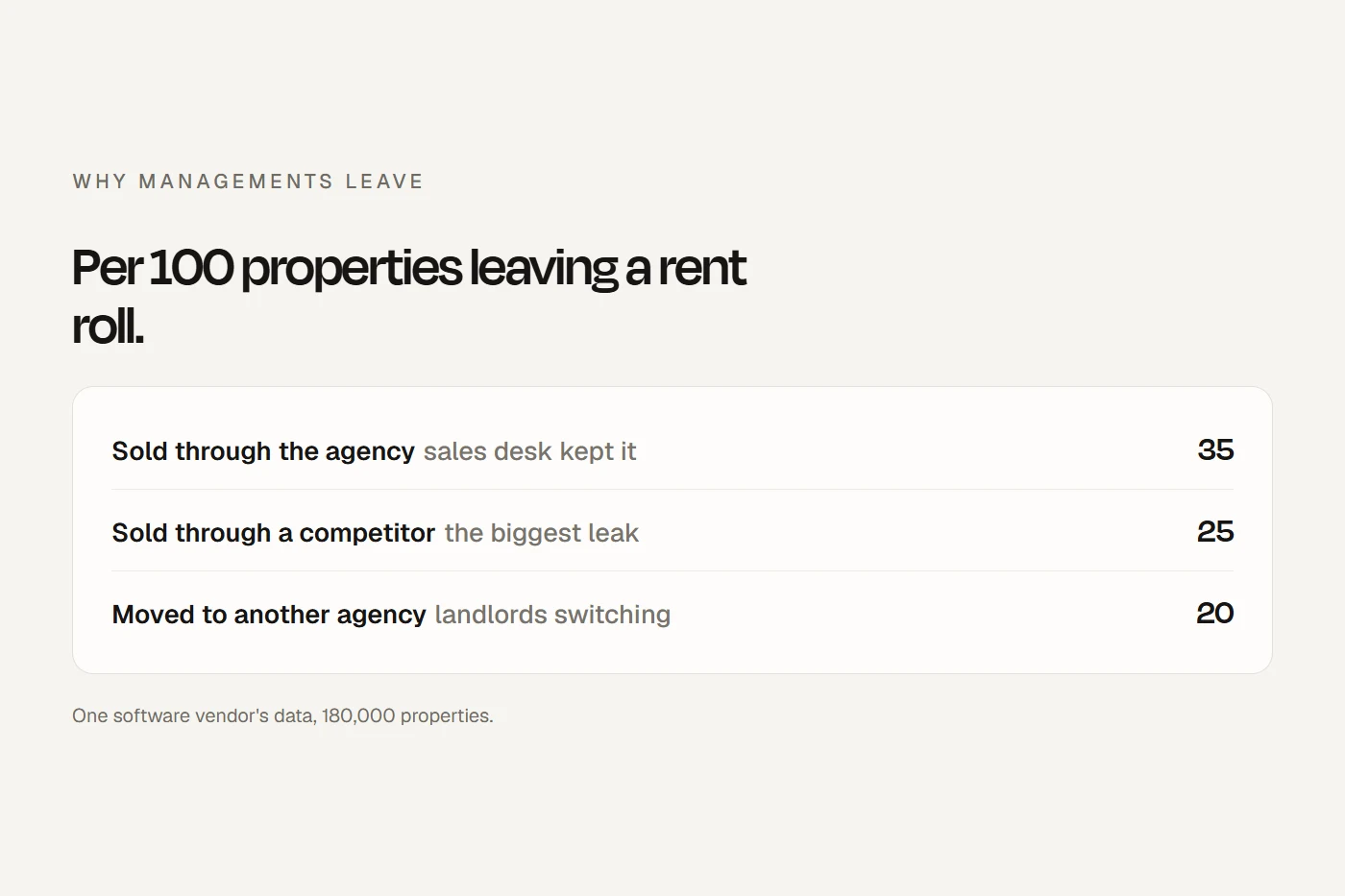
The most useful is from Ailo, a property management software company, which looked at 180,000 properties that left rent rolls. For every 100 that left, 60 were sold, and 25 of those 60 were sold through a competitor. Only 20 in 100 were landlords moving to another agency. More than half had no reason recorded.
If that holds for your agency, the biggest leak isn't landlords being poached. It's owners selling, and your sales team not getting the listing. The other side of the same desk is the biggest source: in one trade press profile of a single agency's business development manager, 49 of the 136 new managements brought in during a year came from the agency's own sales team. That's one agency, so don't read it as a benchmark, but it points the same way.
Two things follow, before any marketing:
- Rent to sale. Every landlord who gives notice because they're selling should be offered your sales team, the same day.
- Sale to rent. Every investor who buys through your agency, and every seller keeping another property, should get a management conversation.
Then count. For the last 12 months, list new doors by where they came from and lost doors by why they left: sold, owner moved in, moved to another agency, or self-managing. The calculator below needs those numbers.
Where your rent roll will settle
A rent roll grows until the doors you lose each month match the doors you win. This shows where that point is for you. The starting numbers are an example, not an Australian average; put in your own.
The last two lines are the ones to sit with. If you lose 12% a year and win six doors a month, your rent roll stops growing at about 566 doors, however long you keep going. To get past it you either win more or lose fewer. Cutting losses is usually cheaper, which is why the handovers above come first.
The rules that decide your tactics
There's no single rulebook for property management marketing. The rules come from your state's agents legislation, the Australian Consumer Law, the spam and Do Not Call laws, and privacy law and data licences. Here's what matters for growth.
Paying someone for a referral
This is where the states differ most, and where I'd be most careful.
- New South Wales. The agents Regulation says an agent "must not offer to provide to a person a gift, favour or benefit, whether monetary or otherwise, to induce a third person to engage the services of the agent as agent." On its plain words, a fee to a broker, an accountant or a past landlord for sending you a new landlord fits that. I found no Fair Trading guidance either way. Separately, the Act bars sharing your commission with unlicensed people, and a fee worked out as a month of management fees looks like a share. Get advice before running any paid referral program in NSW.
- Western Australia allows it with disclosure: before you're appointed, you must tell the landlord in writing about any commission you paid for the referral.
- Victoria and Queensland. I found no provision in the agents legislation on paying for referrals. Secret commission laws still make an undisclosed payment risky, so tell the landlord in writing before they sign.
The safest partnership in every state is a two-way referral with no money involved: a named contact at a broker, accountant or buyer's agent, and a written note to the landlord about the relationship. Your partners have rules too. A broker's credit guide must say if they pay referrers, and an accountant who receives a referral fee must tell the client in writing.
Taking a commission from suppliers
If you're paid for sending landlords to an insurer or a tradie, NSW requires the source and estimated amount of rebates in the agreement, and the nature and value when you make the referral. Victoria requires you to pay any rebate straight to the landlord. Queensland requires the source and estimated amount in the appointment. In NSW you also can't call a supplier independent if you're paid for the referral.
Approaching another agency's landlords
Canvassing landlords who are with another agency isn't banned anywhere I checked. What's banned is narrower:
- Victoria and Western Australia: you can't knowingly induce someone to breach their agreement, or into an arrangement that leaves them owing two commissions (in Victoria, not without clear written warning).
- Queensland: before you accept an appointment, take reasonable steps to find out whether the landlord already has an agent. If they do and the timing overlaps, give a written statement before they sign that they may owe a commission under each appointment, and damages to the old agent. The useful part: in Queensland, a management appointment must say either party can end it on 30 days' written notice. A landlord can always move.
- New South Wales: the rule against soliciting while another agent holds an exclusive agency covers sales, not management. The general conduct rules still apply: no high pressure, no harassment, and no using confidential information you got while acting for clients. A property manager who leaves and takes the old agency's landlord list is the classic breach.
So "move to us when your agreement allows, and here's how to give notice" is fine. "Stop paying them and move now" isn't.
"First three months free"
No state rule I found bans a free period or a discount to win a management. Two things apply. The offer is a fee term, so it goes in the management agreement, not just the ad: when fees start, and what they are after. And under the Consumer Law, the conditions of a free offer have to be clear in the ad itself. If the free months come with a minimum term or a break fee, say so where you say "free". In Victoria, you also have to tell the landlord the commission is negotiable before they sign.
Cold calls, texts and email
- Calls. A landlord's mobile is almost always a private number, so the Do Not Call Register applies. Wash your list against it. Even for numbers not on it, telemarketing calls are allowed only 9am to 8pm on weekdays and 9am to 5pm on Saturdays, never on Sundays or national public holidays, and you must say who you are and why you're calling.
- Texts and email. You need consent first, and you can't send a message asking for it, because the ACMA treats that as marketing. So no cold "would you like an appraisal?" text to a number from a for-lease-by-owner ad.
- Your current landlords fit the ACMA's idea of inferred consent for a landlord newsletter: an ongoing relationship, and marketing directly related to it. Past landlords and appraisal enquiries are safer with a ticked consent box.
- Every message needs your business name or ABN and an unsubscribe honoured within five working days.
Owner data and mailing lists
Letterbox drops addressed to "the owner" are outside the spam laws. Building a mailing list from title or sales data mostly isn't allowed. The title search terms passed on by data providers bar direct marketing or mailing lists in Victoria, Queensland, Western Australia and the Northern Territory, and South Australia limits titles to non-commercial use. Queensland and South Australian sales data notices bar it too, and Queensland has an industry code of conduct on property data. Title searches are for a transaction you're working on, not for prospecting. And never buy a list of local investors: you're responsible for consent on every contact, and trading in personal information brings a small business under the Privacy Act.
Can I do this?
Tap a card for the verdict. General information, not legal advice; where it says get advice, do.
The channels, in order
The rental appraisal
The appraisal is a landlord's first proof that you know what you're doing, and the one place the rules bite hardest: an inflated estimate to win the management is a misleading representation under the agents laws in every state. Give the real number and show your reasoning. On your website, the appraisal page needs a real form, a separate unticked box for newsletter consent, and every enquiry counted by source.
Reviews
Ask every landlord and tenant at a natural point for a Google review, with the same message to everyone and no incentive. RateMyAgent has a separate leasing section where landlords and tenants can review your office, which is worth filling. When you reply to a review, don't mention details of anyone's tenancy. Landlord testimonials on your website are fine if they're genuine, with written permission on file, because a testimonial is taken to be misleading unless you can show otherwise.
Google and the portals
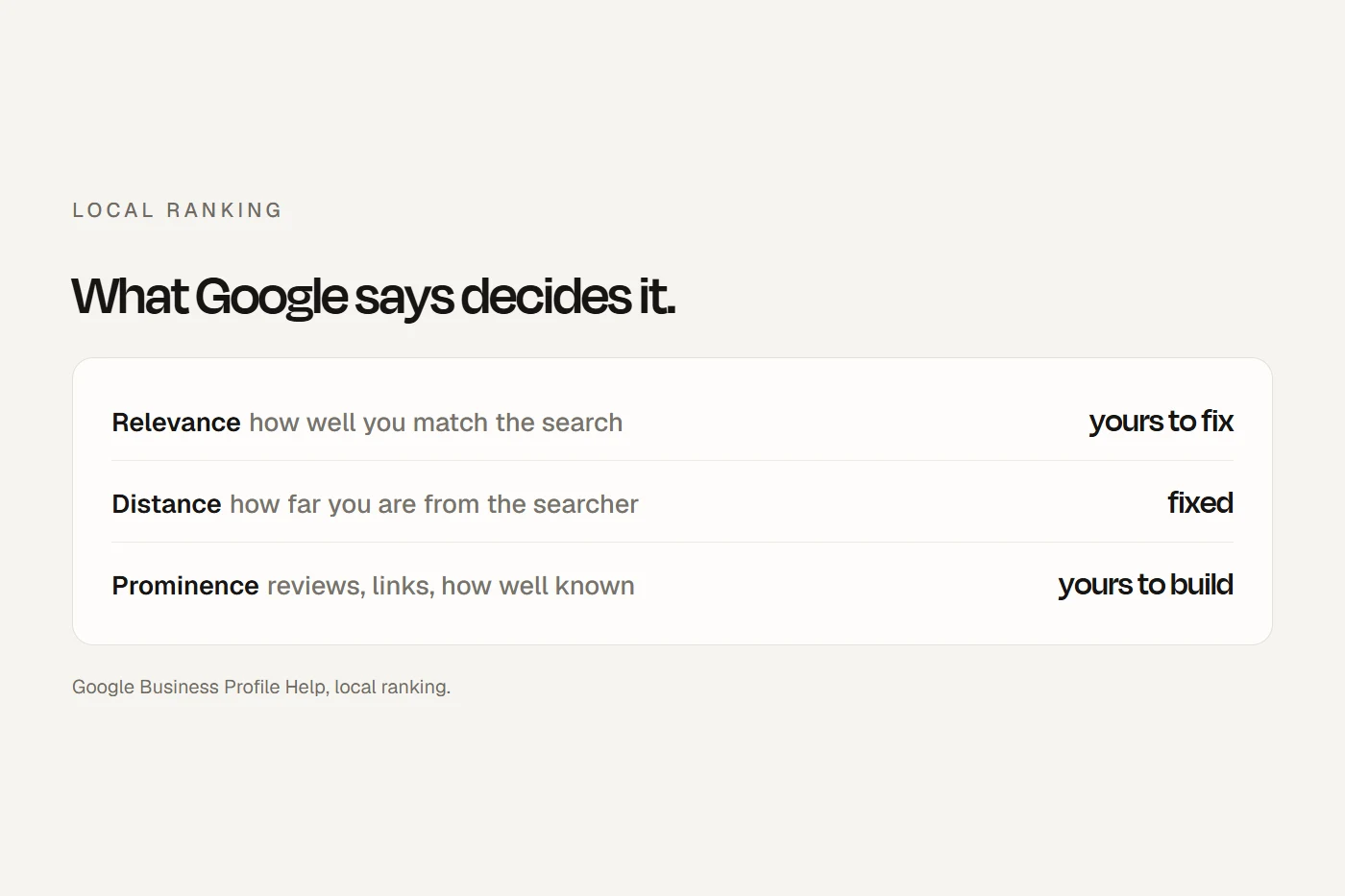
Your agency's Google Business Profile carries the agency's name as on your sign, with no suburb keywords in the name; a public-facing property manager can have their own practitioner profile, but not support staff. More in local SEO for small business. On Domain, a property manager only shows in Find Agent searches if they have listings assigned, and ranking uses profile completeness and live and leased listings. So assign each leased listing to the person who manages it, and complete every profile. Neither portal publishes agency prices.
A landlord newsletter
Monthly to current landlords and to anyone who ticked the box. Keep it useful: what's changing in rules they care about, what you're seeing in your own suburbs, what to do before a lease ends. Trade press points to slow replies as an early sign an owner is about to leave, so a newsletter doesn't replace answering emails.
Meta ads
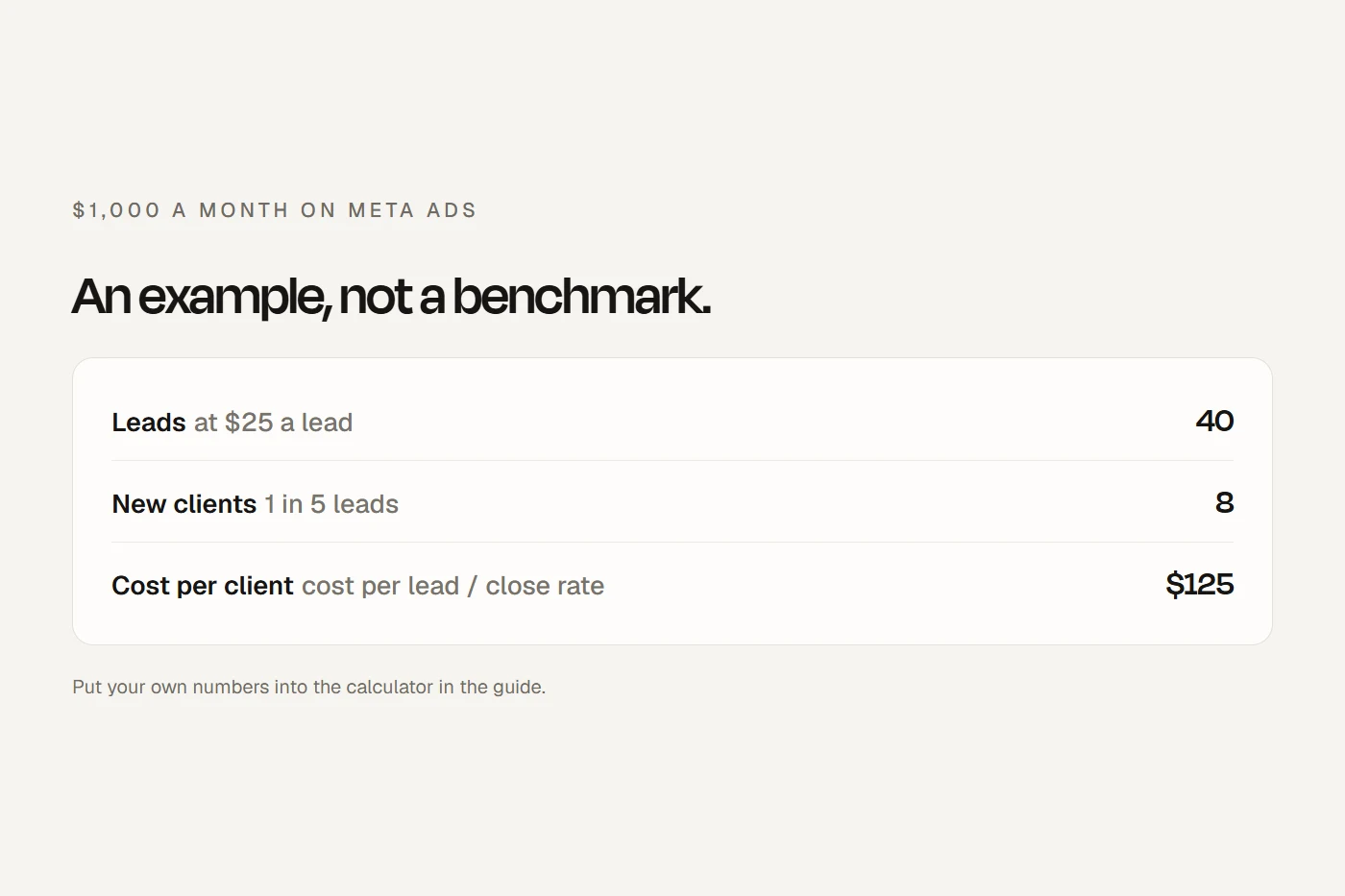
Ads to investors in your area can work, and the US housing targeting limits don't apply to Australia-only advertisers. The ad must carry your licensee's name, as any ad for your business must, and the follow-up email or text needs consent. Start small, with a lead form and a consent tick. More in Meta ads for small business.
Buying a rent roll
Rent rolls are valued as a multiple of annual management fee income, set by recent sales of similar rolls and adjusted for rents, fees, vacancy, arrears and staff. Ask a broker or valuer for today's range; I've left a box for it in the calculator. Two things to know: purchase contracts usually include a retention period, with refunds for managements lost in it, and in Queensland the buyer must notify each landlord within 14 days, and the landlord can still leave on 30 days' notice. An acquisition buys doors and churn risk together.
A 90-day plan
Your ticks save in this browser.
- Count the last 12 months: new doors by source, lost doors by reason.
- Set up the rent-to-sale handover so every selling landlord meets your sales team.
- Set up the sale-to-rent handover for investor buyers and sellers keeping a property.
- Check your management agreement: fee terms, any free period, rebate statement and referral disclosure.
- Fix the appraisal page: a real form, a consent box, and calls and forms counted.
- Ask every landlord and tenant for a review on Google and RateMyAgent, the same way, with no incentive.
- List your partners: brokers, accountants, buyer's agents. Two-way referrals, and no fees in NSW without advice.
- Start a monthly landlord newsletter to current landlords and consented leads.
- Assign leased listings to the property manager so they show in Domain's Find Agent.
- Run a switching campaign by letterbox to "the owner" in target streets, not from title data.
- Wash any call list against the Do Not Call Register and call only in permitted hours.
- In Queensland, check for an existing appointment, give the written statement if needed, and help the landlord give 30 days' notice.
- Run a small Meta campaign to investors in your area, with a consent tick.
- Rerun the calculator with real numbers and decide whether an acquisition is worth a broker conversation.
Your website's part
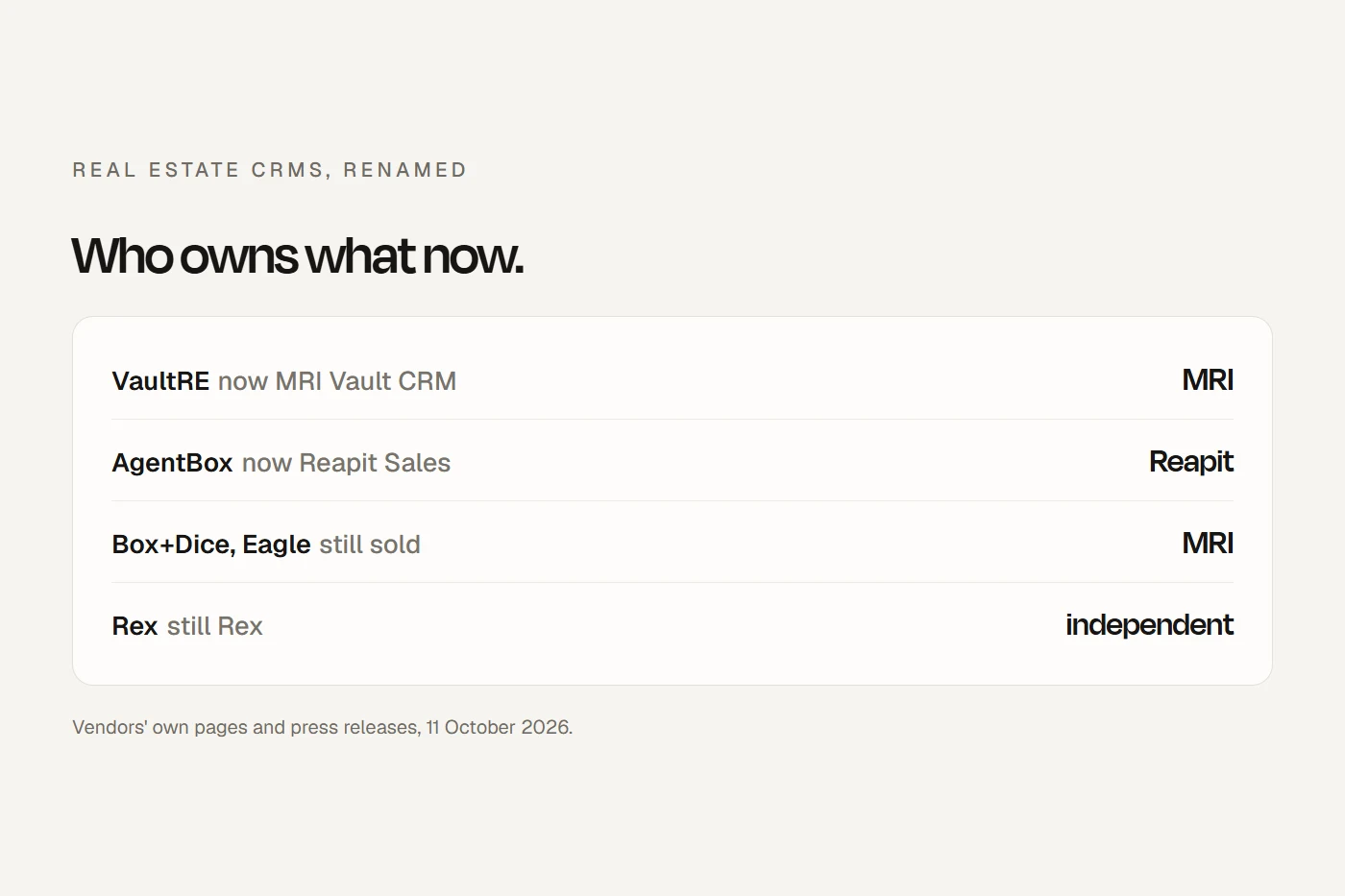
Landlords comparing agencies will look at your website before they ring. It should make the appraisal easy to request, show your fees or how you charge, explain how you handle the things landlords worry about (arrears, maintenance, inspections), and show the people who'll manage the property. It also has to carry your licensee's name like any ad. If your CRM is choosing your website for you, my real estate CRM comparison covers what each one lets you do.
My view
Fix the leaks before you buy growth. Most doors that leave go with a sale, so the handover between your sales and property management desks is worth more than any campaign. After that, the cheapest new doors come from people who already trust you: your landlords, your sales clients and a few partners, referred without money changing hands in NSW until you've had advice. Outbound works too, if you respect the Do Not Call Register and leave title data alone.
Questions I get asked
How do you grow a rent roll?
Stop the leaks first, especially owners who sell through another agency, then win doors from your own sales clients, your landlords' referrals and partners. Track new and lost doors by source every month.
Can property managers pay referral fees?
It depends on the state. NSW's agents Regulation bans offering a benefit to get someone else to engage you, so get advice. WA allows it with written disclosure before you're appointed.
Can I approach landlords who use another agency?
Yes, but you can't induce them to breach their agreement. In Queensland, check for an existing appointment and give a written statement about double commission if needed.
How is a rent roll valued?
As a multiple of annual management fee income, set by recent sales of similar rent rolls and adjusted for rents, fees, vacancy, arrears and staff. Ask a broker or valuer for today's range.
Can I cold call landlords?
Only numbers not on the Do Not Call Register, or with consent, between 9am and 8pm on weekdays and 9am and 5pm on Saturdays. Never Sundays or national public holidays.
About this guide
Written by Joseph Alzein, founder of bdog. bdog builds property management and real estate websites. Rules were read in the NSW, Victorian, Queensland and Western Australian legislation and on the ACMA's and OAIC's pages on 12 October 2026; South Australia, Tasmania, the ACT and the Northern Territory weren't checked. Churn and source figures are one vendor's and one agency's, not industry data. This is general information, not legal advice.
Main sources:
- Ailo: the truth about lost managements
- Property and Stock Agents Act 2002 (NSW)
- Property and Stock Agents Regulation 2022 (NSW)
- Estate Agents Act 1980 (Vic)
- Estate Agents (Professional Conduct) Regulations 2018 (Vic)
- Property Occupations Act 2014 (Qld)
- Property Occupations Regulation 2014 (Qld)
- WA real estate agents Code of Conduct 2016
- Do Not Call Register
- ACMA: avoid sending spam
- Cotality: end-user terms for land titles
- Domain: agent profile settings
- Acumentis: rent roll valuation