Childcare marketing: how independent centres fill vacancies
The ACCC asked parents how they choose a centre, and the answer isn’t ads. It’s the tour, friends and family, and online reviews. Here’s a marketing plan built on that, with what an empty place costs you, the rules on offers and referrals, and a monthly checklist.
On This Page
- What an empty place costs you
- How parents choose a centre
- 1. Make the tour easy to book
- 2. Keep vacancies accurate everywhere
- 3. Word of mouth, within the rules
- 4. Google reviews
- 5. Your Google Business Profile
- 6. Your website
- 7. Social media and parenting groups
- 8. Your rating
- 9. Keep the families you have
- For new centres: marketing before you open
- A monthly childcare marketing checklist
- Questions I get asked
Search "childcare marketing" and page one is almost all agencies. The best evidence on how Australian parents actually choose a centre comes from the ACCC's childcare inquiry, and it points somewhere else: parents shortlist on price, distance and availability, then decide on the educators and a visit, guided by friends, family and online reviews. So the marketing that fills places at an independent centre is mostly unglamorous. Make the tour easy to book, keep your vacancies accurate everywhere parents look, earn reviews and referrals within the rules, and keep the families you have. This guide goes through each, in the order parents use them.
- What worksEasy tour bookings, accurate vacancies by room on your website, Google profile and StartingBlocks, a steady flow of Google reviews, and families who recommend you.
- What's not allowedGift cards, cash, devices or other gifts for enrolling or referring. Free tours and trial days are fine.
- What's underratedKeeping the families you have. The ACCC found parents who switch centres mostly do it over quality, not price.
I build websites for childcare and early learning centres. Everything below comes from the ACCC, StartingBlocks, ACECQA, the Department of Education, the OAIC and Google, with sources at the end.
What an empty place costs you
Before spending anything on marketing, it helps to know what a vacancy is worth. Put in your own numbers. It uses your full daily fee, which the Child Care Subsidy and the family's gap pay between them.
The example uses made-up figures. Whatever yours are, compare one filled place over a year with what any marketing costs. Remember too that some vacancies aren't marketing problems. The Productivity Commission found services "have been delaying expansion plans, closing rooms and limiting enrolments as they are unable to find qualified staff". If a room can't be staffed, advertising it wastes money.
How parents choose a centre
The ACCC's final report describes three steps. "Affordability, location and availability" narrow the list, and parents look very locally, usually within a couple of kilometres of home. Then quality decides, and "the quality of educators and educator-child relationships is particularly important". And at the end, "in person visits and word of mouth (including recommendations from family and friends, and online reviews) play an important role".
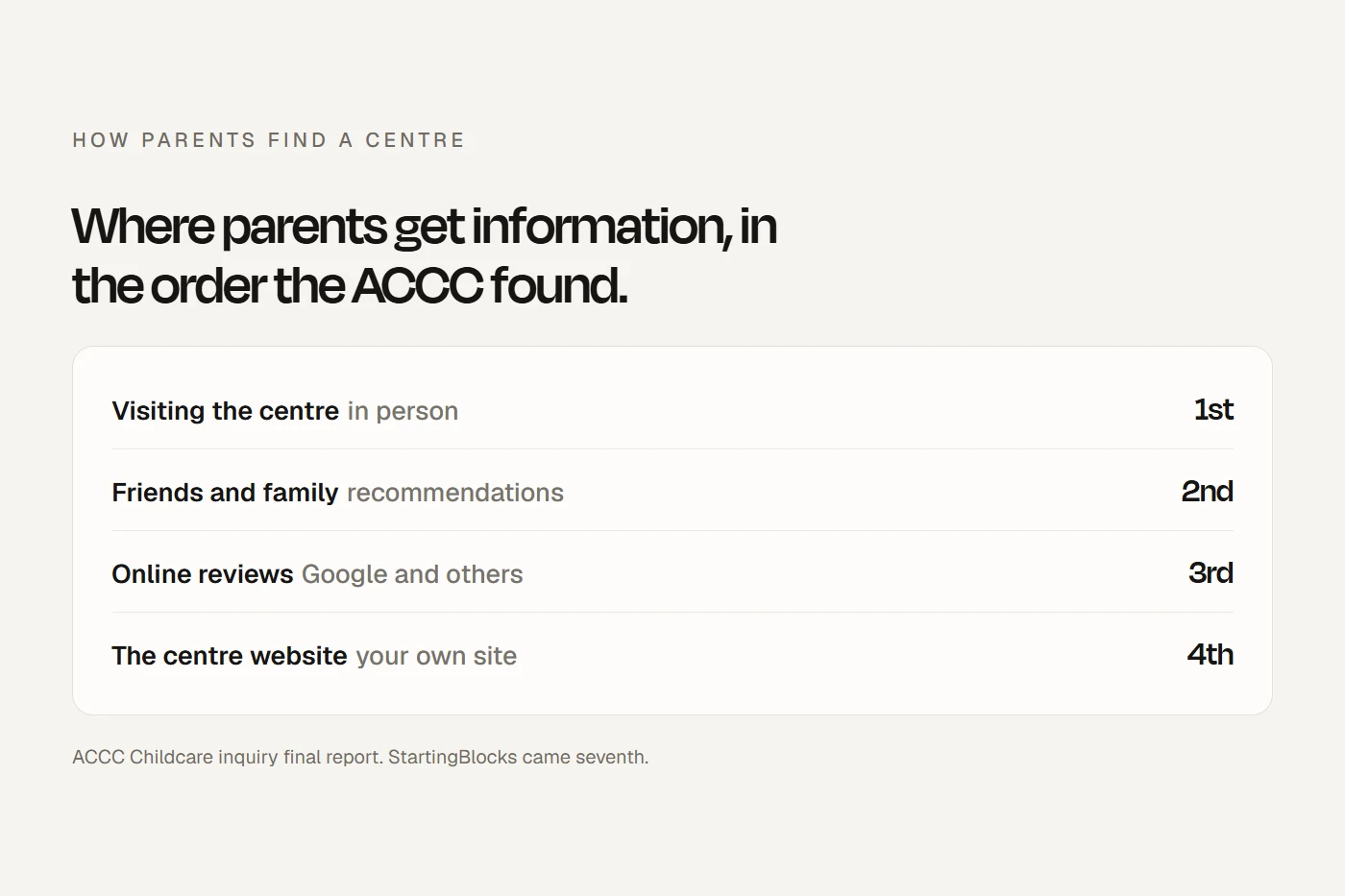
The ACCC also asked where parents got their information. In order: visiting the centre, friends and family, online reviews, the centre's own website, parenting groups, social media, StartingBlocks, and comparison websites. That order is the shape of a childcare marketing plan. My guide to what a childcare website needs covers the website piece in detail.
1. Make the tour easy to book
A visit is the top source of information for parents, and StartingBlocks tells families to "visit the service in person at least once" if they can. Everything else in your marketing should lead here.
- Put "Book a tour" on every page of your website and as the main button on your Google profile.
- Offer set tour times each week, so a parent can pick one without a phone call.
- Answer enquiries quickly. I'd aim for the same day, because a parent comparing centres is likely to book with whoever gets back first.
- Use the tour to answer what StartingBlocks tells parents to ask: who will be my child's main carer, how will you comfort them if they're upset, how will I hear about their eating, sleeping and toileting, and what's your staff turnover like.
Free tours and free trial periods are on the Department of Education's list of things you can advertise.
2. Keep vacancies accurate everywhere
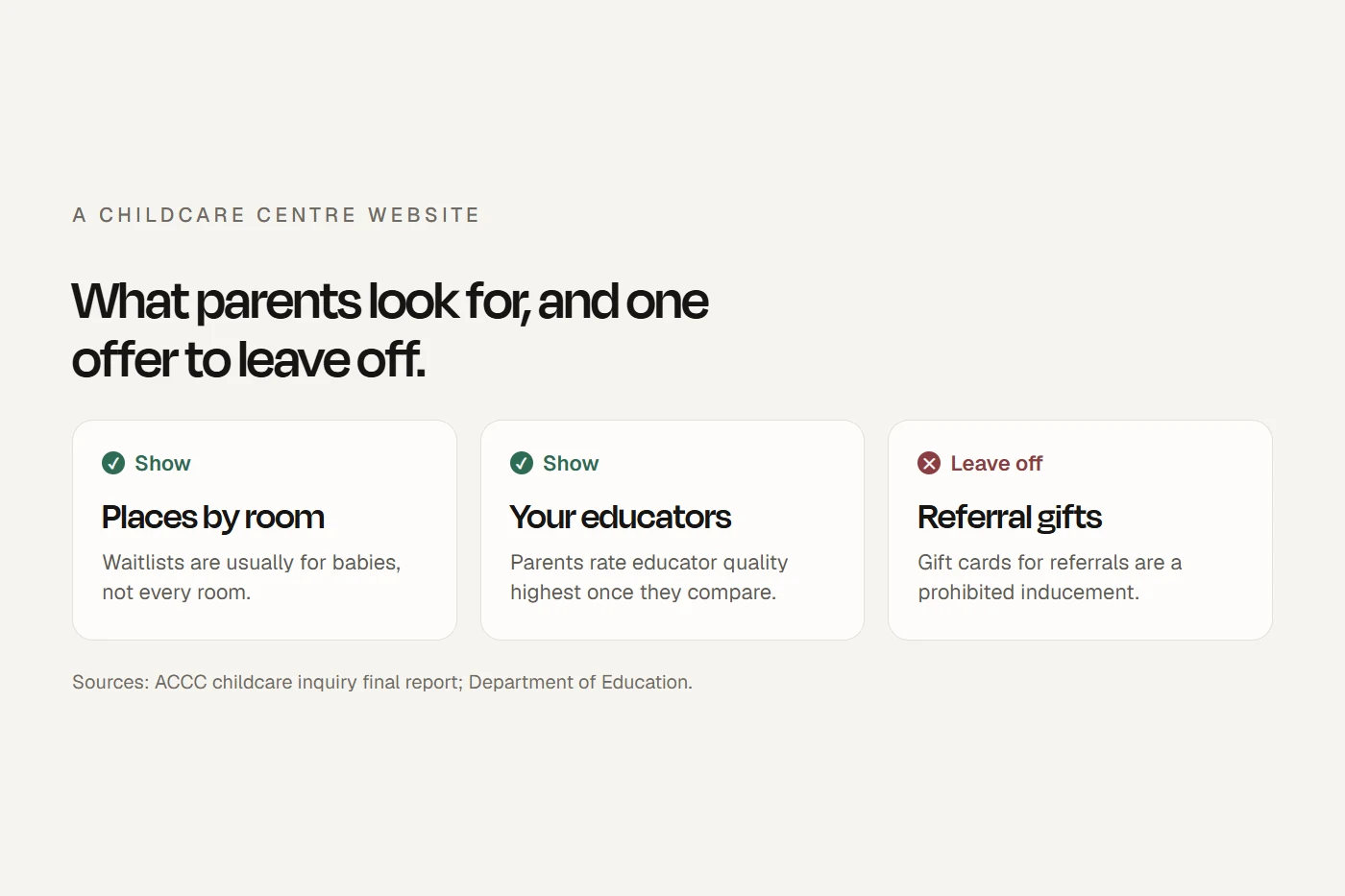
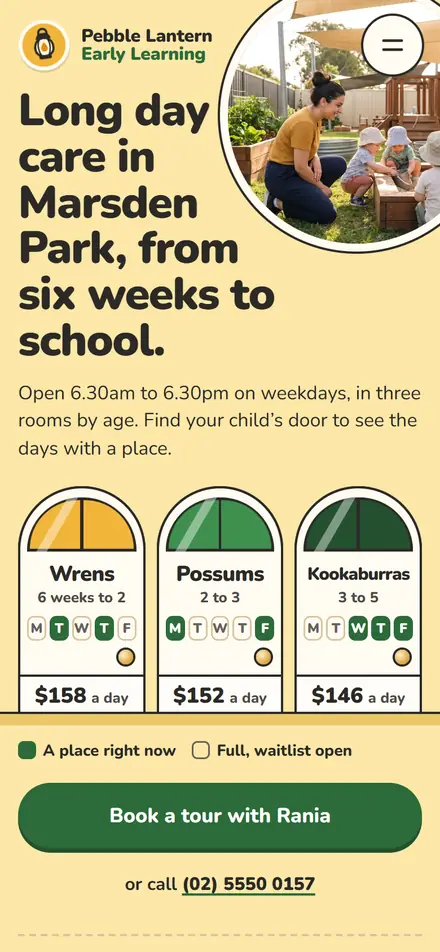
Availability is one of the three things parents shortlist on, and the ACCC found the baby room is usually the tight one: children aged 0 to 2 were the only age group where waitlists held more places than were on offer. So say which rooms have places on which days, rather than "Enquire about vacancies".
Your vacancies on StartingBlocks come from what you enter in the Child Care Subsidy System's Provider Entry Point, or through your childcare software, by age group and day. Changes take 24 to 48 hours to appear, and ACECQA says vacancies must be reported each Friday. Update your website and Google profile at the same time, so a parent who checks all three sees the same answer.
StartingBlocks also shows parents when the regulator last visited your service and flags any enforcement action. Your marketing can't change what's shown there, so it's worth keeping your details current and knowing what's on your page.
3. Word of mouth, within the rules
Friends and family are the second most common source of information for parents. Referrals are your best marketing, and the easiest place to break a rule.
The Department of Education says providers "must not offer prohibited inducements when advertising or promoting their service": cash, vouchers or gift cards, tablets and other devices, and other gifts or giveaways. That includes offers to families already enrolled if they're likely to bring in another family. So "refer a friend and get a $100 voucher" is out.
What you can do is make recommending you easy. Give enrolled families something to pass on, like the tour link or a printed card with the tour times. Invite them to bring a friend to an open morning. Low-value branded merchandise is allowed within the Department's limit for each enrolment agreement, and you can advertise the charity and community work you do. My offers checker goes through common examples.
4. Google reviews
Online reviews are the third most common source. Ask for them, within Google's rules and the ACCC's.
| Do | Don't |
|---|---|
| Ask every family, at a natural point like the end of their first term or a child's move to school | Offer anything in return for a review. Google bans incentives for any review |
| Send a plain link to your Google profile | Ask only the happy families. Google calls that selective soliciting |
| Reply to every review, good and bad, without naming a child | Pressure parents to review at pick-up. Google bans asking while people are on the premises |
| Show the number of reviews next to any star rating on your website, as the ACCC asks | Have staff review the centre, or hide or edit negative reviews |
Scroll the table sideways to see every column.
Keep the message short. Something like: "We'd love other families to hear what it's like here. If you have two minutes, would you leave us a Google review? [link]"
5. Your Google Business Profile
Families searching for care nearby see your Google Business Profile in Maps and search results. Google says to use as few categories as possible and pick the most specific one that describes your main service. Search the category list for "child care" and "preschool" and choose the closest. Keep your hours, photos and tour link the same as your website. Add real photos of your rooms, garden and educators at work, following the photo rules below. My Google Business Profile checklist was written for clinics, but most of it applies to a centre.
6. Your website
The centre's own website is the fourth most common source. Its job is to turn a parent who's heard of you into one who books a tour: your suburb, places by room, fees with a plain explanation of the subsidy, your educators, a day in each room, your child safety approach, your rating shown correctly, and "Book a tour" on every page. The full list, with a marked-up example homepage, is in my childcare website guide.
7. Social media and parenting groups
Parenting groups and social media came next in the ACCC's list. They're good for showing what a day looks like, and they're where photos of children cause the most trouble.
The National Law and Regulations now limit personal devices in services. In a centre, staff can't use or carry personal devices while working directly with children, and photos and videos of children have to be taken on devices the service supplies. The OAIC treats images of people as personal information and says it's good practice to get express consent after explaining how a photo will be used and who will see it, and to discuss it with a child's parent or guardian. I'd get written consent that names each place a photo will appear, and favour photos that don't show faces: hands at work, activities, children from behind, the rooms themselves.
8. Your rating
ACECQA encourages services to promote their rating and provides media release templates for Exceeding, Meeting and Working Towards, with tips for local media. If you use the official rating logo, it must match your current overall rating exactly, and ACECQA says a false or misleading statement about your rating is an offence. When a rating changes or an Excellent rating expires, update everything that mentions it. The detail is in my rating section.
Keep the rating in proportion, though. The ACCC found many households don't place high importance on the ratings when choosing. A good rating helps. It doesn't replace the tour.
9. Keep the families you have
The ACCC found "the most common reason for why parents and guardians switched" services was quality, "with price appearing to play a lesser role". Every family that stays is a place you don't have to fill, and a family who might recommend you. What keeps them is what parents chose you for: the educators, and how well you communicate. Daily updates, a familiar face at drop-off, and quick answers when something goes wrong are marketing too.
For new centres: marketing before you open
ACECQA says it is an offence to advertise an education and care service before it is approved, unless an application for approval has been lodged and not yet decided. In Western Australia a provider pleaded guilty over a billboard for a proposed centre that didn't have approval. Check where your application stands before the pre-opening campaign starts.
A monthly childcare marketing checklist
None of this needs an agency. It needs a routine. Tick these off each month; the list remembers your progress on this device.
- Vacancies updated everywhere StartingBlocks (each Friday), your website and your Google profile, by room and day.
- Review requests sent To every family at a natural point, with a plain link.
- Every review replied to Without naming a child.
- Tour times published For the month ahead, on the website and Google profile.
- New photos added Taken on service devices, with written consent, preferably without faces.
- Educator changes on the website New starters introduced, leavers removed.
- Rating check Everything that mentions your rating still matches it.
- Offers checked against the inducement rules No gifts, vouchers or cash for enrolling or referring.
Questions I get asked
What is the best way to market a childcare centre?
Make the tour easy to book, keep vacancies accurate by room on your website, Google profile and StartingBlocks, ask every family for a Google review, and look after the families you have. The ACCC found visits, word of mouth and online reviews matter most to parents.
How do I increase enrolments at my childcare centre?
Show which rooms have places on which days, answer enquiries quickly, offer set tour times, and make it easy for enrolled families to recommend you. Check first whether any empty room is really a staffing limit.
Can we offer a referral bonus to families?
No. The Department of Education counts offers to enrolled families that are likely to bring in another family as prohibited inducements. Free tours and trial days are allowed.
Can we offer a discount to fill places?
Yes. The Department allows discounted or free care, but the discount must be reported correctly if the family claims the Child Care Subsidy.
Should we use our NQS rating in marketing?
Yes, if it's current and shown correctly. ACECQA provides media release templates. Don't lean on it alone: the ACCC found many parents don't place high importance on ratings.
Can we post photos of children on social media?
With written consent from the parent or guardian for that use, taken on a device the service supplies. Many centres use photos that don't show faces.
Can we advertise before our centre is approved?
Not unless an application for approval has been lodged. ACECQA says advertising a service before then is an offence.
About this guide
Written by Joseph Alzein, founder of bdog. I build websites for childcare and early learning centres. Sources were checked on 11 October 2026. This is general information, not legal advice. For your service, check with your regulatory authority, ACECQA or the Department of Education. I've left out subsidy rates and other figures that change.
Main sources:
- ACCC Childcare inquiry, final report
- Productivity Commission: early childhood education and care inquiry
- StartingBlocks: what does a quality service look like
- StartingBlocks: how services update fees and vacancies
- StartingBlocks: child safety and compliance
- ACECQA: are your details up to date on StartingBlocks
- ACECQA: promote your rating
- ACECQA: NQS rating logo terms
- ACECQA: offences related to service approval
- ACECQA: personal devices and images of children
- Department of Education: how to advertise your service
- OAIC: posting photos and videos
- Google Maps user-contributed content policy
- Google: choosing Business Profile categories
- ACCC: online reviews