Testimonials for coaches: what Australian consumer law allows
What the law says about testimonials, income and results claims, paid and swapped testimonials, getting permission, the extra rules for health and wellness coaches, and Google and Meta. With a typical result calculator, a wording check, a consent checklist and a testimonial sorter.
On This Page
- Why testimonials matter more for coaches
- What the law says
- Income and results claims
- Work out your typical result
- Check your results wording
- Paid, swapped and connected testimonials
- Getting permission the right way
- If you coach on health, weight or mood
- Google reviews and Meta ads
- Can I use this testimonial?
- Turning testimonials into clients
- Questions I get asked
Coaching isn't a registered profession in Australia, so there's no coaching board telling you what your testimonials can say. That doesn't make it a free-for-all. The Australian Consumer Law covers every testimonial, case study and results claim you publish, and the ACCC has been clear about fake, edited and paid ones. If you coach people on health, weight or mood, state codes of conduct and the Privacy Act can reach you too. This guide covers what the law allows, how to get consent, how to present results honestly, and what Google and Meta add on top. It draws on the ACL, the ACCC's guidance, the state codes of conduct, the Privacy Act, the ICF Code of Ethics and Google's and Meta's own policies. It's general information, not legal advice.
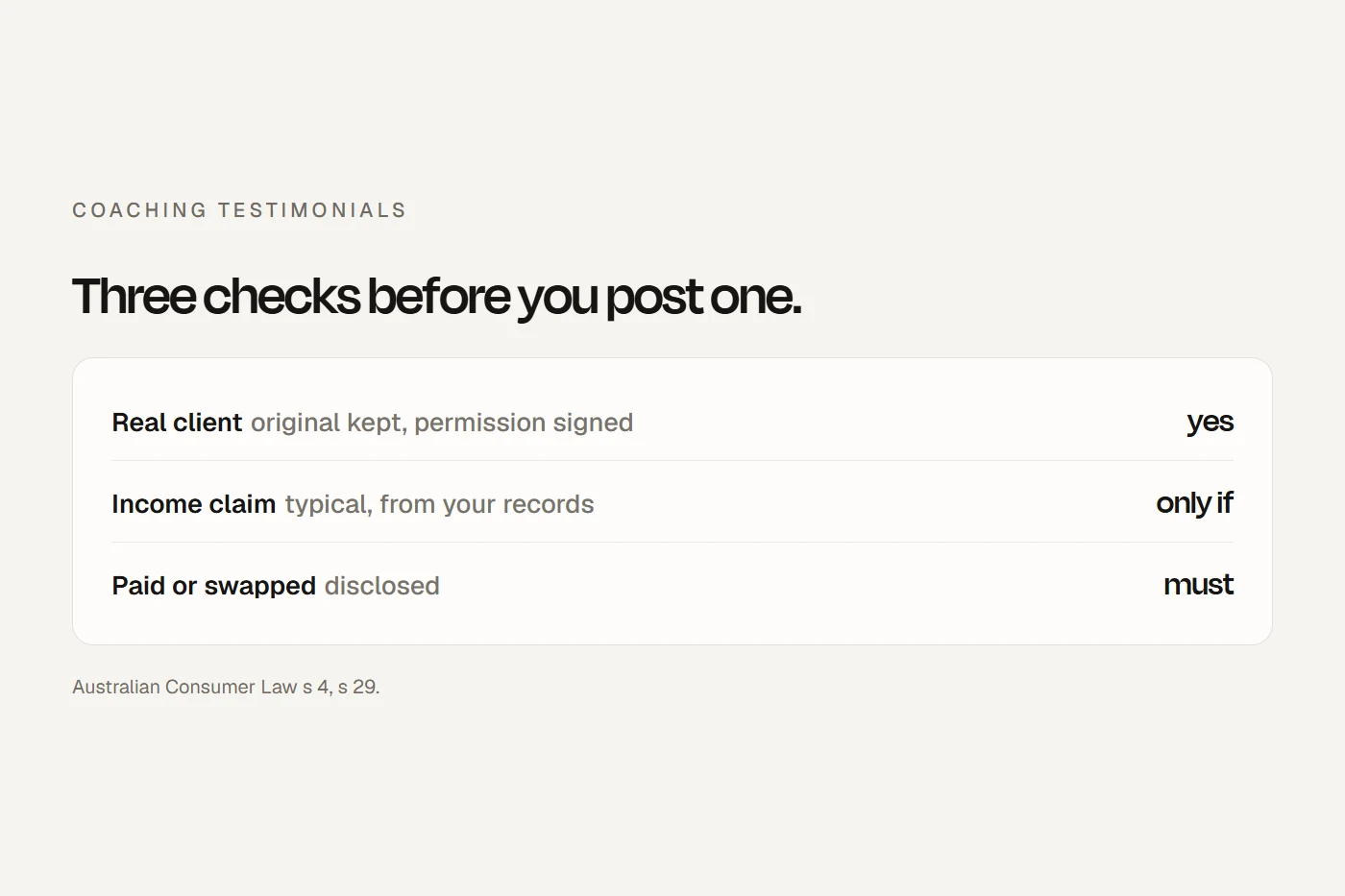
- Testimonials are allowedThey must be real, from a client, unchanged in meaning, and backed by the original message and the client's written permission.
- "Clients make $10k months" is a claim about the futureIt's taken to be misleading unless you had reasonable grounds when you made it. A small "results not typical" line doesn't fix a big headline.
- Paid or swapped ones must say soA free session for a testimonial, a testimonial from a friend, or a client post in return for a discount all need disclosing. Google bans rewards for reviews outright.
Why testimonials matter more for coaches
There's little Australian data on how people choose a coach. One survey of Australians by a nutrition app found that after cost, the biggest things holding people back were not knowing how to find a good coach and not trusting the quality of the advice. Testimonials answer both, which is why coaching websites lean on them so heavily. It's also why regulators look at them closely: when the product is a promise of change, the proof is the advertising.
On Google, the pages that rank for "coaching testimonials" are mostly coaches' own testimonial pages and templates. None of them explains whether those testimonials are lawful, how to get permission, or how to show results honestly. That's what this guide is for.
What the law says
The ACL bans conduct that's misleading or deceptive, and it has two lines aimed squarely at testimonials. You must not "make a false or misleading representation that purports to be a testimonial by any person", or a false or misleading representation "concerning" a testimonial. It applies to business coaching too: there's no consumer-only limit.
The important part is what happens if one is challenged. The law takes a testimonial to be misleading "unless evidence is adduced to the contrary". In plain English, the law starts by assuming it's misleading, and you need evidence that it's real. That evidence is the client's original email, form, recording or review link, and their written permission to use it. Keep both for every testimonial you publish.
The ACCC's guidance fills in the rest. Reviews mislead if they're "edited or changed by someone else after being created", written by people with a connection to the business without saying so, or created "by someone who hasn't actually used the product or service". It also makes no difference whether you meant to mislead.
Some examples of where the line sits:
- Trimming for length is fine if the meaning doesn't change and the client approves the final wording. Mark cuts with an ellipsis.
- Cutting the lukewarm part isn't. The ACCC treated a business that cut "a bit fiddly" and "a bit confusing" out of a review video as misleading.
- Writing it yourself and asking a happy client to sign off is your words presented as theirs.
- AI-written or composite quotes purport to come from a person who never said them. Treat them as fake.
- A testimonials page of your best ten quotes is fine on its own. Pairing a hand-picked set with a rating, or "what all our clients say", is the problem the ACCC flagged when it checked review widgets.
Income and results claims
"Clients make $10k months", "double your income in 90 days" and "lose 10 kg in 8 weeks" are all claims about what a new client will get. Under the ACL, a claim about the future made without reasonable grounds is taken to be misleading. The ACCC puts it simply: a business "is responsible for showing that it had reasonable grounds to make the claim". And even with grounds, a claim can still mislead overall.
If you sell a program that teaches people to run a business from home, such as a coaching practice, an agency or an online store, there's an extra section. The ACL bans false or misleading claims about the "profitability, risk or any other material aspect" of a business that can be run from home. Income claims for that kind of program sit right in it.
Fine print doesn't rescue a headline. The ACCC says qualifications "must not conflict with the overall message of the advertisement". So "Clients make $10k months" in large type with "results not typical" in small grey text underneath is still a problem. Put your typical result next to the standout, the same size.
The Federal Court has dealt with this kind of selling. A wealth-education business sold programs through free webinars, seminars and videos featuring its director. The court found the promised results were false, ordered refunds of course fees, and disqualified the director from managing companies for five years. The ACCC said it should remind company directors that they can be personally liable for what their company says.
Meta adds its own rules. It bans "get rich quick" content, which it describes as "unrealistic financial reward for unclear or minimal effort", and in health ads it bans "promises of specific outcomes within a set timeframe without disclaimers or qualifiers".
Work out your typical result
The honest way to make a results claim is to count every client who started, not just the ones who finished well. Put in your own records. The figures below are made up.
On those made-up numbers, one client in twenty, or 5%, reached the headline. If the median increase among the 15 with a result was $2,000, an honest line would be: "Of 20 clients who started, one passed $10k extra a month. The median increase among those who finished was $2,000." It's less exciting than "$10k months", and much easier to defend. It isn't a legal safe harbour, but it's the kind of record that gives you reasonable grounds.
Check your results wording
Paste your sales page, ad or bio. It flags the phrases most likely to need evidence or a rewrite. It checks wording, not facts.
Paid, swapped and connected testimonials
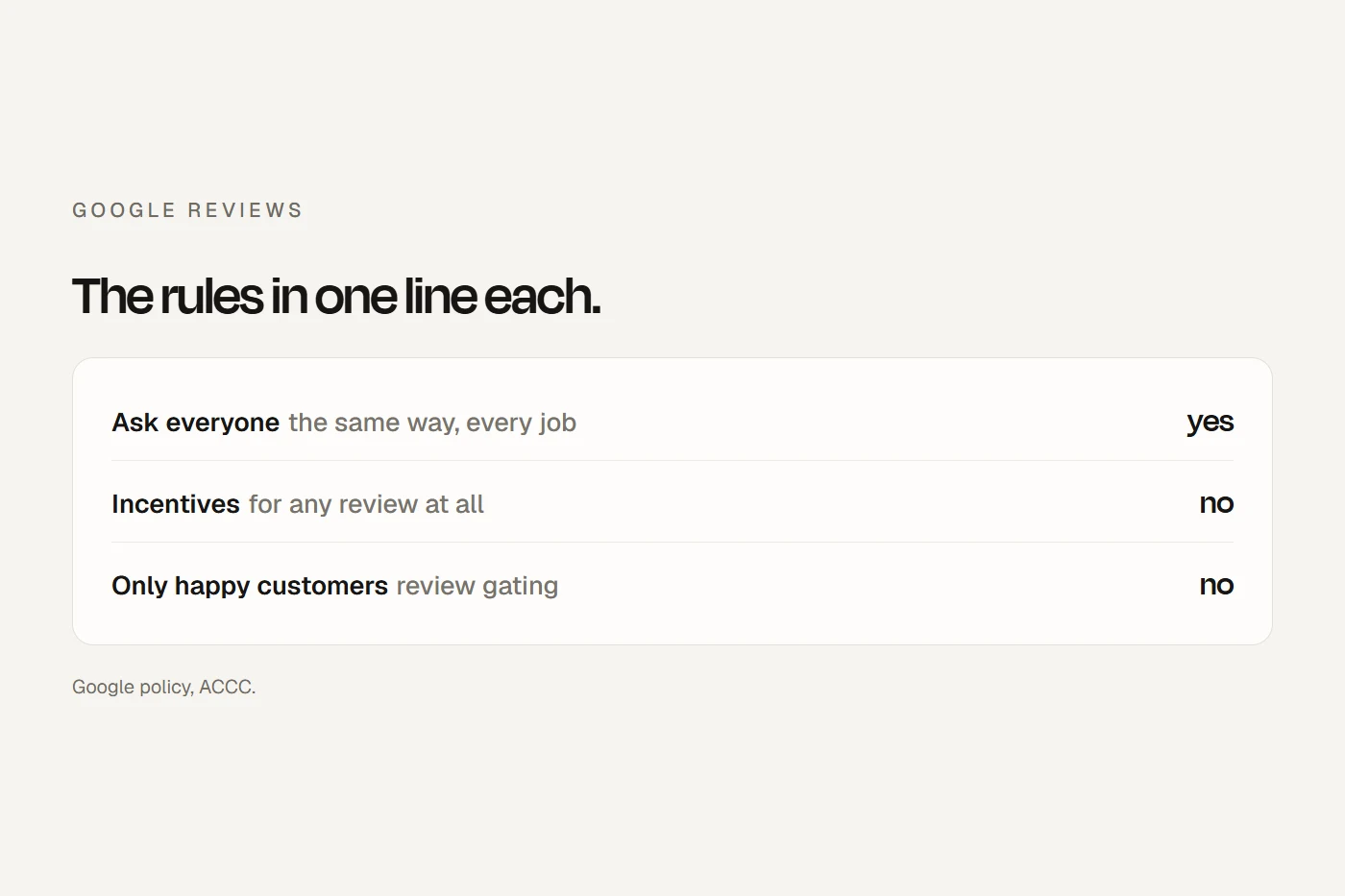
Rewards. The ACCC says businesses that offer incentives for positive reviews "risk misleading consumers". An incentive is only safe if it's given whatever the client says and it's clearly disclosed with the testimonial. For Google reviews, offer nothing at all: Google bans incentives outright.
Friends, partners, staff and other coaches. The ACCC says reviews mislead if they come from family, employees or people paid in some way without the connection being stated. A testimonial swap between coaches is a commercial relationship. Disclose it or don't use it.
Client and creator posts. If you give a client a discount or a free session to post about you, or pay a creator, it's branded content. Meta says it "may only be posted with the use of the branded content tool". The ACCC's review of influencers found tags like "sp", "collab" and "ambassador" confusing and unlikely to fix a misleading impression, and the same for disclosures buried at the end of a caption or only in a bio. Disclose clearly, at the start, on every post. If you brief someone, don't script experiences they haven't had.
Your own comments section. The ACCC holds businesses responsible for misleading comments others post on their pages, and says removing the comment is usually safer than replying. A comment thread full of "made $20k in my first month" from community members is your problem.
Referral rewards. These aren't a testimonial issue unless the referrer posts a review. If you're an ICF member, its code requires you to tell clients about referral payments.
Getting permission the right way
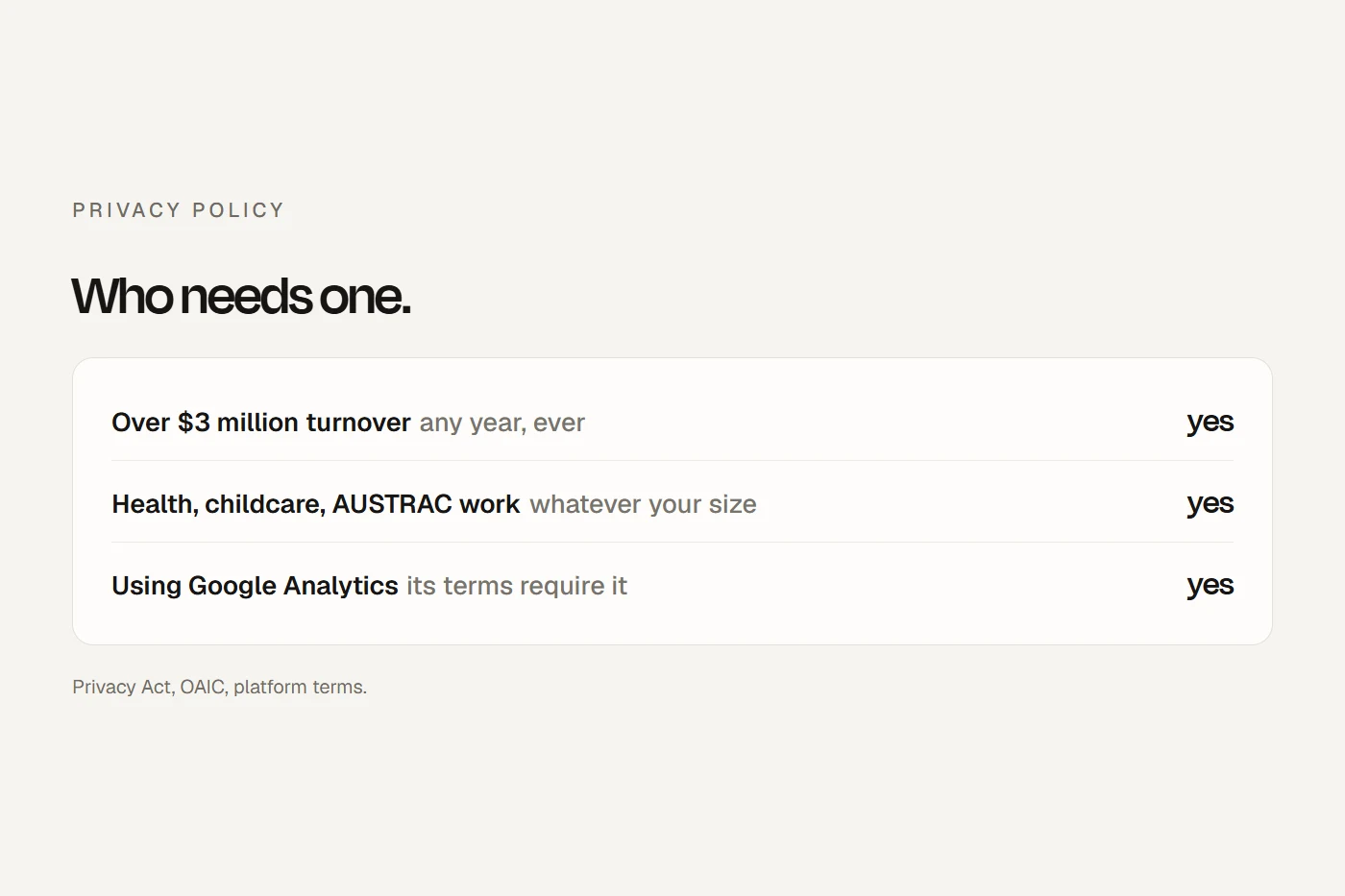
Most small coaching businesses fall under the Privacy Act's small business turnover threshold, but not all. A business that provides a health service and holds health information is covered whatever its turnover, and the Act's definition of a health service includes an activity claimed "to assess, maintain or improve the individual's health", including psychological health. A weight, nutrition, fitness, sleep or stress coach who keeps intake forms or weigh-ins is likely covered. A business or career coach usually isn't.
Get written permission either way. It's your evidence that the testimonial is real, and the ICF Code of Ethics defines confidentiality as protecting information "unless ... written consent to release is given by the client". The OAIC's rules on consent are a good standard even if you're not covered: the person must be "adequately informed", give it "voluntarily", and it must be "current and specific". Don't bundle it into your coaching agreement, and make it easy to withdraw.
- A separate request Not buried in the coaching agreement.
- The exact words shown Including any trimmed version, for them to approve.
- Where it will appear Website, social posts, paid ads, emails, slides.
- How they're named Full name, first name and initial, role and industry, or anonymous.
- Photo or video, asked separately Faces and voices are personal information.
- Health details only if they want them in A separate tick for weight, mood or diagnosis.
- Anything given in return stated And that it was given whatever they said.
- Figures confirmed Any result they mention is accurate and theirs to share.
- How to withdraw One email, and it comes down from your site and out of new posts and ads.
- Dated and kept With the original message, for as long as you use it.
- Paid partnership label on For any post they make for you in return for something.
Some clients won't want their name used at all; the same survey found many people would be embarrassed to say they had some kinds of coaching. A first name and industry, or an anonymous quote, is fine if it's real. Be careful with "anonymous" case studies, though: in a small town or a niche industry, a few details can identify someone.
If you coach on health, weight or mood
State codes of conduct. Most states and territories have a code of conduct for health workers who aren't registered with Ahpra, and some definitions are wide. Queensland's covers a service "for maintaining, improving, restoring or managing people's health and wellbeing". Victoria's covers any activity claimed to "maintain or improve the person's physical, mental or psychological health". If you're covered, you must not make claims about the effectiveness of your services that can't be backed up, and you must not misrepresent your qualifications. The codes don't ban testimonials, but a testimonial that says your coaching "fixed my anxiety" is a claim you'd need to back up. In NSW, covered workers must also show the code and complaints information on their website.
The National Law. Its testimonial ban applies to anyone advertising a "regulated health service", which means a service "usually provided by" a registered practitioner, such as a psychologist or physiotherapist. A business or career coach isn't caught. A coach whose service looks like treating anxiety or rehabilitating an injury risks being treated as advertising a regulated health service, and then can't use testimonials at all. I found no case or guidance applying this to a coach, so keep clear of treatment language.
My advice. On health and wellness coaching sites, I keep testimonials to what it was like to work together, not clinical or weight outcomes, and I avoid fear lines. That's stricter than the law requires for most coaches, but it's the standard I hold health websites to.
Before-and-after photos. If you use them, they must be genuine, unedited and typical or labelled. Ahpra's conditions for registered practitioners make a sensible checklist: same angle, lighting, background, pose and clothing, and an explanation if anything has been altered. Meta allows weight-related transformation images only in ads aimed at people 18 and over, bans "statements of inferiority about physical appearance", and bans pinch-the-fat close-ups.
Supplements. If you sell or earn commission on supplements, the TGA's advertising code bans testimonials from anyone who gets "valuable consideration" for them, "whether payment is disclosed or the testimonial is genuine".
Google reviews and Meta ads
Google only lists businesses that meet customers in person: a business "must make in-person contact with customers during its stated hours", and online-only businesses aren't eligible. If you coach clients in person, a Google Business Profile and its reviews are worth having; ask every client the same way and offer nothing. If you coach only on Zoom, you can't have one, so collect testimonials directly with consent. When you show ratings on your site, show how many reviews they're based on and link to the source. My guide to getting more Google reviews has the wording.
For Meta ads, the rules above all apply, plus: no lines that assert or imply something about the person seeing the ad, like "Struggling with your weight?"; dietary and weight-loss coaching ads must target people 18 and over; and no "get rich quick" content. My guide to Meta ads for small businesses covers the setup.
Can I use this testimonial?
Tap a card to see the verdict.
Turning testimonials into clients
Most of the advice that ranks for "how to get coaching clients" is American, and much of it relies on urgency, income screenshots and results promises, which is exactly what the ACL catches. The approach that works within the rules is quieter:
- Ask every client at the same point, the end of the engagement, the same way. Ask for specifics: what they wanted, what they did, what changed, with any numbers they're happy to share.
- Put proof next to the claim it supports. A specific testimonial beside each service beats a wall of praise on a separate page.
- Add a short note on your testimonials page about how you choose and edit them. The ACCC says businesses should "clearly display their policy for publishing, editing and removing reviews".
- Keep a log: each testimonial, its source, the consent date, where it's used, and any withdrawal.
- Check your qualifications line. State the exact credential or membership you hold now; the ICF code requires members to "accurately identify" their qualifications.
My guide to what a consultant's website needs covers case studies and client logos, which work the same way for business coaches.
Questions I get asked
Can I use client testimonials in Australia?
Yes, if they're real, from a client, not changed in meaning, and you have the original and the client's permission. The law takes a challenged testimonial to be misleading unless there's evidence it's genuine. Registered health practitioners are the exception: the National Law bans testimonials for their services.
Do I need permission to use a client's testimonial?
Get written permission every time. If you hold health information, the Privacy Act probably requires it. Even if it doesn't, the permission is your evidence the testimonial is real, and the ICF code requires written consent to release client information.
Can I say my clients make a certain income?
Only if it's what your clients typically achieve and you can show it from your records. It's a claim about the future, which is taken to be misleading without reasonable grounds. A "results not typical" line in small print doesn't fix it.
Can I give a free session for a testimonial?
For a testimonial on your own website, yes, if you give it whatever the client says and you disclose it with the testimonial. For a Google review, no: Google bans incentives.
Can I edit a client's testimonial?
Fix spelling or trim for length if the meaning doesn't change and the client approves the final version. Don't cut the critical parts, combine two clients, or rewrite it in your words.
Can an online coach have Google reviews?
Not through a Google Business Profile. Google only lists businesses that meet customers in person, so Zoom-only coaches aren't eligible. Collect testimonials directly, with consent.
About this guide
Written by Joseph Alzein, founder of bdog. I build websites for coaches and consultants. Sources were checked on 12 October 2026. This is general information, not legal advice. I've left out penalties and other figures that change.
Main sources:
- ACCC: false or misleading claims
- ACCC: online product and service reviews
- ACCC: social media promotions
- ACCC: social media influencer testimonials and endorsements
- ACCC: wealth seminar appeals dismissed
- NSW Health: code of conduct for unregistered health practitioners
- Health Ombudsman Act 2013 (Qld)
- Tasmanian Health Complaints Commissioner: code of conduct
- ICF Code of Ethics
- TGA: testimonials and endorsements
- Google: Business Profile eligibility
- Meta: health and wellness ads
- Meta: branded content policies
- Ad Standards: distinguishable advertising