What a consultant’s website needs
Most consulting work comes by referral, and the website is where the referral gets checked. What it needs to say, case studies that respect confidentiality, the titles that are regulated, and how to show prices.
On This Page
Most consultants get their work through people they know. The website's job is what happens next: someone hears your name, looks you up, and decides whether to call. Search "consultant website" and you get galleries of pretty examples, none of them Australian and none of them about what that visitor is actually checking. This guide is about that: what an Australian consultant's site needs to say, and the few rules that shape how you say it.
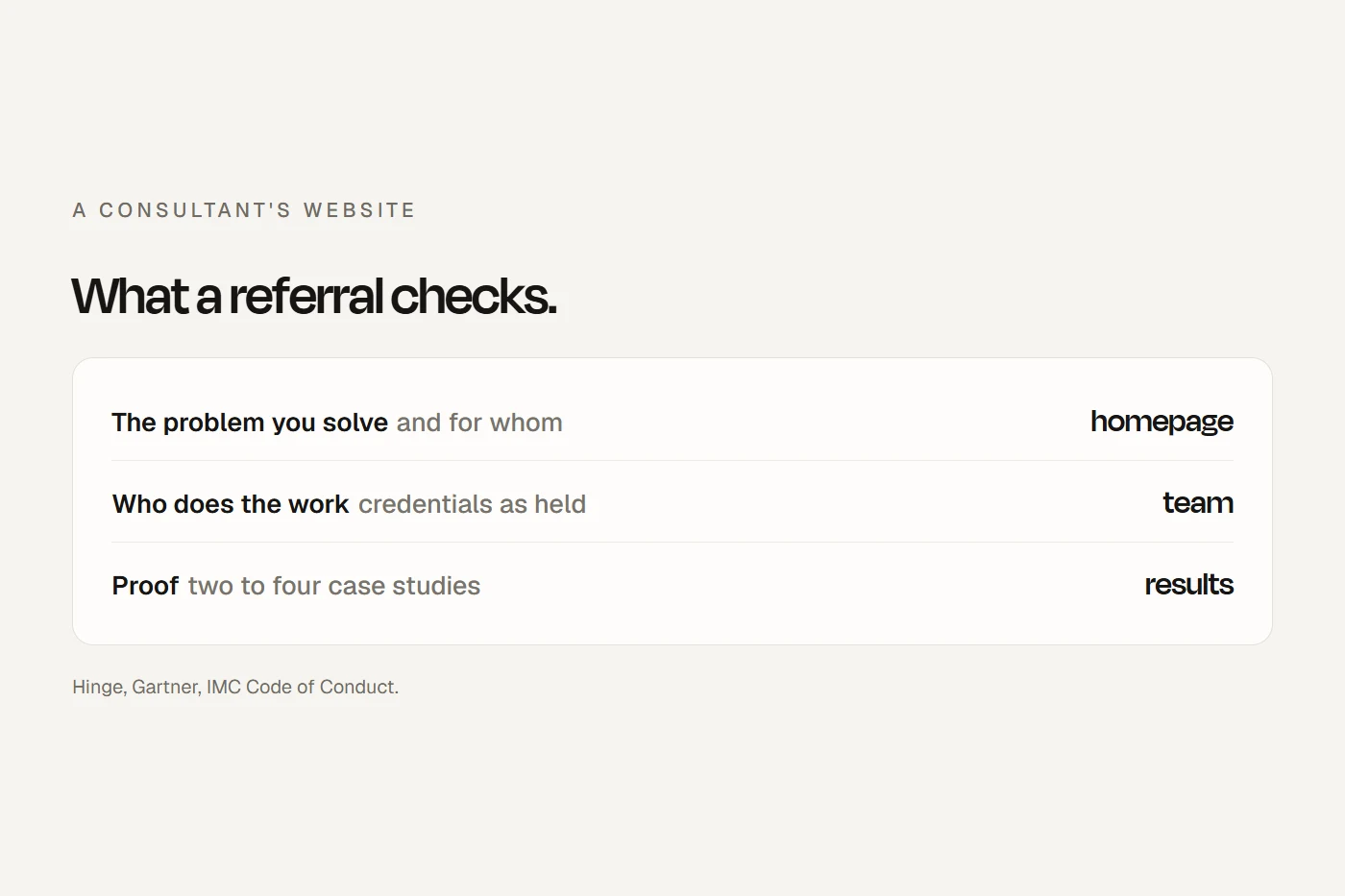
- Confirm the referralSay who does the work, what problems you solve, what an engagement produces, and roughly how it's priced.
- Prove itTwo to four case studies with real numbers and a clear line between what you did and what the client did.
- Watch the regulated wordsManagement consulting has no protected title, but "engineer", "financial adviser", "psychologist", migration and tax work do.
What buyers check
There's no Australian survey of how businesses choose a consultant. The best-known data is American and dated, but it's consistent. In a 2014 survey of more than 1,000 buyers of professional services by Hinge, a marketing firm, 80.8% said they looked at the firm's website before hiring, more than searched online or asked colleagues. Gartner's 2026 survey of business buyers found they used an average of seven information sources, and 45% used AI tools to gather information on vendors.
So most buyers still start with a name from someone they trust, then check the site. It has to confirm what they were told, quickly: who does the work, whether you've solved a problem like theirs, what they'd get and roughly what it costs.
What your site needs
Tick these off for your homepage and service pages. Your ticks save in this browser.
- One line naming the problems you solve, and for whom. In the client's words, not yours.
- Who does the work: named consultants, a photo, and relevant experience, stated accurately.
- Credentials exactly as held: membership grade, "CMC" only if current, and registration numbers in regulated fields.
- Two to four case studies in the format further down.
- What an engagement produces: named deliverables for each stage.
- How pricing works: fixed fee per stage, day rate or retainer; expenses; GST; a "from" price for a first step if you're willing.
- Testimonials only word for word, with written permission on file.
- Client names or logos only with permission. No government crests.
- For government buyers: the panels you're actually on, your ABN, the insurance you hold, and a capability statement to download.
- An enquiry form that asks only what you need, says not to send confidential documents, and links to your privacy policy.
- A newsletter sign-up kept separate, with an unticked box.
- A footer with your legal name and ABN, plus any wording your profession requires.
A useful trick: most of this is already in your proposals. The parts the Institute of Management Consultants' code says you agree before starting work, "objective, scope, timeline, planned outcome and any deliverables and fees", map straight onto web pages:
| In your proposal | On your website |
|---|---|
| Objective | "Problems we solve" on the homepage and each service page |
| Scope | What's in and out, and where advice stops and implementation starts |
| Timeline | "How an engagement runs": stages, with durations as ranges |
| Planned outcome | The result in each case study |
| Deliverables | "What you get": the written outputs and workshops for each stage |
| Fees | "How pricing works" |
| Team and CVs | "Who does the work" |
Scroll the table sideways to see every column.
Case studies without breaching confidentiality
Case studies are what buyers want most, and what confidentiality makes hardest. No law says you need permission to name a business client, but your engagement contract probably does, and the IMC's code tells members not to disclose confidential information "without the owner's explicit consent". So describe the client instead of naming them, unless they've agreed in writing.
Two legal points. A case study is a set of claims about your services, so the Australian Consumer Law applies. And if it quotes the client, it's a testimonial, where the law reverses the burden: a testimonial "is taken to be misleading unless evidence is adduced to the contrary". Keep the client's written words and permission on file.
Fill this in to draft one.
Three habits make case studies believable. Say what the client's team did, not just what you did. Give the period and how the result was measured. And never write "guaranteed" anything: the ACCC says businesses should not "make promises they can't keep".
Client logos
A strip of client logos is rarely trade mark infringement, but it can imply an endorsement, partnership or current relationship that isn't there, which the consumer law bans, and the artwork is someone's copyright. Get written permission from each client. If you've worked for a government department, name it in words. Don't use its crest: the Prime Minister's department says the Coat of Arms must not be shown "in a way which might lead a reader to believe that the material is of Australian Government origin or has Australian Government endorsement."
Titles and regulated fields
Management consulting has no licence or protected title in Australia. The IMC describes its code as "a self-regulatory regime", binding only its members. "CMC" (Certified Management Consultant) is a voluntary IMC certification for Full members and Fellows; it isn't a registered trade mark or a legal title here, but claiming it when you don't hold it is a false claim under the consumer law.
Some consulting fields are regulated, and the words on your site matter:
| Field | Rule | On your site |
|---|---|---|
| Engineering, Queensland | Only registered engineers may use "RPEQ" or "registered professional engineer", or provide professional engineering services unsupervised | An RPEQ number for each registered engineer |
| Engineering, Victoria | "Professional engineer" is reserved for registered engineers in the prescribed areas | The registered area and number |
| Engineering, NSW | Registration needed for work on some building classes; no false claims of registration | Registration and class |
| Financial advice | "Financial adviser" and "financial planner" are restricted | "Business finance consultant" if you don't give personal financial product advice |
| Migration | Only registered agents or lawyers may give or advertise immigration assistance | A registered agent's MARN on the website and social media |
| Psychology | "Psychologist" and endorsed titles like "organisational psychologist" are protected; testimonials about clinical care are banned | "Organisational development consultant" if not registered |
| Tax | Only registered tax or BAS agents may advertise those services | Your TPB number, if registered |
| Legal | Only qualified entities may practise law or say they can | "We don't give legal advice" for workplace or compliance consulting |
Scroll the table sideways to see every column.
Not protected, as far as I could find: "management consultant", "business consultant", "HR consultant", "IT consultant", "accountant", "town planner", "OHS consultant" and "environmental consultant". The consumer law still applies to every claim. If you're in a Professional Standards Scheme, the scheme's liability wording goes on your website too, but only if you're actually in one.
Check your wording
Paste your homepage or a bio. This flags regulated titles to check against your registration, and claims that are hard to prove.
It flags words to check, not every problem. A title can be fine if you hold the registration it implies.
Showing prices
Most consultants don't publish rates, and there's no data on how many do. I'd at least say how you price: fixed fee per stage, day rate or retainer, whether expenses are extra, and whether prices include GST. If you can, give a "from" price for a defined first step, like a diagnostic or a workshop. It filters out enquiries that were never going to work.
On GST: the consumer law's single-price rule applies to services "of a kind ordinarily acquired for personal, domestic or household use", and not to prices shown only to companies. So "+GST" pricing for business consulting isn't unlawful in itself. If you sell to individuals, like coaching or careers advice, show the GST-inclusive price.
If you want government work
The Commonwealth's Management Advisory Services Panel is how most federal consultancies are bought, and it's closed outside its refresh rounds; tenders are published on AusTender, so register there and follow the planned procurements. BuyICT's professional and consulting services marketplace opens periodically. But you don't have to be on a panel: BuyICT says agencies can engage small businesses directly for smaller procurements, under the Commonwealth Procurement Rules. In NSW, the Performance and Management Services Scheme lets suppliers apply at any time.
For the website, government buyers look for the same things tenders ask for: case studies, your ABN, the insurance you hold, and a capability statement. List only the panels you're actually on. And note that consultants doing Commonwealth contract work are covered by the Privacy Act whatever their size, including as subcontractors.
Enquiries and privacy
Most small consultancies are exempt from the Privacy Act, but not all: Commonwealth contractors and health service providers are covered regardless of turnover. Either way, keep your enquiry form short: name, work email, organisation and a line about the problem. Say not to send confidential documents through the form. Keep the newsletter sign-up separate, because the Spam Act needs consent, and an enquiry isn't consent to a newsletter.
My view
A consultant's website doesn't need to be clever. It needs to make a referral feel safe: a clear statement of the problems you solve, the people who'll do the work, a few honest case studies, what an engagement produces, and how it's priced. Build it from your best proposal, keep every title exactly as held, and get permission before you name anyone.
Questions I get asked
What should a consultant's website include?
The problems you solve and for whom, who does the work, two to four case studies, what an engagement produces, how pricing works, and an easy way to get in touch.
Can I name my clients on my website?
No law requires permission to name a business client, but your contract may, and naming them can imply an endorsement. Get written permission, or describe them instead.
Is "management consultant" a protected title in Australia?
No. There's no licence for management consulting. "CMC" is a voluntary certification from the Institute of Management Consultants.
Should consultants publish their rates?
Many don't. At least explain how you price, and consider a "from" price for a defined first step.
How do consultants get government work?
Through panels like the Management Advisory Services Panel and BuyICT when they open, NSW's Performance and Management Services Scheme, and direct engagement for smaller jobs. Register on AusTender.
About this guide
Written by Joseph Alzein, founder of bdog. bdog builds websites for Australian businesses, including consultants. I'm not a lawyer, and this is general information, not legal advice. Laws, regulator pages and panel information were read on 12 October 2026; rules differ by state and change, so check with your registration body.
Main sources:
- IMC: Code of Conduct and Ethics
- IMC: CMC certification
- Competition and Consumer Act, Australian Consumer Law
- ACCC: false or misleading claims
- PM&C: Commonwealth Coat of Arms guidelines
- OAIC: small business and the Privacy Act
- ACMA: avoid sending spam
- Professional Engineers Act 2002 (Qld)
- ASIC: personal advice provider definitions
- Migration Agents Code of Conduct
- Finance: Management Advisory Services Panel
- BuyICT: before applying
- NSW: Performance and Management Services Scheme
- Gartner: B2B buyer survey, 2026