A mortgage broker’s credit guide: what it must say and when to give it
Who gives a credit guide and when, the licensee’s list and the credit representative’s list side by side, what the website copy can and can’t do, the consent wording, when it needs updating, and how it differs from the quote, preliminary assessment and credit proposal. With a contents checklist, a can-I-do-this sorter and a quiz.
On This Page
Most mortgage brokers never write their credit guide. The aggregator's template fills it in, and it goes out as a PDF with the first email. That's fine until a file review asks why it went out after lodgement, or a client asks why last year's lenders are still on it. This guide is for brokers who want to know what their credit guide must say, when it has to be given and what the website copy can and can't do. I build mortgage broker websites. Everything here comes from the National Consumer Credit Protection Act, its regulations and ASIC's own guidance, with the section for each point.
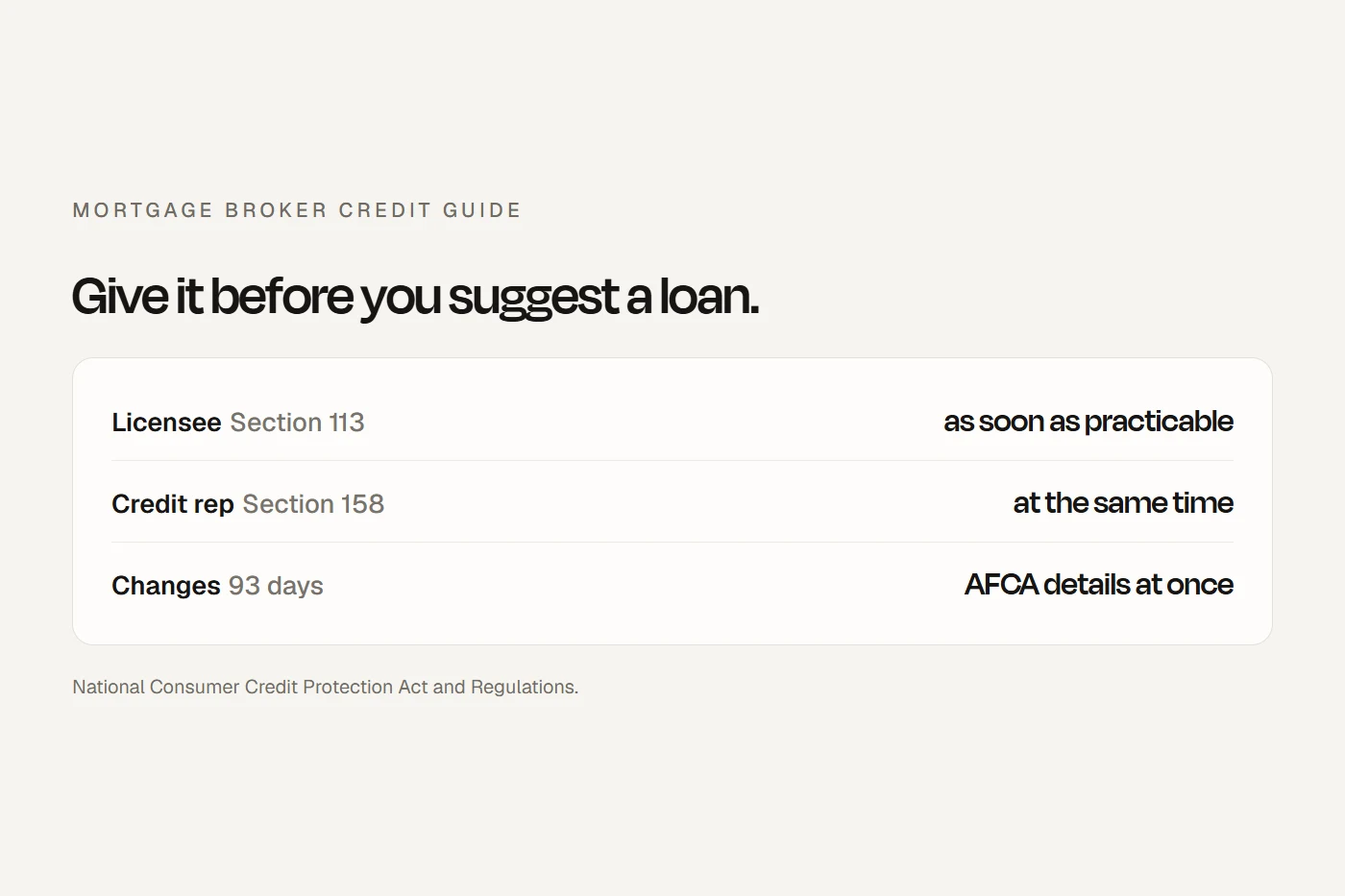
- Before you suggest a loanThe licensee's guide goes out as soon as it's clear you're likely to help (section 113). If you're a credit representative, yours goes at the same time (section 158). One combined document is fine.
- Eight things, plus a few extrasWho you are and your numbers, your fees, your six lenders, how you're paid, who you pay for referrals, how to complain and AFCA's details, and your promise on the preliminary assessment.
- The website copy doesn't count on its ownA guide sitting on your site has only been "given" if the client agreed to electronic documents and you told them it's there. Send it every time.
Who gives one, and when
The trigger is "credit assistance": suggesting a particular loan with a particular lender, helping someone apply, or suggesting they stay in the loan they have (section 8). Once it "becomes apparent" you're likely to do that, the licensee must give its credit guide "as soon as practicable" (section 113(1)). ASIC's working summary is that it will "generally be before you engage in credit activities with the consumer".
- Credit representatives give two guides, or one combined. When you hand over your aggregator's guide, you must give yours "at the same time" (section 158(1)). ASIC and the regulations allow both in a single document if everything required for each is in it.
- Only consumer credit counts. The rules cover loans for personal or household use and for buying, renovating or refinancing residential investment property. A loan wholly or mainly for business purposes doesn't need a credit guide by law, though many aggregators want one anyway.
- Introducers are different. If you only act as an intermediary and someone else gives the credit assistance, ASIC says these disclosure obligations don't apply to you.
- Repeat clients. You don't need to give a new guide if you gave one in the last 12 months and AFCA's contact details haven't changed (regulation 28P(2)). A refinance review 18 months after settlement needs a fresh one. Some aggregators set a shorter window as their own policy.
In practice I'd send it with the booking confirmation for the first meeting. That's usually the moment credit assistance becomes likely, and the email is your record of when it went.
What it must say
The licensee's list and the credit representative's list are close but not the same. The lenders rule catches most brokers out: the licensee names its six lenders, while a credit representative's section 158 list names the licensees it represents, and its own six lenders come from the regulations.
The licensee's guide (section 113)
- Who you are
- Name, contact details and "Australian credit licence number"
- Fees
- Any fees and charges the client pays you, and how they're worked out. Or a statement that you don't charge
- Lenders
- The six lenders you do the most business with, or all of them if six or fewer
- Commissions
- Commissions you, your staff and your credit representatives are likely to get from lenders, with a reasonable estimate or range and the method
- Referrals you pay for
- Whether you pay third parties for introductions, the classes of people you pay, and that the client can ask for an estimate (regulation 26A)
- Volume bonuses
- A statement for each arrangement. Volume-based pay is now banned, so in practice this says there are none
- Complaints
- Your internal dispute process and AFCA's contact details
- Your obligations
- Sections 120 and 123: a free copy of the preliminary assessment on request, and that you won't suggest an unsuitable loan
The credit representative's guide (section 158)
- Who you are
- Name, contact details and "credit representative number"
- Fees
- Any fees and charges the client pays you, and how they're worked out
- Licensees
- The licensees you represent (up to six named) and the credit activities you're authorised to do for them
- Commissions
- What you're likely to receive from those licensees, with an estimate or range and the method
- Referrals you pay for
- Whether you pay for introductions, the classes of people, and that an estimate is available (regulation 27A(2))
- Your six lenders
- Required by regulation 27A(3), but not if your guide is combined with the licensee's in one document. Check whether your aggregator wants them anyway
- Complaints
- Your dispute procedure, including AFCA's contact details
Two shortcuts are allowed. The method for your fees and the commission estimate can be left out if the guide says the client can ask for them and you can actually answer (regulations 27 and 27B). That doesn't let you leave out the fact that commissions exist. "Commission may be paid, ask us" and nothing more falls short.
Also left out of the law: there's no required "best interests" statement, no prescribed form and no template from ASIC. Your aggregator's template is the one to use if you're a credit representative.
Check your own guide
Open your current credit guide and tick what's there. Your ticks save in this browser.
- Licensee name, contact details and Australian credit licence number (s 113(2)(c), (d)).
- Your name, contact details and credit representative number, if you're a credit representative (s 158(2)(c), (d)).
- The licensees you represent and what you're authorised to do (s 158(2)(f)).
- Fees and charges, and how they're worked out, or "we don't charge you a fee for our credit assistance" (s 113(2)(e); reg 28C).
- The six lenders you do the most business with, and the period the figures cover (s 113(2)(f); reg 27A(3)).
- That commissions are likely, with an estimate or range and the method, or how to ask for them (s 113(2)(g); reg 27).
- Referral payments you make: that you pay them, to which classes of people, and that an estimate is available (regs 26A(2), 27A(2)).
- Volume bonus arrangements, which should say none (regs 26A(3), 27A(4)).
- Your complaints process and contact details (s 113(2)(h)).
- AFCA's current contact details, not an old dispute scheme's name (s 113(2)(h)(ii)).
- The free preliminary assessment copy and no unsuitable loans (s 113(2)(i)).
- Saveable and printable if you send it electronically (reg 28L(5)).
- The same version you publish on your website.
The credit guide on your website
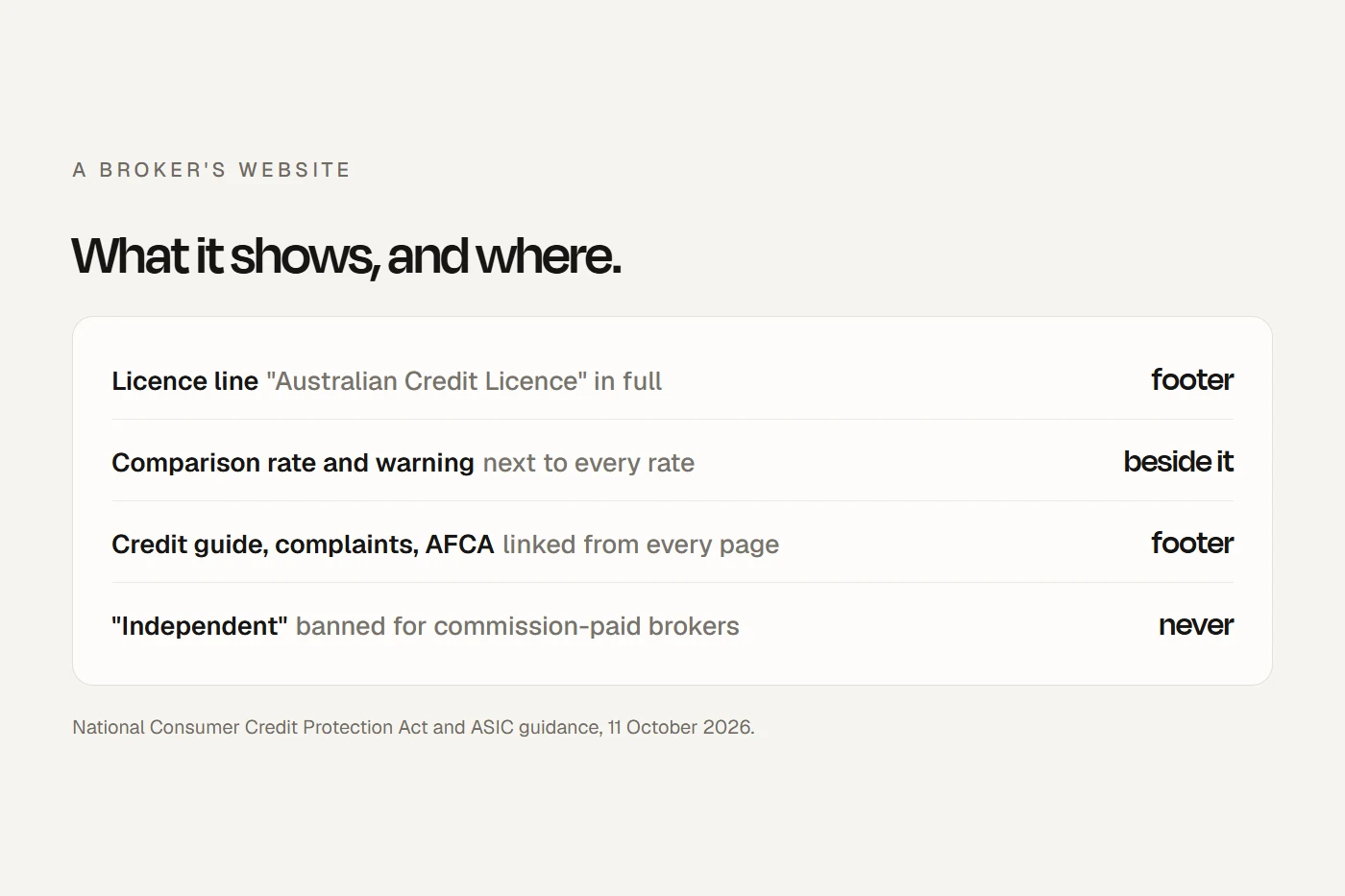
No section requires a credit guide on your website. Publishing one is still worth it: Moneysmart tells borrowers to ask a broker which lenders they use and how they're paid, and the guide answers both. One national brand keeps its credit guide as a web page linked in the footer under Legal, next to Privacy.
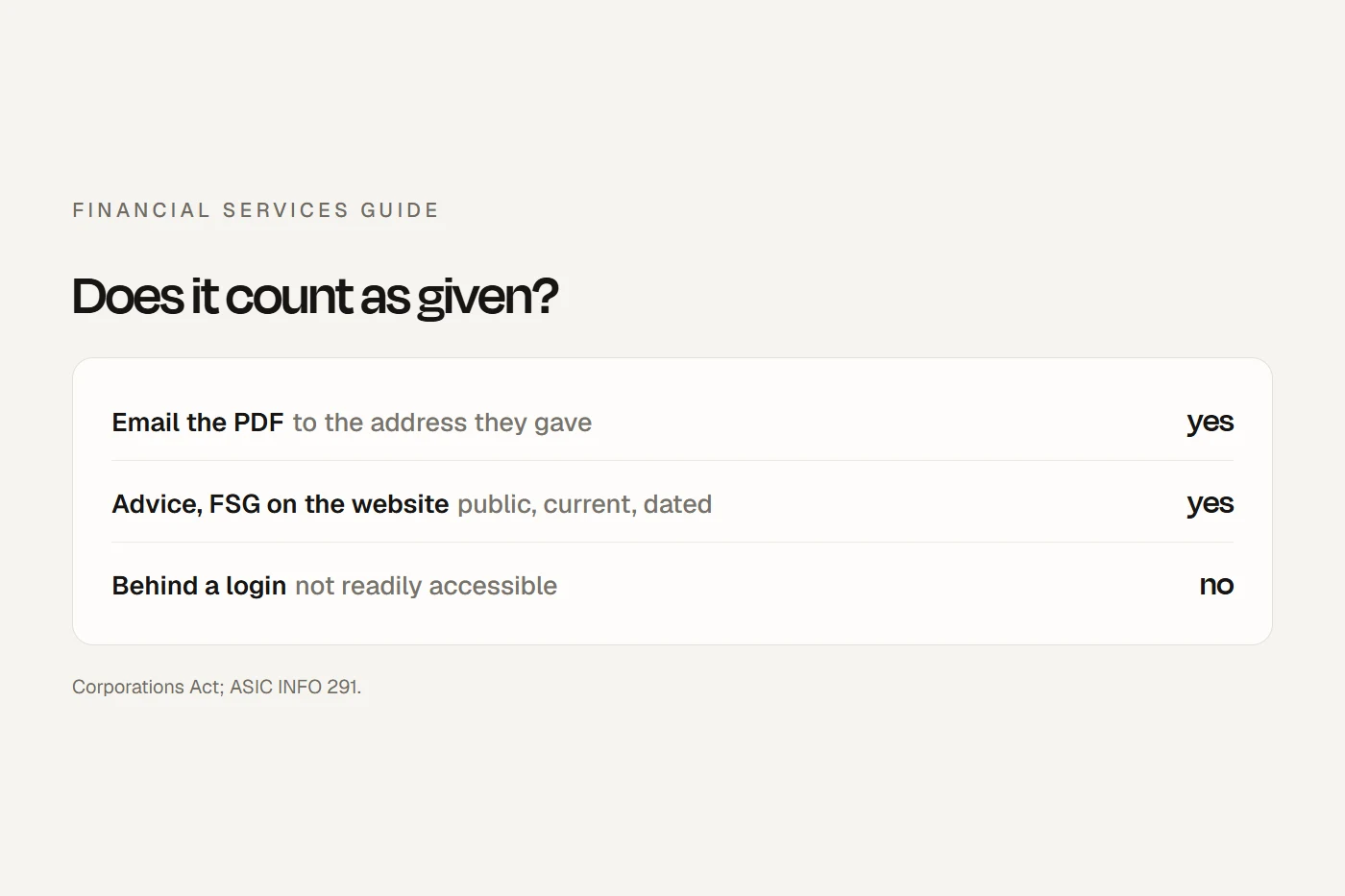
What the website copy can't do is replace giving it. Regulation 28L lets you give the guide electronically only if:
- The client consented first, after being told three things: paper may stop, they need to check their email for documents, and they can change their mind at any time.
- You "promptly" told them it's there and they can get to it. A guide behind a client portal login nobody mentioned doesn't count.
- It can be saved and printed. A PDF or a print-friendly page.
- You're satisfied they received it. For a link, that's when the client tells you they've opened it. For an attachment, it's when it was properly addressed and sent.
Credit guides have none of the "publish and notify" routes that financial services guides have. The simplest reliable method is to attach the PDF to the booking email, after consent, and keep the email.
Consent wording for your booking form
This is my drafting from the three things regulation 28L(4) says the client must be told. It's an example; check it against your licensee's wording.
Keeping it current
There's no rule that a credit guide carries a date or version number. There are two rules about change:
- About three months for most changes. Updated information can be left out of the guide you give if it's less than 93 days old and the guide was correct when published (regulation 28B). New lenders in your top six, changed commission ranges or a new address: update within that window.
- AFCA's details, at once. They're excluded from that grace period.
Telling a client something you know is false or materially misleading is a separate breach (section 160D), so a lender table you know is stale is a real risk. One national brand's guide was dated this year but still carried last year's lender table. Keep each version, too: ASIC expects brokers to keep "a copy of the credit guide which was provided to the consumer" (RG 273). Your aggregator's template only updates itself if you haven't customised it.
The credit guide isn't the other three documents
| Credit guide | Quote | Preliminary assessment | Credit proposal disclosure | |
|---|---|---|---|---|
| Section | 113 and 158 | 114 | 115, 116 and 120 | 121 |
| When | As soon as credit assistance is likely | Signed before you help | Made within 90 days before you suggest a loan | When you suggest a particular loan |
| What it's for | Who you are, fees, lenders, how you're paid, complaints | The most the client will pay you | Whether the loan is "not unsuitable" | Dollar estimates for this loan: fees, commission, referrer's fee |
| Always? | Yes, unless given in the last 12 months | Only if you charge a fee | Copy free on request | Yes |
Scroll the table sideways to see every column.
- No fee, no quote. One sentence in your credit guide, "We don't charge you a fee for our credit assistance", removes the quote step (regulation 28C). If you do charge, you can't ask for payment before the work, or without a signed quote.
- Commissions are disclosed twice. The credit guide gives the kinds and ranges early. The credit proposal disclosure gives the dollar estimate for the client's actual loan.
- Referral fees, the same way. The guide names classes ("real estate agents, accountants"). The named referrer and the amount go in the credit proposal disclosure.
Can I do this?
Tap each card for the answer and the rule behind it.
Is a credit guide due?
My view
A credit guide is a compliance document, but it's also the only place most clients see in writing how you're paid and which lenders you use. Get the aggregator's template right, check the lender table every few months, and send it with the first booking email after a consent tick on your form. Then publish the same version on your site, linked in the footer next to your licence line. That way the website, the email and the file all show the same thing.
Questions I get asked
Do mortgage brokers have to give a credit guide?
Yes, before giving credit assistance on a consumer loan. The licensee's guide is required by section 113, and a credit representative must give their own at the same time under section 158. Both can be one document.
Do mortgage brokers have to disclose commissions?
Yes, twice. The credit guide says commissions are likely and gives a range or how to ask. The credit proposal disclosure gives the dollar estimate for the client's actual loan.
Can I just put my credit guide on my website?
You can publish it, but that alone doesn't count as giving it. The client has to consent to electronic documents, be told it's there, and be able to save and print it.
How often should a credit guide be updated?
Changed information can wait less than 93 days. AFCA's contact details must be updated at once. Returning clients need a new guide after 12 months.
Is a credit guide needed for a business loan?
Not by law, if the loan is wholly or mainly for business purposes. Many aggregators still ask for one.
About this guide
Written by Joseph Alzein, founder of bdog. bdog builds mortgage broker websites and has no relationship with any aggregator or lender mentioned. The rules come from the National Consumer Credit Protection Act 2009 and Regulations 2010, ASIC's information sheet and regulatory guides, Moneysmart and AFCA. Sources were checked on 13 October 2026. Your licensee's template and policies may be stricter than the law. This is general information, not legal advice.
Main sources: