Dental practice management software in Australia, compared
Only one vendor publishes a price, and the contracts differ far more than the features. Here’s server or cloud, prices, HICAPS, CDBS and DVA claiming, online booking costs and how you get your data out, from each vendor’s own pages and terms.
On This Page
Search for dental practice management software and every result on page one is a vendor, a vendor's "neutral" comparison guide, or a review directory. None of them puts the things that actually decide the choice side by side: what each system costs (only one publishes a price), whether it runs on a server in your back room or in the cloud, how you claim CDBS and DVA, what online booking costs, and how you get your data out when you leave. This guide does, from each vendor's own pages and terms, HICAPS's and Tyro Health's partner lists, Services Australia and state health records law, read on 12 October 2026. I build dental practice websites and have no relationship with any of these vendors.
- Decide server or cloud firstDental4Windows and EXACT run on a server in the practice. Dental4Web, Praktika, Core Practice and Dentally run in the cloud.
- HICAPS won't separate themEvery main system is on HICAPS's integration list. Contracts, data exit and booking costs differ far more than features.
- Read the exit terms before you signTerms range from no lock-in to a default three-year minimum, and from a free export to data deleted 30 days after you leave.
The systems, and who owns them
| System | Owner | Runs on | Published price |
|---|---|---|---|
| Dental4Windows | Centaur Software, Sydney | Server in the practice | No |
| Dental4Web | Centaur Software | Cloud | No |
| Praktika | Lizard Software, Melbourne | Cloud, own Australian servers | Yes |
| Core Practice | Core Practice, Sydney | Cloud | Partly (extra seats, SMS) |
| EXACT | Henry Schein One | Server in the practice | No |
| Oasis | Henry Schein One | Server in the practice | No |
| Dentally | Henry Schein One | Cloud | No (tiers named) |
| CareStack | Brisbane entity, US parent | Cloud | No |
Scroll the table sideways to see every column.
A few things trip people up. Praktika isn't Centaur's; it's built and run by a separate Melbourne company. Oasis belongs to Henry Schein One, and its page reads as a product kept for existing customers, so ask about its future if you're on it. Dentrix Ascend and Curve Dental, which show up in American reviews, aren't sold here. Ultimo, Zavy360 and Principle Dental are smaller Australian options also on HICAPS's list.
What it costs
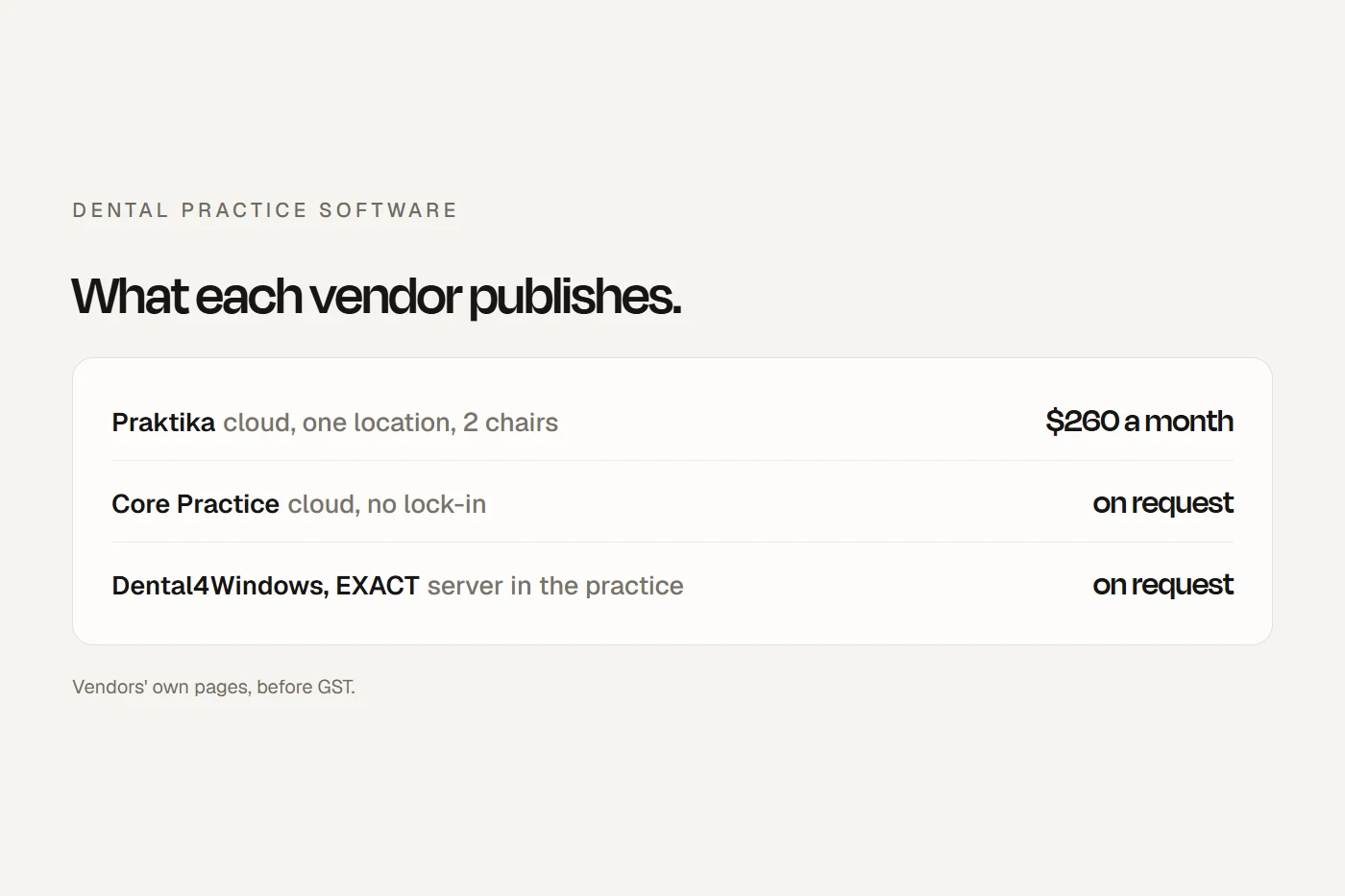
Only Praktika publishes a full price: $260 a month for one location with up to two chairs, $25 a month for each extra chair, and a $500 set-up fee, all before GST, with unlimited users. Practices with two or three locations pay less per location. Core Practice publishes its extra-seat price and SMS rates but not its base plans. Everyone else is "contact us". Text message rates are published by Centaur (22 cents before GST), Praktika (17 to 25 cents before GST, depending on volume) and Core Practice (19 cents on pay as you go). For a busy practice, SMS is a real line item.
For every other system, ask for an Australian quote that states the basis (per chair, per provider or per location), what's included, set-up and conversion fees, and how much and how often the price can rise.
Claiming: HICAPS, Tyro, CDBS and DVA
HICAPS's own partner list shows terminal integration for private health claims, EFTPOS and Medicare for every main dental system, so it won't separate them. Tyro Health lists Dental4Windows, Core Practice and Dentally as dental partners, and Praktika says it works with Tyro terminals too.
The Child Dental Benefits Schedule is claimed through Medicare Online or Medicare Easyclaim, and Services Australia says bulk bill claims can go through "your practice software". Dentally says it submits CDBS invoices electronically, and Core Practice does Medicare (including CDBS) and DVA claims through Tyro Health Online. Core Practice is the only system I could confirm for electronic DVA claiming; ask every other vendor how they do it. Whatever you choose, CDBS needs an eligibility and balance check before treatment and informed financial consent forms, and you must keep CDBS records for four years for audit.
State public dental voucher schemes, such as NSW's fee-for-service scheme and Victoria's emergency, general and denture schemes, are paper vouchers you send back to the health service, not claims from your software. What helps is being able to set each scheme up as a payer with its own fees, and to keep scheme invoices out of your reminder letters.
Online booking and your website
This is where the costs differ most:
- Praktika: its own online booking is free for subscribers; you pay only for the verification text message.
- Core Practice: included in both plans, embedded on your site with your branding, with optional deposits through Stripe.
- Dentally: online booking and digital forms come with its Essentials and Pro tiers, not Starter.
- Centaur: eAppointments is a separate subscription with a six-month minimum, and its terms make putting it on your website your responsibility.
- EXACT: an online booking widget for your website, with deposits.
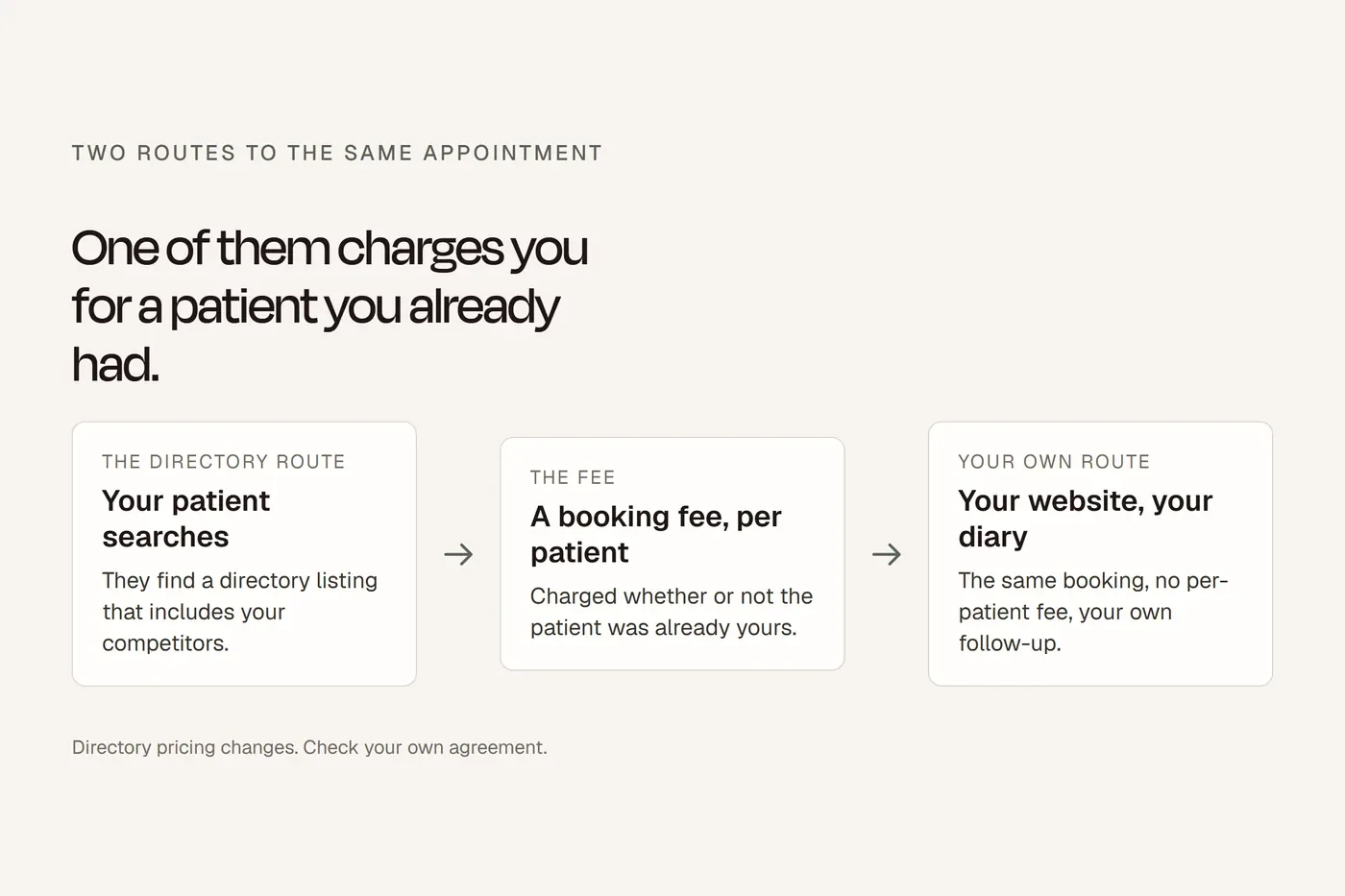
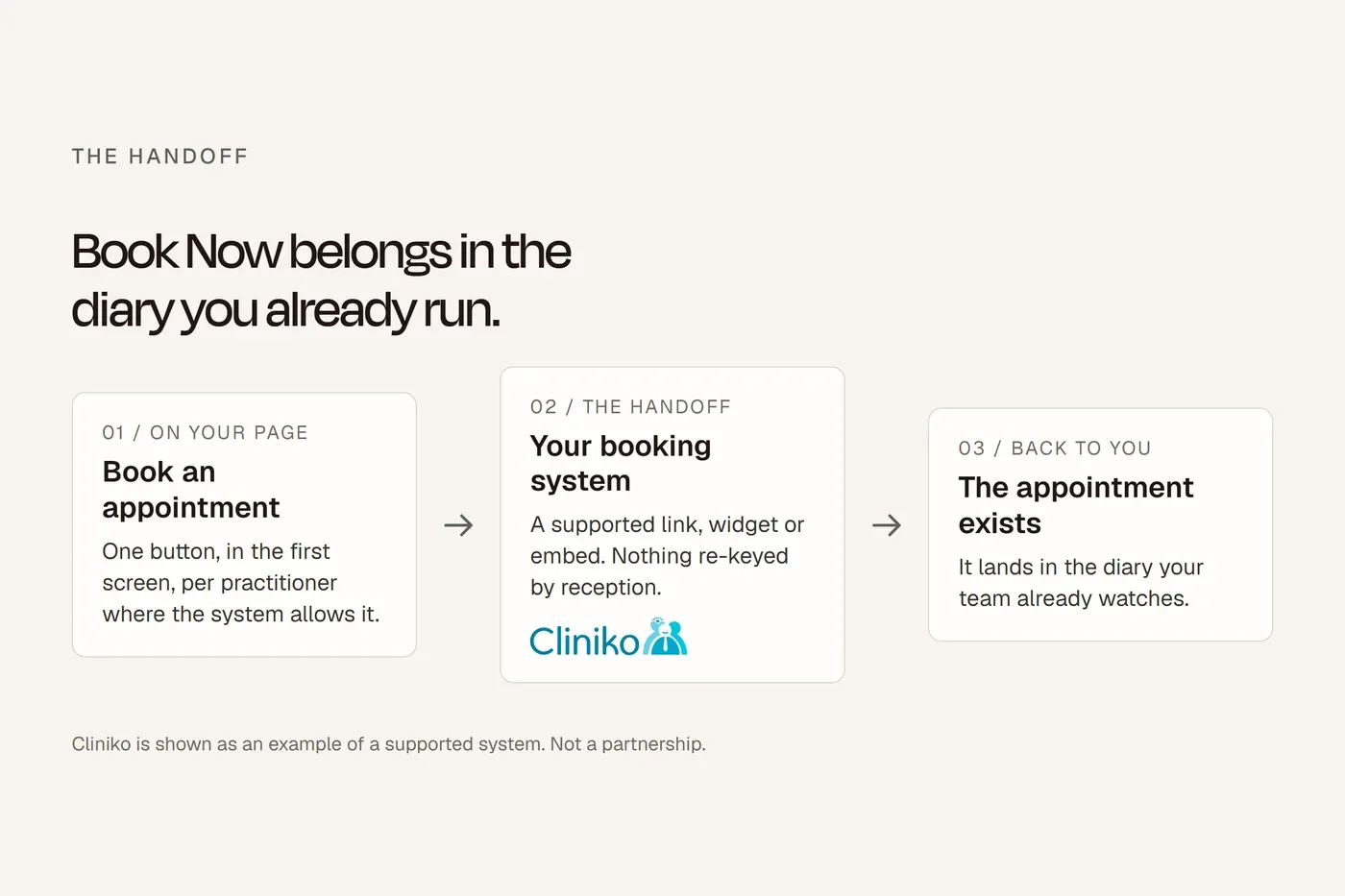
Booking directories charge per new patient. HotDoc's pages show $59 per new patient for practices on Dental4Windows and Core Practice, while Centaur's own patient discovery page lists $65.50 plus GST, so check which applies to you. None of the dental systems, HotDoc or HealthEngine is a Reserve with Google partner, so Google's "Book" button on your profile is a link to your booking page. The cheapest new patient is one who books on your own website through your own system. More on that in HotDoc, HealthEngine or your own website.
Contracts and getting your data out
| System | Minimum term | Your data when you leave |
|---|---|---|
| Dental4Web | One month, renewing; 30 days' notice | Destroyed 30 days after your subscription ends unless arranged; export options both carry a fee |
| Dental4Windows | Licence paid at installation; support starts after 12 months unless you cancel 30 days before | On your own server |
| Praktika | 12 months, then month to month with 30 days' notice | Returned as CSV files plus your original images and documents |
| Core Practice | "No lock in contracts" | Exported "ready to be imported into another system" |
| EXACT, Oasis | Henry Schein One's terms default to three years; leaving early means paying the rest | On your own server |
| Dentally | Monthly or annual, paid in advance | Provided "at our sole discretion"; deleted 90 days after cancellation |
Scroll the table sideways to see every column.
Henry Schein One's terms also say your signed sales agreement overrides them, so read your own order form. Before you sign anything, get three answers in writing: the minimum term, what you can do if the price rises, and the format and fee for your data when you leave.
Records, privacy and where your data sits
The Dental Board retired its own dental records guidelines; its Code of conduct now covers records, and how long you keep them comes from state law. In NSW, Victoria and the ACT, private health providers must keep records for seven years from the last service, or until the patient turns 25 if they were a child. Elsewhere there's no state statute, but most practices work to the same rule. That matters when you switch systems: the old records have to stay readable for years, which a cloud account deleted 30 or 90 days after you leave won't do on its own.
A dental practice is covered by the Privacy Act whatever its size, and using a cloud system doesn't move your security obligations to the vendor. Centaur says hosted data is kept in Australian data centres, Praktika says all its servers are in Australia and it doesn't use third-party cloud providers, and Core Practice says its servers are in multiple Australian data centres. Dentally announced it was moving Australian accounts to Sydney servers, but its Australian security page still mentioned EU servers when I checked, so get it in writing. CareStack's Australian privacy policy lists servers in several countries; ask where clinical data sits. Two vendors, Centaur and Core Practice, say they hold ISO 27001 certification.
One more surprise: none of the dental systems appears on the Australian Digital Health Agency's conformance registers for My Health Record, healthcare identifiers, e-prescribing or secure messaging. Don't choose on those features yet.
Which should you look at?
Switching checklist
Your ticks save in this browser.
- Find your current term and notice period, and check whether leaving early costs you the rest of it.
- Order your data export before you give notice, with the format and fee in writing.
- Ask the new vendor what converts and what doesn't: perio charting, images, documents and recall dates.
- Export your recall list as a backup, and check recall dates are right on day one.
- Keep old records readable for seven years, or until a child patient turns 25.
- Re-map claiming: HICAPS merchant IDs per provider, and a Tyro Health Online account if you claim Medicare or DVA online.
- Re-create health fund fee schedules and any voucher-scheme payers.
- Test the imaging bridge with your exact sensors, scanners and software versions before go-live.
- Swap every booking link on cut-over day: website, Google profile, HotDoc or HealthEngine, reminders and QR codes.
- Register your SMS sender ID so reminders don't arrive as "Unverified".
- Budget for set-up, conversion, training and a month of paying for both systems.
- Ask where data is hosted, including any AI note-taking or imaging AI.
My view
Decide server or cloud, then shortlist on contract and exit terms, claiming routes and online booking cost, because that's where these systems really differ. Praktika's published price is a useful benchmark when the others quote. And plan the website side of any switch: the booking button on your site and Google profile is where new patients come in, and it changes the day you move.
Questions I get asked
What is the most commonly used dental software in Australia?
Dental4Windows has long been the default, though there's no independent current survey of market share. Henry Schein One's EXACT and Dentally, Praktika and Core Practice are the other main names.
How much does dental practice software cost in Australia?
Only Praktika publishes a price: $260 a month for one location with up to two chairs, plus $25 per extra chair and a $500 set-up, before GST. The others quote on request.
Which dental software is cloud-based?
Dental4Web, Praktika, Core Practice, Dentally and CareStack. Dental4Windows and EXACT run on a server in the practice.
Does dental software connect to My Health Record?
Not yet. None of the dental systems is on the Australian Digital Health Agency's conformance registers for My Health Record or e-prescribing.
How long do dental records have to be kept?
In NSW, Victoria and the ACT, seven years from the last visit, or until 25 for patients treated as children. CDBS records must also be kept four years for audit.
About this guide
Written by Joseph Alzein, founder of bdog. bdog builds dental practice websites and has no relationship with any software vendor here. Prices, terms and features were read from the vendors' own pages and terms on 12 October 2026. Prices and terms change, so check before you sign.
Main sources:
- Praktika prices
- Praktika FAQ
- Core Practice pricing
- Dental4Web terms
- Henry Schein One terms (ANZ)
- Dentally: Australian claiming
- HICAPS integration partners
- Services Australia: claiming CDBS
- Health Records and Information Privacy Act 2002 (NSW), s 25
- Dental Board: dental records
- Australian Digital Health Agency: conformance registers