Local SEO for dental practices: what actually moves you up the map
Google decides which three practices appear on the map when someone nearby searches for a dentist. What it says it looks at, what you can change, and the profile and review mistakes that put a dental practice at risk with Google or the Dental Board.
On This Page
Someone in Penrith types "dentist near me" into their phone. Before a single website appears, Google shows a map with three practices on it. Most people tap one of those three and never scroll further.
That map is the main event in local SEO for dentists, and it runs on different rules from the ordinary results underneath. This guide covers both, in the order they matter, with what Google itself says, what the Dental Board's title rules mean for your profile, and the things agencies sell that can get a dental practice suspended or reported.
How Google decides, in its own words
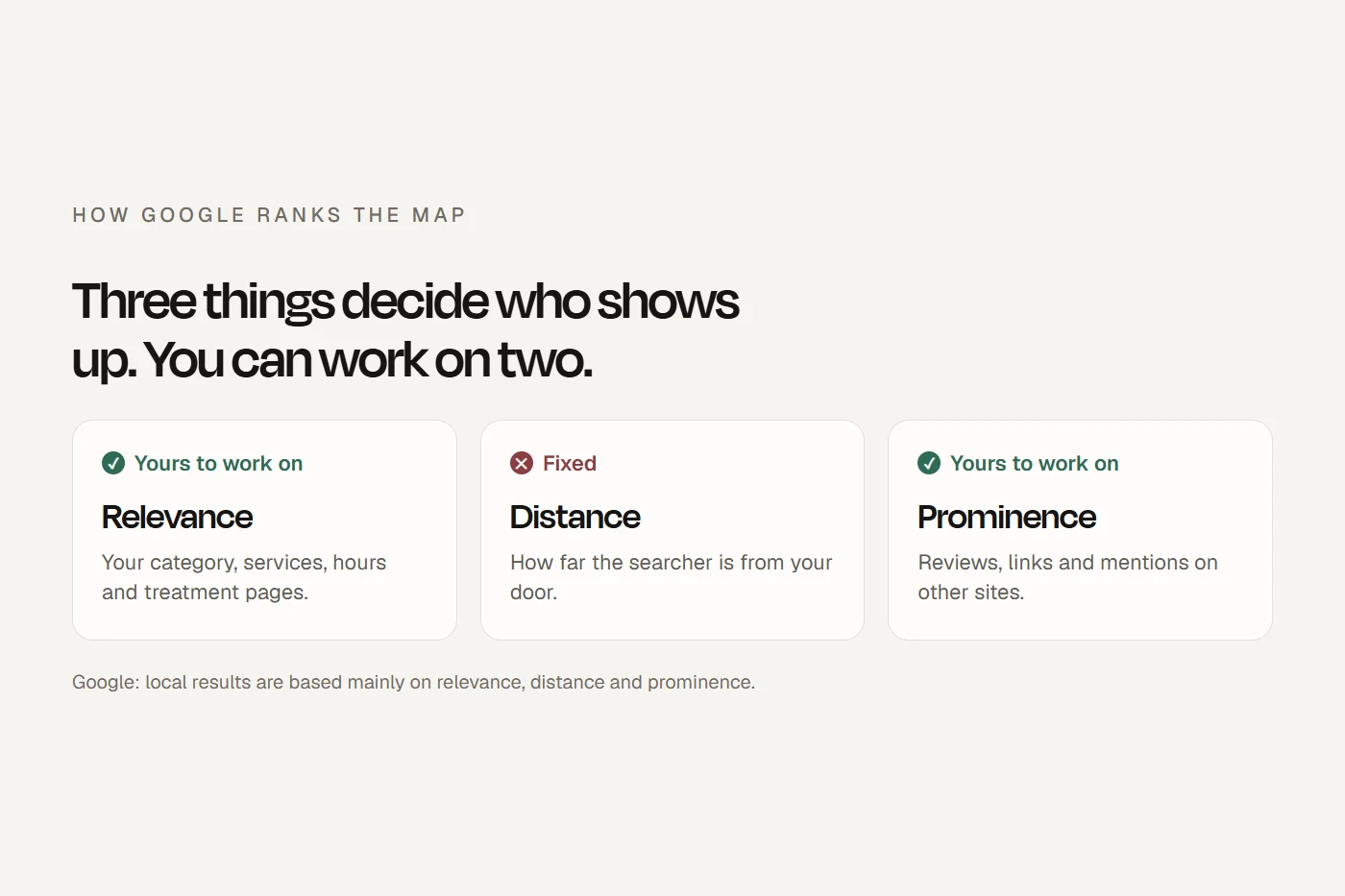
Google publishes a short page on how it ranks local results. It says they're based mainly on three things: relevance, distance and prominence. Relevance is how well your profile matches what was searched. Distance is how far you are from the searcher. Prominence is how well known you are, which Google says comes partly from how many websites link to you and how many reviews you have. "More reviews and positive ratings can help your business's local ranking," in its words.
The same page says something every practice owner should read before signing an SEO contract: "There's no way to request or pay for a better local ranking on Google."
You can't move your building, so distance is fixed. That leaves relevance, which is mostly your Business Profile and your website, and prominence, which is mostly reviews and mentions elsewhere. Everything below is one of those two.
What the experts rank highest, and the one not to copy
Google doesn't publish weights. The most-cited estimate is Whitespark's Local Search Ranking Factors survey, which asks local SEO practitioners to score each factor. The 2026 edition, published in November 2025, surveyed 47 of them across 187 factors. It's expert opinion, not Google data, but it's the best map there is.
| Rank in the 2026 survey | Factor | What a dental practice can do |
|---|---|---|
| 1 | Primary Business Profile category | Choose it carefully. More on this below, because for dentists it has a legal edge |
| 2 | Distance from the searcher | Nothing. It's where you are |
| 3 | Keywords in the business name | Nothing. Adding them breaks Google's rules |
| 4 | Address in the suburb being searched | Nothing, unless you move |
| 5 | Open at the time of search | Keep hours, public holidays and closures accurate |
Scroll the table sideways to see every column.
Number three is why you see profiles called "Smile Co Dental | Dentist Parramatta | Implants". It works for a while, which is why agencies do it. Google's guidelines say the name has to be your real name as used on your signage, website and stationery, with no services or locations added, and that unnecessary information in the name "could result in the suspension of your Business Profile." A suspended profile disappears from the map entirely. For a practice that gets most of its new patients from Google, that's the worst outcome on this page.
The same survey has a newer list for visibility in AI answers, the summaries now sitting above some search results. Its top three there: appearing in "best of" lists, having a dedicated page for each service, and being prominent on the big sites in your industry. Google's own position is that there's nothing special to do for its AI features beyond the basics, including keeping your Business Profile up to date.
Your Business Profile, set up for a dental practice
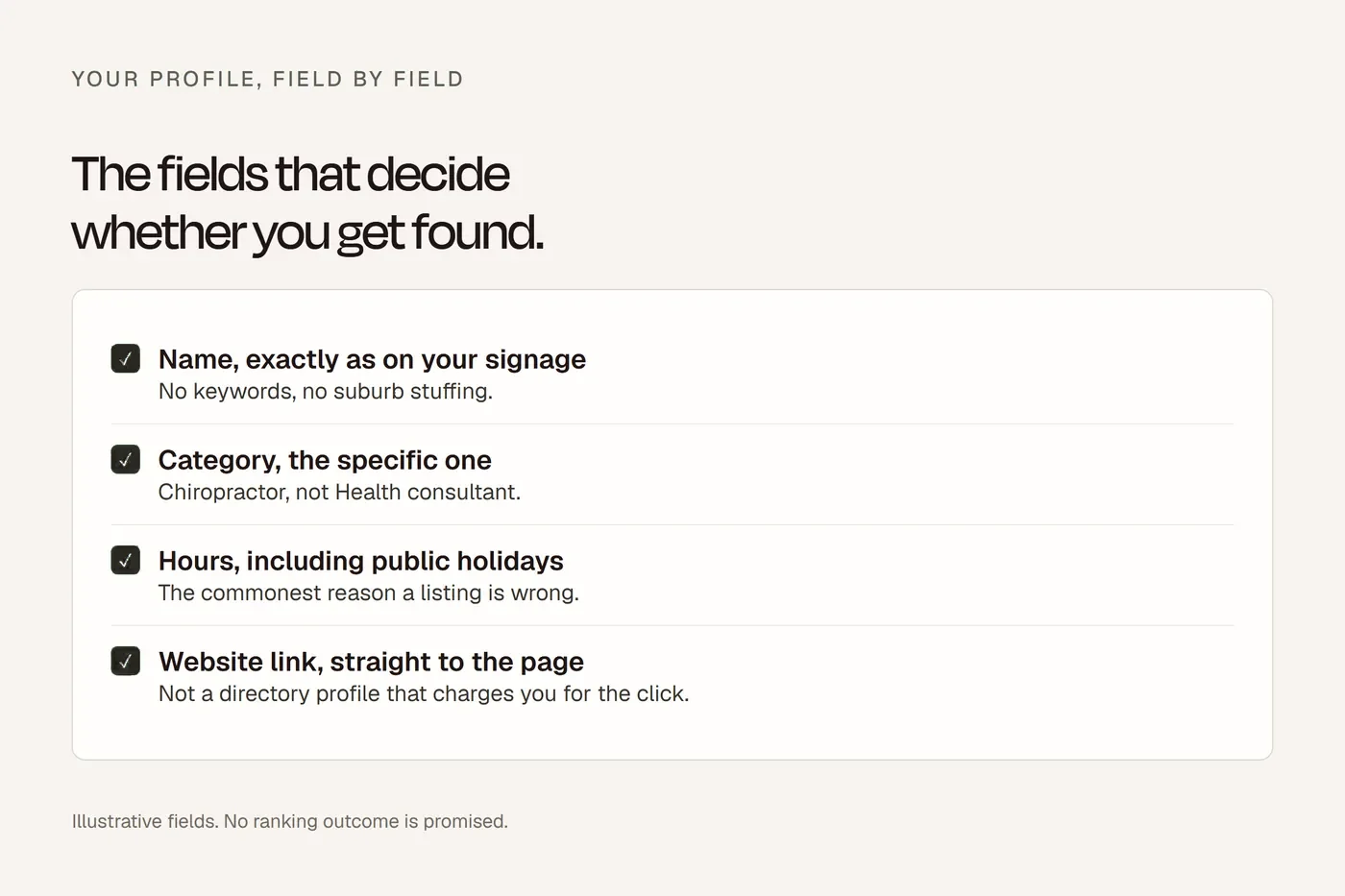
We've written a field-by-field profile checklist for clinics in general. These are the parts that are different, or riskier, for dentists.
The name
Exactly what's on the sign. If the sign says "Penrith Family Dental", that's the name. Not "Penrith Family Dental: Dentist Penrith, Emergency Dentist".
The primary category, and the specialist trap
For a general practice, the primary category is Dentist, or Dental clinic. Google's own rule is to use as few categories as possible and only ones that complete the sentence "This business is a...".
Here's the part most dental SEO guides miss, because most of them are written for American practices. In Australia there are 13 recognised dental specialties, including orthodontics, periodontics, endodontics, prosthodontics, paediatric dentistry and oral surgery. The titles that go with them, such as "orthodontist", "periodontist", "endodontist", "prosthodontist", "paediatric dentist" and "oral surgeon", are protected. Under section 115 of the National Law, you can't use a specialist title unless you hold specialist registration in that field. Section 118 goes wider and covers any word or description that could reasonably be taken to mean you're a specialist. The maximum penalty is $60,000 for an individual and $120,000 for a company.
Google's category list includes Orthodontist, Periodontist, Endodontist, Prosthodontist, Pediatric dentist and Oral surgeon. A general practice that adds "Orthodontist" because it offers clear aligners is, on our reading, displaying a protected title on a public profile. We haven't found a regulator statement about Google categories specifically, so treat this as our interpretation, but it's an easy risk to avoid: only add a specialty category if a dentist with specialist registration in that field practises there. You can check anyone on the Ahpra register.
Categories like Cosmetic dentist, Emergency dental service and Dental implants provider aren't specialist titles. They still have to be true. If you don't see emergencies, don't claim it.
Practitioner profiles
Google treats dentists as individual practitioners. A dentist who sees patients at the practice can have their own profile, with only their name as the title, and "Dr" is allowed. The practice keeps its own profile. One profile per dentist, not one per treatment they offer. A solo dentist working under a brand shares one profile named "Brand: Dr Name".
Ahpra's rule on "Dr" is that if you're not a medical practitioner, it has to be clear what you are. Google's category, Dentist, shows directly under the name on the profile, which does that job. On your website, write it out: "Dr Sam Lee (Dentist)".
Hours
"Open at the time of search" came fifth in the survey. Put in your real hours, set special hours for public holidays and closures ahead of time, and if you take emergencies outside normal hours, say how. A patient with a broken tooth at 7pm is searching right now.
Services and booking links
List your treatments in the words patients use: check-up and clean, fillings, root canal treatment, wisdom teeth, crowns, implants, children's dentistry, teeth whitening. Add a short description and a price where you can. Google lets you add booking links, and if you use HotDoc, HealthEngine or another system, a third-party link may already be there. Set your own booking page as the preferred link if you can, so the booking happens on your terms.
Posts and Q&A
Posts are fine for telling patients about holiday hours or a new dentist, and they archive after six months unless you set dates. The survey ranks post frequency 148th, so do them for patients, not for ranking. Google discontinued the Q&A feature for developers in November 2025 and has been removing Q&A from profiles since, so don't spend time on it.
Reviews: where Google and Ahpra overlap
Reviews are the biggest part of prominence you can influence, and the area where dentists most often get into trouble.
Google's rules. You can ask patients for reviews. You can't offer anything for one, ask only the patients you think will be happy, pressure people while they're still in the practice, or ask for specific content. Since April 2026 you also can't set staff review quotas or ask for reviews that name a staff member. If Google finds fake or manipulated reviews, it can remove them, stop your profile taking new reviews for a period, hide your existing reviews, and show a public warning that fake reviews were removed.
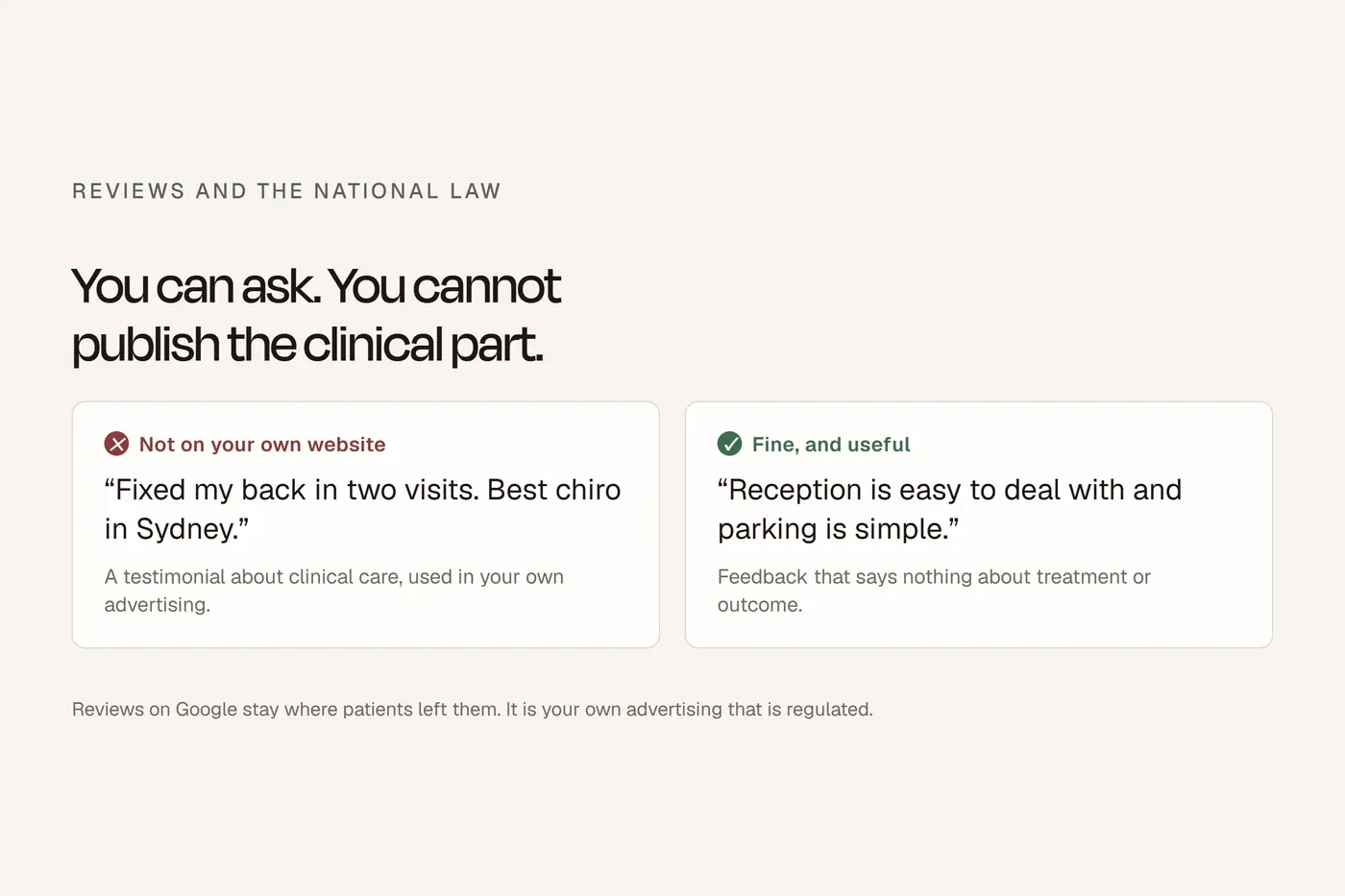
Ahpra's rules. Testimonials about clinical aspects are banned in your own advertising. Ahpra says practices aren't responsible for reviews on platforms they don't control, which includes Google. But it also says to take care when engaging with them, because that "may be considered using a testimonial". So patients can say what they like on Google; you can't copy it onto your website, quote it in an ad, or embed a Google reviews widget on your homepage. Google won't show review stars in search for reviews you host about yourself anyway.
Replying. Medical defence organisations Avant and MDA National both advise keeping replies general and taking the complaint offline. A patient can discuss their care in public. You can't, and confirming they're your patient is itself a disclosure. In 2024 the privacy commissioner found a real estate agency had breached the Privacy Act by replying to a Google review using the reviewer's full name. Something like "We take all feedback seriously. Please call the practice manager on 02 xxxx xxxx so we can talk it through" is enough. Our reviews and Ahpra guide has the full detail.
The Australian Dental Association is sceptical of review sites. Its social media policy says review sites "may be fraudulent, unreliable and open to bias" and that private communication and referral are fairer and more effective. That's worth knowing, but your patients still read them.
The website half
Google builds your profile partly from what it finds on your website and in third-party data. The site also competes on its own, in the ordinary results under the map. Five things matter.
One page for each treatment. A page about dental implants, with what's involved, who it suits, the risks, roughly what it costs and how to book, gives Google something to match to an implant search and gives the patient an answer. One "Our services" page with a list of twenty treatments does neither. Link each one from your homepage or menu: Google says every page you care about should have a link from at least one other page on your site.
No suburb-page farms. You'll be offered "location pages": Dentist Penrith, Dentist St Marys, Dentist Kingswood, each a near copy. Google's spam policies call pages built to funnel searchers from different towns to one place doorway pages, and a block of text listing suburbs you want to rank for counts as keyword stuffing. The ACCC has also acted on fake local presence: in 2024 an online florist was ordered to pay $1 million over 156 suburb websites and thousands of ads implying local shops it didn't have. A suburb page is fine when you have a practice in that suburb.
The same details everywhere. Practice name, address and phone number written the same way on your site, your profile and the directories below. Google doesn't call this a ranking factor, but it builds your profile from those sources, and conflicting details are how wrong hours and old phone numbers end up on the map.
Dentist structured data. Schema.org has a Dentist type, and Google's documentation says to use the most specific business type available, with your name and address as the minimum. It doesn't make you rank on its own. It removes guesswork.
A fast site that works on a phone. Google indexes the mobile version of your site, and says Core Web Vitals are used in ranking but won't beat relevance: it will show the most relevant page even if its experience is poor. Fast is necessary. It isn't enough.
On "near me": Google's John Mueller said in 2018 that adding "near me" to a page title doesn't make much sense, because Google works out what's near the searcher. Put your real address on the site and in your profile. Don't stuff "dentist near me" into your pages.
Directories worth ten minutes
Experts rate citations, meaning listings on other sites, lower every year. Getting the important ones right matters more than having hundreds.
| Listing | What it is | Worth it? |
|---|---|---|
| HotDoc | Booking platform and directory | If you use it. See our HotDoc and HealthEngine guide on fees |
| HealthEngine | Booking platform and directory | As above. It can also add a Book online button to your Google profile |
| Healthshare | Find a dentist directory | Yes, check your details |
| ADA Find a Dentist | Lists ADA member dentists | If you're a member |
| Apple Business | How you appear in Apple Maps. Formerly Business Connect | Yes. Every iPhone uses Apple Maps by default |
| Bing for business | How you appear in Bing and Microsoft products. Formerly Bing Places | Yes, it can import from Google |
| Yellow Pages | General directory | Check the details are right |
| Health fund networks | Bupa Members First, HCF More for Teeth, Medibank Members' Choice, nib First Choice | These are contracts with fee rules, not free listings. A business decision, not an SEO one |
Scroll the table sideways to see every column.
What to say no to
Most of what goes wrong in dental SEO is sold, not done by accident.
Keywords in your business name. Covered above. Suspension risk.
Any review scheme. Paid reviews, reviews written by staff or the agency, a discount for a five-star review, or a system that sends happy patients to Google and unhappy ones to a private form. That last one is called review gating and Google bans it. Under the Australian Consumer Law, fake reviews and reviews filtered to mislead are illegal, and maximum penalties for a company now run to $50 million or more. The ACCC took HealthEngine to court partly over how it handled patient reviews; the penalty was $2.9 million.
Bought links. Google's spam policies name buying links for ranking as link spam. Private blog networks, sold as "authority links", fall under the same policies.
Specialty categories you're not entitled to. Covered above. Legal risk, not just a Google one.
"Guaranteed first page." Google says there's no way to pay for a better local ranking. Nobody can guarantee one.
On cost: we couldn't find any reliable, independent figure for what Australian dental practices pay for SEO, so we won't quote one. When you're quoted a monthly retainer, ask what will actually be done each month, and whether any of it is on this list.
Local SEO for a dental practice: the checklist bdog.com.au · Current at October 2026
Business Profile
- Name exactly as on the sign. No suburbs, no treatments
- Primary category Dentist or Dental clinic
- No Orthodontist, Periodontist, Endodontist, Prosthodontist, Pediatric dentist or Oral surgeon category unless a registered specialist in that field practises there
- Other categories only if true
- Hours, public holidays and closures accurate. Emergency arrangements stated
- Services listed in patients' words, with prices where you can
- Your own booking page set as the preferred booking link
- Real photos of the practice and team
- A profile for each dentist who sees patients, name only
Reviews
- The same plain request to every patient
- No incentives, no staff quotas, no asking for specific content
- No review widgets or quotes on your own website
- Replies that never confirm someone is a patient
Website
- A page for each main treatment, linked from the menu or homepage
- Suburb pages only where you have a practice
- Name, address and phone the same as the profile
- Dentist structured data with name and address
- Fast on a phone
- "Dr" written with the profession beside it
Listings
- Apple Business, Bing, Healthshare, Yellow Pages checked
- HotDoc or HealthEngine details match, if you use them
Questions we get asked
What is local SEO for dentists?
Getting your practice into the map results and the ordinary results when someone nearby searches for a dentist or a treatment. Google says it ranks local results on relevance, distance and prominence.
What's the most important thing to get right?
Your Business Profile category, according to the main survey of local SEO experts. For a general practice, that's Dentist or Dental clinic.
Can I add "Orthodontist" as a category if we do Invisalign?
Not unless an orthodontist with specialist registration practises there. "Orthodontist" is a protected title under the National Law.
Should I put "dentist" and my suburb in our Google business name?
No. It breaks Google's guidelines and can get your profile suspended.
Can I ask patients for Google reviews?
Yes. Ask everyone the same way, offer nothing, and don't ask for particular content.
Can I put our Google reviews on our website?
Not ones that mention treatment, symptoms or results. In practice that means no widget.
Do suburb landing pages work?
Only where you have a real practice. Near-identical pages for suburbs you don't operate in are what Google's spam policies call doorway pages.
How long does local SEO take?
Profile fixes like the right category and accurate hours can show up within weeks. Reviews and links build over months. Distance never changes.
How much does dental SEO cost in Australia?
We couldn't find a reliable independent figure. Ask any agency what they'll do each month, and check it against the "say no" list above.
Does Google rank you higher for paying for Google Ads?
No. Google says there's no way to request or pay for a better local ranking.
About this guide
Written by bdog, a web studio that builds websites for Australian dental and allied health practices. We are not lawyers and this is not legal advice. Google rules are from Google's own help and Search Central pages; the specialist title rules are from the Health Practitioner Regulation National Law and the Dental Board of Australia; the ranking survey is Whitespark's 2026 Local Search Ranking Factors. All checked in October 2026.