How to get more dental patients, within the Ahpra rules
Cost is the most common reason Australians put off the dentist. Twelve ways to win and keep patients by fixing that, from fee tables and health funds to the CDBS, recalls and referrals, with the Ahpra, privacy and spam rules for each.
On This Page
- The rules, in one screen
- 1. Make the cost knowable
- 2. Say which funds and schemes you work with
- 3. Use the Child Dental Benefits Schedule
- 4. Public dental vouchers
- 5. Make booking easy
- 6. Recalls that stay inside the law
- 7. Reviews
- 8. Referral programs
- 9. Offers
- 10. Titles and words that get dentists reported
- 11. Google Ads
- 12. Social media
- Questions we get asked
Most dental marketing advice is written for American practices, where the rules are looser and the funding is different. In Australia every ad, post, recall SMS and web page you publish is advertising under the National Law, and the biggest thing keeping people out of the chair isn't a lack of ads. It's cost.
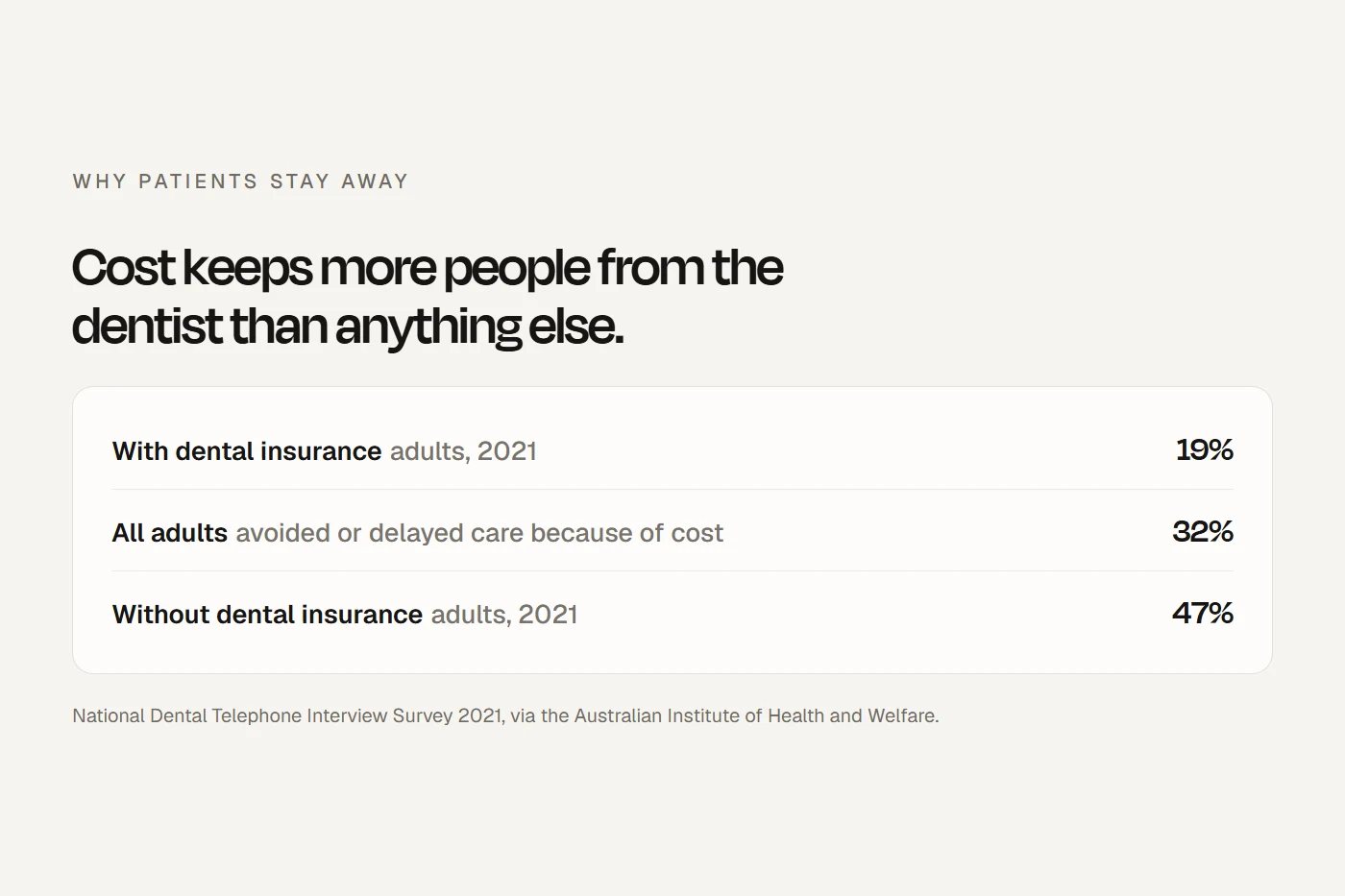
In the Bureau of Statistics' 2024 to 2025 patient experience survey, 16.1 per cent of people aged 15 and over who needed a dental professional delayed going, or didn't go, because of cost. In the most disadvantaged areas it was 23.1 per cent; in the least disadvantaged, 9.6. The last national dental telephone survey, in 2021, put it higher among adults: 32 per cent had avoided or delayed care because of cost, 19 per cent of those with dental insurance and 47 per cent of those without. And 11 per cent of adults in the last national oral health study hadn't seen a dentist in five years or more.
So the practices that grow are usually the ones that make the cost knowable, make the funding easy, make booking easy and then keep the patients they've got. Here's how to do each of those inside the rules.
The rules, in one screen
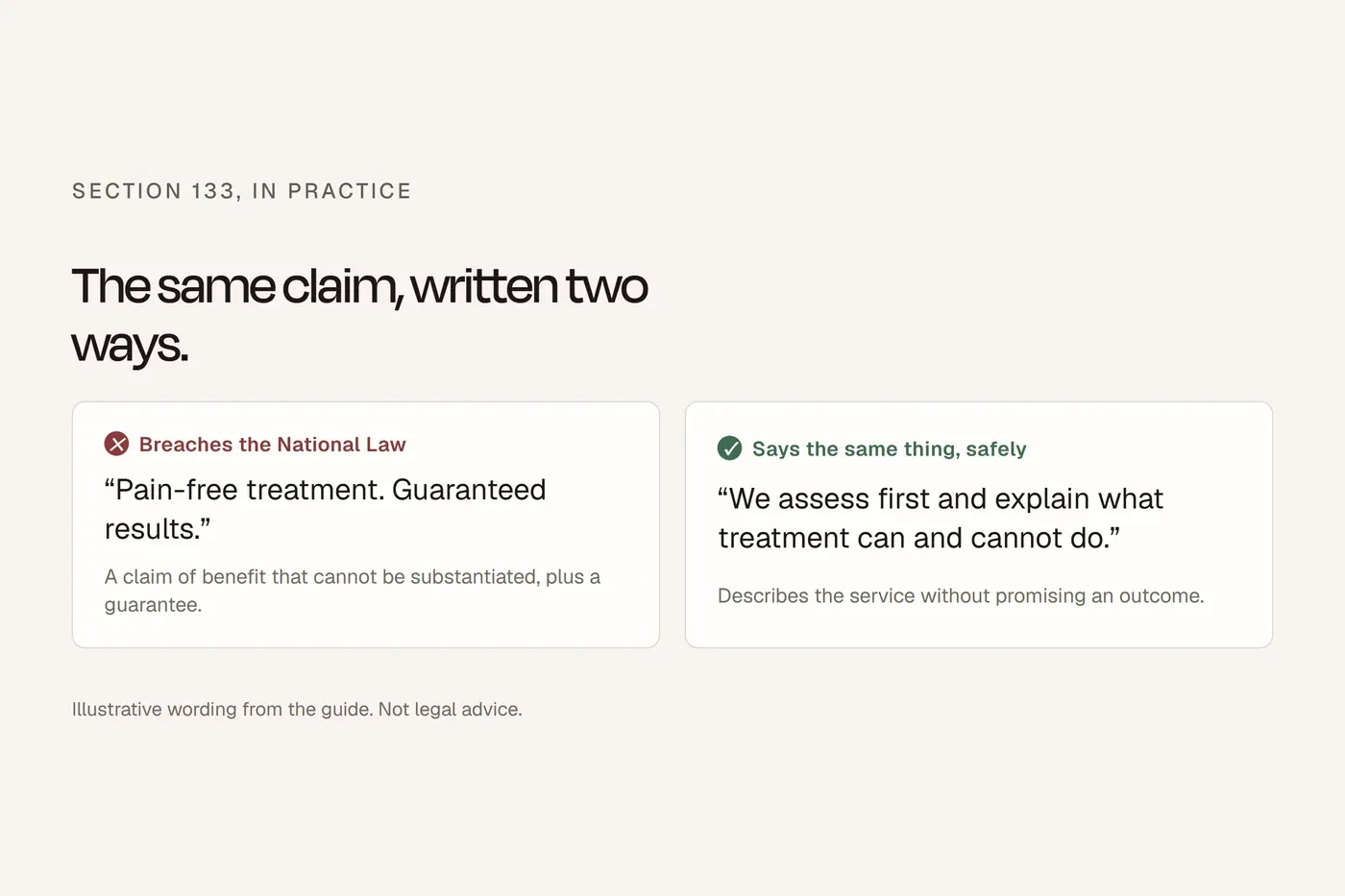
Section 133 of the National Law makes it an offence to advertise a regulated health service in a way that:
- is false, misleading or deceptive, or likely to be
- offers a gift, discount or other inducement without stating the terms and conditions
- uses testimonials
- creates an unreasonable expectation of beneficial treatment
- encourages indiscriminate or unnecessary use of health services
The maximum penalty is $60,000 per offence for an individual and $120,000 for a company, in every state and territory. Ahpra's definition of advertising includes websites, social media, directory listings and patient recall notices.
Dental veneers are also covered by Ahpra's guidelines for higher-risk non-surgical cosmetic procedures, in force since 2 September 2025. If you advertise veneers, those add more: the dentist's registration number when you name them, no images of anyone under 18, nothing aimed at under-18s, no "painless", and no procedure offered as a prize. Our Ahpra website checklist covers the general rules in full and the cosmetic advertising guide covers the 2025 ones.
1. Make the cost knowable
If cost is what stops people, the most useful thing on your website is a fee table. Most dental sites don't have one.
The Australian Institute of Health and Welfare publishes what health funds see. For 2024 to 2025, the median charge for a dental examination was $60, with a median benefit of $43 and a median gap of $16 for insured patients. For a scale and clean, item 114, the median charge was $118 and the median gap $25. A patient with extras cover who reads "check-up and clean from $X, with most members paying around $Y after their fund" knows whether they can afford to come in. A patient who reads "contact us for pricing" often doesn't call.
The rule to watch: Ahpra's guidelines say price information that is vague or inexact is likely to mislead, and so is leaving out restrictions. List the item numbers, say what's included, and say what can change the price. If you offer payment plans, Ahpra says an instalment amount without the total cost may breach the rules, so never write "$30 a week" on its own.
2. Say which funds and schemes you work with
HICAPS. If you claim on the spot, say so on your homepage. HICAPS covers all Australian private health insurers. "Claim on the spot with your health fund card" answers a question patients have before they book.
Preferred-provider networks. Bupa Members First, Medibank Members' Choice, HCF More for Teeth and nib First Choice each send members to participating dentists with better rebates. Some offer no out-of-pocket costs on check-ups and cleans for eligible members. Joining means agreeing to the fund's fee arrangements, so it's a business decision, not a marketing one, and the Australian Dental Association opposes third parties influencing which dentist patients choose. If you are in a network, say so plainly, and check your agreement for how you can use the fund's name and logo.
Careful with "gap-free" and "free". Ahpra's guidelines say people read "free" as absolutely free, and that when the cost is recouped elsewhere, including through Medicare or other sources, the offer isn't actually free. A check-up paid by a health fund isn't free to anyone. Write it the long way: "No out-of-pocket cost for check-ups for eligible HCF members with extras cover. Annual limits and waiting periods apply."
3. Use the Child Dental Benefits Schedule
The Child Dental Benefits Schedule pays up to $1,158 per eligible child over two consecutive calendar years, for the period starting in 2026. Children aged 0 to 17 are eligible if they're Medicare-eligible and the family receives a relevant government payment such as Family Tax Benefit Part A. It covers examinations, x-rays, cleaning, fissure sealing, fillings, root canals, extractions and partial dentures. It doesn't cover orthodontics, cosmetic work or anything done in hospital.
The AIHW estimates that only just over a third of eligible children used it between 2018 and 2021. That's a lot of families who don't know, and a practice that explains it clearly on one page, and says whether it bulk bills, is answering a question nobody else nearby is answering.
The rules: if you bulk bill a CDBS service, the benefit is the full payment, and by law you can't charge any co-payment. You need a signed consent form at each visit, private health insurance can't top up a CDBS item, and bulk-billed claims for services from 5 September 2025 have to be lodged within a year. On your website, write "bulk-billed for eligible children under the Child Dental Benefits Schedule", not "free kids' dental".
4. Public dental vouchers
Most states send some public patients to private practices with a voucher. In New South Wales, the Oral Health Fee for Service Scheme covers adults with a Health Care Card, Pensioner Concession Card or Commonwealth Seniors card who've been triaged by the public service, with vouchers of up to $485 for urgent care, $1,070 for general care and $1,870 for dentures. Victoria, Queensland, Western Australia and South Australia run their own schemes. If you take vouchers, say which on your fees page. Patients who hold one are actively looking for a practice that accepts it.
5. Make booking easy
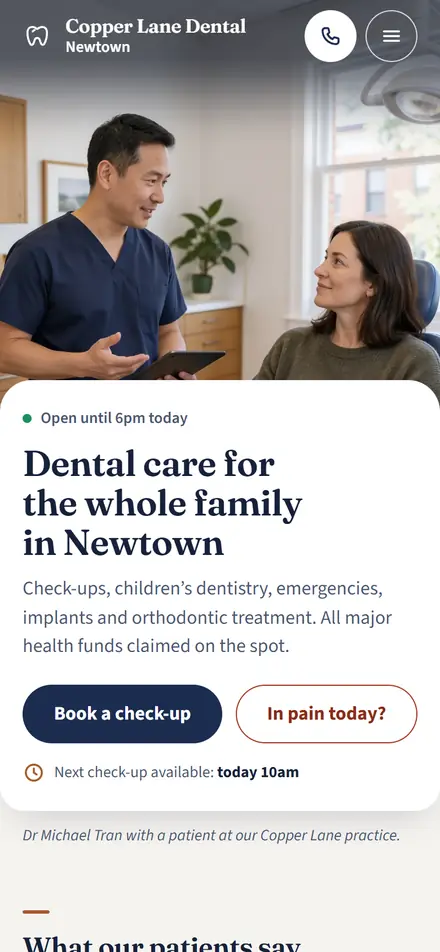
The patient you've convinced still has to book. On a phone, that means a phone number they can tap and a Book Now button on the first screen, your hours and suburb visible, and online booking that works without a login. Our online bookings guide covers every common system, including the fees some directories charge for bookings you could have taken yourself.
If you see emergencies, say when and how, and make sure it's true. "Same-day emergency appointments" has to mean same day. If you don't take after-hours calls, say where patients should go instead.
6. Recalls that stay inside the law
Keeping a patient is cheaper than finding one, and the recall is how you keep them. Three sets of rules apply to it.
Ahpra. Recall notices are advertising. Tie them to the clinical interval the dentist has recommended for that patient, not a blanket "time for your six-monthly visit" to everyone, because encouraging unnecessary use of a health service is one of the five offences.
The Spam Act. A message that's no more than factual information, like "Your appointment with Dr Lee is at 10am on Thursday", plus who it's from, doesn't need consent or an unsubscribe link. A message that's marketing, like "It's been a year, book now and get 10 per cent off whitening", is a commercial message: it needs consent, it has to identify you, and it needs an unsubscribe that works.
The Privacy Act. Your patient list is health information. The OAIC's guidance on Australian Privacy Principle 7 says using sensitive information, including health information, for direct marketing needs the person's consent, even if they're an existing patient. Add a clear marketing consent tick box to your new-patient form, separate from treatment consent, and only send marketing to people who ticked it.
7. Reviews
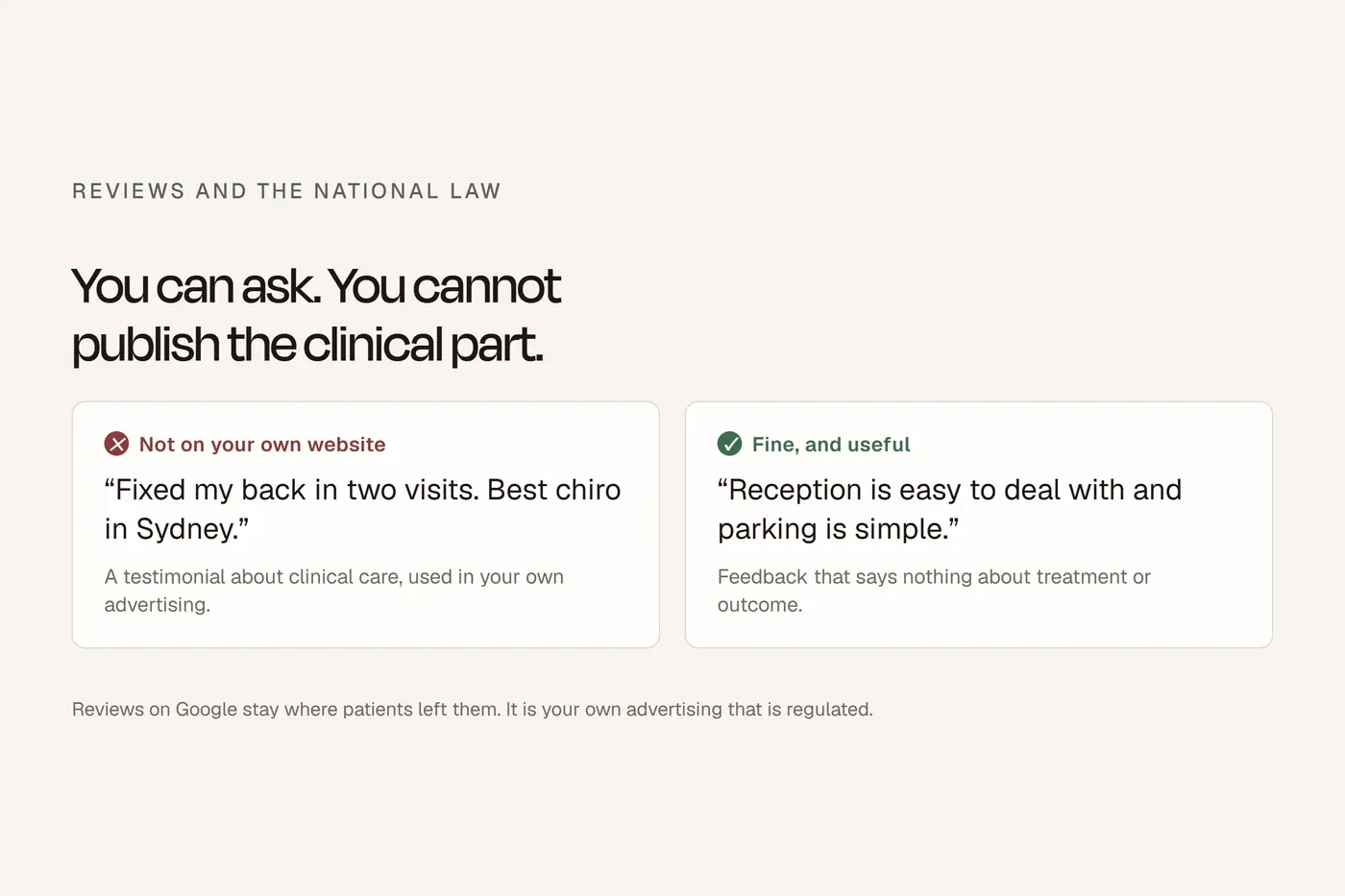
You can ask every patient for a Google review. You can't offer anything for one, ask only the happy ones, or quote clinical reviews in your own advertising. Ahpra's FAQ says showing a star rating from a review site on your website is not likely to breach the testimonial ban, as long as you don't republish the reviews behind it. That's a useful middle ground: "4.8 stars from 312 Google reviews", linked to your profile, with no quotes. The detail is in our reviews and Ahpra guide, and the map side is in our local SEO guide for dentists.
8. Referral programs
Ahpra uses a refer-a-friend offer as one of its own examples. A $20 discount on a first visit for friends and family of existing patients was non-compliant only because it had no terms and conditions. With terms added, such as "only available to new patients", Ahpra presents it as compliant. Keep the reward modest: Ahpra says prizes or incentives whose value greatly outweighs the cost and risk of the service can encourage unnecessary use.
Referral relationships with other practitioners are different. The Shared Code of Conduct, which applies to dentists, says not to offer inducements to colleagues or enter arrangements that could be seen as inducements, and to declare any financial interest. No referral fees to GPs, specialists or anyone else.
9. Offers
Discounts are allowed with the terms stated in plain language, either in the ad or behind a link that's easy to find. Ahpra's FAQ says discounts for pensioners or Health Care Card holders are fine with terms. The common breaches are leaving out who's eligible, when it ends or where it applies, and anything that pushes people to buy more treatment than they need, such as bulk-purchase deals. For veneers, no procedure can be a competition prize.
One offer to leave alone completely: early release of superannuation. In May 2024 the Dental Board said Australians accessed $313.4 million of super for dental treatment in 2022 to 2023, up 83 per cent, and urged dentists to comply with the advertising rules. The Board lists advertising compassionate release of super as a warning sign for patients, and the ADA's advertising policy says not to advertise it.
10. Titles and words that get dentists reported
"Specialist". There are 13 recognised dental specialties, and only dentists with specialist registration in one can use the title. Ahpra says "specialist", "specialises in", "specialty" and "specialised" are likely to mislead when used by a general dentist. "Substantial experience in" or "working primarily in" are less likely to.
Orthodontics. A general dentist can provide orthodontic treatment, including clear aligners. They can't call themselves an orthodontist or say they specialise in orthodontics. In 2018 an unregistered man who held himself out as an orthodontist was fined $65,000 plus $25,000 in costs.
"Cosmetic dentist" and "implant dentist". Neither cosmetic nor implant dentistry is a recognised specialty. We found no Ahpra or Dental Board statement banning either term, and Ahpra allows descriptive terms that don't imply specialist registration, but both carry risk. "Dentist with a focus on cosmetic dentistry" is safer.
"Sedation dentist". Conscious sedation is a Dental Board endorsement. Only endorsed dentists can provide it, and Ahpra's guidelines prohibit claiming an endorsement you don't hold. Nitrous oxide on its own doesn't need the endorsement, so say exactly what you offer.
"Pain-free" and "painless". Ahpra lists "pain-free", "safe" and "risk-free" as language that can mislead when used without acknowledging risk. For veneers, "painless" isn't allowed at all. "We'll talk you through options for comfort, including numbing and nitrous oxide" says the useful thing without the claim.
"Dr". Write the profession beside it on your website: "Dr Sam Lee (Dentist)".
11. Google Ads
Google's healthcare policy says ads targeting Australia can't use prescription drug terms in the ad or on the page it leads to. That matters if your practice offers anti-wrinkle injections alongside dentistry. Google also treats health conditions and invasive procedures as a sensitive category for personalised advertising, which can rule out remarketing and customer-list audiences. Routine dentistry isn't named, but an ad about implants or gum disease may be classed as health, and Google decides case by case. Every ad, sitelink and landing page is advertising under the National Law too, so the same rules on testimonials, "free" and "specialist" apply.
12. Social media
Social media is advertising, and the testimonial rules cover your own pages. Patient comments on your Facebook page are your responsibility, which is why Ahpra suggests turning reviews off there. For veneers and other higher-risk cosmetic procedures, the 2025 guidelines make you responsible for anything an influencer or content creator posts for you, and liking or responding to a review counts as using it. The ADA's social media policy says to get a patient's consent before involving them in any post.
Getting more dental patients inside the rules bdog.com.au · Current at October 2026
Cost
- A fee table for common items, with item numbers and what's included
- What can change the price is stated
- Payment plans show the total cost, not just the instalment
- HICAPS claiming mentioned on the homepage
- Health fund networks named accurately, with the conditions
- No "free" or "gap-free" without the eligibility and limits
- A CDBS page that says whether you bulk bill
- Public dental vouchers you accept are listed
Booking and keeping patients
- Phone and Book Now on the first screen
- Emergency arrangements stated, and true
- Recalls tied to each patient's clinical interval
- Marketing consent collected separately on the new-patient form
- Marketing messages carry an unsubscribe; reminders stay factual
Words
- No "specialist" or "specialises" without specialist registration
- No "orthodontist" for a general dentist
- No "sedation dentist" without the endorsement
- No "pain-free" or "painless"
- "Dr" with the profession beside it
- Registration numbers shown where veneers are advertised with a named dentist
- No early-release super advertising
Offers and reviews
- Every offer has its terms stated or a clear link to them
- Referral rewards are modest, with terms
- No referral fees to other practitioners
- Reviews requested from everyone, with no incentive
- Star rating shown on the site if you like, no review quotes
Questions we get asked
What's the most effective way to get new dental patients?
Make cost and funding clear, then make booking easy. Cost is the most common reason Australians give for delaying dental care.
Can I advertise a free check-up?
Only if it's genuinely free to the patient, with the terms stated. Ahpra says an offer recouped through a health fund, Medicare or a price rise elsewhere isn't free.
Can I say "gap-free" for health fund members?
Say who it applies to, which fund, which level of cover, and that annual limits and waiting periods apply.
Can I run a refer-a-friend offer?
Yes, with modest rewards and the terms stated. Ahpra uses a $20 first-visit discount with terms as a compliant example.
Can I pay a GP for referrals?
No. The Code of Conduct says not to offer inducements to colleagues.
Can I call myself a cosmetic dentist?
It isn't a specialty, and it carries risk. "Dentist with a focus on cosmetic dentistry" is safer.
Can a general dentist advertise Invisalign or clear aligners?
Yes, as long as nothing implies they're an orthodontist or a specialist.
How much is the Child Dental Benefits Schedule in 2026?
Up to $1,158 per eligible child over two consecutive calendar years.
Do I need consent to send recall SMS?
Not for a purely factual reminder. Yes for anything promotional, and the Privacy Act needs consent to use health information for marketing at all.
Can I show our Google star rating on our website?
Ahpra says a star rating on its own is not likely to breach the rules. Don't republish the reviews behind it.
About this guide
Written by bdog, a web studio that builds websites for Australian dental and allied health practices. We are not lawyers or accountants, and this is general information, not legal or financial advice. Check anything that matters with your indemnity insurer, the ADA or the relevant agency. Everything here was checked against the sources below in October 2026.
Main sources:
- Ahpra, Guidelines for advertising a regulated health service
- Ahpra, advertising examples for all professions
- Ahpra, advertising FAQ
- Department of Health, Guide to the Child Dental Benefits Schedule
- ABS, Patient Experiences 2024 to 2025
- AIHW, Oral health and dental care in Australia
- ACMA, avoid sending spam
- OAIC, APP 7 direct marketing
- Dental Board, conscious sedation