What an engineering firm website needs
There’s no national engineer licence, and each state’s rules reach your website: who’s registered, which titles are protected, and what you can say about insurance, ISO and Engineers Australia. With a rules quiz, a profile line builder and a website check.
On This Page
Search for engineering firm websites and you mostly get big consultancies' homepages and design galleries, which are no help to a small practice. Nothing on page one covers the part that's specific to engineers: there's no national licence, each state registers engineers differently, some titles are protected by law, and there are rules on insurance claims, Engineers Australia's logo and "ISO certified". Get those wrong on a website and it's not just a bad look. This guide covers them, from each state's Act and regulator and from Engineers Australia, read on 12 October 2026, and then what builders, architects and councils look for when a referral sends them to your site. It's general information, not legal advice. Check your state's regulator for anything specific.
- Put registrations against people, not the companyQueensland, Victoria, NSW and the ACT register individual engineers only. Name each engineer with their registration, area and state.
- Use protected titles only where they're held"RPEQ" in Queensland, "professional engineer" in Victoria, WA's prescribed titles. A graduate's bio can't use them.
- Make every claim checkableInsurance, ISO certification, panels and Engineers Australia credentials: only if current, stated exactly, and never with the EA or ISO logo.
Who reads an engineering firm's website
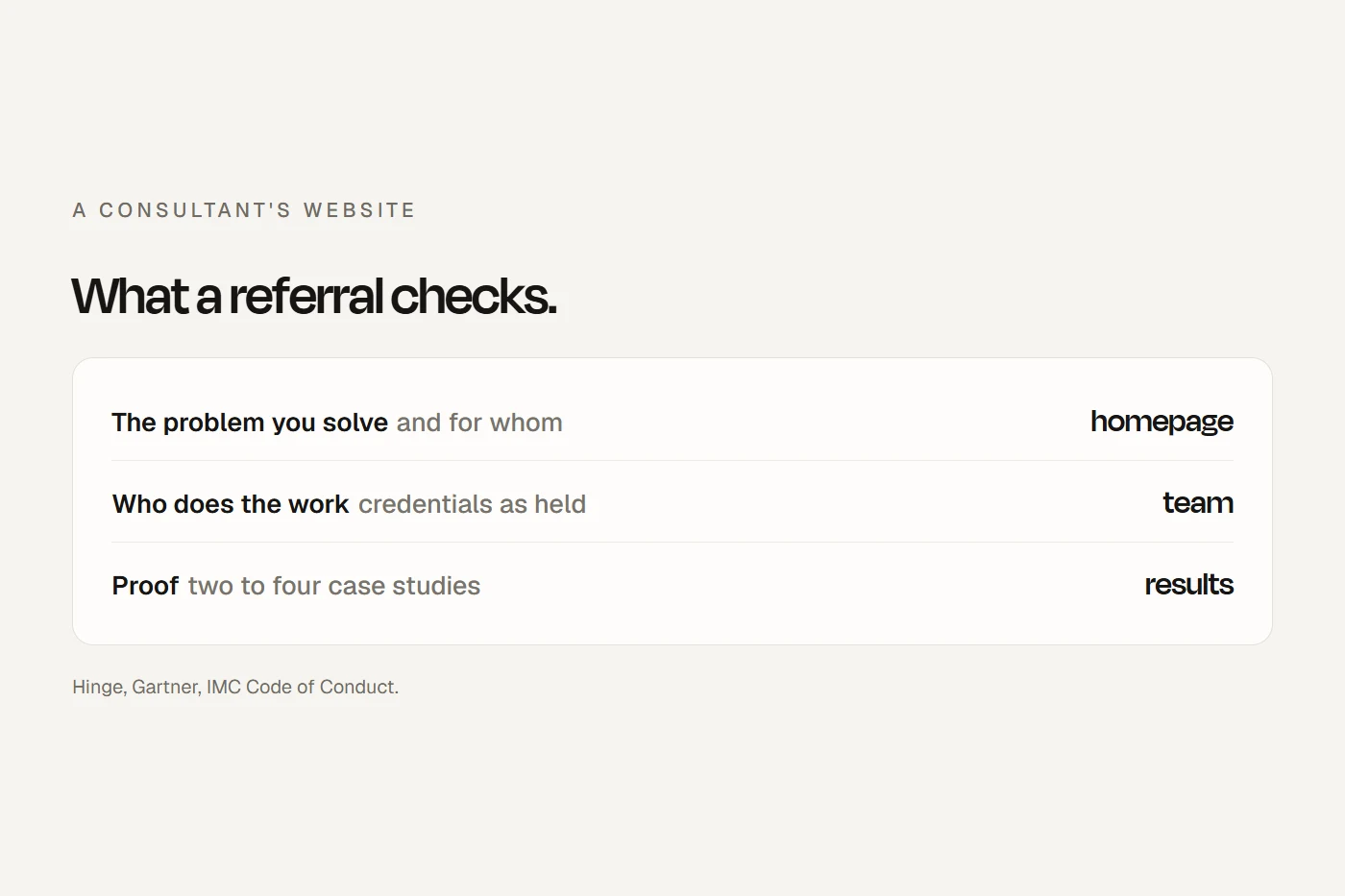
I couldn't find any Australian survey of how builders, architects, developers, homeowners or councils choose a consulting engineer. In the nearest professional survey, the architects' institute found seven in ten clients came by referral. My view is that engineering works the same way: most work arrives through a referral or a panel, and the website is where the builder, architect or council officer checks you before they ring. They want to know four things quickly: are your engineers registered for this work in this state, have you done projects like this, how fast do you turn work around, and how do I get in touch.
Clients can check registration themselves. Queensland's board says the public can search for an RPEQ "by name, location, area of engineering or RPEQ number", Victoria, NSW and the ACT publish registers, and Engineers Australia's National Engineering Register "is available for anyone to search". So whatever your site says about registration will be checked against those.
Registration, state by state
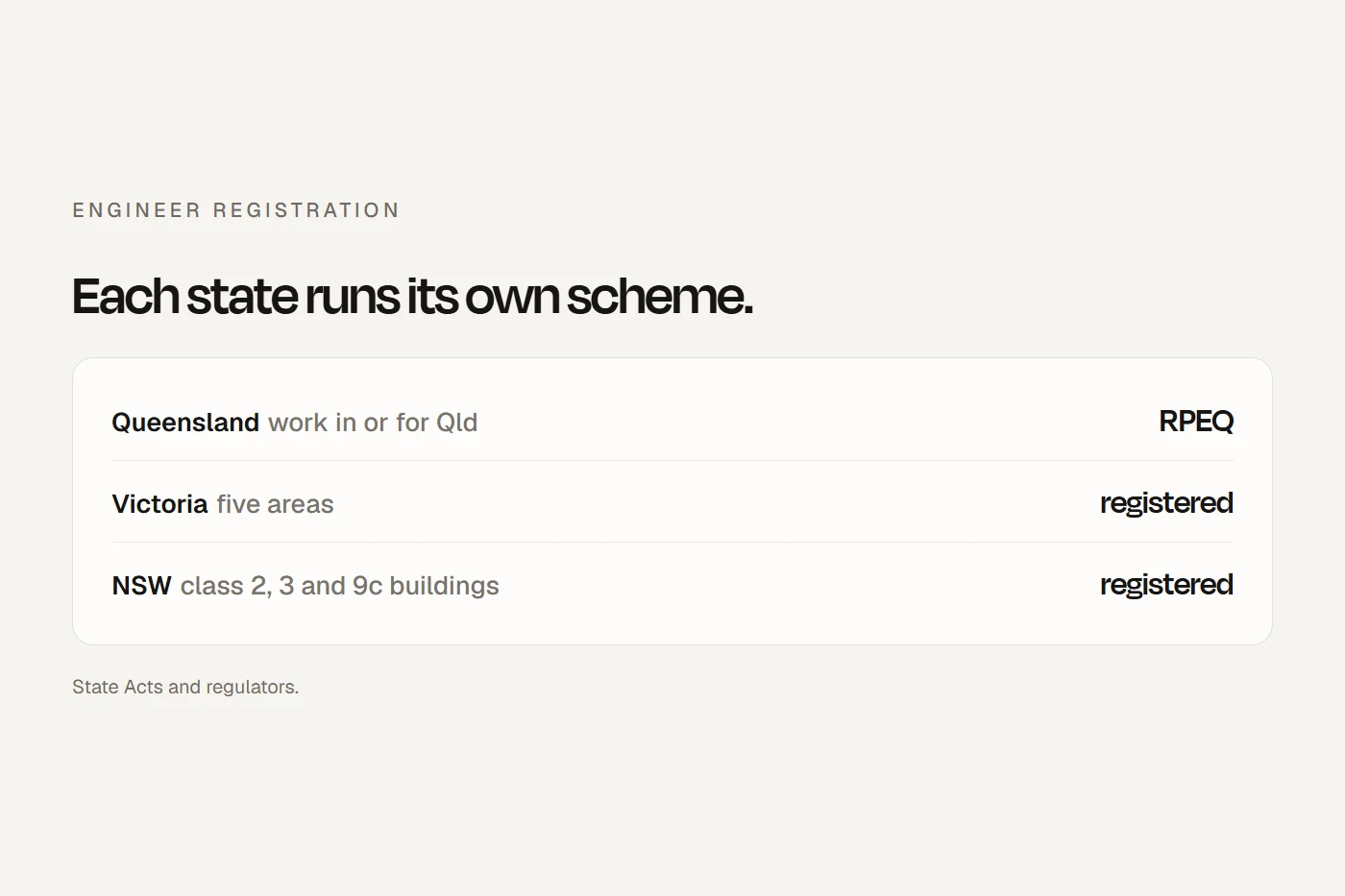
There's no national engineer licence. Each scheme covers different work:
| State | Who must be registered | Protected words |
|---|---|---|
| Queensland | Anyone providing professional engineering services in or for Queensland, from anywhere, unless directly supervised by a practising RPEQ | "registered professional engineer", "registered professional engineer of Queensland", "RPEQ" |
| Victoria | Engineers in Victoria, or serving Victorian projects, in structural, civil, mechanical, electrical and fire safety engineering; building industry work also needs an endorsement | "professional engineer"; "endorsed building engineer" |
| NSW | Engineers working on class 2, 3 and 9c buildings (apartments and similar), in six classes including geotechnical | No title offence, but falsely claiming registration is one |
| ACT | Engineers providing services in five areas | No title offence, but a false claim of registration is one |
| WA | Building engineering in four areas once the transition ends; the business also registers as a contractor to contract with clients | Prescribed titles such as "Registered Building Engineer" |
| Tasmania | Building services work under an Engineer licence | Holding out as licensed when you're not |
| NT | Certifying engineers | Registration as a building practitioner |
Scroll the table sideways to see every column.
I couldn't confirm a registration scheme in force in South Australia, so say nothing about SA registration either way. The word "engineer" on its own isn't protected in any of the Acts I read.
What this means for your website:
- Registration belongs to people. Queensland, Victoria, NSW and the ACT register individuals only; NSW's own page says "Companies cannot apply". So don't write "NSW registered" or "RPEQ certified" against the company. Name the engineers, their registration, the area and the state.
- Match your service areas to your registrations. A Sydney firm advertising Queensland work needs RPEQs doing or supervising it. Queensland's board says its Act applies "regardless of whether any of the work is physically undertaken in Queensland".
- Don't imply NSW registration covers everything. It's for work on class 2, 3 and 9c buildings. If you only do houses, sheds, commercial or civil work in NSW, you don't need it, and you shouldn't claim it.
- Graduates work under supervision, and their bios can't use protected titles or say "registered". Queensland's board has prosecuted someone who put "RPEQ" in a report's signature block without being registered, and has warned about the same thing on LinkedIn profiles, websites and email signatures.
- Take it down the day it lapses. Registration claims have to be true now, not when the bio was written.
Registration numbers
Only two places write a number into advertising law for engineers. In WA, a registered building service contractor must show its registration number in any advertisement for its services, which on its face includes a registered building engineering contractor's website, though WA's own guidance only mentions builders, painters and surveyors. In the NT, a company registered as a building practitioner must name its registered individual in its ads. Tasmania's regulator says engineers don't have to list their licence number in advertising. Everywhere else, it's good practice: it's the first thing a builder or certifier will check, and it saves them a phone call.
Engineers Australia, insurance and ISO
Engineers Australia credentials and logo
Engineers Australia says its credentials, such as Chartered, NER and membership post-nominals, can only be used when they're current and "held by the individual using them". You can show them on websites, CVs and LinkedIn. The logo is different: it "is not allowed for business promotion, including engineering companies or services", and Engineers Australia lists "using the logo on company websites or marketing material" as not allowed. Queensland's board also points out that membership of Engineers Australia "is not registration". So credentials go next to each person's name, in text, and the logo goes nowhere.
Professional indemnity insurance
PI insurance is required for registered engineers in NSW, for endorsed building engineers in Victoria, for Tasmanian licensees and WA contractors, and it's expected under the Queensland and ACT codes. NSW makes it an offence for a registered engineer to "hold out that the engineer is adequately insured" unless they are. No rule requires you to mention insurance on your website. "Professional indemnity insured" is a fair line if it's true. The insurer and cover limit belong in your capability statement and tenders, where they're kept current.
ISO 9001
ISO says it "does not perform certification or issue certificates" and doesn't allow its logo to be used for certification. Certification comes from a certification body, ideally one accredited through JASANZ, and NSW's prequalification scheme for construction consultants asks for ISO 9001 certification "through an organisation listed by JAS-ANZ". Say "ISO 9001 certified by [certification body]" only with a current certificate. If you run your own system to the standard, "quality system aligned with ISO 9001" is accurate. Never use the ISO logo. A false certification claim is a misleading representation about approval or affiliation under the Australian Consumer Law.
Projects, credit and confidentiality
Project pages are where most engineering sites make claims, so a few rules apply:
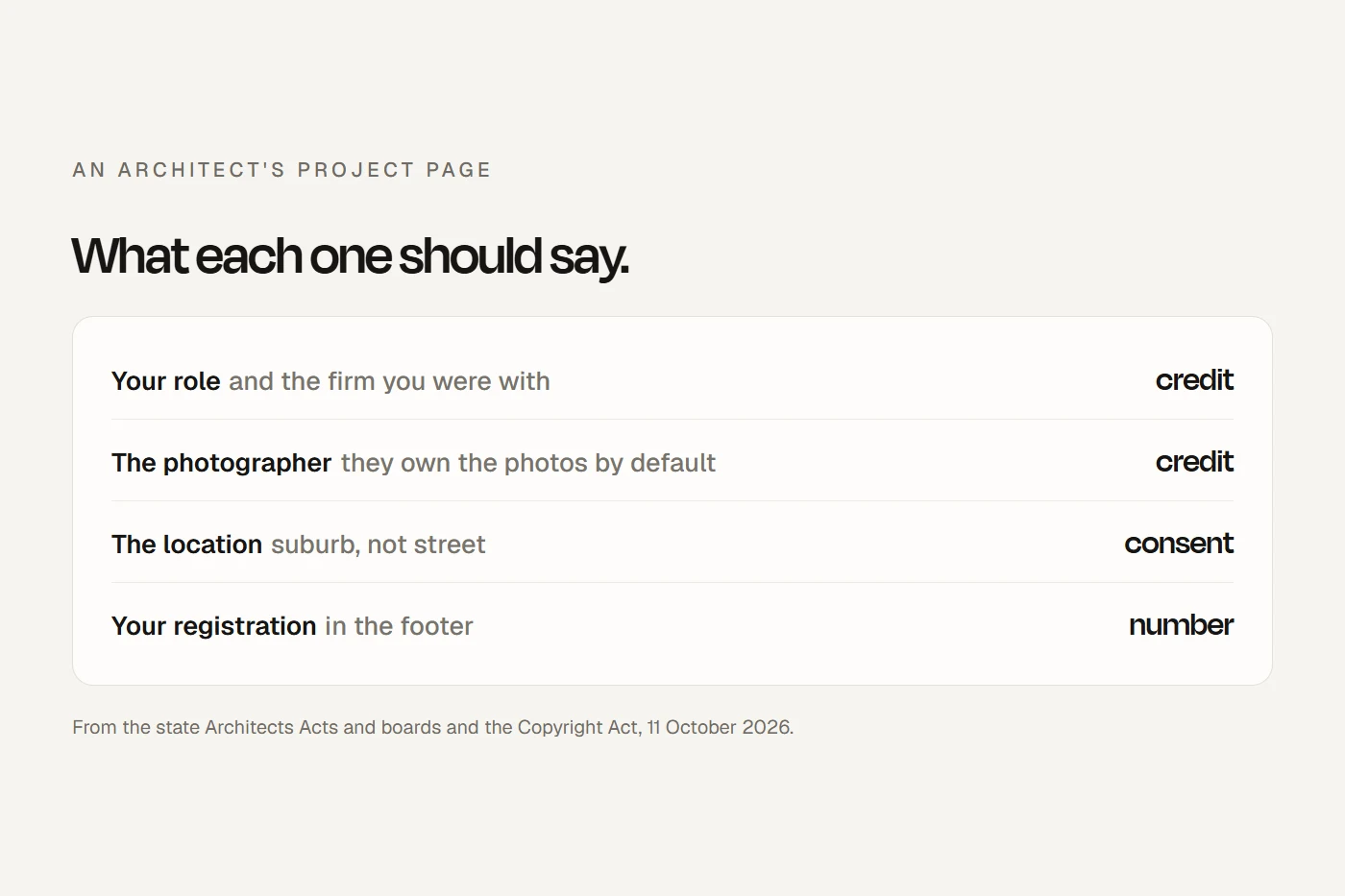
- State your role. Victoria's and the ACT's codes bar letting your name be used to falsely represent authorship of, or responsibility for, work. Engineers Australia's code says not to misrepresent "experience or prior responsibilities". If you did the structural design and someone else did the civil, say so.
- Label work from a previous firm. "Structural design, while at [previous firm]" is accurate; listing it as your firm's project isn't.
- Get consent before naming clients. Queensland's code says engineers keep client information confidential unless authorised in writing, and NSW's code has a similar duty. Ask before you name a client, quote a report or show someone's house.
- Credit photographers, and make sure your licence covers web use. Commissioned photographers own the copyright unless you've agreed otherwise.
- No government or council logos that suggest an endorsement you don't have.
What clients look for
Beyond the rules, these are the sections that make a referral pick up the phone:
- Services by discipline and deliverable. A visual inspection, a written report, design drawings and a certification are different things, at different prices. Say which you do.
- Sectors and building types. Houses, apartments, commercial, industrial, civil, education, health. Builders look for "have you done this kind of job".
- Turnaround, defined. "Site visit within five working days" means something; "fast turnaround" doesn't. Make sure it's true, because claims about service have to be based on reasonable grounds.
- Service area. Only places you really serve, and states where your engineers are registered.
- Prequalification and panels, named exactly: scheme, category and tier. NSW's Consultants in Construction scheme, for example, asks for referee reports and insurance certificates, so keep those current. Queensland and Victoria run their own prequalification registers.
- Contact details, including your principal place of business, an easy way to upload plans and photos with a privacy note, and a capability statement to download.
- Prices, if you show them. Many of your clients are homeowners, so any price shown to consumers has to be a single total including GST.
Write your engineer line
Every engineer on your team page, capability statement and email signature needs the same few facts. Fill this in to get a consistent line:
Which rules apply to you?
How does your website score?
Tick what your site already does, and tick anything that doesn't apply to you. Items near the top come from the law and count for more. Your ticks save in this browser.
- Protected titles only on people who hold them: RPEQ, "professional engineer" in Victoria, WA's prescribed titles.
- No claim that the company, or an unregistered person, is registered.
- Services offered only where a named registered engineer does or supervises the work.
- "Endorsed building engineer" only if endorsed (Victoria).
- Insurance claims true.
- WA contractor registration number on advertising, if you're a registered contractor.
- Any price shown to consumers is a single total including GST.
- Testimonials and reviews genuine, with records.
- Each engineer named with discipline, registration, number and state.
- Engineers Australia credentials only if current, against the person.
- No Engineers Australia logo.
- Projects state your role, and previous-firm projects are labelled.
- Client consent before naming clients or showing homes.
- "ISO 9001 certified" only with a current certificate, and no ISO logo.
- No government or council logos implying endorsement.
- Services split by deliverable: inspection, report, design, certification.
- Service area and states served.
- Turnaround defined: response, site visit, documents.
- Sectors and building types you work on.
- A capability statement with ABN, key people, projects and insurances.
- Panels and prequalification named exactly.
- Links to the registers so clients can check.
- Phone, email and principal place of business.
- A plan and photo upload with a privacy note.
Your capability statement
Government buyers and many builders ask for one, and Business Queensland calls it "a resume for your business". Keep one master copy and link to it from your site. What goes in, following Business Queensland's guide and NSW's prequalification requirements:
- Business overview: legal name, ABN or ACN, offices and states served.
- Disciplines and services, by deliverable.
- Key people: name, role, degree, registrations by state with numbers, and current Engineers Australia credentials.
- Sectors and building types.
- Three to six projects: your role and scope, with clients named only with consent.
- Quality, safety and environment: certifications with the certifier's name, or "aligned with" if not certified.
- Insurances held, with certificates on request.
- Prequalification and panels, named exactly.
- Referees, with their permission.
- Memberships, as text rather than logos.
My view
An engineering website wins work by being easy to check. Every claim on it, from registration to insurance to ISO, can be looked up by the builder or council officer reading it, so make each one current, exact and attached to a named person. Then show projects like the one they're planning, say how fast you turn work around, and make it easy to send you plans. That's most of what a referral needs before they call.
Questions I get asked
Do engineers have to show their registration number on their website?
Only WA (for registered building engineering contractors) and the NT (naming the registered individual) write it into advertising law. Everywhere else it's good practice, because clients check.
Can an engineering company be registered?
Not in Queensland, Victoria, NSW or the ACT, where only individual engineers register. In WA, the business registers separately as a building engineering contractor.
Can I use the Engineers Australia logo on my website?
No. Engineers Australia says its logo isn't allowed for business promotion, including on company websites. You can show current credentials, such as Chartered or NER, against the person who holds them.
Who can call themselves an RPEQ?
Only engineers registered by the Board of Professional Engineers of Queensland. The titles "RPEQ", "registered professional engineer" and "registered professional engineer of Queensland" are protected.
Can I say my firm is ISO certified?
Only with a current certificate from a certification body, and name it. ISO doesn't certify anyone and doesn't allow its logo for certification. If you follow the standard without certification, say "aligned with ISO 9001".
About this guide
Written by Joseph Alzein, founder of bdog. bdog builds websites for engineering firms. The rules come from each state's Act and regulator, Engineers Australia, ISO and JASANZ, read on 12 October 2026. Registration schemes are changing, so check your state's regulator. This is general information, not legal advice.
Main sources:
- Professional Engineers Act 2002 (Qld)
- Board of Professional Engineers of Queensland: FAQs
- Professional Engineers Registration Act 2019 (Vic)
- Design and Building Practitioners Act 2020 (NSW)
- Professional Engineers Act 2023 (ACT)
- Engineers Australia: credentials and logo
- ISO: certification
- JASANZ: accreditation marks
- NSW: Consultants in Construction scheme
- Victoria: Construction Supplier Register