Marketing a family law practice
How people find a family lawyer, what the Family Law Act stops you publishing, specialist and accreditation wording, costs and free consultations, family dispute resolution practitioners, a website that’s safe and conflict-aware, and each channel. With a wording check, a website checklist and an enquiry calculator.
On This Page
Family law isn't marketed like other legal work. The people you want to reach are often frightened, sometimes in danger, and one partner's search history may be visible to the other. The Family Law Act limits what you can publish about any case, Google restricts how you can target people going through a divorce, and "no win, no fee" isn't available. This guide is for small family law firms, sole practitioners and family dispute resolution practitioners who want more enquiries from their website, Google and referrers. It covers how people find a family lawyer, the rules specific to family law, a website that's safe and conflict-aware, and each channel. It's general information, not legal advice; check anything you're unsure of with your law society's ethics service.
- Most family clients come through peopleFriends, family, a lawyer they've used before, and the professionals they already trust. Make those referrals easy to act on.
- Build the website for safety and conflictsA quick exit button, a safe-contact question, and an enquiry form that runs a conflict check before anyone tells their story.
- Never identify anyone in a caseThe Family Law Act makes it an offence to publish an account of proceedings that identifies a party, witness or relative. That rules out most case studies and "win" posts.
How people find a family lawyer
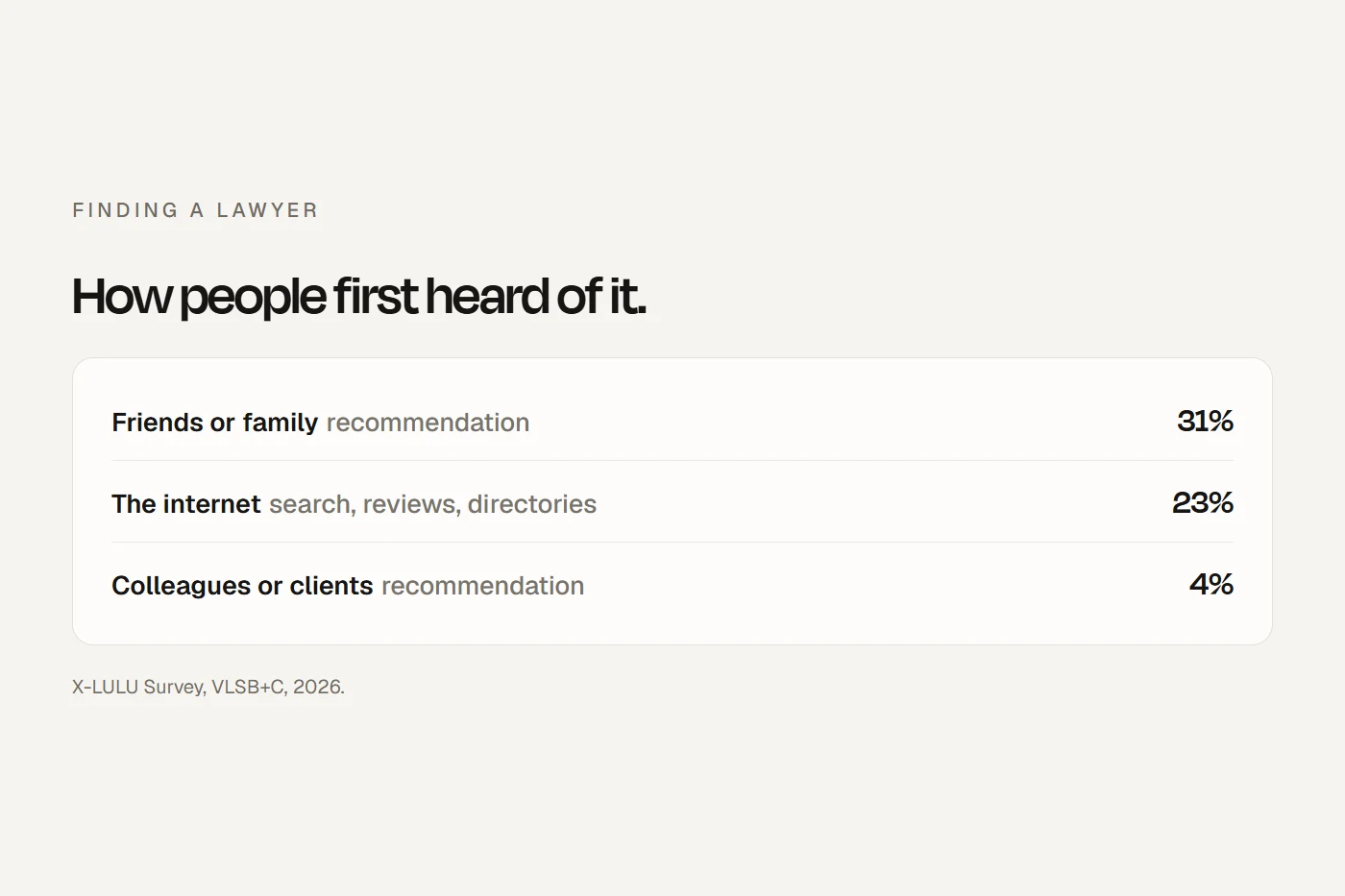
There's no Australian survey of how people choose a family lawyer specifically, but the evidence points one way. The Victorian Legal Services Board's survey of legal service users outside Victoria found people with family matters were less likely to have found their lawyer on the internet, and more often found them through friends or family. They were also more likely to go back to a solicitor they'd used before: the idea of "the family lawyer". Face-to-face contact was strongly associated with family matters. In Victoria, private solicitors were the most common source of legal help for a disputed separation, with legal aid and community legal centres handling a large share too.
Most separations never reach a lawyer as the main path. Australian Institute of Family Studies research found most separated parents sorted out arrangements between themselves, a minority through mediation or family dispute resolution, fewer through lawyers, and only a few per cent through the courts. Those who do reach court are disproportionately families affected by violence or safety concerns.
The court's own numbers show the shape of the work. There are about a hundred thousand family law applications a year, and the number is edging up. Almost half are divorce applications, and applications for consent orders (agreed outcomes) outnumber applications for contested final orders. In most parenting cases that reach the court, family violence is alleged, and the share has risen every year.
One more thing worth knowing: the court won't send people to you. Its website says court staff "cannot refer you to a private lawyer" and points people to each state's law society referral service, legal aid and community legal centres. So a law society listing is one of the few official doors into private practice.
What you can't publish
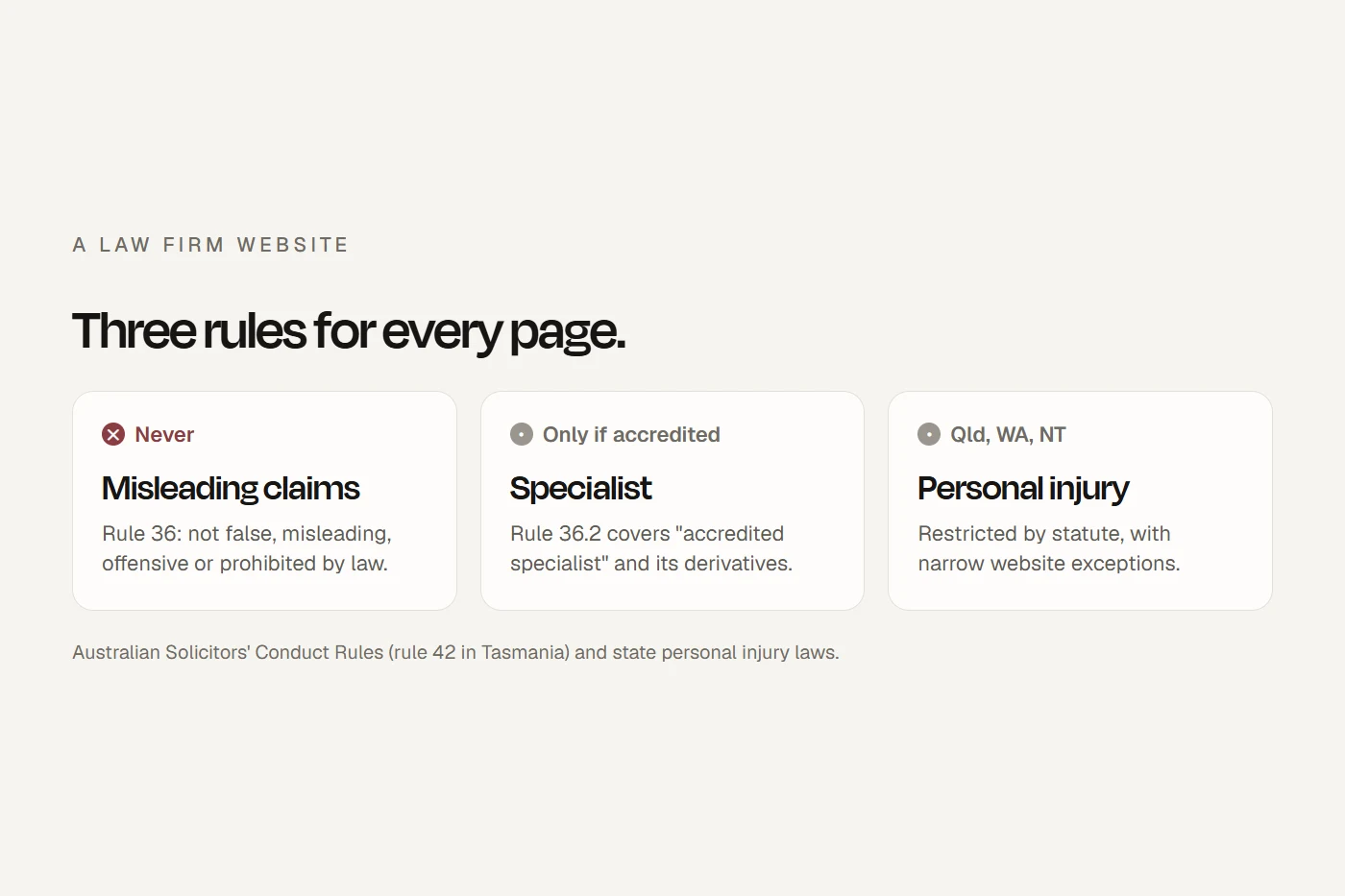
Part XIVB of the Family Law Act (sections 114N to 114T, which replaced the old section 121) makes it an offence to communicate to the public an account of proceedings that identifies a party, a witness, a person related to or associated with a party, or anyone else concerned in the matter. "Communicate" expressly includes the internet and social media.
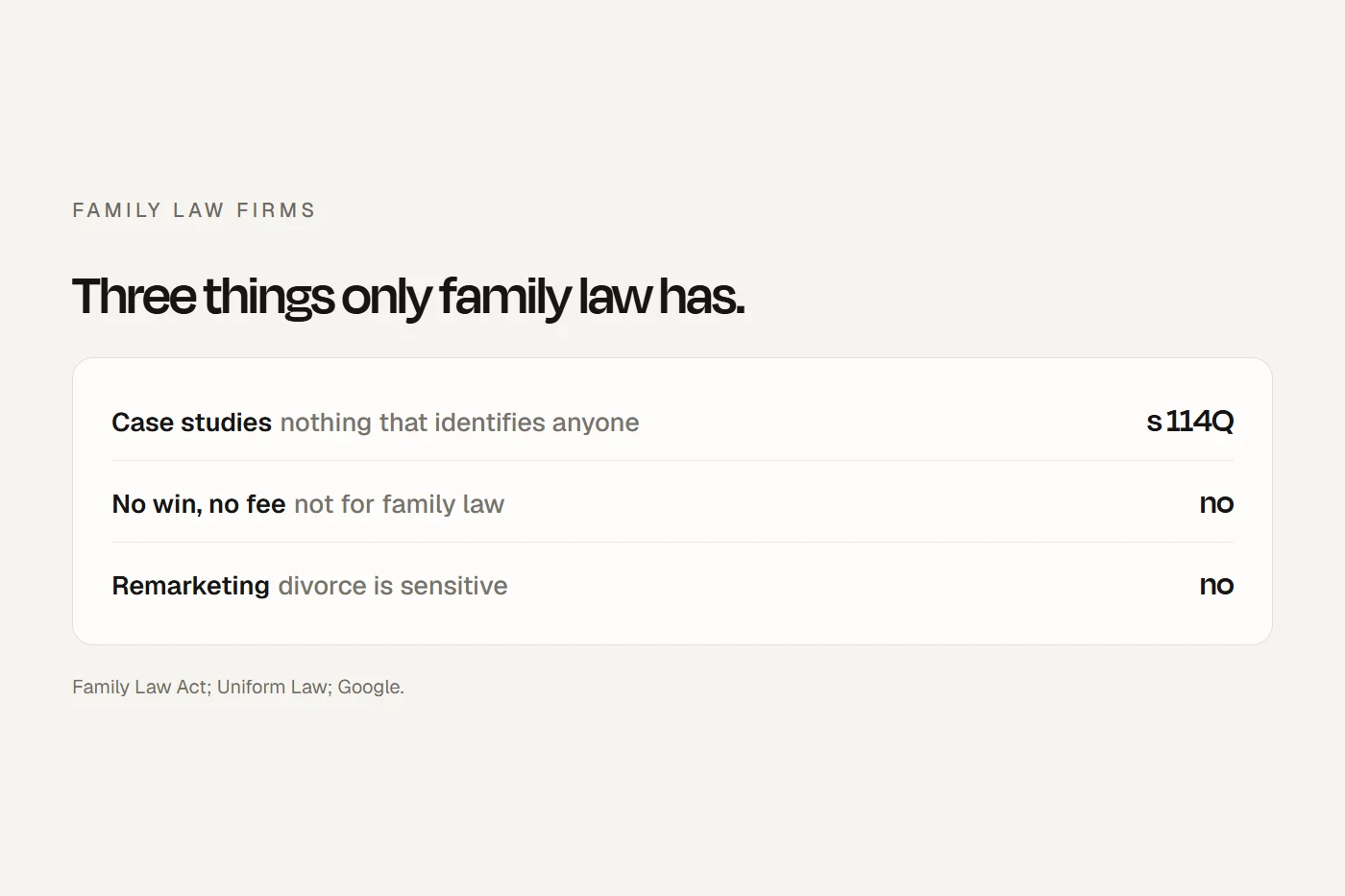
The identifying test is wide. Section 114Q(3) says an account identifies someone if it includes material sufficient to identify them to a member of the public, and lists examples: a picture or description, a name, where they live or work, their job, their relationship to an identified person or business, their beliefs, and property associated with them. So "a Parramatta nurse kept the family home" can be enough. In practice that means:
- No case studies that describe a real matter with a suburb, job, business, property or photo.
- No social posts about "today's win in court".
- No testimonials that name the other party or the children, and no review replies that add any detail.
Matters that settle without proceedings aren't "proceedings under this Act", but your duty of confidentiality still applies to them. And state family violence laws carry their own publication bans: a Queensland tribunal disciplined a solicitor for an email that identified a party and a child.
"Specialist" and accreditation
Family law specialist accreditation is run by the law societies in NSW, Queensland, South Australia and Western Australia, and the Law Institute of Victoria. Accreditation belongs to the person, not the firm. The Law Society of NSW gives exact wording: "John Smith is an Accredited Specialist in Family Law" or "We have an Accredited Specialist in Family Law" is correct; "We are accredited in Family Law" is not. Queensland Law Society says its logo must sit next to the accredited person's name, never the firm's. Family law is federal, so recognition in another participating state follows an application to that state's board.
Plain "specialist" is less settled. The NSW and Queensland accreditation guides say general terms like "specialist" and "expert" are outside their control. But Queensland Law Society's ethics guidance reports the Legal Services Commission's view that "specialist" is a derivative of the restricted term, and everywhere the conduct rules ban a false impression of specialist expertise. The safe default: only accredited people use "specialist". Everyone else can say "family law is all we do" if it's true.
Costs, fixed fees and free consultations
- "No win, no fee" isn't available. The Uniform Law (NSW, Victoria and WA) says a conditional costs agreement can't relate to proceedings under the Family Law Act.
- Costs disclosure. The usual written disclosure applies when you're retained. Family law adds the court's own layer: before each court event, the lawyer must give the client a written notice of actual and estimated costs, and file and serve a copy on the other side. Your estimates end up on the court file anyway, so a fees page that's honest about stages and ranges fits how the court already works.
- Free first consultation. It's allowed if it's genuine. A WA tribunal found nothing wrong with "Your first consultation is free" where the consultation was real advice, not unrealistically short, and not charged if the client went ahead. Say how long it is and what it covers.
- Fixed fees. Show the total, and say what's excluded, such as the court filing fee.
Family dispute resolution practitioners
Most parenting applications can't be filed without a section 60I certificate from a family dispute resolution practitioner, so FDR practitioners see separating parents early. The rules for marketing an FDR practice:
- Say you're an "accredited family dispute resolution practitioner". The Attorney-General's Department discourages putting your registration number on your website, and the public FDR Register lets people check you and find you on a map, if you consent to showing your contact details.
- A non-lawyer practitioner can't give legal advice in FDR, except on procedural matters.
- Fees must be given in writing before sessions, so putting them on the website matches what you already do.
- FDR confidentiality only protects accredited or court-authorised practitioners, so a mediator who isn't one shouldn't imply it.
- Don't advertise a guaranteed certificate or a certificate "in 48 hours": the kind of certificate depends on your assessment and on the other party.
- Information from FDR can't be used for personal gain, which sits badly with case stories drawn from sessions.
Check your copy
Paste a page, ad or post. It flags the phrases most likely to cause a problem in family law.
It catches common patterns, not everything.
A website that's safe and conflict-aware
Quick exit. No law requires one, but the Family Court's website and respect.gov.au both have a quick exit button on every page, and the NSW Government design system has one. Keep it always visible in the same place, working on phones, and loading a neutral page quickly. Both government sites explain plainly that it doesn't clear browsing history, and so should yours, with a short note on private browsing.
Safe contact. The Law Society of NSW's guide for family lawyers on domestic and family violence says to ask for and record safe contact details and safe times, mindful of shared phone accounts, shared calendars and email the other party can access. Put that question on the enquiry form, so your first reply doesn't put anyone at risk.
Conflict checks. A prospective client who tells you confidential information can become a former client you can't act against. Family law always has an identifiable other party, and family courts have been reluctant to accept information barriers. So ask for the other party's name first, keep the form to the minimum, and ask people not to send details until you've confirmed you can act.
Privacy. Enquiries often contain sensitive information about health, allegations, the other party and children. Keep submissions in a secure inbox, out of marketing tools, and keep ad pixels off the enquiry and family violence pages.
- A quick exit button on every page, always visible, working on phones.
- A short note on what quick exit does and doesn't do, and how to browse privately.
- 000 and 1800RESPECT linked in the footer or on the contact page.
- The enquiry form asks for the other party's name for a conflict check.
- It asks how and when it's safe to contact them.
- It asks people not to send details until you've confirmed you can act.
- Minimum fields, a collection notice, a secure inbox, and no ad pixels on the form.
- A fees page: first consultation terms, fixed fees and exclusions, and how estimates work.
- No "no win, no fee" anywhere for family law.
- "Accredited Specialist" only beside the accredited person's name, in the law society's wording.
- No case studies or posts that could identify anyone.
- Testimonials only with written consent, de-identified, never naming the other party or children.
- Articles checked for outdated law, such as equal shared parental responsibility.
- For FDR practitioners: "accredited family dispute resolution practitioner", fees shown, no registration number, no legal advice unless you're a lawyer.
My law firm website checklist covers the items every firm needs.
The channels
- Referrers. The people separating clients already trust: counsellors, GPs, accountants, FDR practitioners, other lawyers who do their wills or conveyancing, and past clients. Your state law society's referral service. If you do legally aided work, your legal aid commission's private practitioner panel. Paying any referrer needs prior, written disclosure to the client.
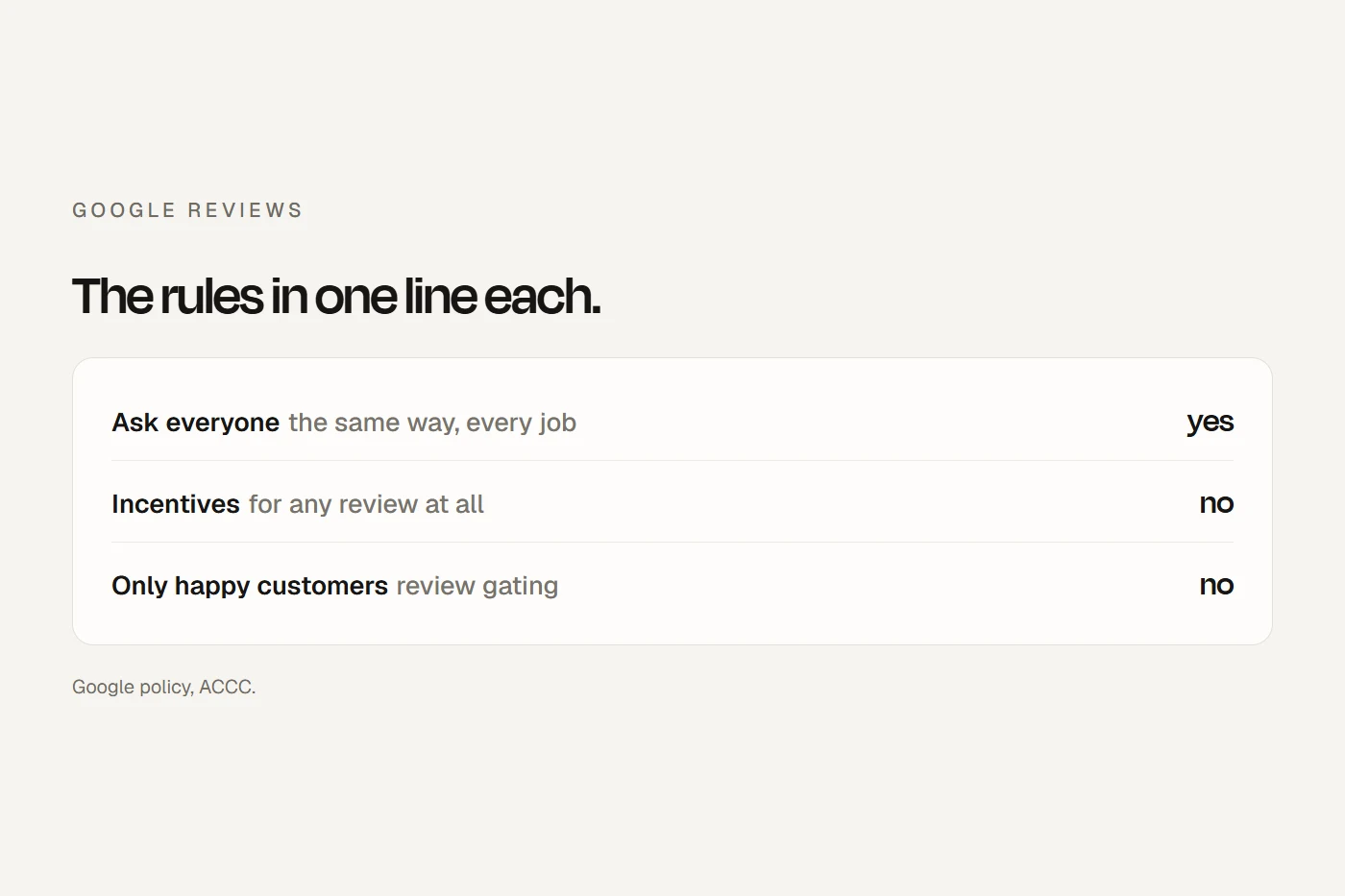
- Google Business Profile and reviews. Ask every finished client the same way, with no incentive. Some family clients won't want to post, since a review reveals they separated, but ask everyone anyway: Google bans asking only some. Reply without confirming anything: your duty of confidentiality means you can't discuss any matter, and in family law never mention the other party or children.
- Google search ads. Allowed on keywords. But Google treats divorce services as a sensitive "relationship hardships" category, so no remarketing to people who visited your divorce page and no uploading client lists. Keep "specialist" out of ad text unless accredited.
- Meta ads. Meta's personal attributes rule doesn't cover marital status, so "Going through a separation?" is allowed there. Lines about money hardship or mental health aren't.
- Content. The court and the Attorney-General's Department publish neutral how-to material on divorce, property, parenting and family dispute resolution. Link to it and add what the court can't give: advice on what to do in a particular situation and what it costs. The Act already requires lawyers to tell clients about non-court options, parenting plans and the best interests of the child, which makes good, balanced content.
- Social media. Post about the law and the process, never about a case.
Enquiries to clients
Family law loses enquiries to conflicts in a way other practices don't, so count them. The defaults are a made-up example, not industry figures.
Track where each new client came from. If most arrive through referrals, that's where the next hour of your time is best spent.
My view
A family law website does two jobs other legal sites don't: it has to be safe for someone whose phone may not be private, and it has to protect you from a conflict before anyone tells their story. Get those right, say plainly how fees work, and keep every word about cases general. The clients come mostly through people who trust you, so the best marketing is making that trust easy to pass on.
Questions I get asked
How do family lawyers get clients?
Mostly through people: friends and family, past clients, and professionals like counsellors, GPs and accountants. Law society referral services, a safe and clear website, Google reviews and search ads add to that.
Can family lawyers use case studies?
Not ones that could identify anyone. The Family Law Act makes it an offence to publish an account of proceedings that identifies a party, witness or relative, and a job or suburb can be enough. Describe the legal issue only, invented and labelled as an example.
Can a family lawyer offer no win, no fee?
Not in NSW, Victoria or WA, where conditional costs agreements can't be used for Family Law Act proceedings. Fixed fees and staged estimates are the alternative.
Should a family law website have a quick exit button?
It isn't legally required, but the Family Court's own site and respect.gov.au have one, and it's good practice for anyone at risk. Explain that it doesn't clear browsing history.
Can I call myself a family law specialist?
Safely, only if you're accredited by your law society, in its wording, next to your name. In Queensland the regulator treats plain "specialist" as restricted.
About this guide
Written by Joseph Alzein, founder of bdog. bdog builds websites for family law firms. The rules come from the Family Law Act, the court's Family Law Rules, the Family Dispute Resolution Practitioners Regulations, the Uniform Law, the law societies' accreditation guides, the Attorney-General's Department, Google and Meta. Data is from the Victorian Legal Services Board's lawyer use surveys, the Australian Institute of Family Studies and the court's annual report, described without dated figures. This is general information, not legal advice.
Main sources:
- Federal Circuit and Family Court: find a lawyer
- Federal Circuit and Family Court: personal safety online
- VLSB+C: lawyer use survey outside Victoria
- Law Society of NSW: accredited specialist branding guidelines
- Attorney-General's Department: practical considerations for FDR practitioners
- Google Ads: relationship hardships
- respect.gov.au: online safety