How long does SEO take for a small business in Australia?
What happened to Google’s “four months to a year” line, the waits Google does publish for profiles, indexing, site moves and core updates, what makes a local business faster or slower, and a timeline you can work out from your own numbers. With an estimator, a six-month checklist and a sorter for SEO promises.
On This Page
Ask how long SEO takes and you'll hear anything from "two to four weeks" to "twelve to eighteen months", often from the same kind of agency. Google's own answer box still says "According to Google's official guidance, most businesses need 4 months to a year". Google has removed that line from its guidance. This guide is for an Australian local business owner who has been told SEO takes six to twelve months and wants an honest answer before paying for it, or while wondering whether what they're paying for is working. It separates the waits Google actually publishes from the part nobody can promise, and gives you a way to work out your own. I build websites for local businesses and set up their Google profiles; everything here is from Google's own documentation unless I say otherwise.
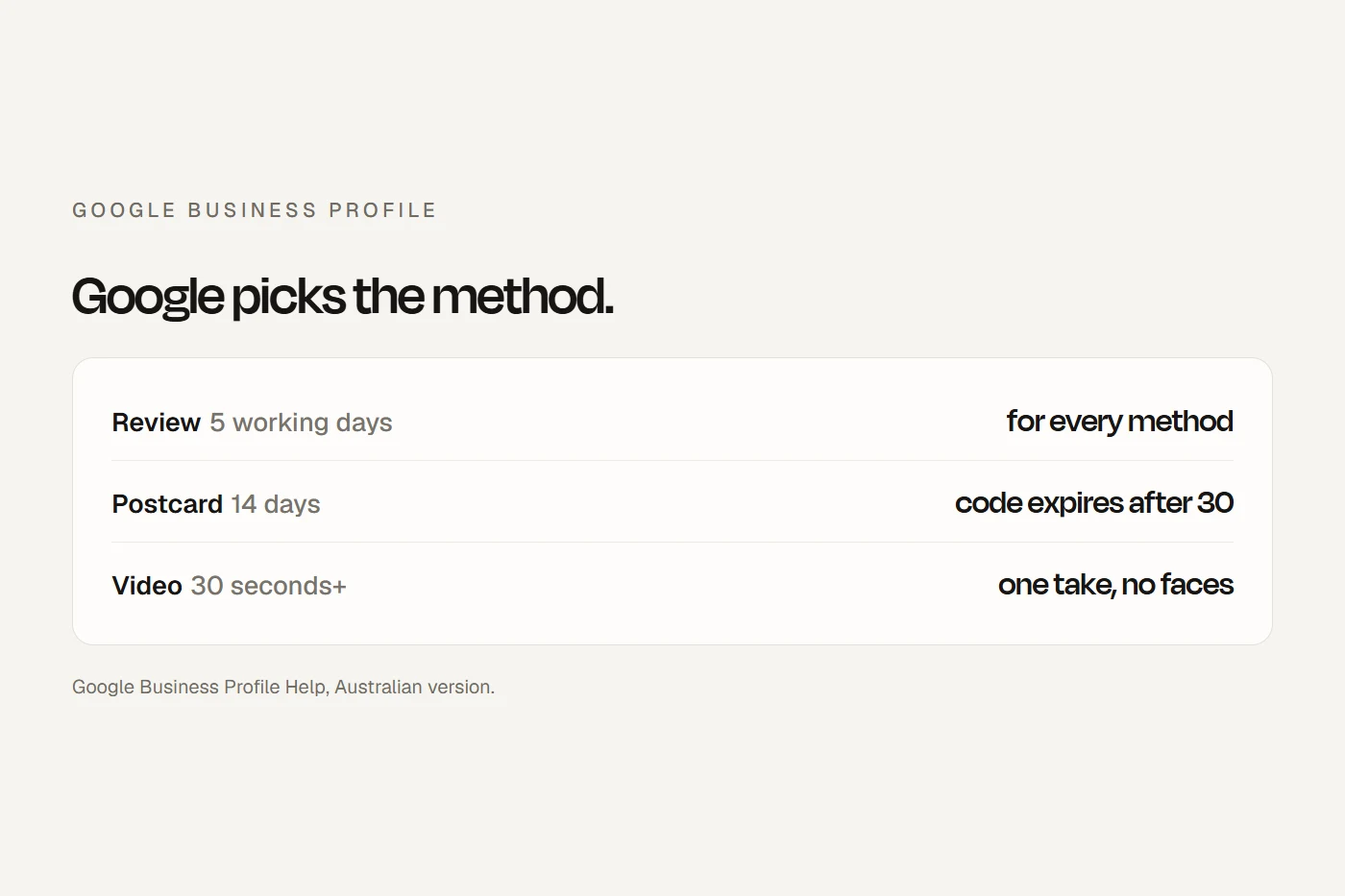
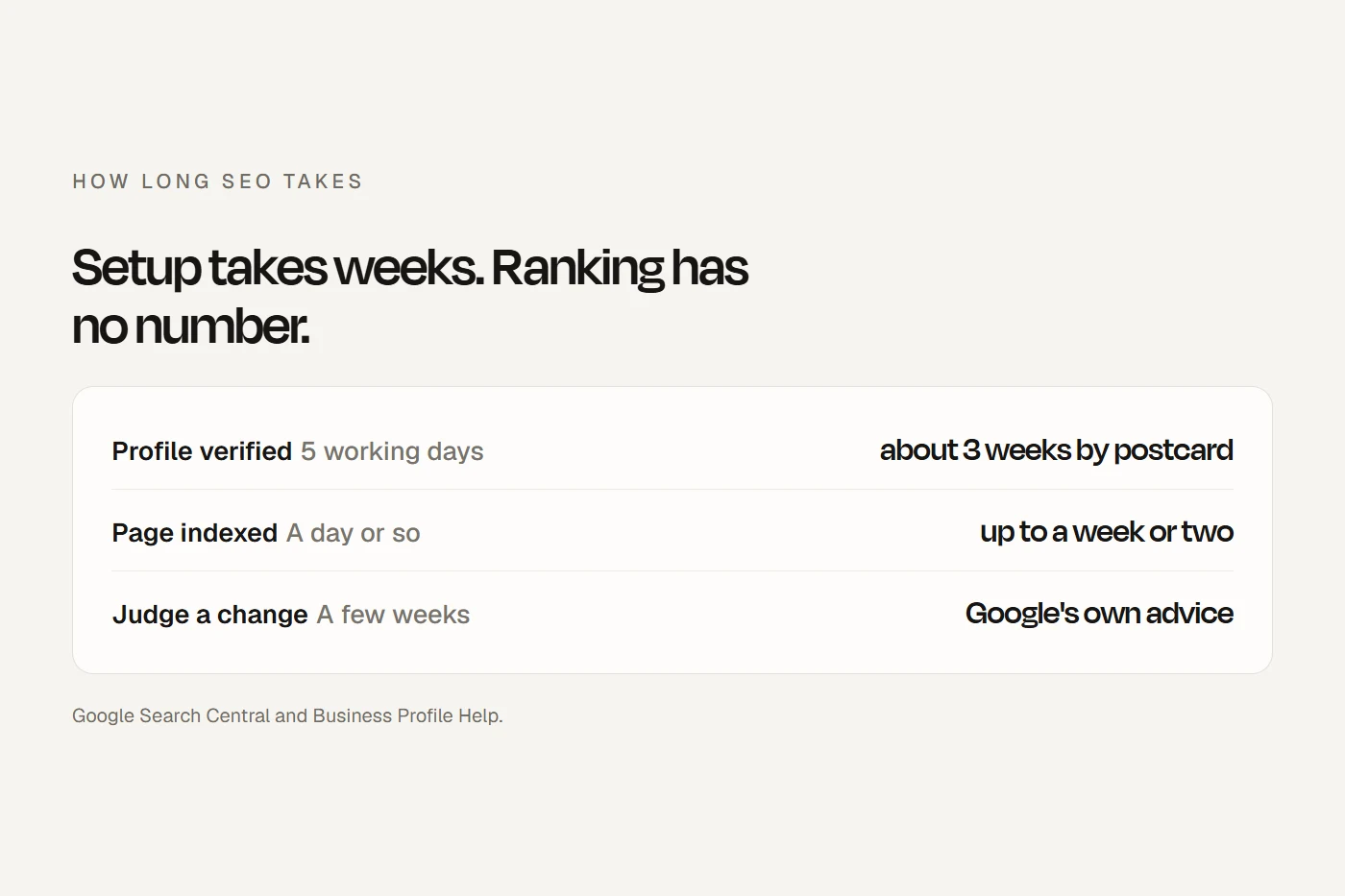
- Setup takes weeksGoogle publishes the waits: up to five working days to verify a Business Profile (about three weeks by postcard), a day to a week or two to index a page, a few weeks to notice a new site.
- Judge after a few weeksGoogle says changes take "a few hours" to "several months", and to "wait a few weeks to assess" whether they worked.
- Ranking has no numberHow long it takes to outrank competitors depends on them, mostly on reviews and how established their sites are. Anyone who promises a date is guessing.
What happened to "four months to a year"
For years, Google's page on hiring an SEO said results "typically" take "from four months to a year". Google has since rewritten that page and dropped the number. It now tells you to ask the SEO: "What kind of results do you expect to see, and in what timeframe? How do you measure your success?" Most "6 to 12 months" figures you'll read trace back to that old line or to a poll of SEO professionals, not to any study. I found no Australian data on SEO timelines at all.
What Google's current guide says is this: "Some changes might take effect in a few hours, others could take several months. In general, you likely want to wait a few weeks to assess whether your work had beneficial effects."
The waits Google does publish
| What | Google's published time |
|---|---|
| Business Profile postcard arrives | "Most codes arrive within 14 days" |
| Business Profile verification review | "up to five working days"; instant possible if your website is verified in Search Console |
| Profile edit approved | "up to 10 minutes", sometimes "up to 30 days" |
| Service area change shows | "up to 48 hours" |
| Photos show | A day or two |
| A new review appears | "might take a few days" |
| A new site is noticed | "a few weeks" |
| A page you ask Google to index | "a day or so", up to "a week or two" |
| Changed pages recrawled | "a few days to a few weeks" |
| Judge whether a change worked | "wait a few weeks" |
| A small site moves to new addresses | "a few weeks for most pages" |
| Keep old redirects | "at least 1 year" |
| Whole site reassessed for quality | "several months", maybe "the next core update" |
| A core update rolls out | About two to three weeks, a few times a year |
| Ranking above competitors | No Google figure |
Scroll the table sideways to see every column.
Add up the setup waits for a typical local business and they come to a month or two. That's the part you can plan. The rest depends on the competition.
What makes it faster or slower
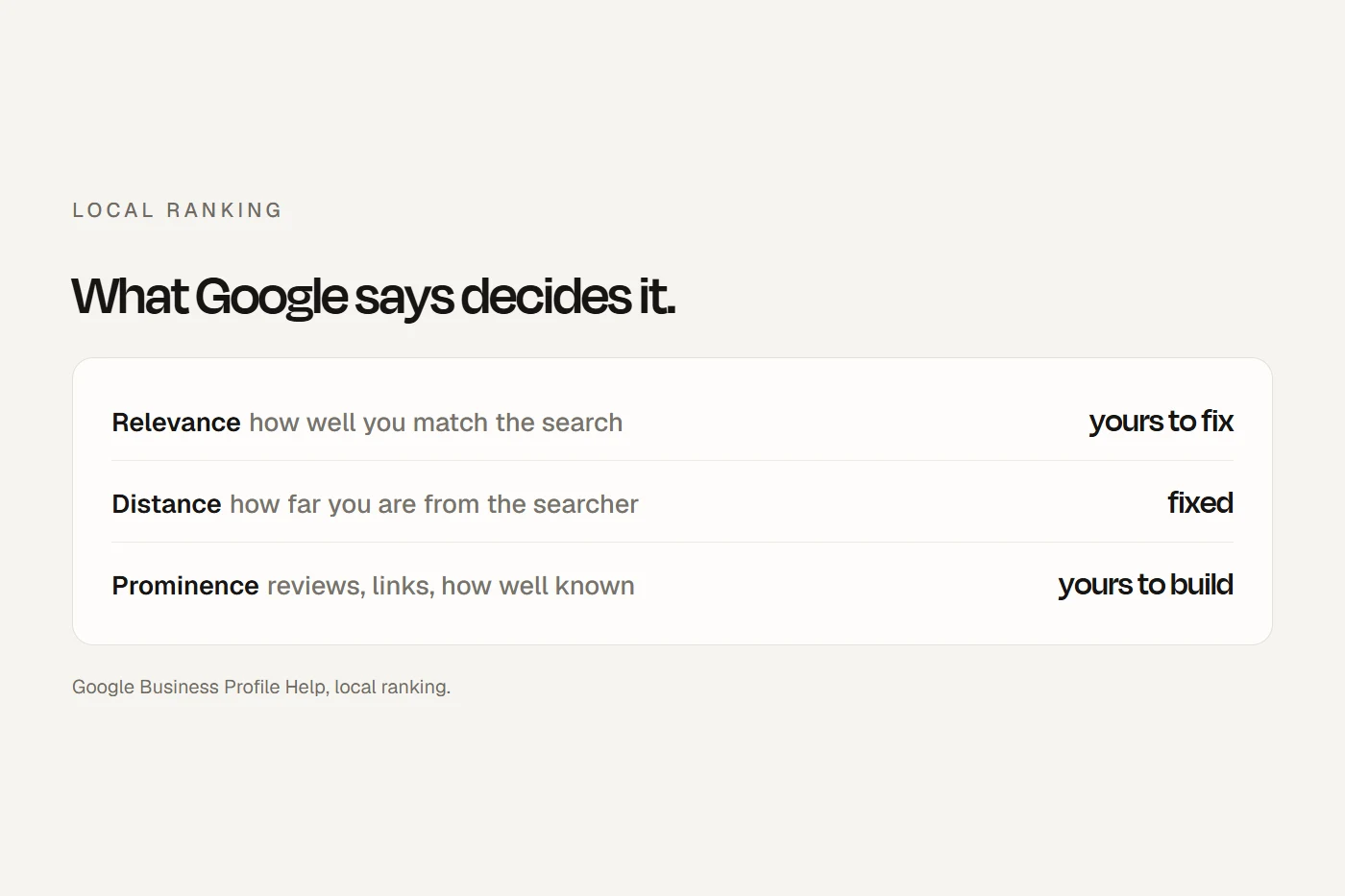
- The map runs on relevance, distance and prominence. Distance is where the searcher is, and nobody can change it. Relevance is fast to fix: categories, services and hours update in minutes to 30 days. Prominence is slow: Google says it's "based on info like how many websites link to your business and how many reviews you have".
- Reviews are the slow lever. They arrive at the pace customers leave them, and there's no shortcut within Google's rules: no incentives, no filtering who you ask.
- A brand-new domain bounces around. Google's John Mueller once said a new site's rankings can go up and down for up to a year before settling. Keep your existing domain when you rebuild if you can.
- A rebuild that changes page addresses is a site move. Google says to "Expect temporary fluctuation" and to keep redirects for at least a year. Ask for a redirect map before launch.
- Competitive searches take longer. In a large global study by the SEO tool company Ahrefs, the average number one page was five years old, and only 1.74% of new pages reached the top 10 within a year. But of the pages that did reach the top 10, 40.82% got there within a month. Pages that are going to rank often do so quickly; the rest need more work.
- Core updates. A few times a year Google reworks its ranking systems, and each rollout takes about two to three weeks. Rankings can move while it does, through no fault of yours.
Work out your own timeline
This never gives you a ranking date, because no one can. It gives you the setup wait and the one slow number you can calculate: how long it takes to match the review count of the businesses already in the map for your main search. Search your main service and suburb on your phone and note the three businesses in the map.
The review number isn't a promise of ranking; it's how long it takes to close the gap on the most visible signal. In my example, the setup waits add up to about two months, and the rest depends on reviews and on competitors.
The first six months
All of this can be done yourself. Your ticks save in this browser.
- Week 1: verify your website in Google Search Console and note today's clicks, calls and direction requests as your "before".
- Week 1: claim or verify your Business Profile, with the most specific true category set first.
- Weeks 2 to 4: fill in hours, services and photos on the profile.
- Weeks 2 to 4: build one page per real service, each with a clear title, and request indexing for each.
- Weeks 2 to 4: start asking every customer for a review, the same way every time.
- Month 2: check the Page indexing report to see that your important pages are in.
- Month 3: first fair look at the changes, comparing with the same months last year, not just last month.
- Month 3: if numbers moved sharply, check Google's Search Status Dashboard for a core update and wait a week after it finishes.
- Months 4 to 6: improve any service page still outside the top 10.
- Months 4 to 6: recalculate your review gap against the map leaders.
- If you pay an SEO: compare results with the timeframe and measures written in your agreement.
Is this promise realistic?
Tap each one.
If you're paying someone
Most small business SEO agreements are covered by the consumer guarantees: the ACCC says a service bought for business use is covered if it costs less than $100,000 including GST. The work must be done with due care and skill, and if no timeframe is agreed, it must be supplied "within a reasonable time". So agree the timeframe and how success will be measured, in writing, before you start. Terms that only let one side end the contract may be unfair.
My view
For a local business, the honest answer is that the setup takes a month or two and the ranking takes as long as it takes to become more relevant and better reviewed than the businesses already in the map. That's why I'd spend the first month on the things Google publishes waits for, then put most of your effort into asking every customer for a review and giving each service its own page. Judge it every few weeks against the same months last year, not against a promise. And make sure the website the map sends people to turns a visit into a call.
Questions I get asked
How long does SEO take to work?
Google says changes take anywhere from a few hours to several months, and to wait a few weeks before judging. For a local business, setup takes a month or two; outranking competitors depends on them.
Does Google say SEO takes four months to a year?
It used to. Google has removed that line, though its answer box still repeats it. Its current page asks the SEO for their own timeframe.
How long does local SEO take?
Verifying and setting up a Business Profile takes up to five working days, or about three weeks by postcard. Moving up the map depends mostly on relevance and reviews, which have no published timeline.
How long does it take for a new website to show on Google?
Google says it can take a few weeks to notice a new site. A page you ask it to index typically takes a day or so, up to a week or two.
How do I know if my SEO is working?
Compare Search Console and Business Profile numbers with the same months last year, a few weeks after each change is indexed. Check for core updates before reading too much into a sharp move.
About this guide
Written by Joseph Alzein, founder of bdog. bdog builds websites for Australian local businesses and offers local SEO. The timings come from Google Search Central, Search Console Help and Business Profile Help; ranking data from Ahrefs, a global study; the consumer rules from the ACCC and the Australian Consumer Law. Sources were checked on 13 October 2026. This is general information, not legal advice.
Main sources: