What a junior sports club website needs
The parent’s questions answered on the first screen, the full cost, government vouchers, and the child safety page several states expect to be public. With a photo sorter, a state-by-state quiz, a weighted checklist and a season launch plan.
On This Page
- What parents are looking for
- The first screen
- Registration usually isn’t yours to choose
- The full cost, in one place
- Your child safety page
- What you can say about working with children checks
- Photos of junior players
- Wet weather and cancellations
- Contacts and the footer
- What applies in your state
- How does your website score?
- A season launch plan
- My view
- Questions I get asked
Most advice on what a sports club website should have is a list of teams, fixtures, news and a sponsor wall. That's fine for a senior club. A junior club or a kids' sports program has a different job: a parent who has never met you needs to know when and where, what it costs, whether their child has to be good, and whether the people running it are safe. Several states now expect part of that answer to be public. This guide covers what a junior club or kids' program site needs, what you can truthfully say about checks and photos, and how to handle registration platforms and vouchers. It's from the child safe regulators' guidance, Sport Integrity Australia, eSafety, the Australian Sports Commission's research and the voucher programs' own terms, read on 12 October 2026. It's general information, not legal advice.
- Answer the parent's questions firstAge groups, days, venue, full cost, a free first session, and a register button that goes straight to your page on the registration platform.
- Put child safety on the siteA public commitment, your policy and code of conduct, and how to raise a concern. Victoria, Queensland and NSW expect the commitment to be public.
- Be exact about checks and photosOnly say every coach holds a check if it's true for every coach. Get written consent before posting photos, and never put names with them.
What parents are looking for
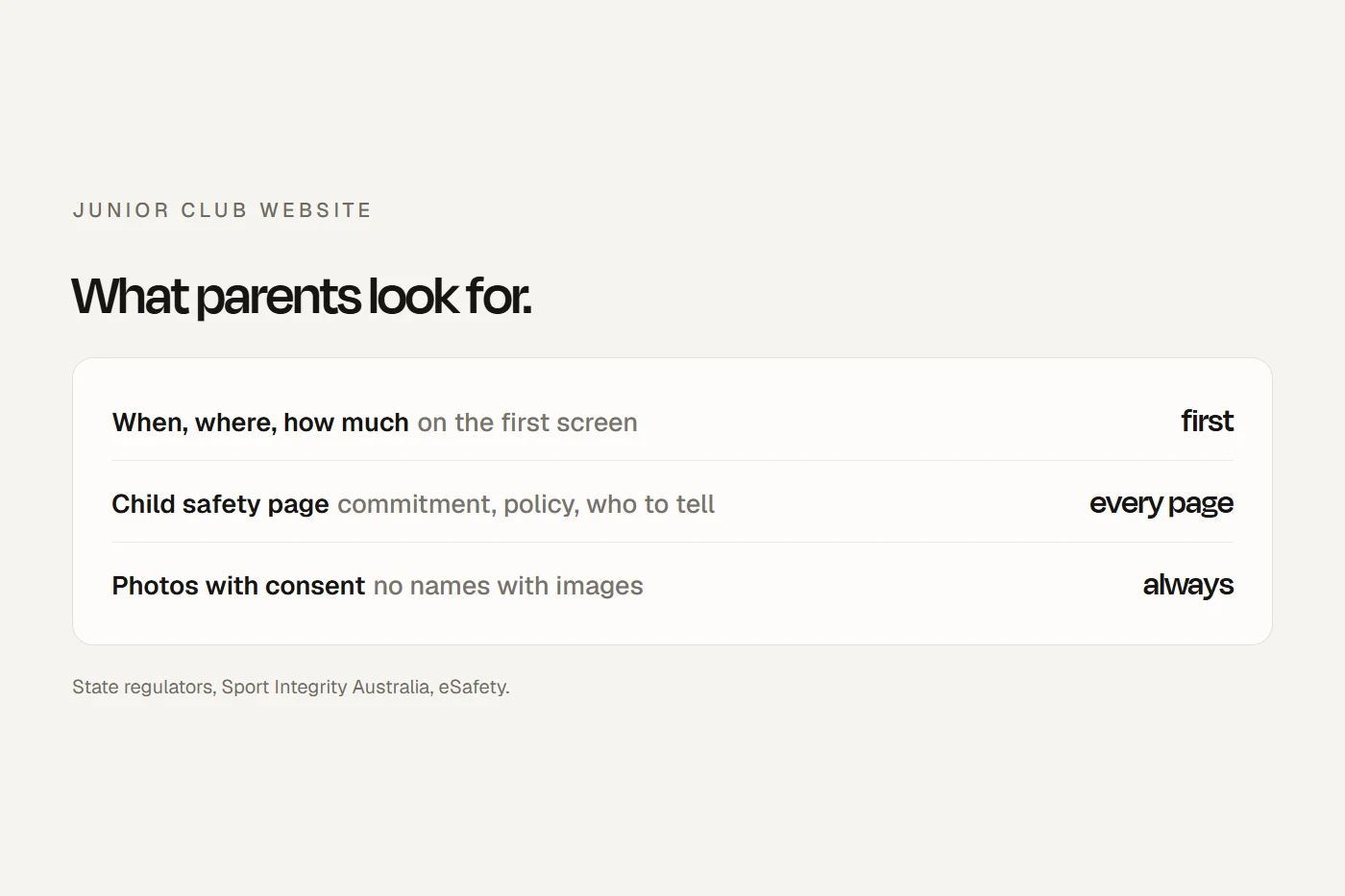
The Australian Human Rights Commission's guide for parents tells them, before joining any organisation, to "Visit their website" and look for a child safety policy, a code of conduct, whether staff and volunteers have working with children checks, the photo policy, and how to raise a concern. The top-ranking lists of what a club website needs don't mention any of them.
The Australian Sports Commission's research into how parents choose a sport found the things that move them are good coaching, a free chance to try, consistent game times and venues, and clear information about the commitment asked of the parent and the child. Its AusPlay survey shows cost is the barrier parents name most for children aged 5 to 11 who don't play. And it shows two kinds of reader: clubs run most team sport from about age 9, while swimming, gymnastics and martial arts are mostly run by businesses and centres. Everything below applies to both, and I've noted where they differ.
The first screen
A parent arriving from a school newsletter or a search should see, without scrolling:
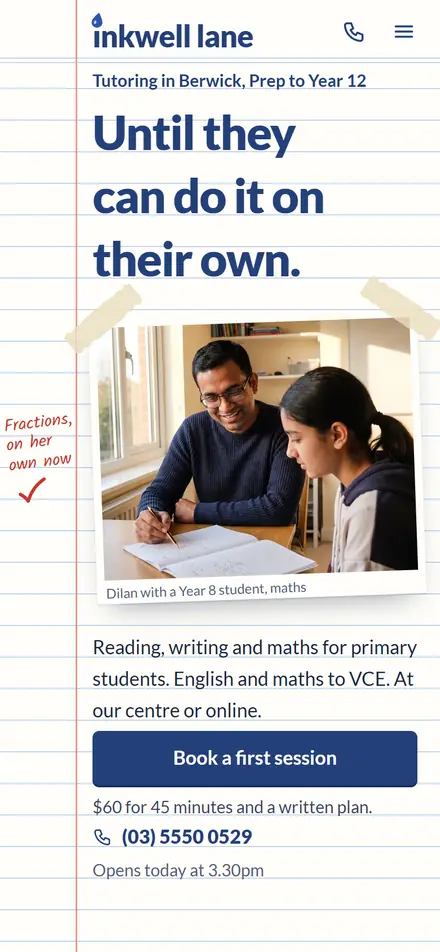
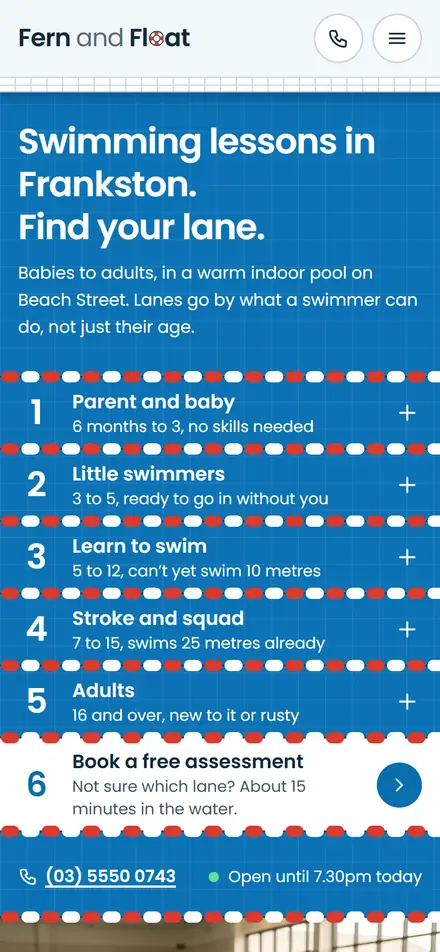
- Which ages you take and what the groups are called.
- Which days, times and venue. Training night and game day, and roughly how long the season runs.
- When registration opens, and a button to register.
- A free first session or a come-and-try day, if you offer one. If it's called free, it must be free.
Keep the current season on the page itself, not in a PDF. Old season pages are a common problem: they keep ranking in Google long after the dates have passed, and a parent who lands on last year's training times may not come back.
Registration usually isn't yours to choose
In most sports, the governing body picks the registration platform. AFL, netball, basketball, cricket and hockey run on PlayHQ. Football uses PlayFootball and rugby union uses Rugby Xplorer. Many other sports use GameDay or revolutioniseSPORT. Private programs usually use enrolment software such as Class Manager, Enrolmy or Clubworx, covered in my guide to dance studio software, which works the same way for swim and gym programs.
So the website's job isn't to take the registration. It's to explain the season, the cost and how you keep children safe, then send the parent straight to your club's own page on the platform, not the platform's home page where they have to search for you. Some platforms include a free basic website; revolutioniseSPORT does, for example. That's a reasonable start, but those sites look like every other club on the platform and they rarely have room for the child safety and cost detail below.
The full cost, in one place
Cost is the barrier parents name most, so answer it plainly. One page, updated each season:
- The season fee including any compulsory levies or insurance, so the number on the website matches the number at checkout.
- What the fee covers and what's extra: uniform, training top, equipment.
- Sibling discounts, payment plans and the refund rule.
- Which government voucher you accept, linked to the official program page.
The ACCC expects businesses to show a single total price including unavoidable fees. Whether that law reaches a volunteer club's registration fees is a fair question, but there's no downside to showing the full price anyway. Queensland's Play On! voucher terms list what a provider must confirm with a parent before redeeming a voucher: membership rules, what the fee includes and excludes, attendance expectations and any extra costs. That list is a good checklist for your fees page whichever state you're in.
Vouchers
Every state except the ACT has a kids' sport voucher: Active and Creative Kids in NSW, Get Active Kids in Victoria, Play On! Sports Vouchers in Queensland, Sports Vouchers Plus in South Australia, KidSport in WA, Ticket to Play in Tasmania and the NT Sport Voucher Scheme. Amounts and rounds change, so don't put the amount on your site; name the program and link to it. Only say you accept a voucher once you're approved. The provider rules differ: Victoria's program doesn't accept sole traders or private companies, and WA, Victoria, Queensland and Tasmania require affiliation with a recognised sporting body. NSW providers must not "price gouge" when accepting or promoting the voucher. Queensland, WA and Tasmania give approved providers posters and social media tiles to use on their websites.
Your child safety page
This is the part of a junior club website the law actually reaches. The National Principles for Child Safe Organisations, which every government endorsed, start with "The organisation makes a public commitment to child safety". How each state puts that:
| State | Who's covered | What it says about publishing |
|---|---|---|
| Victoria | Sport and recreation services for children, and coaching or tuition for children | Mandatory standards. A compliance indicator: "A public commitment to child safety is available and displayed for public access." |
| Queensland | Sport and recreation organisations delivering activities mainly for children, including swim schools | The regulator's guideline: "Display your organisation's commitment ... prominently on your website", and make the code of conduct "publicly available". |
| NSW | Sport and recreation clubs whose workers need a working with children check | The Office of the Children's Guardian says to "Promote and publish your Statement of Commitment to Child Safety", including on your website. |
| South Australia | Clubs and coaching services for children, including sole traders | The state sport office says safeguarding policies should be "made available on organisation websites". |
| ACT | Sport and recreation organisations providing services to children | Has adopted the National Principles, including the public commitment. |
| Tasmania | Clubs with significant involvement by children, and coaching for children | Standards that mirror the National Principles. |
| WA and NT | No mandatory scheme yet | Organisations are encouraged to follow the National Principles. |
Scroll the table sideways to see every column.
So the page should have:
- Your statement of commitment to child safety, including a commitment to the cultural safety of Aboriginal and Torres Strait Islander children, which Victoria, Queensland and Tasmania specifically ask for. The Human Rights Commission and NSW's Children's Guardian both publish free templates.
- Your safeguarding policy and code of conduct, or a link to your national body's current version. Many sports use Sport Integrity Australia's National Integrity Framework, and its policies are being updated, so a link stays current where an uploaded PDF goes stale. The biggest junior codes, including AFL, football, netball, basketball and cricket, have their own policies instead.
- How to raise a concern: the role responsible (a child safety or member protection officer), how to contact them, another route if the concern is about that person, and 000 if a child is in immediate danger.
- How you screen coaches and volunteers, worded accurately (next section).
- A summary of your photo and filming rules.
Link the page from the main menu and the footer of every page, so it's there when a parent looks.
What you can say about working with children checks
"All our coaches hold a current Working with Children Check" is the line nearly every club wants. It's only safe if it's true for every coach. In NSW, Victoria and Queensland, a parent volunteering in their own child's activity is generally exempt from needing a check, and many clubs rely on parent coaches. In South Australia, sport clubs with junior teams need checks for all volunteers and staff, and NSW voucher providers must have every worker checked regardless of exemptions.
The safer wording describes what you actually do: "Every coach and team manager holds a current Working with Children Check, and we verify each one with the state screening agency before the season." If you rely on exemptions, say what your policy is instead and link to it. Don't publish check numbers. No state requires it, they're personal information, and a parent can't do much with one.
Photos of junior players
Sport Integrity Australia's guide to photographing children in sport makes written consent from a parent or carer mandatory under a sport's safeguarding policy. It says to "not include any personal details of the child or young person with an image", which includes their name, to show the child the photo before it's used, to mark children without consent (coloured wristbands, without making them feel left out) and to take extra care in swimming, gymnastics and athletics, showing children from the waist or shoulders up. Collect consent at registration, with separate choices for the website, social media and ads, and take photos down when a parent asks.
Tap a card to see the verdict. Your sport's safeguarding policy is the rule that applies to your club.
Wet weather and cancellations
Under the social media minimum age law, Facebook, Instagram, TikTok, Snapchat, YouTube and others must stop under-16s having accounts. eSafety's page for sport clubs says clubs that use these platforms to reach young people "may need to explore alternative methods", and notes under-16s can still see public content that doesn't need a login. If your club's Facebook page is where wet-weather calls go, a 13-year-old can no longer follow it with their own account. A plain page on your website needs no login and works for players and parents alike. Put cancellations there first, then share the link wherever else you post.
Contacts and the footer
The Human Rights Commission's parent guide asks "Who runs the organisation and who is responsible for child safety and wellbeing?" List your committee or staff by role, with role email addresses rather than personal mobiles. In the footer:
- Your registered name. In NSW an incorporated association's name must appear on its notices and publications. In Victoria, Consumer Affairs says the name and registration number must appear on notices and advertisements. A private program should show its business name and ABN.
- A privacy policy, if you're covered or collect health information. The privacy regulator says a club that helps members with injuries or fitness is probably providing a health service and should assume it's covered. Keep medical details inside the registration platform, not in a website enquiry form; a parent's name, contact details and the child's age group are enough there.
- No charity tick unless you're registered. The ACNC says most sporting clubs aren't charities.
What applies in your state
How does your website score?
Tick what your site already does. The first eight items come from the law or a regulator's guidance and count for more. Your ticks save in this browser.
- A public statement of commitment to child safety, linked from every page.
- A commitment to the cultural safety of Aboriginal and Torres Strait Islander children.
- Your safeguarding policy and code of conduct, or a link to your national body's current versions.
- How to raise a concern: the role, the contact, another route, and 000 for danger.
- Screening wording that's true for every coach.
- Photo rules summarised, consent collected at registration, no names with photos.
- Registered name in the footer, with the registration number in Victoria, and ABN.
- A privacy policy if you're covered, and no medical details in public forms.
- The current season: age groups, days, venues, start.
- A register button that goes to your own page on the platform.
- The full fee, what it includes, refunds and payment options.
- Vouchers you accept, named and linked, without amounts.
- A free first session or come-and-try day.
- Wet weather and cancellations on a public page.
- Committee or staff listed by role, with role emails.
- Coaching qualifications named exactly, not just "qualified coaches".
- A venue map, parking, toilets and where to meet.
- A Google Business Profile for your home ground or venue.
- A sponsor page.
- Volunteer roles explained: canteen, scoring, team managers.
A season launch plan
Timed from the day registration opens, since seasons and voucher rounds vary by sport and state:
- Eight weeks before: confirm the fee and your direct registration link with your state or national body. Check your voucher registration is current and your policy links point to the latest versions.
- Six weeks before: update the child safety page and confirm every coach's and manager's check is current and verified.
- Four weeks before: publish the season page with age groups, days, venues, the full fee, the refund rule and vouchers accepted. Make sure registration asks for photo consent with separate choices.
- Two weeks before: announce the come-and-try day and send notices to school newsletters, a channel the Sports Commission found works with parents. Post the voucher program's approved tiles if you have them.
- The day it opens: point the homepage button at your registration page and email last season's families first.
- A week before the season: publish how cancellations will be announced, and sort out who takes official photos.
- After the season: archive the old season page so it stops showing up in searches, and delete photos you no longer need.
My view
A junior club website wins families by answering the parent's questions in the first screen, and keeps their trust with a child safety page that's easy to find. Most clubs have neither, so doing both puts you ahead of almost every club near you. Keep the registration on the platform your sport chose, keep the fee and season on one page you update, and treat the photo gallery as the riskiest part of the site.
Questions I get asked
What should a junior sports club website have?
Age groups, days, venue, the full cost, a free first session and a register link on the first screen, plus a child safety page with your commitment, policy, concern contact, screening and photo rules.
Does our club have to publish a child safety policy?
In Victoria a public commitment to child safety is a compliance indicator, Queensland's regulator says to display it on your website, NSW says to publish your Statement of Commitment, and South Australia says policies should be on your website.
Can we say all our coaches have a working with children check?
Only if it's true for every coach, including parent coaches who'd otherwise be exempt, and you've verified each one. Otherwise describe your screening policy.
Can we post photos of junior players?
With written consent from a parent or carer, without names or other personal details, and taken down when consent is withdrawn. Your sport's safeguarding policy sets the rules.
Do we need our own website if we use PlayHQ or GameDay?
The platform handles registration and fixtures. A website explains the season, cost and child safety, and sends parents to your exact registration page.
About this guide
Written by Joseph Alzein, founder of bdog. bdog builds websites for kids' sports clubs and programs. The rules come from the state child safe regulators, Sport Integrity Australia, eSafety, the privacy regulator and the voucher programs' own terms, and the research from the Australian Sports Commission, read on 12 October 2026. This is general information, not legal advice; your state regulator and your sport's policies are what apply.
Main sources:
- National Principles for Child Safe Organisations
- Victoria: complying with the Child Safe Standards
- QFCC: guidelines for the Child Safe Standards
- NSW Office of the Children's Guardian: getting started
- SA Office for Recreation, Sport and Racing: keeping children safe
- Sport Integrity Australia: photos and videos
- eSafety: social media age restrictions and sport
- OAIC: sporting clubs
- Australian Sports Commission: parents research
- AusPlay results