A coaching website in Australia: what it needs and what it can’t claim
The pages a life, business or wellness coach’s site needs, how to name training and ICF or EMCC credentials, how to show package prices and instalments, when a sales call triggers a 10-day cooling-off, refunds and coaching contracts, and the claims that get coaches into trouble. With a price calculator, an unsolicited-sale checker, a sorter and a launch checklist.
On This Page
Anyone in Australia can call themselves a coach. There's no licence and no register, which is exactly why the people who buy coaching check the website so carefully. This guide is for a life, business, executive, career or wellness coach in Australia working out what their website needs: the pages, how to show credentials and prices, how the discovery call should work, refunds and contracts, and the claims that get coaches into trouble. I build coaching websites. The rules come from the Australian Consumer Law, the ACCC, the National Law, ACMA and the coaching bodies themselves. For testimonials specifically, see my coaching testimonials guide.
- Five things buyers look forWho you coach and on what, your training and credentials (named exactly), what each package includes, the total price, and an easy way to book a call.
- "Coach" is free; "psychologist" isn'tNo title protects coaches, but "psychologist" is protected even with other words, so "coaching psychologist" is for registered psychologists only.
- The discovery call matters legallyIf the client booked it, fine. If the sale started with your cold call or DM, they get 10 business days to cancel, and you can't take payment or start sessions until it ends.
The pages a coaching site needs
- Homepage: who you coach, on what, where (online, in person, which city), and one next step: book a call. One line of proof you can back up. No "Australia's #1" unless you can show it.
- About: your name and photo, your training (the course, and the type of provider), your credential with the body and level, any membership listed separately, and how long you've been coaching.
- Programs or packages: for each, the number and length of sessions, any support between sessions, whether it's one-to-one or group, how long it runs, the total price and how to cancel. Selling "1:1 coaching" that turns out to be mostly group calls or videos is a misleading description.
- Book a call: a booking page that says what the call is for (see below).
- Terms: plain language, linked before checkout.
- Privacy policy, and a collection notice on any intake form.
- "What coaching isn't": a short line that coaching isn't therapy and where to go instead. Both CHOICE and the ICF's code point the same way.
A Google Business Profile only makes sense if you meet clients in person; Google doesn't allow online-only businesses.
Titles and credentials, exactly
- "Coach", "life coach", "health coach", "counsellor" and "personal trainer" aren't protected titles under the National Law. "Psychologist", "nurse", "physiotherapist" and the other registered professions are, "with or without any other words".
- Name your certifier. "Certified life coach" after a short online course implies a recognised credential; "certified by [the body], [the level]" doesn't.
- ICF credentials: the ICF's logo rules say only current holders may use them, and only "where the approved Credential-holder is described, not where the organization as a whole is described". ICF membership isn't a credential. The ICF's free digital badge is better than a static logo, because clients can check it.
- EMCC accreditation comes in four levels with set experience requirements. Name the level.
- Training: a nationally recognised Certificate IV in Life Coaching Practice exists. It's training, not a licence.
- Divorce, money or "legal" coaching: legal practice and financial product advice are regulated. Keep your site clear of anything that reads as either.
Showing prices
For coaching sold to individuals, the Australian Consumer Law requires a single total price, including GST if you're registered, at least as prominent as any part of it. A business-only page for organisations can say "+GST", but only if it's clearly aimed at businesses; a sole trader isn't a company, so the exception for prices aimed only at companies doesn't cover them.
- Instalments: show the total as prominently as the instalment. "3 easy payments of $990" with no total falls short. If paying by instalments costs more than paying upfront, check with an adviser before you publish it, because the extra can count as a credit charge.
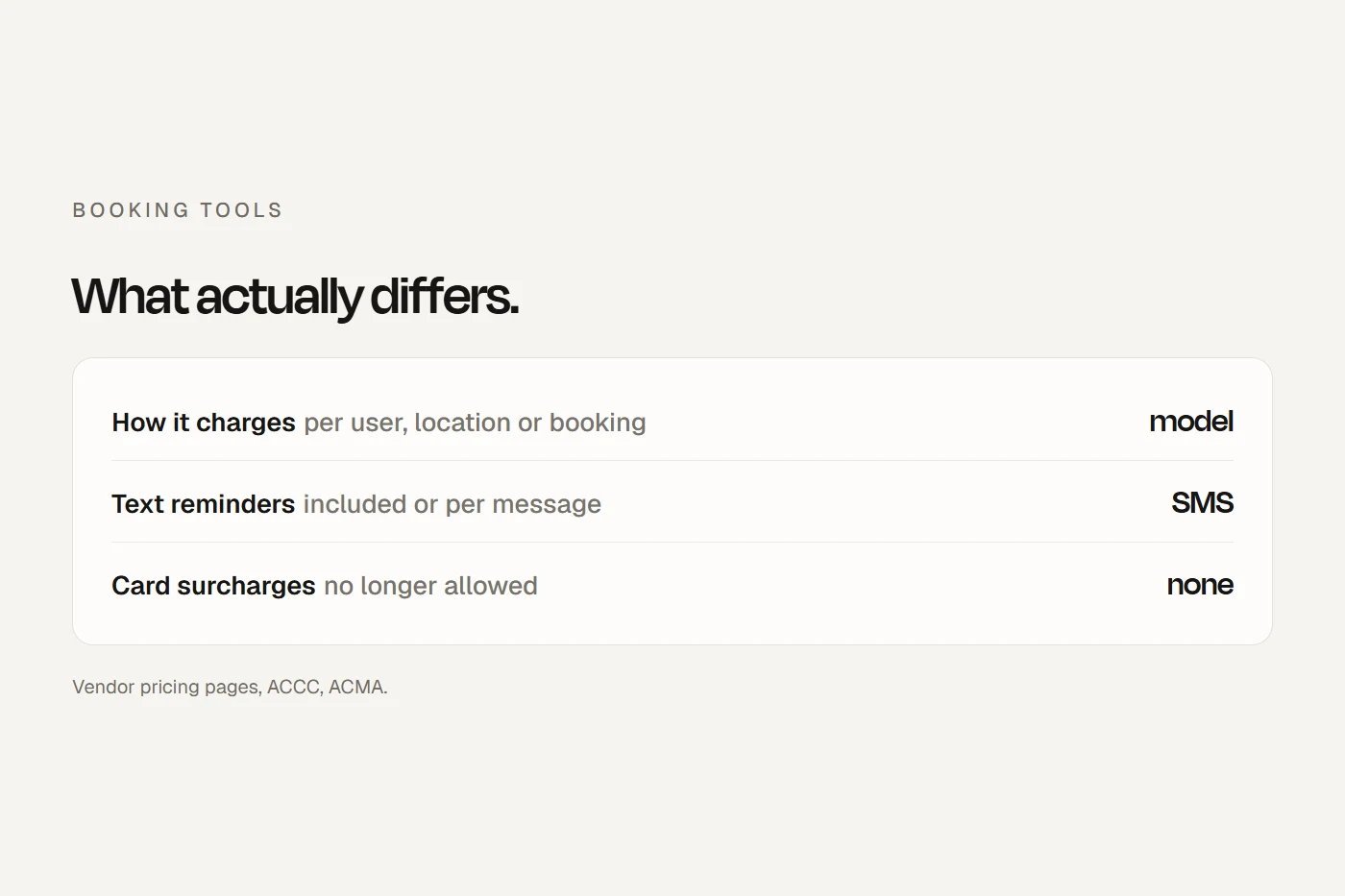
- No card surcharges. They're banned on Visa, Mastercard, Amex and eftpos.
- "From" prices must be a real package someone can buy at that price.
On the page that reads as: "$1,500 for six sessions (or 3 payments of $520, total $1,560)".
The discovery call, and when cooling-off applies
An agreement is "unsolicited" under the Australian Consumer Law when it's negotiated by phone, or face to face somewhere other than your premises (a public place counts), and the client didn't invite you to contact them to discuss buying. For almost any coaching package, that means:
- The client can cancel for 10 business days, longer if the rules weren't followed.
- You can't take any payment or start coaching in those 10 business days.
A discovery call the client booked through your website, for the purpose of talking about coaching, is an invitation. A cold DM that turns into a call isn't. Someone downloading your free guide isn't either: the law says giving contact details for another purpose isn't an invitation, and the ACCC has said a sale stays unsolicited "unless the purpose of the data collection to generate a sales contact is clearly disclosed". The law doesn't mention video calls; I'd treat one as a phone call.
So word your booking form plainly: "A free 20-minute call to see if my coaching suits you, including price." Keep the booking record, because if it's ever disputed, the law presumes the sale was unsolicited unless you show otherwise.
Refunds, guarantees and contracts
- Consumer guarantees cover most coaching, including business coaching sold to small businesses under the threshold. Services must be delivered with "due care and skill", and if the client told you the result they wanted, they must be reasonably expected to achieve it.
- "No refunds" is misleading. The ACCC says businesses can't take these rights away by saying refunds aren't available.
- Coaching agreements are standard form contracts, so unfair terms are void. The law's examples match common coaching clauses: only one side can end it, a penalty for leaving ("pay all 12 months if you stop"), or changing the program at your discretion. Cancellation terms are one of the ACCC's current priorities.
- A real guarantee is fine. "Results or your money back" with the terms linked and honoured; the fine print can't contradict the headline.
- "Fully insured": no law found requires coaches to hold insurance. If you say you're insured, name the cover.
What you can and can't say
Tap each line.
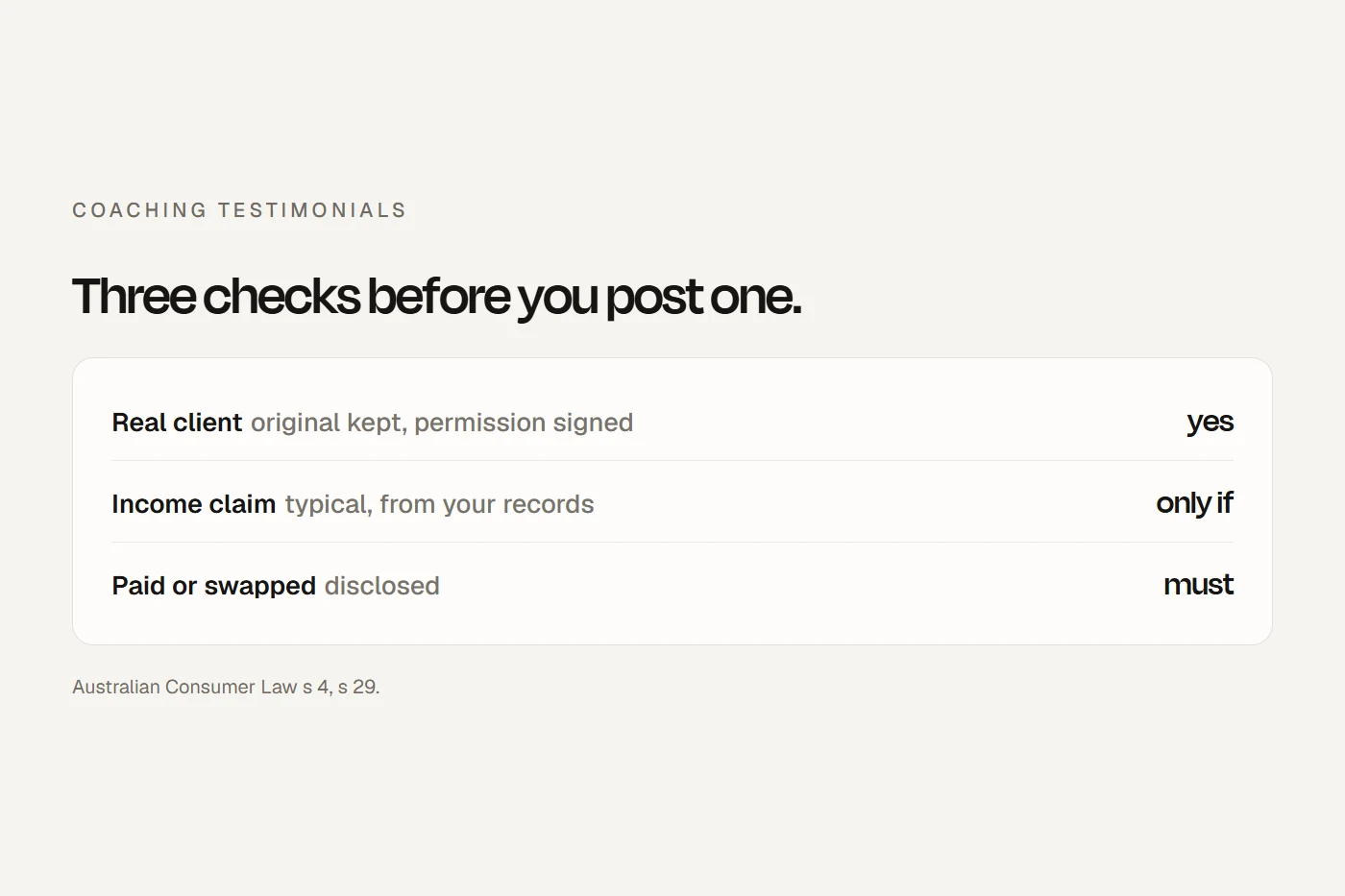
Results claims have a real Australian case behind them: in an ACCC action over property "mentoring programs", the court found income promises, the founder's own success story and students' testimonials on the websites all false or misleading. Payment processors police this too: Stripe's Australian terms prohibit "get rich quick" schemes, "outrageous claims", "deceptive testimonials" and "high-pressure upselling".
Free guides and email lists
ACMA's rule is simple: "you must first have consent" before sending marketing emails, and "it's up to you to prove" it. On a free guide form, say that signing up means getting your emails, keep a record, and put an unsubscribe link in every email. If you'll phone people, say that too, for the reason above.
Health and wellness coaches
If you coach on health, nutrition, sleep, stress or mental fitness, more applies. The state codes for health practitioners who aren't registered ban cure claims and require evidence for any claim that something works; NSW requires its code and complaints information "on the website" if you have one. Health information on intake forms brings you under the Privacy Act whatever your turnover. And if what you offer is usually provided by a registered practitioner, the National Law's testimonial ban may reach you. On health sites I leave testimonials off entirely.
If you coach anyone under 18, you'll need a Working with Children Check or Queensland blue card. Say "current check, number on request".
Launch checklist
Your ticks save in this browser.
- The homepage says who, what, where and how to book.
- Training and credentials are named exactly, with any ICF or EMCC level and a verifiable badge.
- No protected titles such as "psychologist" in any combination, unless registered.
- Each package lists inclusions, format, length and a total price including GST for individuals.
- Instalment totals are shown, and any extra cost checked with an adviser.
- No card surcharge.
- Plain-language terms, cancellation both ways, no "no refunds", linked before checkout.
- The booking form says what the call is for, and you keep the record.
- Testimonials have consent on file and typical results are labelled.
- Income and results claims are rewritten from your own records.
- Free guide form has consent wording, and every email has an unsubscribe link.
- Privacy policy and a collection notice on intake forms.
- Wellness coaches: your state's code checked; in NSW, the code and complaints information on the site.
- Coaching under-18s: check held, "number on request" line.
- Sales page checked against your payment provider's restricted list.
My view
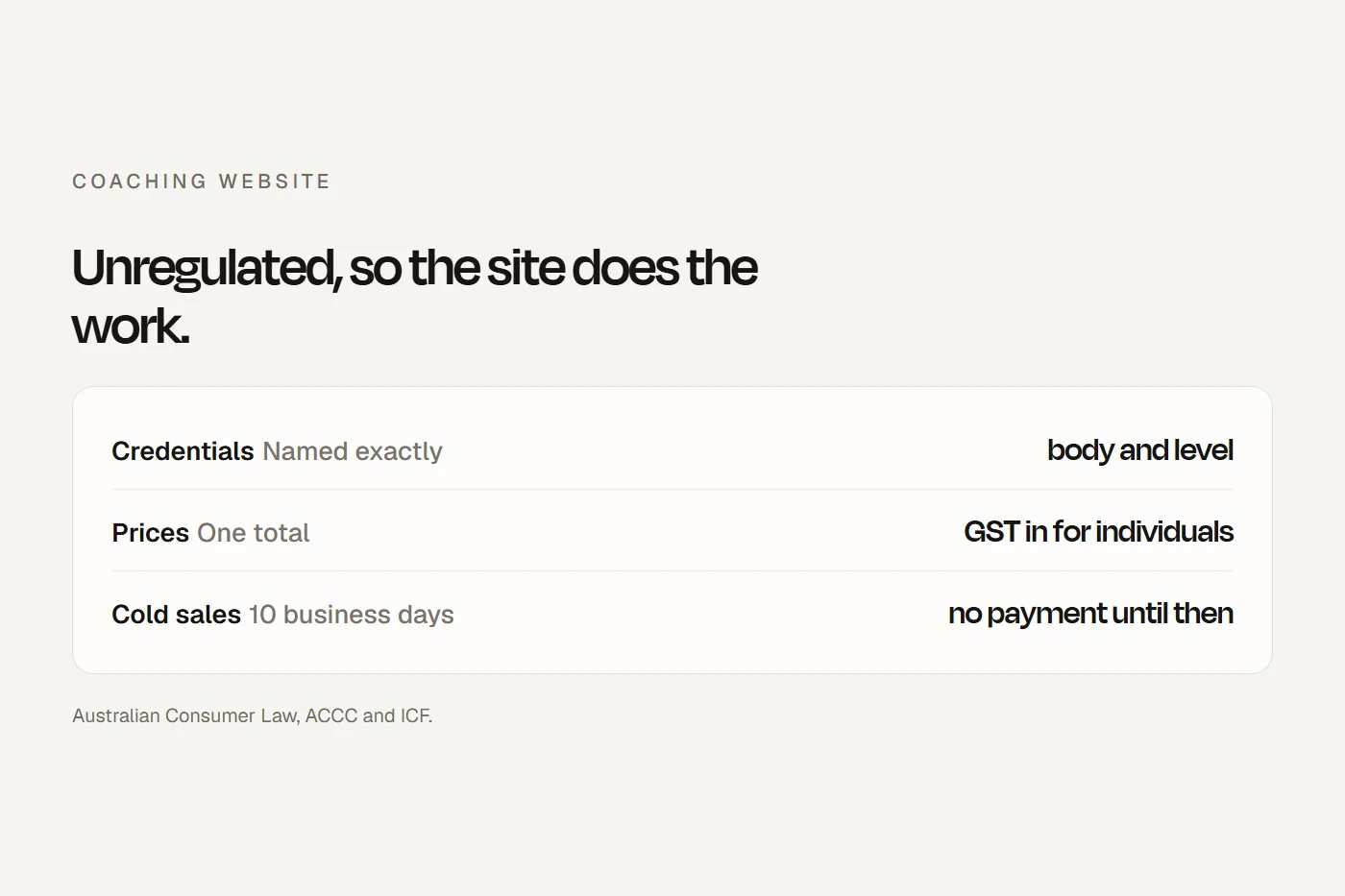
Because coaching is unregulated, the website does the work a licence would: it shows exactly who you are, what you're trained in, what a client gets and what it costs. The coaches I see win are specific: one kind of client, one clear program, a real price, a named credential and a booking page that says what the call is for. Skip the income screenshots and "#1" claims. A plain, honest site reads as more credible than a loud one, and it keeps you on the right side of the law and your payment provider.
Questions I get asked
What should a life coach website include?
Who you coach and on what, your training and credentials named exactly, each package with inclusions and a total price, a booking page for a discovery call, plain terms and a privacy policy.
Do coaches need a licence in Australia?
No. Coaching isn't regulated, but "psychologist" and other registered health titles are protected, and the consumer law applies to everything you say and sell.
Should I show prices on my coaching website?
Showing prices builds trust. If you do, show a single total including GST for individuals, at least as prominent as any instalment amount.
Does a cooling-off period apply to coaching?
If the sale started with your phone call, DM or approach and the client didn't invite it, yes: 10 business days, with no payment or sessions in that time. A discovery call the client booked isn't covered.
Can I say I'm ICF certified?
Yes, if you hold a current ICF credential such as ACC or PCC. Name the level. ICF membership on its own isn't a credential.
About this guide
Written by Joseph Alzein, founder of bdog. bdog builds websites for coaches and other small businesses. The rules come from the Australian Consumer Law, the ACCC, ACMA, the Health Practitioner Regulation National Law and the coaching bodies' own terms. Sources were checked on 13 October 2026. This is general information, not legal advice.
Main sources: